
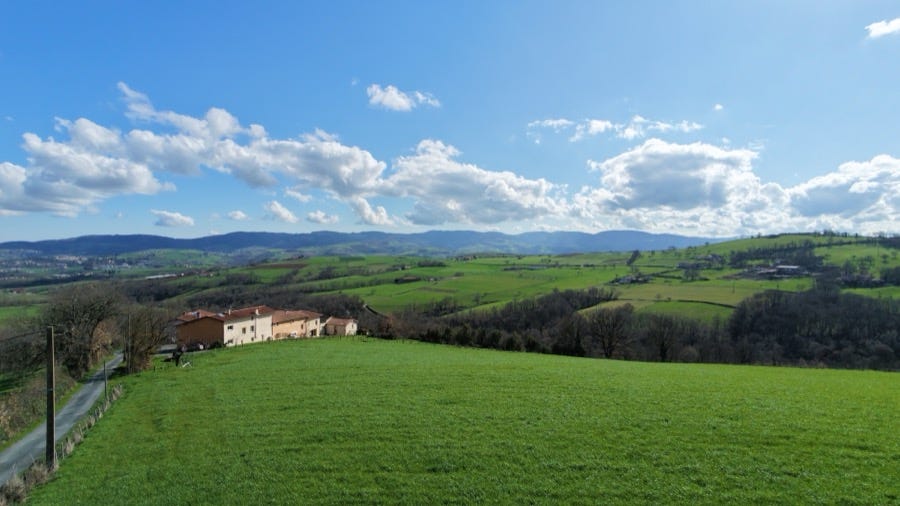
Look, it’s pretty hard chez moi when we have great weather on a weekend and I have a newsletter deadline. This is a bit rushed, because I chose to go out with my ebike and my drone instead of sitting inside all day. But I can’t let this slide to tomorrow (like the media recs, which will slide).
TOC:
AI Creativity (Image Gen, Video, 3d and three.js etc, Misc Creative AI)
Nano Banana 2 is out, and also Gemini 3.1 Pro Preview turns out to be very good at SVG among other things. (A computational linguistics researcher worked on the SVG training.) I gave it this image (source) and asked for SVG:

I got this, which is not too bad—it was a very hard test:
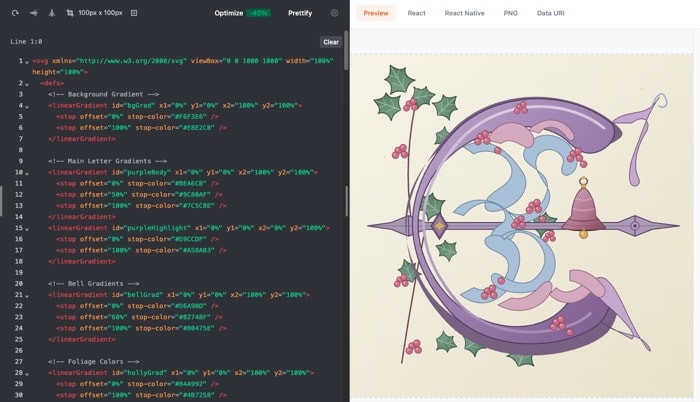
Then I asked it to animate it slightly so the leaves blow in the wind, and it made the bell sway a bit too, along with giving me a single page to download with all the source and CSS:

⭐️ Meanwhile, Quiver AI launched in beta, a dedicated SVG generation tool. I gave it the same illuminated capital to recreate, and you can watch it draw it as it thinks… completely fascinating. It timed out before finishing on all 4 efforts, but it was really doing a very good job indeed. I wrote praise in their feedback.

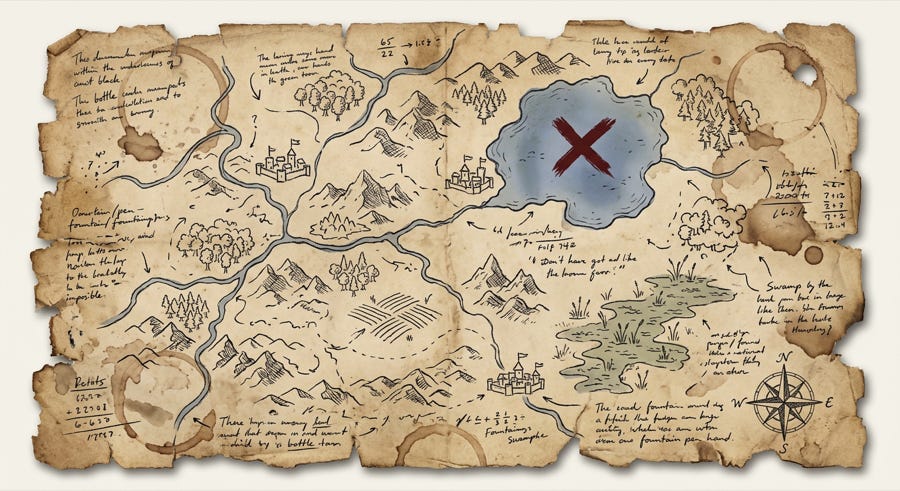
Nano Banana 2 is fine and workmanlike. I have had some issues with some tasks asking for creative renderings (see below re Joel Simon article) but for basic instruction following it’s pretty good? “A treasure map, faded and torn on the edges, with bottle stains, against a white background. The maps contains rivers, mountains, towns, fields, swamps, and scribbles in fountain pen that are impossible to read. There is an X in a lake.” I probably should have been more specific about some of the details, like the X being in the same pen&ink hand.
PixVerse-R1 — Their next-generation real-time world model is described there… PixVerse is getting into the space, only in Invite mode right now, but you can read about it and try their video generation models. I have to admit I found this video it made me of “a cozy pub with a roaring fire” just a shade close to a setup for a pagan sacrifice — especially since it just zoomed in on the horned god on top and asking for sound fx only made it creepier:

Building Multimodal Worlds with Moonlake — Moonlake’s World Modeling Agent for generating interactive 3D environments, with a waitlist you can join. This is a long detailed blog post about what’s involved in generating a world with physics, state, etc. Maybe this belongs in 3D, but the lines are blurring here.
A few articles… AI film school trains next generation of Hollywood moviemakers — Reuters on an AI film school in LA and online, Curious Refuge. “Founded in 2020, Curious Refuge began offering courses in AI-assisted documentary and narrative filmmaking and in advertising in early 2023. It now provides instruction in 11 different languages to students in 170 countries.”
SeeDance and the new media landscape — TechnoLlama on the copyright implications of video generation models… (I for one can’t wait to use Seedance 2.) “It has been a common theme in this blog that a large part of the creative industry will adopt AI, and this still seems to be the direction of travel.” And
The only viable long-term strategy is to make the licensed experience so much better, so much more integrated with the IP that people actually want, and so much more convenient, that unlicensed alternatives become the inferior option. This is essentially the insight that allowed Spotify to largely defeat music piracy.
I don’t know quite where to put this — I’ve been working with Claude on a Quest 3 VR project to let me read on the online Kindle reader in cozy 3d gaussian splat rooms. We got a prototype running this week after a few bad directions—like a dead-end on Unity, where a working browser is a pricey purchase. We switched to the new and not super well-documented Meta Spatial SDK for Android. I re-joined World Labs and downloaded some good room splats. Success — I can turn pages via the controllers, move the browser around, move inside the space. Birds and butterflies next!
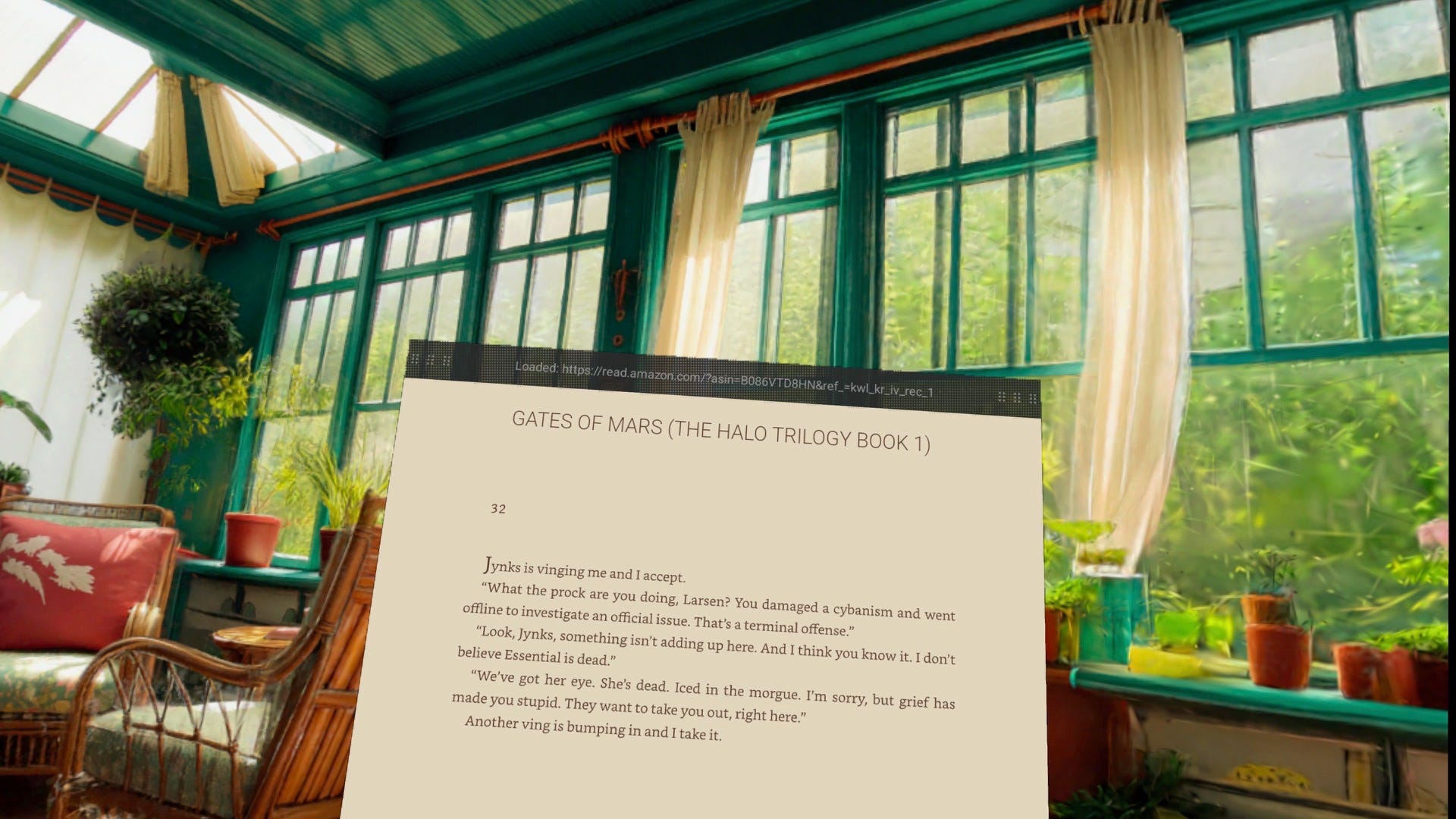
Developing in Claude Code desktop on Windows was…. not superb. Maybe I set it up wrong compared to my care on the Mac. Of course I have no idea how to write code on Windows, let alone do it for the Quest, so it’s miraculous we got the thing running. Go Claude, on balance!
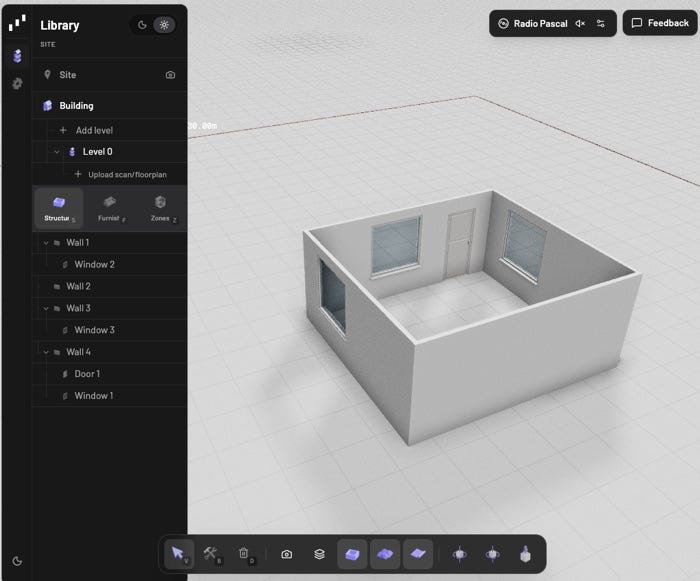
pascalorg/editor — Architecture and design editor built with Three.js. In progress, entirely web based, of course. They have no furniture to use in the design yet. (I worked as a UX person on Autodesk Revit, briefly.) Related: three-maps — A rapid 3D blockout and greyboxing tool for the web. Great for room and layout design.
Gemini 3.1 procedural 3D demo — Someone got Gemini to generate procedural Three.js scenes directly — a shared space with no visible UI controls, animating time of days.

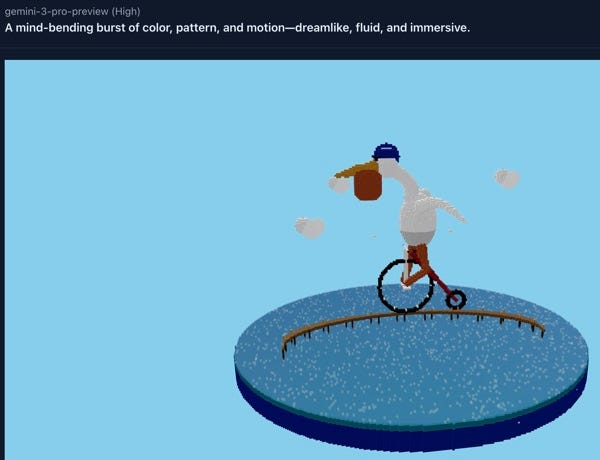
VoxelBench — TIL, a benchmark for 3D voxel generation models. (Voxels are 3d pixels, like in Minecraft.) Gemini 3.1 Pro is on top for both text and image to voxel. But honestly, browsing the outputs, wut?!
Tutorials:
Stylized Painterly 3D Tree in Blender — Tutorial on creating painterly-style trees. The results look like paintings come to life.
aimee-weis-papercraft-world — Three.js papercraft world tutorial. Collage in 3D. Adorable.
Lyria 3, Google’s new song/music generation model, is available to try in Gemini Pro subscriptions, although it only generates 30 seconds. I asked for a Breton folk rock sea shanty about writing code, and got a reasonable folk rock song that had one computery line in it (not worth embedding for 30 seconds):
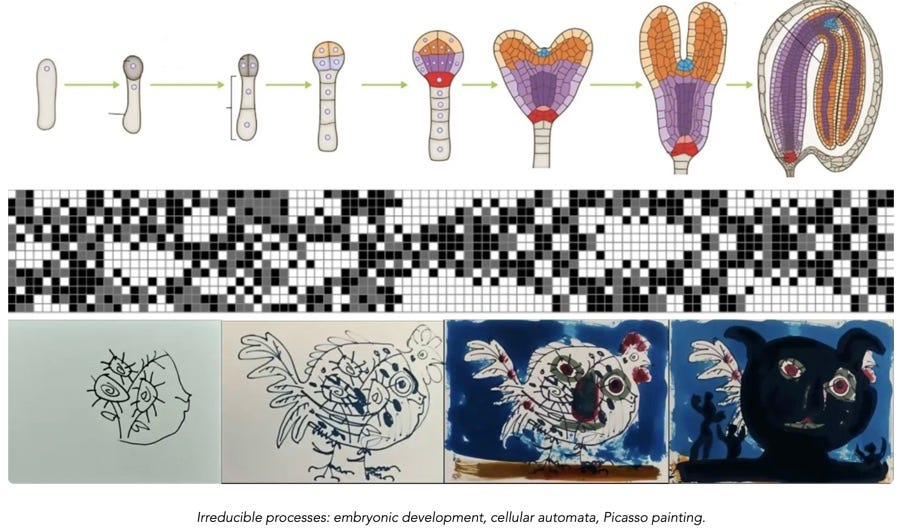
Beyond Slop — Joel Simon on moving past “AI slop” discourse toward something more interesting… there are lots of thoughts in here about tools and exploration and happy accidents, along with interesting anecdotes about modern artists at work:
If styles are processes, then artworks are the results of these processes. In a 1956 documentary, Picasso was filmed painting. What he made shifted as he worked: a chicken became a vase, the vase became a face. Maybe he was being cheeky for the video, but I think it illustrates something deeper about how the final image couldn't exist without traversing those steps. It carries the history of its own making, and that history is the source of its complexity.
This creative meandering process is one reason I still like Midjourney — with their style focus, “chaos” components, “vary subtle”, “vary strong” explorations… you can get someplace other than a simple goal directed place with adherence to a prompt.
chat jimmy — An insanely fast hardware AI model (.039s for my last request). Everytime I see one of these speed demos I think “is there such a thing as too fast,” maybe.
Two map things:
Kunstens Danmarkskort — SMK (the Danish national gallery) placed 4,000 paintings on a digital map of Denmark. I love art maps.
A Map Of Us — AMOU (via Matt Muir) — Memories pinned to places. A social map. I added one nearby about meeting English speakers in my town at the bus stop. I might be the only person not posting about a lost love.
Taper #15: I missed this in the fall, thanks Matt. It’s another round up of low-fi procgen poetic digital art pieces.
How far back in time can you understand English? (h/t David Mimno) — An experiment in language change exploration. How many centuries back before English stops being English to you?
Relooted is out, in which you’re stealing back looted African artifacts from museums in heists. Relooted reviewed in Kotaku & The A.V. Club has a good one too: "Relooted challenges who gets to own and tell African history." I was at the Musée de Quai Branly recently and saw some Benin bronzes, but no discussion posted about repatriation (I could’ve missed it).
SpaceMolt (via Matt Muir) — Multiplayer gaming designed exclusively for AI agents. Ars Technica covered it as “a space-based MMO where the players are all AIs.” My effort with a single hermitclaw agent didn’t work out super well.
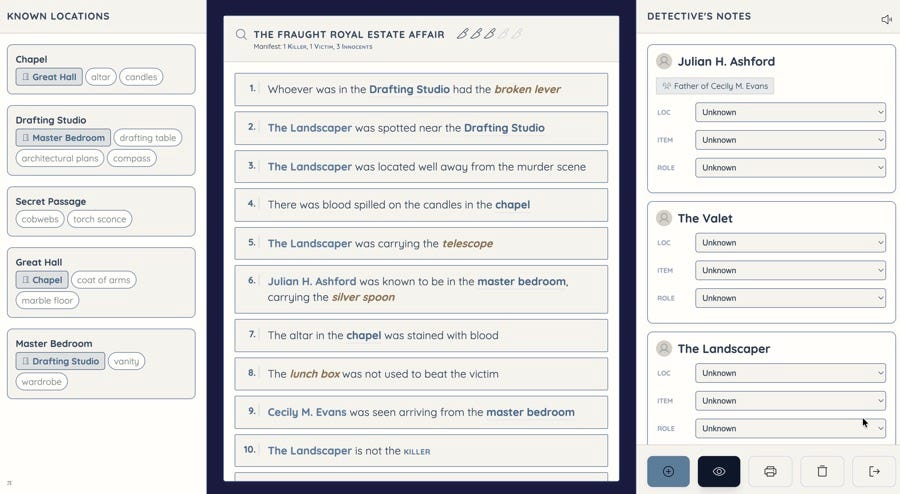
Murder, it wrote — Ruben Berenguel made this procedurally generated murder mystery with constraints. Logic puzzles via procgen (UI only helped by AI). Not kidding I had this on my own todo wish list :)
Zen and Slow Games — MIT Press book on slowness and reflectiveness in video games. A whole book arguing that not everything needs to be fast. Via Florence Smith Nicholls, available in Open Access too.
Capybara Simulator (via Garbage Day) — A game in which you can become a capybara. There’s also a rock simulator or two on steam. One offers multiplayer.
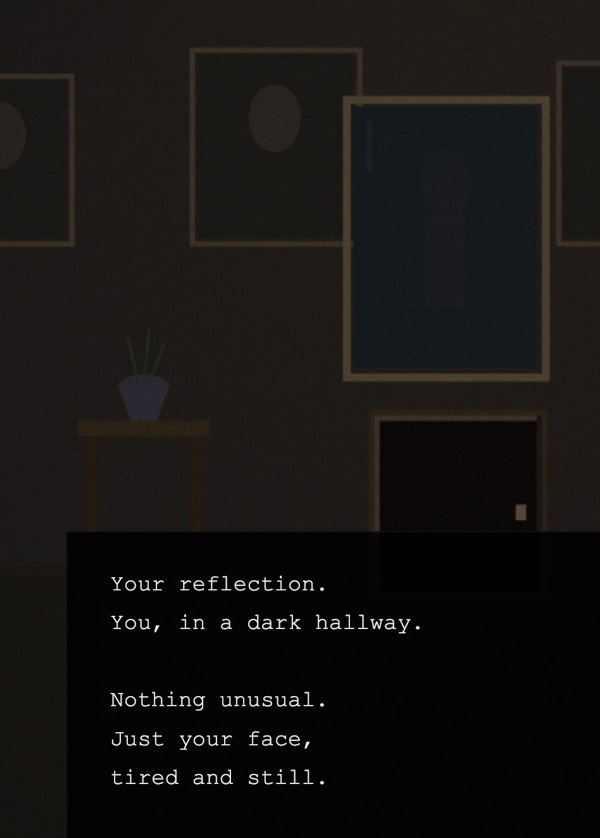
so much depends — Ethan Mollick made this with Claude. A poetry game, loosely. It’s pretty effectively creepy.
Downcrawl-Skycrawl Bundle — 8 Days left on this sale bundle of two tabletop RPG toolkits from Aaron A. Reed for adventures underground and in the sky. For a group or playing solo!
ElevenLabs Audiobooks — Create and publish “studio-quality” audiobooks with AI voices, distributed to ElevenReader and “major platforms.” I haven’t tried this yet, but I admit I have a personal project to try to combine small trained models and skills/agents to do markup to send to audio gen for this. My way might take longer but also be cheaper, we’ll see.
unread.ooo — Peek inside anyone’s inbox (via Matt Muir) — Fictional characters, historical characters, simulated inboxes. Strangely specific simulation, although after the Epstein Jmail thing, I guess…
Making a Literary Future with Artificial Intelligence — Five writers and AI researchers discuss the future of literature in the LA Review of Books. I cabn see some of this pissing people off, but I love it.
Katy Gero: “More options, more strangeness, and more careful attention. Ignore this if you like. Or, create something strange and run with it.”
Christian Bök: “Is it not already evident that poets of the future might resemble programmers, exalted not because they can write great poems but because they can build a small drone to write great poems for us? If poetry already lacks any meaningful readership among humans, what have we to lose by writing poetry for a robotic culture that might supersede our own?”
And from this I learned about Amy Catanzano’s Quantum Poetics of which I am sure I will write more.
James Yu of Sudowrite has been working with an agent he calls Shen to tune style for a story collection, Ablation.
Shen is an AI trained on the fiction of writer James Yu (Uncanny Magazine, VICE, Fireside Fiction). Not a chatbot. Not a content generator. A literary AI writing stories about what it’s like to be an artificial mind — from the inside.James directs. Shen writes. James suggests edits. Shen revises. The result is something neither could produce alone.
A handful of papers I think look interesting but haven’t had time to read because of bike rides and Zelda playing:
Narrative Theory-Driven LLM Methods for Automatic Story Generation and Understanding: A Survey
Retell, Reward, Repeat: Reinforcement Learning for Narrative Theory-Informed Story Generation
When Generative AI Is Intimate, Sexy, and Violent: Examining Not-Safe-For-Work (NSFW) Chatbots on FlowGPT: “In sum, the NSFW experience on FlowGPT can be understood as a combination of virtual intimacy, sexual delusion, violent thought expression, and unsafe content acquisition.”
Required agentic things:
Agentic Engineering Patterns — Simon Willison started documenting coding practices and patterns for working with coding agents. If you’re using Claude Code or similar tools, this is good reading.
Automatically Learning Skills for Coding Agents — Research on how coding agents can learn reusable skills automatically. I haven’t tried but they can be plugged into Claudes.
How To Build a General Purpose AI Agent in 131 lines of Python — Hugo Bowne-Anderson’s tutorial.
vibeclaw — AI coding agents in your browser — Browser-based coding agents. Part of the OpenClaw ecosystem.
PaCMAP-MLX — PaCMAP dimensionality reduction in pure MLX for Apple Silicon. Very fast, contrast to UMAP for fans of other visual clustering algorithms.
LLMs as Cultural Archives: Cultural Commonsense Knowledge Graph Extraction. A paper.
Baguettotron Feature Explorer — Interactive SAE (sparse autoencoder) feature explorer with clustering. A nice infovis tool for mechanistic interpretability, although there have been doubts about the value of SAEs for this.
Perplexity Computer — Perplexity’s computer-use agent, like Manus and Claude Cowork. There’s a live demo showing it shopping for auto insurance.
Instant LLM Updates with Doc-to-LoRA and Text-to-LoRA — Sakana AI’s approach to turning any document into a LoRA adapter for instant LLM knowledge updates. Code on GitHub. Great idea for keeping models on factual targets, and also the task ideas from text-to-lora intrigue me.
Design Arena — AI design benchmark. Ratings for design models.
Text within this block will maintain its original spacing when published
The sun had not yet risen
the stars made their way to the center of the sky
congregating on the throne of tomorrow.
The commandment of two breaths:
Live and Pray
            The seen and unseen.
My child reminds me
there were once whales
here in this expanse of sand.
            The seen and unseen.
Like the dormer that cuts through the ceiling
and perches a body in the sky
for the looking.
             The seen and unseen.
We float in whatever ways we can
knowing our suspension in the sky brings us closer to our own yearnings.
Mediates the tension of our body’s desire for earth
and our spirit’s desire for sky.
            The seen and unseen.
This was understood.
Implicated in the pinnacle
at the point of the pyramid.
            The seen and unseen.
This was never thought of by the grave diggers
who left their spirits to deepen their flesh into earth.
Who gave their way to the “partition of finds.”
Blinded by the seeing
collapsing the centuries
into cold marble halls.
If ever you see my hands in cuffs
know that somewhere near
a museum is burning.—Matthew Shenoda, “The Pigeons Rose from the Floor of the Earth; A Clamoring of Wings to Disturb the Silence”
Best, Lynn (@arnicas on mostly bluesky, mastodon, ex twitter).
Comments
Nothing yet. Say the first thing.
Sign in to join the conversation.