
🇺🇸 America at 250
A Series on the Moral, Theological, and Historical Foundations of American Liberty
As we continue examining America’s Protestant constitutional inheritance and the historical foundations of religious liberty, one recommendation repeatedly surfaces: revisit John Locke’s Letter Concerning Toleration. It is a worthwhile suggestion, but perhaps not for the reason many people assume.
Today, Locke is often presented as the intellectual father of the American Founding. That narrative has become so commonplace that many Americans have come to believe the nation’s understanding of religious liberty originated primarily with Enlightenment philosophy. In the process, our distinctly Protestant heritage has been pushed into the background, even by Christians.
The historical record tells another story.
As political scientist Donald S. Lutz demonstrated in his landmark study of the Founding era, the Bible accounted for approximately 34 percent of the political citations used by America’s Founders, while John Locke accounted for only about 2.9 percent. That does not make Locke unimportant. It simply places him in his proper historical perspective.
Locke is valuable here not because he was the principal architect of America’s understanding of religious liberty, but because he demonstrates that concern over papal political authority was firmly embedded within the broader Protestant political tradition from which America emerged.
In other words, Locke serves as corroborative evidence rather than foundational evidence.
The historical progression is better understood this way:
The Bible, understood through the Protestant doctrine of Sola Scriptura, was the primary source of political thought and law in colonial America. (Sola Scriptura is not another name for the Bible; it is the Protestant doctrine that Scripture is the supreme authority).
The Protestant Reformation established the doctrines of Sola Scriptura, liberty of conscience, and resistance to ecclesiastical tyranny.
More than a century of English constitutional struggles including conflicts over the authority of the Crown, Parliament, and the papacy further shaped Protestant political thought.
Puritan, Reformed, Presbyterian, Baptist, and other Protestant traditions carried these biblical convictions into the American colonies.
Colonial laws and institutions reflected those convictions long before independence.
John Locke demonstrates that even one of England’s most influential political philosophers shared the widespread Protestant concern regarding papal temporal authority.
The Founding generation inherited this broader Protestant constitutional culture rather than inventing it.
This ordering is historically accurate, rather than beginning with Locke and overstating his significance.
An additional point is often overlooked.
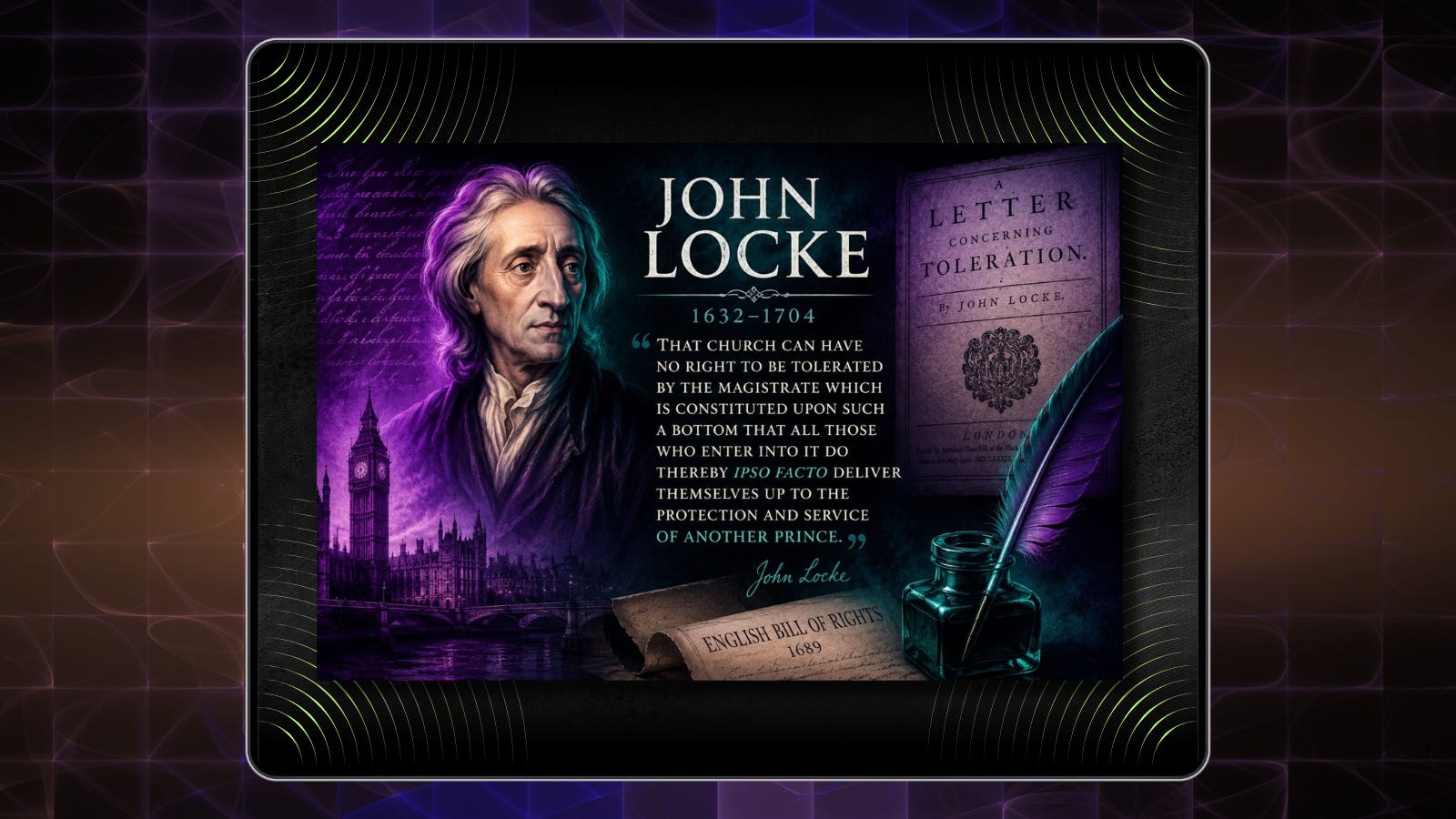
Locke wrote A Letter Concerning Toleration in 1689, immediately following England’s Glorious Revolution and the English Bill of Rights. England had already spent more than a century wrestling with the political implications of the Protestant Reformation, the Marian persecutions, the Spanish Armada, the Gunpowder Plot, the English Civil War, and the reign of James II.
Locke was not creating a new Protestant political tradition.
He was writing from within one.
His own words make this clear. Discussing the limits of civil toleration, Locke wrote:
“That church can have no right to be tolerated by the magistrate which is constituted upon such a bottom that all those who enter into it do thereby ipso facto deliver themselves up to the protection and service of another prince.”
Locke’s concern was not merely theological disagreement. Rather, he argued that any religious body claiming political allegiance to an external sovereign presented a constitutional problem for a Protestant nation committed to civil self-government.
That civil governments should not tolerate any religious group that demands its members' ultimate allegiance to a foreign leader (specifically targeting the Pope and the Roman Catholic Church).
Why does this matter?
Because it demonstrates that concern over papal political authority was not an isolated American issue. It was already well established within the broader English Protestant political tradition decades before the Declaration of Independence.
Historically, the opposite is much closer to the truth. Locke inherited many assumptions that had already been developed through more than a century of Protestant political theology.
This historical ordering also aligns with Donald Lutz’s findings. If Scripture overwhelmingly shaped the Founders’ political vocabulary, then we should expect Locke to appear as one influential voice within a much larger Protestant intellectual tradition, not as its replacement.
For that reason, we should understand Locke as an important witness rather than as the principal architect of America’s doctrine of religious liberty.
His Letter Concerning Toleration demonstrates that concerns about papal political authority were neither isolated nor fringe. They were well established within seventeenth-century Protestant political thought.
John Locke deserves careful study, particularly because he confirms that concerns regarding papal political authority were well established within seventeenth-century Protestant political thought. But history should not be read backward.
The center of gravity remains where history itself places it: Holy Scripture, the Protestant Reformation, the long struggle for Protestant constitutional liberty, and the biblical convictions that ultimately shaped America’s constitutional inheritance.
This historical perspective also explains why these questions are not merely academic. As we continue examining the future of religious liberty in America and the long-term implications of federal institutions such as the White House Office of Faith and the Religious Liberty Commission, it is essential to understand the Protestant constitutional tradition that informed the American Founding. Before we can evaluate modern institutions and commissions, we must first understand the historical principles they may either affirm or dangerously depart from.
This article serves as an introduction to a much larger conversation. In the coming weeks, we will welcome Rev. Matthew Littlefield1 back to Armor of Truth to examine John Locke's Letter Concerning Toleration within its proper historical context, showing how it confirms, rather than replaces, the broader Protestant constitutional tradition that shaped America's understanding of religious liberty and liberty of conscience. Together, we will explore why concerns regarding papal political authority were well established long before the American Founding, and why recovering this forgotten history is essential as Americans evaluate modern questions surrounding religious liberty, church-state relations, the White House Office of Faith, the Religious Liberty Commission, and America's constitutional future.
History is not merely something we study.
It is something we steward.
Soli Deo Gloria.
“For from Him and through Him and to Him are all things. To Him be glory forever. Amen.”
Romans 11:36

🇺🇸 America at 250
Our latest series
📖 Article 1
Before We Celebrate America, We Must Remember Her Foundation
The Inheritance We Dare Not Lose CLICK HERE
📖 Article 2
The Battle for Liberty of Conscience
Why America’s Founders Rejected Every Earthly Claim to Ultimate Authority CLICK HERE
📖 Article 3
The Great Revision
Who Gets to Tell America’s Founding Story? CLICK HERE
Rev. Matthew Littlefield is the pastor of New Beith Baptist Church in Queensland, Australia. He holds a Master of Arts in Theology with a concentration in church history and the early Enlightenment and is a respected commentator on theology, church history, and the biblical foundations of civil and religious liberty. He is the author of Like a Roaring Lion, co-author of Defending Conscience: How Baptists Reminded the World to Defy Tyranny, and a regular contributor to Caldron Pool and The Spectator Australia.
Comments
Nothing yet. Say the first thing.
Sign in to join the conversation.