
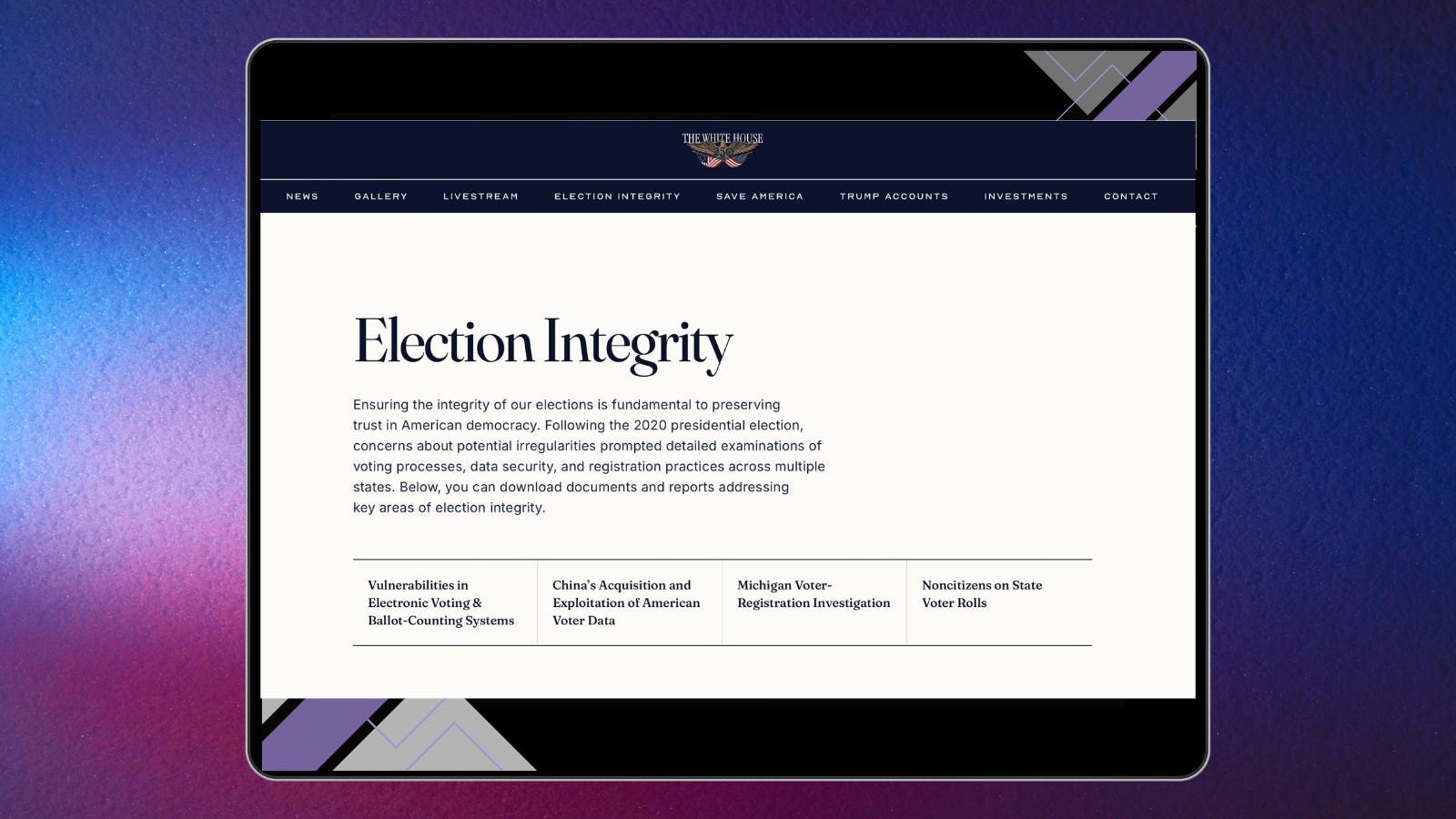
The White House Election Integrity Files1 confirm that foreign actors have repeatedly targeted voter registration databases because the personal information they contain has long-term intelligence and operational value.
This report is not saying foreign hackers changed vote totals. Instead, it argues that voter registration databases themselves are attractive targets because they contain the personal information used to verify voters.
Think of it this way:
Imagine your bank’s customer database gets hacked.
The hackers don’t necessarily steal the money immediately.
But they now have enough information to impersonate customers later.
The report says the same principle applies to voter registration databases.
Why is that a concern?
If someone steals voter registration information, they may have access to things like:
your name
date of birth
address
driver’s license number
portions of your Social Security number
sometimes even your signature
That information could potentially be misused to:
request absentee ballots in someone else’s name,
change a person’s registration information (such as address or party affiliation),
or delete or alter voter records.
The report emphasizes that the real danger is what someone could do later with stolen data, not simply that the database was breached.
Why does the report list Russia, China, and Iran?
It is documenting examples over roughly the past decade where officials reported cyber activity involving election-related systems.
The report cites examples involving:
Russian cyber actors,
Chinese cyber actors,
Iranian cyber actors,
as well as other security incidents involving vendors and state election systems.
Its overall message is:
“Election officials should assume these systems are targets and build stronger cybersecurity.”
The big-picture message
Together, these documents argue there are two separate election-security issues:
Cybersecurity — protecting voter registration databases from hackers who may want to steal or misuse voter information.
Voter-roll accuracy — identifying and removing registrations that may belong to people who are not eligible to vote, including alleged non-citizens or deceased individuals.
These are related because both involve the integrity of voter registration records, but they are distinct issues:
one concerns unauthorized access to the database, and
the other concerns whether the information already in the database is accurate and up to date.
They state that foreign actors, including actors attributed to Russia, China, and Iran, have targeted voter registration systems over a period of years.
They argue that stolen voter-registration data could later be used to impersonate voters, request absentee ballots, or alter registration records.
They recommend treating voter registration databases as critical infrastructure requiring stronger cybersecurity protections.
My concern is that the activity is centrally coordinated by a broader transnational network (our chief enemy—the globalists); that actors inside multiple nation-states are functioning as a “fifth column” for that network; and that one of its ultimate purposes includes identifying and targeting political opponents in a myriad of asymmetrical ways.
SEE MORE OF THE REPORTS https://www.whitehouse.gov/election-integrity/
The deeper significance of Trump’s announcement is his assertion that there was a “deep state” cover-up. That means the threat is not simply foreign governments acting independently, but fifth-column factions operating within multiple nations on behalf of a broader transnational network.
It is not simply, “China, China, China,” nor, “Russia, Russia, Russia.”
Rather, when considered alongside broader geopolitical, financial, intelligence, and ideological evidence, one possible interpretation is that these operations are components of a larger transnational struggle in which...
...actors operating across multiple countries pursue overlapping strategic objectives to destroy the United States, its original constitutional founding, and, consequently, Christian civilization.
The indication is that a broader transnational network (the globalist faction) coordinates these activities through aligned factions embedded within multiple countries. Those factions function as a “fifth column,” meaning the host nation itself is not necessarily directing the activity.
In this instance, the focus would be on a compromised globalist faction operating inside China, not necessarily with the Chinese government itself. That distinction also helps explain why these developments need not be viewed as inconsistent with the cooperative relationship between Xi, Putin, and Trump.
China has repeatedly signaled that it does not support or prefer the globalist Great Reset agenda, and so has Putin.
Be cautious of outdated, simplistic geopolitical narratives that reduce everything to, “It’s China, China, China,” or, “It’s Russia, Russia, Russia.” That’s a ditch the Fabian Davos establishment wants people to fixate on.
The DHS report serves as corroborating evidence of the strategic importance of voter registration databases, not as proof of the broader network itself, but as evidence that these databases possess significant long-term intelligence and operational value.
Taken together, the administration’s actions against the globalist ICC, its lawful action plan against radical-left terrorism, the refusal of major news networks (NBC/ABC)2 to air the President’s national-security announcement concerning American elections, and Trump’s assertion of a deep-state cover-up of election fraud… the pattern suggests that the administration appears to be more overtly identifying the globalist City of London Corporation faction as America’s principal strategic adversary. 🇺🇸
Step by step, the public is awakening to the transnational network and its proxies working against American liberty, as conceived by our Founding Fathers, and against Christian civilization.
SEE:
Trump Administration Unleashes Global Campaign to Crush Radical Left Terrorism
Trump Administration convened senior officials from governments around the world to launch an unprecedented global offensive against the transnational threat of Radical Left terrorism.
SETTING THE RECORD STRAIGHT: President Trump Declassifies Intel on Foreign Election Interference and Deep State Coverup
WHAT THEY ARE SAYING: President Trump Exposes Bombshell Evidence of Foreign Election Interference and Deep State Suppression
Trump Slams NBC, ABC for Not Covering Election Integrity Speech: ‘They Want to Protect the Radical Left’
White House - The Biggest Election Interference Revelation in American History. On July 16th, President Trump delivered a national address revealing newly declassified intelligence establishing that China, over a period of years beginning with the 2020 election cycle, stole 220 million U.S. voter files — names, addresses, phone numbers, party affiliations, and sensitive personal data sufficient to interfere at scale with American elections. The intelligence shows China assigned a dedicated data exploitation unitspecifically to this operation. DHS separately confirmed that 275,000 noncitizens have been identified on voter rolls. The administration has published the full declassified intelligence at whitehouse.gov/election-integrity, and the DOJ has already accelerated its crackdown on noncitizen voting.
White House - NBC and ABC Refuse to Air Presidential Address — Nation Reacts. When President Trump addressed the nation Thursday night on this historic election security revelation, NBC and ABC refused to carry the broadcast. No other topic. No breaking news preemption. A deliberate choice to black out a sitting president speaking on a matter of national security. President Trump responded directly, saying the networks “want to protect the Radical Left.” House Intelligence Committee Chairman Crawford called it “an elaborate cover-up.” The question now before the country: should broadcast networks that operate on public airwaves face license consequences for refusing to carry a presidential address? Senator Markwayne Mullin has already announced an election security crackdown in response.
Comments
Nothing yet. Say the first thing.
Sign in to join the conversation.