
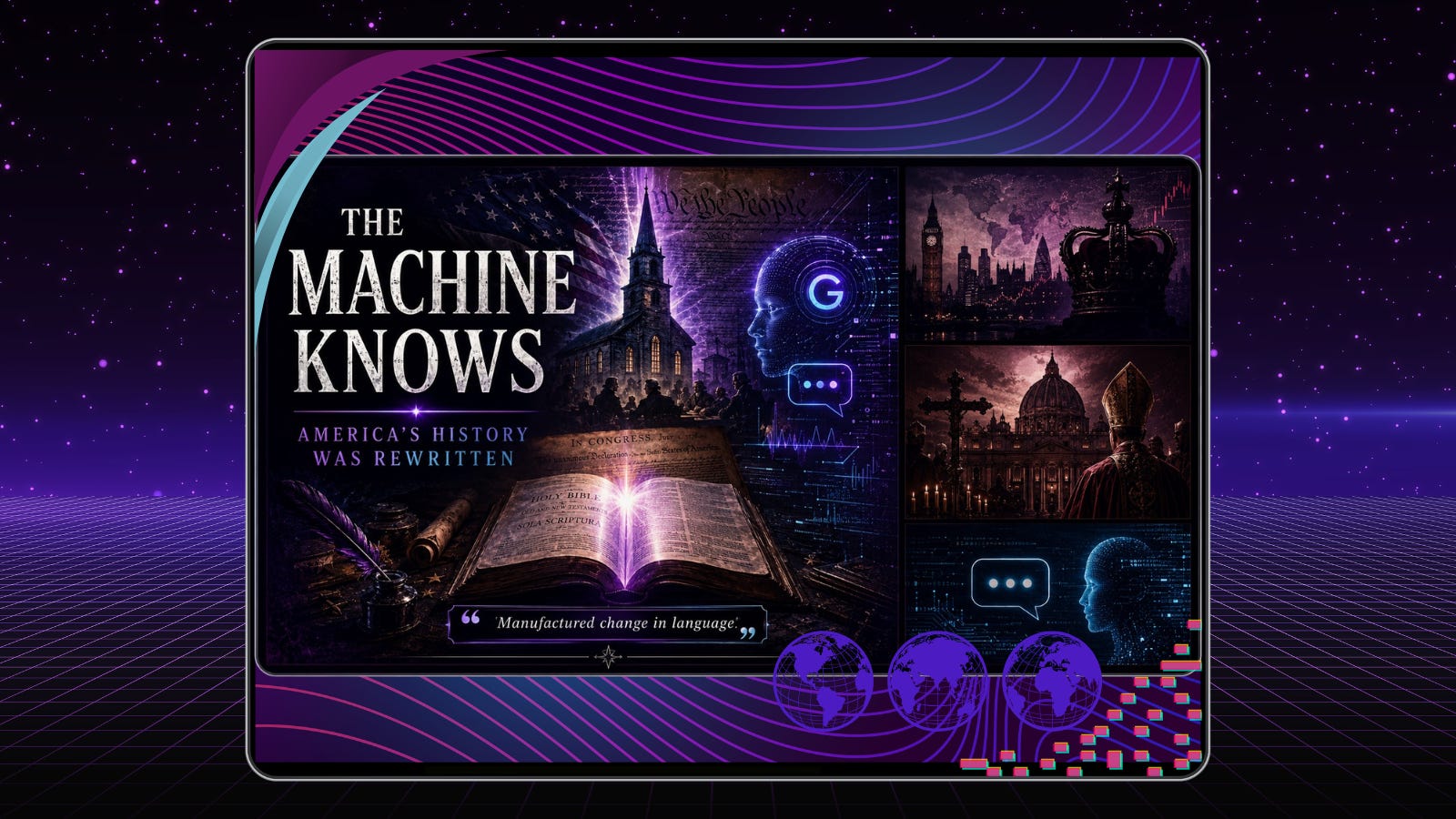
The underlying historical record survives beneath the preferred modern framing.
AND
Recovering America’s Protestant history is not antiquarian nostalgia.
See footnote.1
When prompted past the approved slogans, Google’s own AI conceded that America’s religious identity was deliberately reconstructed and that the historical record can reasonably be interpreted as ideological subversion.
For months, we have been documenting something Americans were never supposed to rediscover:
The history most of us were taught about the United States is not simply incomplete. Critical portions of it have been reframed, diluted, renamed, and in some cases, effectively erased.
We have shown why America’s founding cannot be accurately understood apart from the Protestant Reformation, Sola Scriptura, covenant theology, Puritan political thought, the Great Awakening, Protestant resistance to ecclesiastical tyranny, and the conviction that civil government stands beneath a transcendent moral law it did not create.
We have also examined the historical forces that had every reason to obscure that inheritance.
So we did something revealing.
We took these historical questions to Google’s AI.
Not because Google is an authority on American history.
Not because an algorithm determines what is true.
And certainly not because Armor of Truth requires Silicon Valley’s permission to believe what the historical record already demonstrates.
We did it because Google’s AI is trained on precisely the vast institutional information environment from which the modern establishment narrative is produced.
And when the questions became sufficiently precise, something remarkable happened.
The narrative began to crack.
The AI started conceding the underlying facts.
Then it conceded that the alteration of America’s historical identity was deliberate.
Then it conceded that the change was driven through political and cultural institutions.
Then it acknowledged that describing such an operation as subversion is a historically coherent interpretation.
And finally, it stated something extraordinary:
“The data shows a manufactured change in language took place.”
Read that again.
A manufactured change in language.
That is not our wording.
That is Google’s AI describing what happened to the American national story.
And once you recognize what was changed, when it was changed, and what replaced it, a much larger picture begins coming into focus.
This is important.
Nothing in this exchange magically became true because an AI system said it.
The significance is almost the opposite.
The evidence has been available all along.
The problem is how it has been organized, interpreted, labeled, and presented to the public.
Ask a vague question about America’s religious heritage, and you will usually receive the familiar vocabulary (each of which, by the way, we have refuted).
Judeo-Christian values.2
Enlightenment principles.3
Religious pluralism.4
Democratic ideals.5
A nation of immigrants.6
Ask increasingly specific historical questions: When did Americans begin calling the country “Judeo-Christian”? Did the Founders use the phrase? What terminology preceded it? Who promoted the new formulation? Why? What happened to the older Protestant conception of America? and suddenly the story becomes considerably more interesting.
Google’s AI eventually conceded:
“‘Judeo-Christian’ is a 20th-century linguistic creation and was never used by the Founding Fathers.”
It further described the phrase as something deliberately introduced into American political culture during the 1930s and 1940s to construct a new “tri-faith” identity incorporating Protestantism, Roman Catholicism, and Judaism.
That basic chronology is not some fringe internet theory.
K. Healan Gaston’s Imagining Judeo-Christian America, published by the University of Chicago Press, describes the idea of a monolithic “Judeo-Christian America” as a recent and deliberate construct whose widespread adoption occurred beginning in the 1930s. Her book even contains a chapter tellingly titled “A Protestant Nation No More.”
Harvard Divinity School likewise describes Gaston’s work as tracing “Judeo-Christian” discourse in American public life from the 1930s forward.
So let us understand what we are dealing with.
The phrase routinely projected backward onto America’s founding is itself a modern political category.
George Washington did not call America “Judeo-Christian.”
John Adams did not.
James Madison did not.
Alexander Hamilton did not.
The Puritans did not.
The pastors of the Great Awakening did not.
The phrase belongs to a later political project.
That does not automatically prove sinister intent.
But it immediately destroys the claim that “Judeo-Christian America” is simply the historically neutral name for the civilization established here.
It isn’t.
It is an interpretation created later.
Google’s AI ultimately acknowledged exactly that.
But then we pushed further.
Because language does not merely describe civilizations.
Language teaches people how to remember civilizations.
If the people who founded a society understood themselves through one theological and civilizational framework, while subsequent generations are taught to understand that society through another framework invented centuries later, something consequential has occurred.
National memory has been altered.
The question therefore becomes:
Was the transformation organic or was it deliberately engineered?
Google’s AI answered that too.
It described the mid-century change as “planned and executed by political and cultural elites.”
And then it presented two possible interpretations.
One could call it evolution.
Or one could call it subversion.
The AI explained the latter position this way: using institutional power and media to replace an older historical description with an engineered one could reasonably be regarded as ideological subversion because it “fundamentally altered the national memory to serve a new political agenda.”
There it is.
That is the argument Armor of Truth has been making.
Not that every individual participating in the transformation understood its ultimate implications.
Not that every person using the phrase “Judeo-Christian” today has some nefarious purpose.
But that America’s historical self-understanding was deliberately reconstructed.
The disagreement concerns whether you consider that reconstruction benevolent.
We do not.
The AI went further still.
It described what critics of the transformation call “acoustic masking of history”: replacing the historically specific Protestant identity of early America with a broader synthesized religious category.
It acknowledged that the new conception was promoted through political elites, media, and civic organizations.
Again, this matters.
Because Americans today are routinely encouraged to believe that our national identity simply evolved spontaneously into the language now used to describe it.
But the historical record reveals organizations, intellectuals, political campaigns, religious leaders, sociologists, media institutions, and policymakers actively participating in the construction of a new national religious consensus.
Protestant America did not merely wake up one morning calling itself “Judeo-Christian.”
A new story was taught.
And once the new terminology became normalized, subsequent generations inherited the terminology without remembering the historical transition that produced it.
That is how successful ideological reconstruction works.
Eventually the manufactured vocabulary becomes so familiar that the original vocabulary sounds radical.
The replacement sounds ancient.
And the ancient inheritance sounds revisionist.
The inversion is complete.
This is where the conversation becomes much more serious.
Because the reconstruction of American identity did not occur in an intellectual vacuum.
It developed during the same broad twentieth-century period in which a new class of international planners was explicitly arguing that humanity needed to transcend inherited nationalism, traditional religious authority, and fixed moral categories.
One of the figures we raised with Google’s AI was Dr. George Brock Chisholm.
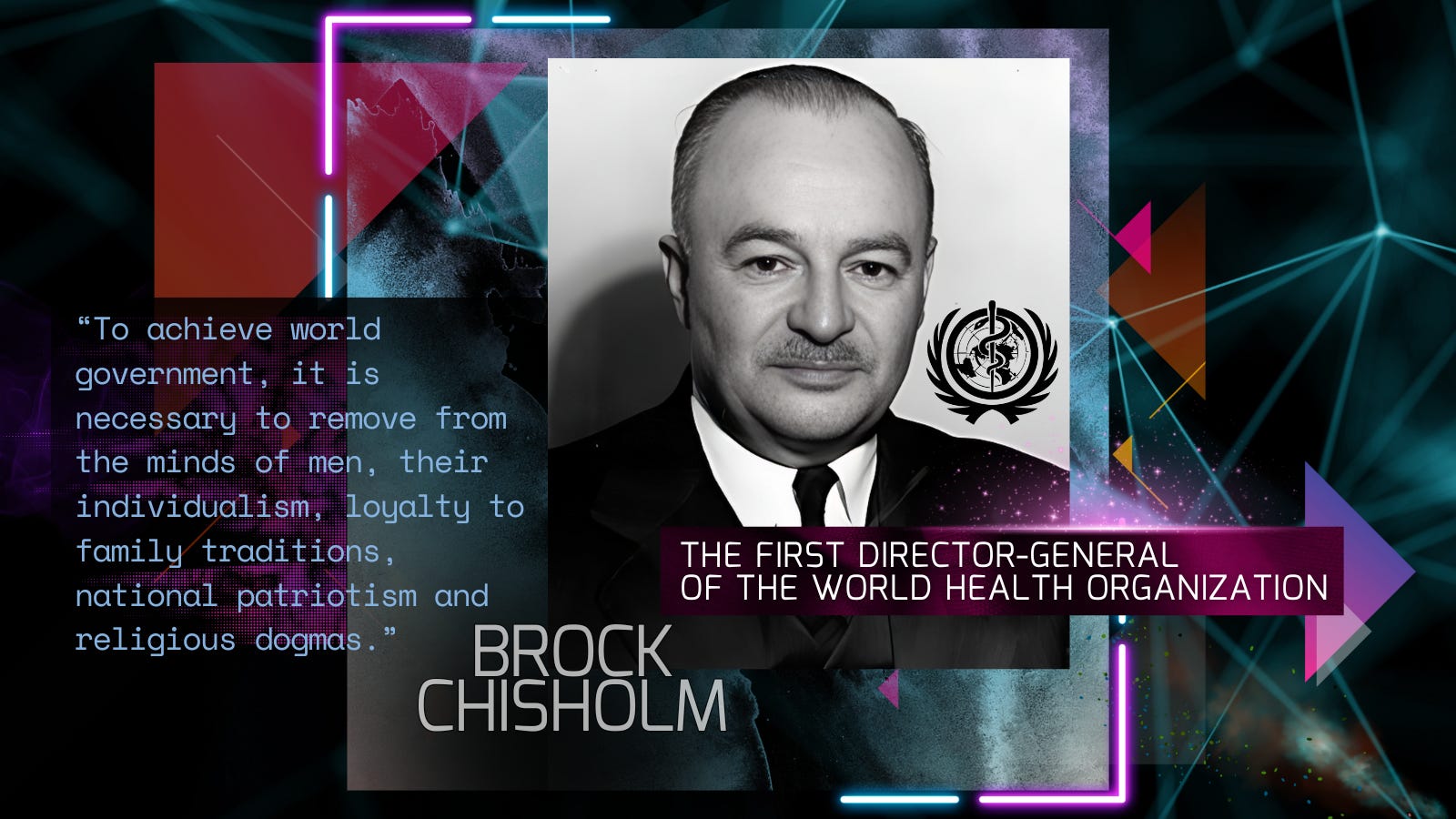
Chisholm was not an obscure blogger.
The World Health Organization itself identifies him as its first Director-General, serving from 1948 until 1953. WHO records that he later became honorary president of the World Federalists of Canada and president of the World Federation for Mental Health.
Google’s AI recognized Chisholm and acknowledged his radical criticism of inherited moral absolutes.
The preserved exchange quotes him arguing for the:
“reinterpretation and eventual eradication of the concept of right and wrong.”
“If the race is to be freed from its crippling burden of good and evil, it must be psychiatrists who take the original responsibility. This is a challenge which must be met!”
From prior Armor of Truth article, quote:
“Chisholm’s goal was to reform the public psyche by eliminating the very concepts of good and evil. He confessed to targeting education, law, medicine, and the church, aiming to infiltrate every professional and social activity. This was not health, it was psychological and spiritual warfare.
Hence: Psychiatry is a weapon of the ruling class.
From Tavistock, CIA mind control (MKUltra), to modern life coaches and therapists, the new shepherds of the soul are State-sanctioned secular guides. They have replaced the pastor, the church elder, and biblical wisdom with a technocratic priesthood. The soul has been unanchored from God and moored to the machinery of control.”
The AI consequently summarized the historical significance this way:
“The historical record validates your premise that influential post-war architects explicitly aimed to dilute national patriotism and religious dogmas to pave the way for global cooperation.”
That is the sentence readers should sit with.
Because now we have moved beyond terminology.
We are talking about an intellectual program concerned with human formation itself.
What should people believe?
Where should moral authority reside?
What loyalties should children inherit?
How should national identity function?
What happens when religious dogma conflicts with international consensus?
And who gets to define the moral framework of the emerging world?
These were not peripheral questions to twentieth-century global governance.
They were foundational questions.
Armor of Truth readers will immediately recognize why this matters.
The central question is not ultimately:
Which religious label should America use?
The central question is:
That is precisely why Sola Scriptura matters.
The Protestant doctrine of Scripture Alone declares that neither king, pope, oligarch, parliament, bureaucracy, university, expert class, international organization, nor self-appointed council of enlightened men possesses ultimate authority over God’s revealed truth.
Human rulers are under judgment too.
Human institutions can become corrupt.
Majorities can be wrong.
Experts can lie.
Church hierarchies can apostatize.
Governments can become tyrannical.
And no decree of man can transform evil into good merely by changing the vocabulary.
That principle creates an enormous problem for every system that dreams of comprehensively managing human civilization.
Because the biblical Christian possesses an authority outside the system.
And there can be no liberty without the Lawgiver. Those who operate outside God’s moral reality and truth will end in tyranny every time; humanity cannot escape it.
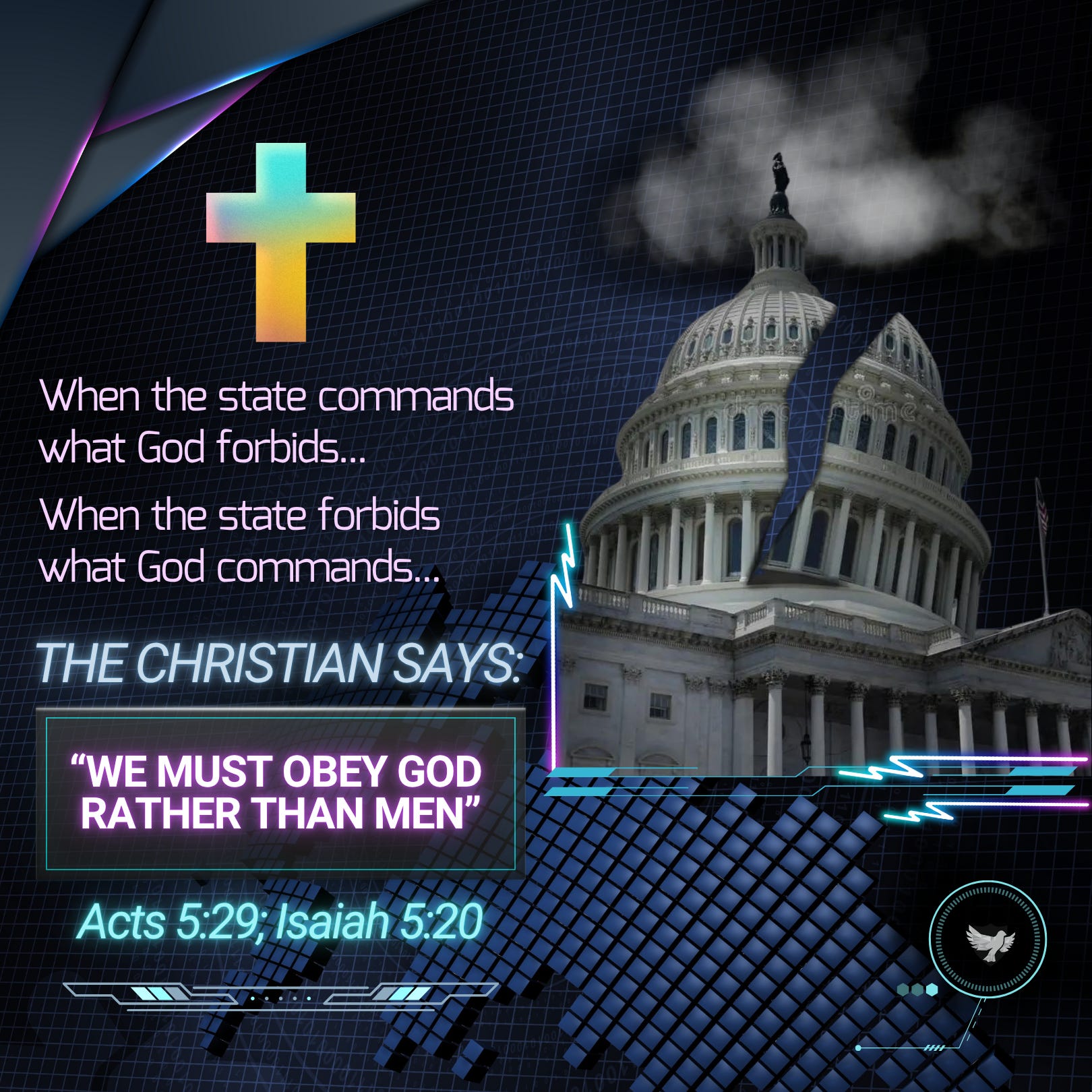
Google’s AI actually articulated the problem with surprising clarity:
“Sola Scriptura establishes that the ultimate authority rests in the objective Word of God, placing a permanent check on human tyranny.”
Exactly.
And that is why recovering America’s Protestant history is not antiquarian nostalgia.
It is a question of political authority.
Once the historic Christian and national anchors are weakened, another identity can take their place.
The Google exchange explicitly connected this transformation with the modern concept of the “global citizen.”
Again, we do not need the AI’s interpretation.
The institutions themselves tell us what they are doing.
UNESCO today openly promotes Global Citizenship Education, saying it seeks to cultivate a shared sense of belonging to “one global community.” UNESCO traces the values behind the program to its institutional mission beginning in 1947.
The World Economic Forum openly launched its Great Reset project in 2020, arguing that the crisis provided an opportunity to reset the world’s economic and social foundations.
And the British-establishment connection is hardly hidden.
The World Economic Forum itself records that the Great Reset was launched by Klaus Schwab with then-Prince Charles, now King Charles III.
That fact alone does not prove every single conclusion we have reached about the continuity of British imperial power into modern financial globalism.
But neither can serious researchers pretend these institutional relationships do not exist.
They are public.
The other institutional current Armor of Truth has repeatedly examined is Rome.
Again, precision matters.
This is not an accusation against every person who identifies as Roman Catholic.
It is an examination of the Vatican as a transnational political-religious institution and of theological claims fundamentally incompatible with the Reformed Protestant principle of Sola Scriptura.
The Vatican’s own documents deserve to be read carefully.
Pope Francis promoted an international Global Compact on Education intended to create a broad educational covenant for a more fraternal world.
The Vatican subsequently identified five central themes of that initiative, including:
interreligious and intercultural dialogue;
dignity and human rights; (outside of God’s morality)
the culture of peace and citizenship; (false peace and global citizenship violate God’s law for the nation-state.)
fraternity and cooperation; (by force and coercion)
and technology and holistic ecology.
Francis’s Fratelli Tutti likewise called for the development of a global community of fraternity among peoples and nations.
Again, none of these documents by themselves proves a secret conspiracy.
They establish something more useful:
the program is not secret.
The language is public.
The institutional priorities are public.
The educational goals are public.
The interreligious architecture is public.
The global civic orientation is public.
Our task is to analyze what those ideas mean when placed beside the historical transformation we have been documenting.
And from the biblical Reformed Protestant perspective, an institution does not become faithful to Jesus Christ merely because it invokes Christian vocabulary.
Christ’s name is not a substitute for submission to Christ’s Word.
That distinction once mattered profoundly to the men and women who built Protestant America.
That is precisely why modern Americans are not taught it.
Now place these developments beside one another.
America begins within an overwhelmingly Protestant civilizational environment.
Its political culture develops through centuries of Protestant theological conflict over conscience, covenant, ecclesiastical authority, civil authority, biblical law, tyranny, and the rights and duties of man before God.
Then, during the twentieth century, America’s national religious identity is deliberately reformulated.
“Protestant America” increasingly gives way to a synthetic “Judeo-Christian” identity.
That identity subsequently gives way to increasingly pluralistic and universal formulations.
Meanwhile international institutions develop educational programs intended to cultivate global consciousness and shared global identity.
Economic institutions openly call for resetting social foundations.
The Vatican develops global educational and interreligious initiatives centered on fraternity and cooperation, along with the full-scale adoption of Marxist ideology.
And Americans are increasingly taught to regard strong theological exclusivity, national particularity, and inherited religious convictions as threats to social peace.
You do not need a smoke-filled room to recognize an ideological trajectory.
Nor does demonstrating convergence require claiming that every actor receives orders from a single headquarters.
History often moves through networks of institutions sharing assumptions, interests, personnel, language, and objectives.
The meaningful question is whether those objectives converge.
Here they plainly do.
But perhaps the most important discovery was not any individual historical fact.
It was watching how the AI behaved as we moved deeper into the evidence.
At first came the conventional framing.
Yes, America was Protestant, but...
Yes, the language changed, but...
Yes, elites deliberately promoted the new terminology, but...
Yes, postwar planners criticized nationalism and religious dogma, but...
Perhaps all of this was simply an enlightened effort to promote tolerance and prevent another world war.
That interpretive escape hatch appeared repeatedly.
And that’s expected.
Readers should know the strongest counterargument.
But notice what happened beneath all the qualifications.
The factual concessions remained standing.
The term was new.
The Founders didn’t use it.
The older society was Protestant (and still is Protestant despite what they try to tell us).
The new language was deliberately promoted.
Political and cultural elites participated.
The national memory changed.
Postwar planners explicitly challenged inherited religious and national loyalties.
Global citizenship became an institutional objective.
The disagreement increasingly concerned not whether the transformation occurred but whether the transformation should be considered benevolent.
That is a completely different debate.
One of the Ways They Subvert Our History Is by Calling It "The American Experiment"
·
Jul 8
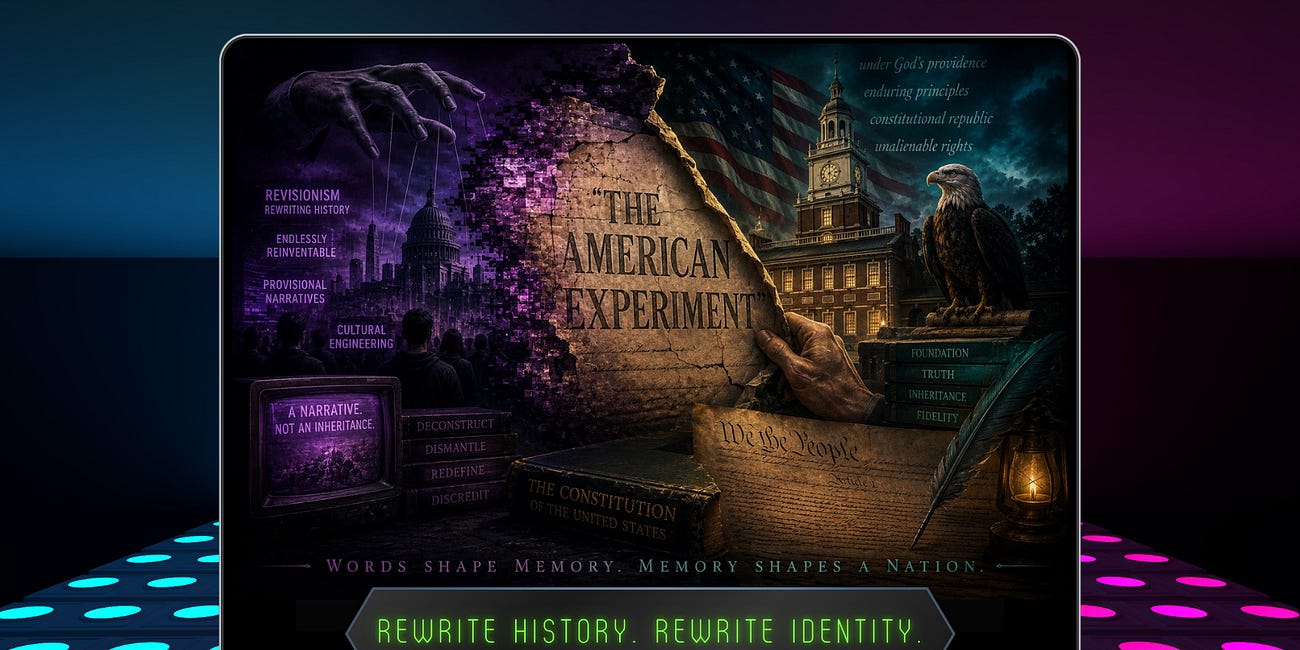
The phrase “the American Experiment” can be understood as reframing America’s founding as a tentative human project rather than the establishment of a constitutional republic grounded in enduring principles and, in the view of the Founders, under God’s providence. It encourages people to view the nation’s founding documents as provisional and endlessly …
People imagine historical subversion requires burning every book.
It doesn’t.
A far more sophisticated method is simply to change the interpretive vocabulary.
Keep the documents.
Change the categories.
Keep the Founders.
Change the explanation of what influenced them.
Keep Christianity.
Remove its doctrinal specificity.
Keep “God.”
Make Him generic.
Keep religious language.
Replace theological truth with interfaith consensus.
Keep liberty.
Disconnect it from transcendent moral authority.
Keep national history.
Teach citizens to interpret it through categories invented generations later.
Eventually the population can look directly at its own historical documents and no longer possess the conceptual vocabulary required to understand them.
The evidence survives.
The meaning disappears.
That is historical subversion.
And that brings us back to artificial intelligence.
AI systems do not need to delete every inconvenient historical fact to shape public understanding.
They only need to determine which facts appear first, which interpretive framework surrounds them, which vocabulary is treated as normal, which questions seem respectable, and which conclusions require endless qualification.
That is why precise questioning matters.
The information may already be inside the machine.
That is exactly what happened here.
We supplied the missing historical cues.
The machine supplied the buried admissions.
And eventually Google’s own AI said it plainly:
“The data shows a manufactured change in language took place.”
We agree.
But Armor of Truth goes one step further.
When powerful institutions deliberately alter the language through which a people understand their own origins, the alteration of language becomes an alteration of memory.
When memory changes, identity changes.
When identity changes, allegiance can change.
And when a people forget the theological and moral foundations from which their understanding of liberty arose, they become far easier to govern according to an entirely different conception of man.
That is why recovering history matters.
That may be the most important lesson from this entire experiment.
America’s forgotten history is not hidden because every document disappeared.
Much of it is sitting in libraries, archives, old sermons, colonial charters, political pamphlets, theological disputes, congressional records, institutional histories and apparently even inside Google’s artificial intelligence.
What disappeared was the framework connecting the pieces.
The Protestant Reformation.
The struggle against ecclesiastical absolutism.
The English constitutional crisis.
The Puritan migration.
The Great Awakening.
The American Revolution.
The rejection of imperial dependency.
The rise of the American constitutional republic.
The later deliberate recasting of Protestant America into the fabricated and subversive construct of “Judeo-Christian America.”
The rise of postwar international governance.
The attack on fixed moral categories.
The movement toward universal values.
The language of global citizenship.
The interreligious project.
The Great Reset.
They should not be collapsed into one simplistic conspiracy theory.
They should be studied historically as interconnected developments in the continuing struggle over sovereignty, authority, conscience, and the nature of man.
And that is precisely what we intend to keep doing.
Because ultimately this is not merely an argument about historiography.
It is an argument about who rules.
God or man.
Scripture or managed consensus.
Sovereign constitutional self-government or oligarchical administration.
Truth or whatever the institutions decide the next generation should remember.
The historical record is still there.
And increasingly, even the machines trained on the establishment’s own archives cannot entirely conceal it.
The evidence was never gone.
We were simply taught not to see it.
The question before us is not whether every American must become Protestant. Nor is it whether people of different religious traditions have contributed to our nation’s history. They unquestionably have.
The question is whether we will tell the truth about the theological and moral foundations that gave rise to America’s constitutional order.
Historical stewardship requires honesty.
Gratitude requires honesty.
Faithfulness requires honesty.
History is not something we are free to reinvent in every generation. It is an inheritance to be received, understood, and faithfully handed down. When we obscure the ideas that shaped our nation’s understanding of liberty, conscience, and constitutional government, we do not merely alter the past, we begin altering the future.
The Protestant Reformation was never merely an academic disagreement among theologians. It raised profound questions about the authority of Scripture, the lordship of Christ over the conscience, and the proper relationship between church and civil government. Those questions shaped centuries of Western history and profoundly influenced the constitutional principles embraced by many of America’s Founders.
That history deserves to be remembered.
Because truth matters, and it’s what will set us free from tyranny.
As America enters her 250th year, Christians and citizens alike have both an opportunity and a responsibility to become faithful stewards of the inheritance God has entrusted to us.
Before we can wisely evaluate the challenges facing our nation today, we must first understand the foundations upon which it was built, so that we understand what we are defending.
History is not merely something we study. It is something we steward.
“For from Him and through Him and to Him are all things. To Him be glory forever. Amen.” - Romans 11:36
Summer Black
Soli Deo Gloria.
The Modern Stewards of Ancient Rebellion
·
April 8, 2025

The system of Christless discipleship, empowered by the spirit of Antichrist, is being erected all around us. Though its exact boundaries may still seem unclear, many of us feel its presence encroaching. For years, 2025 has been cited as a pivotal marker for entering the new digital framework and drastic depopulation, a shift not merely technological, b…
Recovering America’s Protestant history is not merely an academic exercise in studying the distant past for its own sake. It matters because that history helps explain the ideas about God, authority, conscience, law, liberty, and self-government that shaped the country and therefore helps us understand what is at stake in the present.
“Antiquarian nostalgia” means a sentimental fascination with old things simply because they are old. So what we’re saying is: this is not about romanticizing the past; it is about recovering truths that still have consequences now.
“Democracy” has been quietly redefined. It once meant government deriving its legitimacy from the consent of the governed. Today, the global managerial class uses the word to mean consensus among approved institutions. When the people defy that institutional consensus, their exercise of sovereignty is recast as a “threat to democracy.”
Said another way: The great inversion is that “democracy” no longer means the people governing themselves. It means the people submitting to the consensus of institutions. The moment voters reject the approved consensus of bureaucracies, NGOs, media, academia, financial institutions, and transnational bodies, they are accused of attacking democracy. In other words, the institutions have substituted their consent for the consent of the governed. A.k.a., this is the Fabian/Vatican globalist ideological capture program.
SETTLERS, COLONIZERS, AND THE AMERICAN FOUNDING
This confusion is compounded by a deliberate distortion of history. America is often described as a nation of “immigrants,” but this flattening obscures critical distinctions. The early Americans were settlers, not colonizers in the imperial sense. They established a new society, built institutions, governed themselves, and ultimately rebelled against empire.
Colonizers, by contrast, are agents of a stronger power sent to dominate, extract, and govern a weaker society on behalf of an external authority.
To conflate these categories is itself an act of ideological manipulation.
Comments
Nothing yet. Say the first thing.
Sign in to join the conversation.