
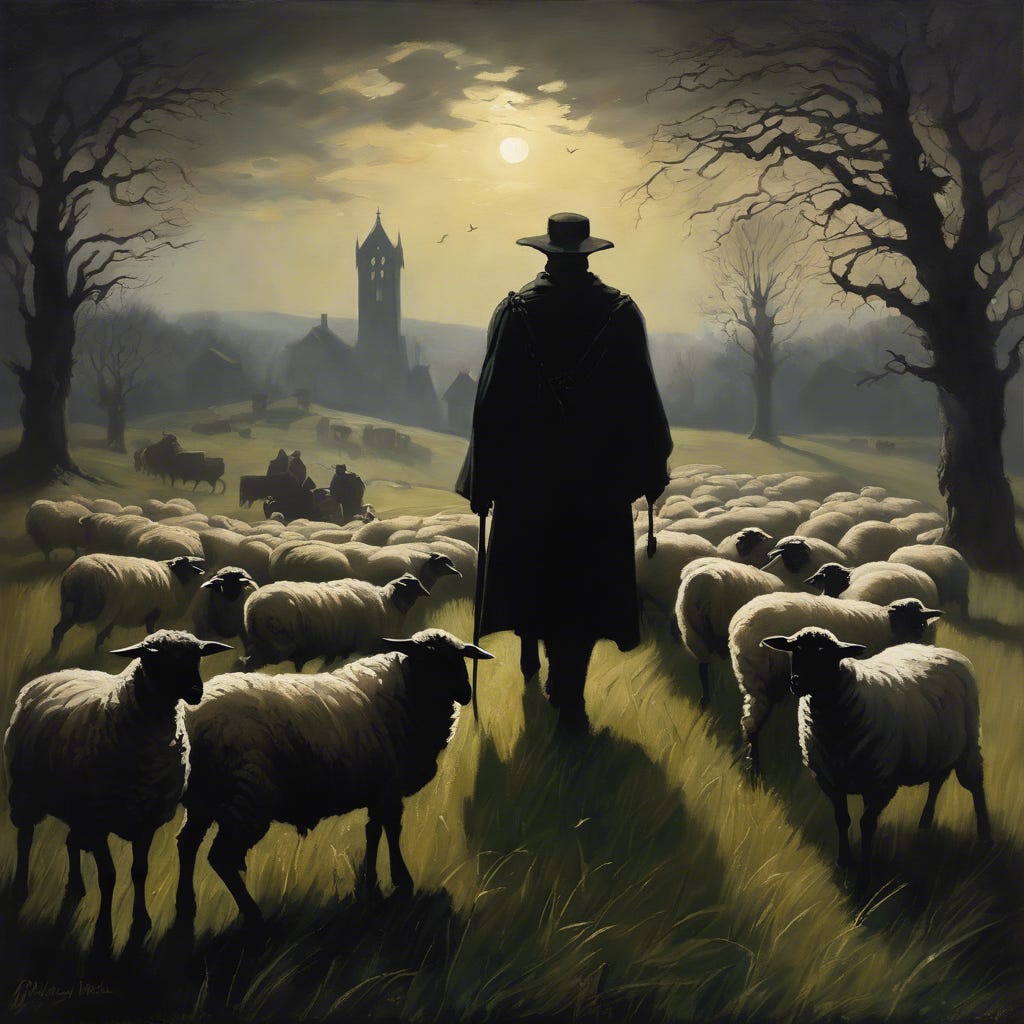
As we continue our journey across the shifting seas of Old Terra’s moral landscape, we spot dry land in the form of guilt and punishment. Twin islands of base human behavior that seem only a hair less ingrained in humans than eating and sex. Our guide again asks us to ponder the question of origination. Where did the feeling of guilt come from and what does it have to do with the earliest human punishments?
Nietzsche’s first supposition is that humanity’s drive towards cruelty to their fellow man is innate, not learned. Anyone who has ever been around young children playing with each other will agree. Before education conditions children, cruelty and disproportionate reactions are commonplace in their interactions.
You stole my toy? Perhaps you’d enjoy a few swift kicks as well. Without any need for formal instruction, children take to the principles of bullying quite well. We can only surmise this must be instinct. Certainly capacity for physical violence and social ostracization lies within all human beings. The wisdom to use them proportionately or to drive some outcome appears the learned behavior to us.
Nietzsche postulates that cruelty had two functions. The first was the catharsis felt when expressing your raw anger towards another person. The second was to serve as an incentive for memory retention.
Debt is a concept that appears in even the most primitive of human tribes. Even human social groups that do not have the concept of money have the concept of debt. The tracking of debt is thought to be what instantiated writing and is thus responsible for most of human societal advancement for the last ten thousand years or so.
Debt comes in many forms, one of them social. Even without personal property humans persist in laying exclusive claim to something. But in order for debts to matter as such there must be the enforcement of collections. And the most straightforward way to collect on any debt is a liberal application of violence. Thus the capacity for cruelty gains fitness as a means of protecting one’s own resources across time. The continued application of these painful punishments as a means of debt collection eventually formed the emotion of human guilt. Guilt now being useful to avoid said punishments.
Before the invention of guilt the punishments themselves had to strike a long-lasting chord in the minds of the tribe’s members. Hence the levels of cruelty in pre-modern human organizations.
A man owes you but cannot pay. In lieu of payment, you take your pleasure in beating him until you're satisfied. This is in fact where ‘demanding satisfaction’ comes from. It directly ties to the pleasure taken in harming one’s enemies. Humans, beaten enough, eventually develop the social tools to avoid being punished. This is from where the conscience, your sense of right and wrong, arises.
This strikes us as a fundamentally Darwinist explanation for the rise of such emotions. Thus we may ask, where else might these emotions have come from? If we are to be rational, we must first dispense with the notion that these human actions came from nowhere; which is to ultimately say, from the Creator himself. If you wish to entertain that these phenomena always were then your revelation lies in scripture rather than reality.
Let us also dispense with delusions of grandeur that would explain punishment as a component of any existing ‘justice system’, ‘deterring crime’, ‘protecting the citizenry’ or any other advanced societal construct. Although this may be true now. It does nothing to explain the origins of punishment or feelings of guilt. It does not explain where the conscience came from. One may metaphysically view any unpaid debt as a ‘crime’ regardless of the historical context. But this is a semantics argument alone. The Magna Carta was signed in 1215. Not while the Earth was still cooling. To elevate law in this way is simply an attempt to use the same argument while swapping God with a code book. God is to remain dead, please stop trying to revivify him with magic incantations. This is extremely embarrassing behavior in a post-Hiroshima world.
It is rather distasteful to imagine that our intuition from the grandest institution of justice down to our base sense of right and wrong exist merely as monuments to the pleasure others partook in violence. After all we are taught our fellow man, though he may have wronged us, is first our brother and neighbor. Yet, within the privacy of our own hearts, few take pity on a rapist killed by his victim. Or when a parent takes matters into their own hands regarding their child’s murderer. Our eyes turn blind for them. Looking at the true wellspring of justice is like looking into the sun. Perhaps going blind is a blessing. Imagine what we might see if we were allowed to gaze longingly into such chaos.
As a new priestly class of leaders rise to supplant the old warriors, such cruelty and penchant for violence must be subverted. But the priest, being clever, suspicious, and cunning discovers a method of turning the fruits of such cruelty back onto its creators.
Rather than simply moralize against cruelty, the priest subverts man’s natural instincts for defending what is his by enticing him to turn it inwards.
This is the origin of bad conscience. It was man, who, lacking external enemies and obstacles, and imprisoned as he was in the oppressive narrowness and monotony of custom, in his own impatience lacerated, persecuted, and gnawed, frightened, and ill-treated himself. It was this animal in the hands of the tamer which beat itself against the bars of its cage. It was this being who pining and yearning for that desert home of which it had been deprived was compelled to create out of its own self an adventure, a torture chamber, a hazardous and perilous desert. It was the fool, this homesick and desperate prisoner who invented bad conscience.
A new constellation of values ascends the throne. Humility, Charity, Kindness, Gratitude and ultimately Pity for the weak. Having defeated the enemies without, the locus of attention shifts to focus on the enemy within; the self. There but for the grace of God is the calling card of this new day.
With these new values in place the Priest can begin to elevate the weak and diminish the strong. The virtues inherent in the poor, the brigand, and the sickly are extolled while commanding such people out of your own space is disallowed. This is a display of dominance by the Priest. By protecting the weak as they wreak havoc on physical space from the latent urge to stop them, the Priest is showing his absolute authority and dominion over the Warrior.
So deep and thorough is the Priest’s victory that the virtues of strength and action are not only pilloried by a man’s neighbors, but from within the man himself. Doubt has cast a cloud over his mind, and soul as he stops his own will to action before it can manifest in physical space. His bad conscience imprisons him more than any bars of steel ever could. So total is the Priest’s dominion over his mind that most never even think to ask whether they chose their own values. To even consider such an option without the guiding vision of Christ is anathema: anti-social, dangerous, to be prevented at all costs.
Thus the purpose of a system of justice becomes realized. To make real the bad conscience and constrain the masculine. That strong and beautiful impulse to aggressively assert dominion over space. Pity– great multitudes of pity– are heaped upon such impulses in order to impede them. The man is conditioned to turn his own aggression back on himself, to undo his soul as ruthlessly as he would have once dealt with his enemies.
This is the ultimate trick of the Priest. In elevating pity above all the Warrior is asked not merely to pity the weak, but find and foster the weakness within himself in order to elevate pity even further. Here lies you.
You have become tame. Domesticated through centuries of machinations by the priestly constellation. The results of poor breeding, poor diet, both psychological and cultural degeneration have been to dilute your beauty, strength, intelligence, vitality, and capacity for any action. Least of all violence. You are as the golden retriever is to the wolf.
This is the result of putting your faith in the Priest. He offers community, a promise of an eternal afterlife, and atonement for guilt. Imagine that, forgiveness for a debt you owe to yourself!
Inward cruelty now holds sway infecting all who practice it with a spiritual sickness that causes them to disdain the physical and sensual. They imagine a distinction between the mental and the physical– that depression, addiction, anxiety, and neurosis can be neutralized with no change of environment. Your body is as much a host to these maladies as your mind. The Priest promises meaning in suffering as he sells you the pill to ease it.
Your body is as a garden. Just as prone to growing weeds and other undesirability without regular maintenance. Its beatification is nourishing to your soul. Dousing it in herbicide kills weed and crop alike. Only the specially modified plant can survive in such soil. Have you ever even attempted to grow a tomato?
No posts
Comments
Nothing yet. Say the first thing.
Sign in to join the conversation.