
Is it possible to improve your vision? Could you throw away your glasses or make that your last pair of contact lenses you will ever buy? We have to understand what causes eye changes in the first place. It turns out that it is probably not just “genetics” with nearsightedness or “just getting old” with presbyopia. There are many things that happen in the course of “modern lifestyle” that can contribute to the change in vision. Once we understand the cause of vision changes, we can implement these strategies and see real progress in changing our eyesight. Nothing in the body is as “permanent” or “incurable” as we have been led to believe.
If you currently need corrective lenses for seeing far or near, you are not alone. Millions of people have to deal with issues with their eyesight and will be adjusting prescriptions probably for the rest of their lives. One of the first doctors to write about natural vision correction was Dr. William Bates. In the early part of the 20th century, Dr. Bates assisted many people and had good results in helping people to improve their vision. He writes about the possibility":
“Errors of refraction are regarded as temporary abnormalities which, when exposed to the healing and self-regulatory powers of the body, can be reduced in severity or eliminated altogether.” William Bates, MD 1919
It’s not very good business model to show people how to naturally change their vision, is it? What model could be better than a person who will need glasses or contacts for life? They will need the eye exams, new frames, new lenses, new contacts, maybe changing prescriptions and more. Wearing corrective lenses may even be considered a crutch of sorts. If you do wear them, you do not do anything typically to consciously improve the vision as it is possible to do. If you do nothing, and wear corrective lenses, then the person will likely require a stronger prescription over time as the underlying issue has gone unresolved.
Everything in the human body is of nature. Nature is inherently self-healing. If the body is made to heal itself, then why are we all wearing glasses and contacts? It is because of a gap in knowledge. This knowledge is really about how the eyes work, how emotions and the functions of the brain play into this and how to apply real world exercises in order to improve vision.
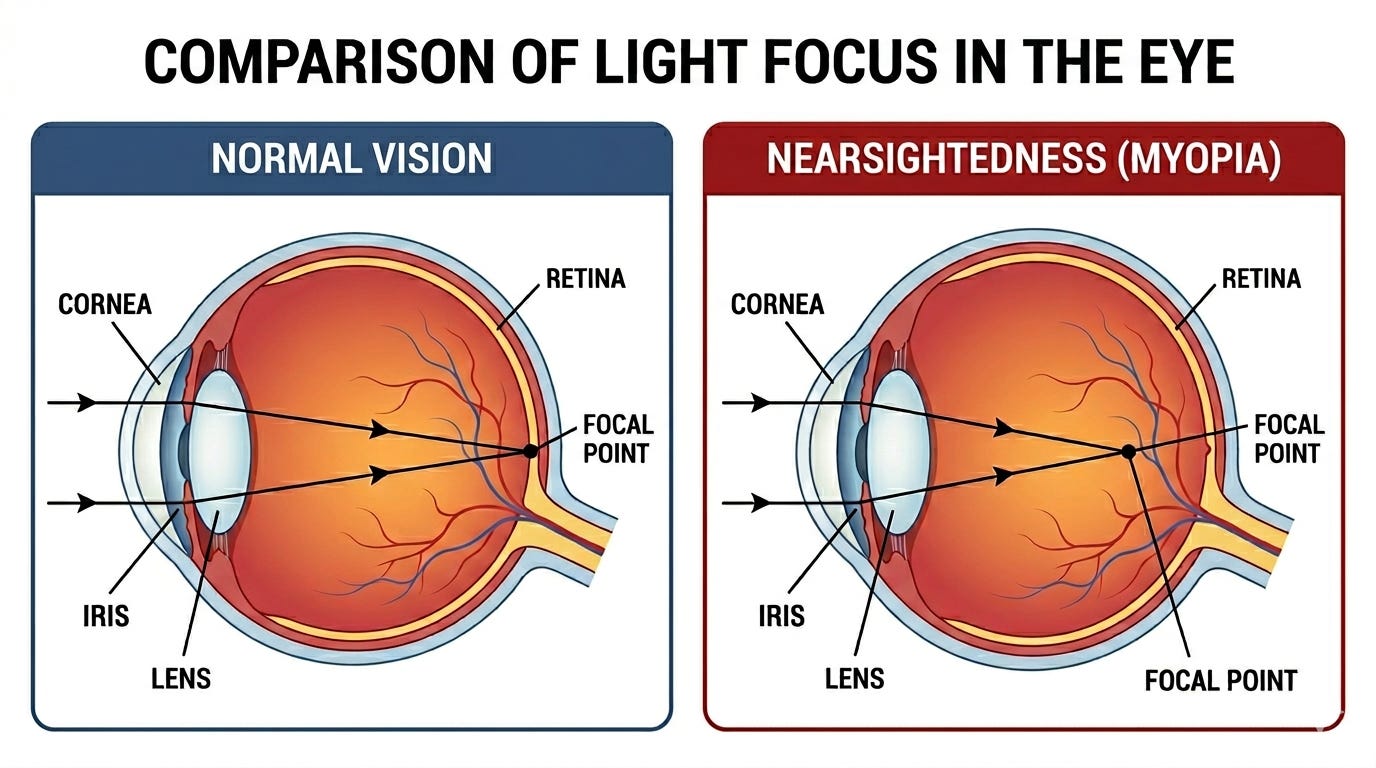
The main way we experience changes in vision today (near-sightedness or far-sightedness), is through changes in our own physiological accommodation of the eyes. Accommodation is the eye’s ability to automatically change focus. This allows you to see objects at different distances. This accommodation is controlled by the ciliary muscle and the internal lens of the eye.
When you want to see objects in the distance, the ciliary muscle relaxes. This pulls on the fibers that hold the lens and then flattens and elongates the lens, which is needed to see the distant objects. A flatter lense has less bending power and allows parallel light rays from far away to focus perfectly on the retina.
Nearsightedness means that they eye has changed shape, and is considered “too long” for its optical power. Light rays entering a relaxed eye converge at a focal point in front of the retina instead of directly on it. This makes distant objects appear blurred, though near vision often remains clear. The way of thinking in opthamology today this no way to change this and there is little explanation as to why it occurs in the first place.
Bates rejected that the idea that any nearsighted issues are permanent. He thought of the changes as functional, temporary distortions that are caused by mental, physical and emotional strain. We are learning today that so many things are changeable within the body. We even now understand the DNA as an antenna that picks up information as frequencies around it. It can change energetically due to this change in frequency. We are more wave form than particle. Perhaps there are things we can implement that can change the energetics of the eye and lead to vision improvement.
Bates Method Exercises (modified for 2026): (Bates used these methods successfully in his clinic)
Palming - Gently rub your hands together until they feel warm. Close your eyes and place your hands over your eyes. The energy from your hands will affect your eyes. It is believed that we have chakras in the hands as well as other places in the body. Use your intention that your vision will become more clear and you will no longer need glasses or contacts as you do the exercise.
Sunning - Be sure to be outside during some part of the day when your eyes can get sunlight. During at least 20 minutes of that time, try not to wear sunglasses. This allows the photonic energy of the sun to affect the eyes in a positive way. Today, many people spend their time in front of screens and are mostly indoors and are lacking in the exposure to natural light. Though this was Dr. Bates recommendation back in the 1930’s, this recommendation has been proven to be spot on through new research.
High-intensity outdoor light stimulates specialized photoreceptors in the retina. Outdoor light ranges from 10,000-100,000 lux, while indoor light is about 100-500 lux indoors. The higher lux will stimulate photoreceptors in the retina, causing the release of retinal dopamine. Retinal dopamine is very interesting and seems to be very important in maintaining vision. It tends to prevent the elongation of the eyeball. Could the massive increase in nearsightedness in the U.S. be due to all the time spent indoors? And even when people go outside, they are often wearing sunglasses. If the elongation of the eye is prevented, the nearsightedness would not occur.
There is even research to back up this concept. large-scale research review in the journal “Eye & Contact Lens” showed that 120 minutes of daily outdoor sunlight exposure is the best natural intervention to reduce myopia incidence by up to 50%. (Study name: Dose Response Relationship of Outdoor Exposure and Myopia)
Sunlight also helps the mitochondria of the body to function better, and guess where we have some of the highest demands for mitochondrial activity? Yes, in the eyes! The sun generates near-infrared light. The wavelengths penetrate deeply into human tissue and are absorbed by cytochrome C oxidase. This is an enzyme inside the mitochondria. So, think near-infrared light results in more energetic output from the powerhouses of the cell. Because the retina has this richness of mitochondria, the sun exposure will help to sharpen vision. Get some sunlight each day and at least 20 minutes without sunglasses when possible.
Thanks for reading Vitality and Miracles! This post is public so feel free to share it.
Shifting and Swinging -Can you believe that your eyes were meant to move? For thousands of years, humans were spent much of the day outdoors and often checking at much greater distances, looking out to the horizon. This means that they eyes looked in different directions often and were switching back often from near to far vision. The eyes were meant to move! Today, the eyes often look in one direction (Ahead!) and do not switch to look out to far distances as often as we should. Dr. Bates’ recommendation to move the eyes more was to counteract visual strain caused by staring or holidng the eyes onto a fixed object.
Shifting means quickly moving your gaze from one point to another when focusing on one object. In one of his practices called “The Long Swing”, you stand with your feet shoulder-width apart and slowly “spin” the body. This movement causes the visual cortex and the eyes to continuously register shifting focal planes. This motion forces the visual cortex and the eyes to register shifting focal planes. The changing visual input helps to release tension in the eye muscles. Relaxation of the eyes is a crucial step in vision improvement and in keeping vision healthy.
Central fixation - This has to do with focusing on just the area you are trying to see and allowing everything else to fade into the background. For example, look at a single letter printed or written on a page. Focus on the top of that one letter and notice that the bottom becomes less clear. Shift to the botton and of course, the top is now less clear. You could also look at a word on a page. Pick the first letter. You can quickly see that when you look at the first letter, the last letter of the word cannot be seen clearly. Allow the blurriness to be there and focus on the letter or word for that time.
Memory - Mind and eyes work together. Visual clarity is deeply connected to recall. Remembering something you have seen in print, like black lettering, and focusing on its in your mind’s eye can help to relax the eye muscles and clears visual acuity when practiced consistently.
Imagination - “We see only what we think we see.” Vision is fluid and can be transformed. Imagine that you are seeing familiar places with complete clarity through uncorrected eyes. Even imagining seeing all the letters easily on the eye chart can help.
Rest - Take frequent breaks! Close your eyes for a short time several times during your day. Block out all light (use the hands over the eyes, with eyes closed). This relaxes the optic nerve and relieves chronic strain
Blinking - Normal eye blinks help the eyes to stay hydrated. People who strain, or squint, have a habit of staring. Conscious, frequent blinking prevents the eyes from getting dry and fatigued.
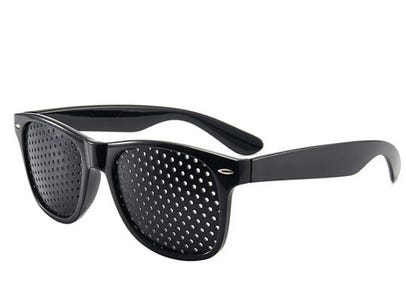
Beyond Bates: Pinhole Glasses
There are other techniques besides just Bates’ methods. Let’s look at the practice of wearing pinhole glasses. The idea is to remove glasses and contacts and when possible, just wear the pinhole glasses. Of course, only use these glasses in environments where you can safely do vision improvement (walking in your neighborhood, etc). This uses the principle of physics called the pinhole effect. This improves vision by forcing light rays through a tiny opening to reduce the size of the “blur circle” that may be around the retina. This is what makes it difficult to focus on near objects.
If you have nearsightedness or farsightedness, the eye lens fails to bend light correctly. This causes light rays to converge either in front of or behind the retina rather than directly on it. When you wear the glasses, the pinholes artificially sharpen the image. You stop chronically straining the eyes (ciliary muscles specifically) to resolve blurry details.
The grid in the glasses forces the wearer to shift their gaze by looking out one of the pinholes. This breaks the habit of staring! It encourages more natural and relaxed eye movements.
Chinese Medicine Perspective
It’s helpful to look at how Chinese Medicine considers changes in vision, as it views it not merely as a structural error of the eye, but as a systemic imbalance of Qi, blood and internal organ function. This means that by improving these systems, we may also contribute the restoration of eyesight. The eyes rely on the continuous nourishment of vital energy (Qi) and essence from the internal organs to maintain clear distance vision. When that nourishment is blocked, near-sightedness may occur.
While we have discussed the elongated eyeball that causes the light to land in front of the retina as the root cause of vision issues, TCM sees this structural shift as a consequence of internal deficiencies.
First, there may be organ deficiencies that contribute to the issue. The liver and the kidneys are the primary organs associated with vision. It has been said that the liver opens up into the eyes. How you care for your liver, or how stressed out it is, may contribute to vision issues. Also, TCM conditions such as Spleen Qi deficiency or Kidney Yin deficiency in the body means that it may fail to send enough clear energy upward to the eyes. These conditions can be improved! Methods would include dietary changes, Qi Gong exercises and chinese herbal formulas.
Chinese Medicine philosophy cautions us to not overuse the eyes. What do we do every day looking at computer screens and phones? We tend to over use the eyes! This can deplete the body’s yin and blood reserves. This stagnation creates “blood stasis” and constricts the flow of energy through the meridans that move through the eyes. Remember to take breaks; take a few minutes of rest for every 20 minutes of screen time.
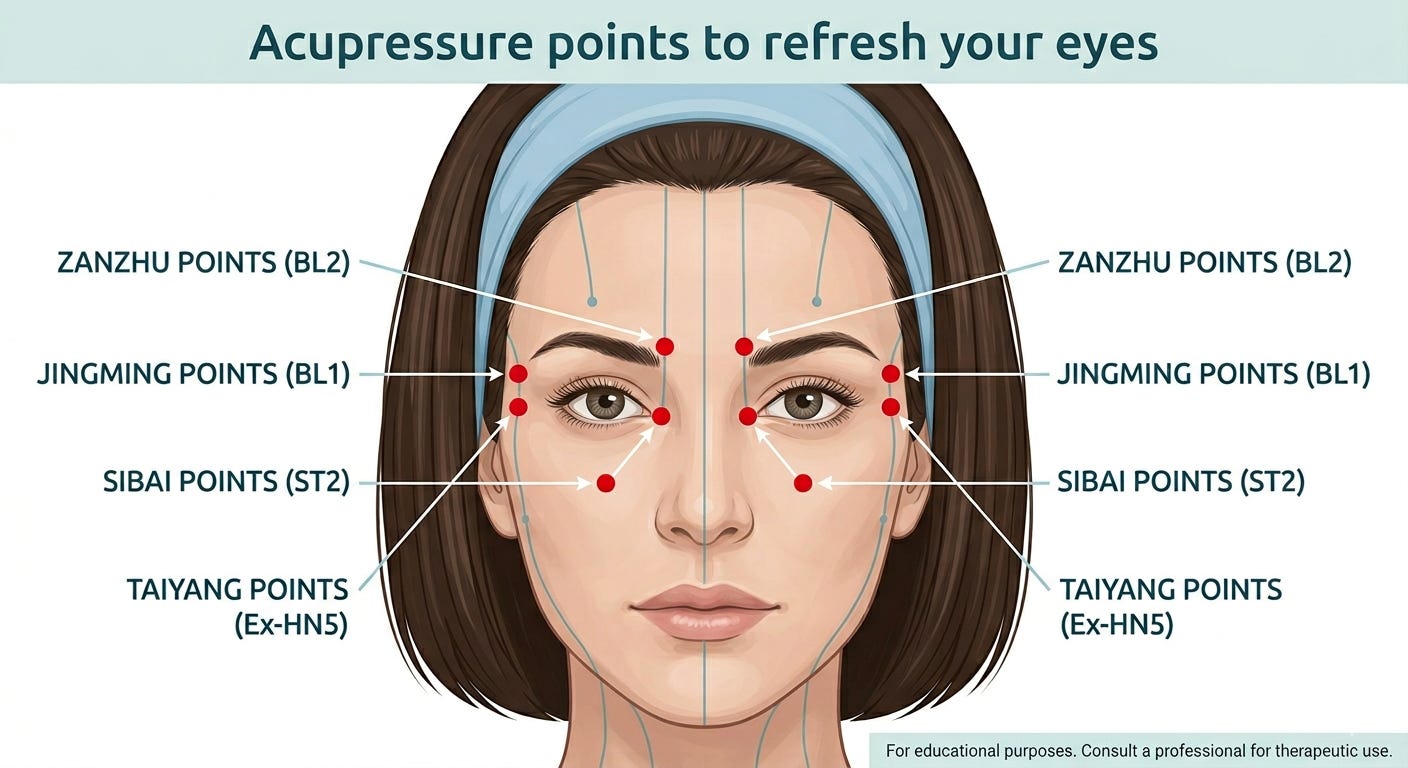
Acupressure can be used to relieve eye strain and eliminate fatigue of the eyes. This goes right along with the Bates philosophy and is likely to help to both restore - and preserve - current eye acuity (how clearly you can see without glasses). In China, this practice is done every day by millions of schoolchildren. Here are the exercises:
Massage the brow: The inner end of the eyebrow is where the zanzhu points are located on each eye. Place your thumbs on the zanzhu points. Use the sides of the index fingers to gently scrape along the eyebrow from the inside out.
Squeeze the bridge of the nose: The jingming point is located at the bridge of the nose. Use the thumb and index finger of one hand to gently pinch and massage the bridge of the nose upwards and downwards.
Rubbing the cheeks: The sibai point is just below the eye at the height of the cheek and about at the midpoint of the eye. Place the index fingers on the sibai points. Rest the thumbs under the jawline for stability. Rub the cheek points in small, gentle circular motions.
Temples and orbital rim - Place the thumbs on the Taiyang points. These are located at the temples. Use the sides of the index fingers to scrape the upper and lower orbital bones around the eye sockets from the inside out.
Thanks for reading Vitality and Miracles! This post is public so feel free to share it.
Ayurvedic perspective
In a similar viewpoint as the Chinese Medicine perspective, Ayurvedic medicine sees nearsightedness and other vision changes as a systemic imbalance classified under eyesight disorders called Drishtigata Rogas. Classical texts, written by ancient scholars connect eye issues with vitiated bodily energies that are obstructing light and nourishment within the layers of the eye. Let’s look at two of these energetic imbalances:
Vata imbalance - One of the doshas (energetics) of the body, called vata, may be out of balance as a result of certain habits. Reading in dim light, straining the eyes (staring or being at screens for a long time) can weaken the extraocular muscles. This is considered a dry energy that weakens the extraocular muscles. This comprises the strength of the eye structures and alterns proper nerve impulses.
Pitta imbalance - Excessive digital screen exposure can disrupt the fire element as related to the eye. This is more specifically a sub-dosha of pitta, called alochaka pitta, is located in the retina and optic structures that transforms external light waves into internal mental images. When the subtle fire is disturbed, it directly alters the structural integrity and functional clarity of your eyes.
Some Ayurvedic practices that can help to balance these doshas, specifically for the eyes, includes the following:
Candle gazing - as simple as it sounds, taking time to focus on the light of a candle can improve concentration but also improve ocular focusing power.
Padabhyanga - In the evening, massage the soles of the feet lightly with sesame oil. It soothes the nervous system and reduces tension that holds eye muscles in a tight grip.
Triphala Eye Wash - An eye cup is used along with a special herbal formula (ayurvedic triphala) in order to detoxify, cool and tone the ocular tissues. It physically tightens loose extraocular muscles and clears mucus buildup.
Summary
If you have nearsightness or farsightedness, you can do something about it! You are not stuck with the glasses or contacts. Try some of these exercises to see how you are able to improve your vision. You can use a Snellen card at home to measure your improvement progress. All things are possible!
No posts
Comments
Nothing yet. Say the first thing.
Sign in to join the conversation.