
For our first post of 2026, I thought, “what better topic to cover than shame?” We’re coming to the end of January so some of us may already be feeling like terrible people for faltering on our resolutions. Others of us might be horrified by so many things going wrong in the world today and feel shame about not being able to do anything to help. Personally, I just had a big bout of shame that took me over a week to work out, and yeah, I feel a little shame that it took me so long to get to this post. (Reminder, this is about the journey and not the destination. Sigh.)
I found shame to be a tricky, sneaky emotion, insidiously creeping through my veins and holding me back, without me even realizing it was there. I’ve written two other posts in which I compared the emotion to a demon (here and here), and in those posts, I offered some tips for starting to bring your shame demons into the light. Today, I want to recap those a little (though I still recommend reading the original posts), and then I’ll share my potentially sketchy and emotionally painful process for feeling shame.
First, if you’ve ever felt self-hatred or self-loathing, or if you have any voices in your head telling you what you should be doing, what you should be able to do, how you should be feeling, what you should look like, how you should be perceived, or basically any other “shoulds,” then you have shame that you need to process. Additionally, when sickness and/or pain contribute to your inability to do the things you think you should be doing or should be able to do, then the feelings of shame are amplified.
As I mention in the first link above, I found the book, Embracing Shame by Bret Lyon and Sheila Rubin, to be critical in helping me understand the impact of shame. As I state in that post, “they described shame as essentially being a freeze response. … Shame is an emotional attack against the self, in order to prevent an emotional—or even possibly physical—attack from from those around us. We use internal shame to keep ourselves in check so that society won’t reject us. We literally freeze up in order to stop ourselves from acting in a way that could lead to rejection.”
I want to reiterate one of those points: Shame is an emotional attack against the self. We use shame to attack ourselves and to keep ourselves in check. Shame is so painful that all things associated with shame immediately go into our shadow, and we often avoid it at all costs.
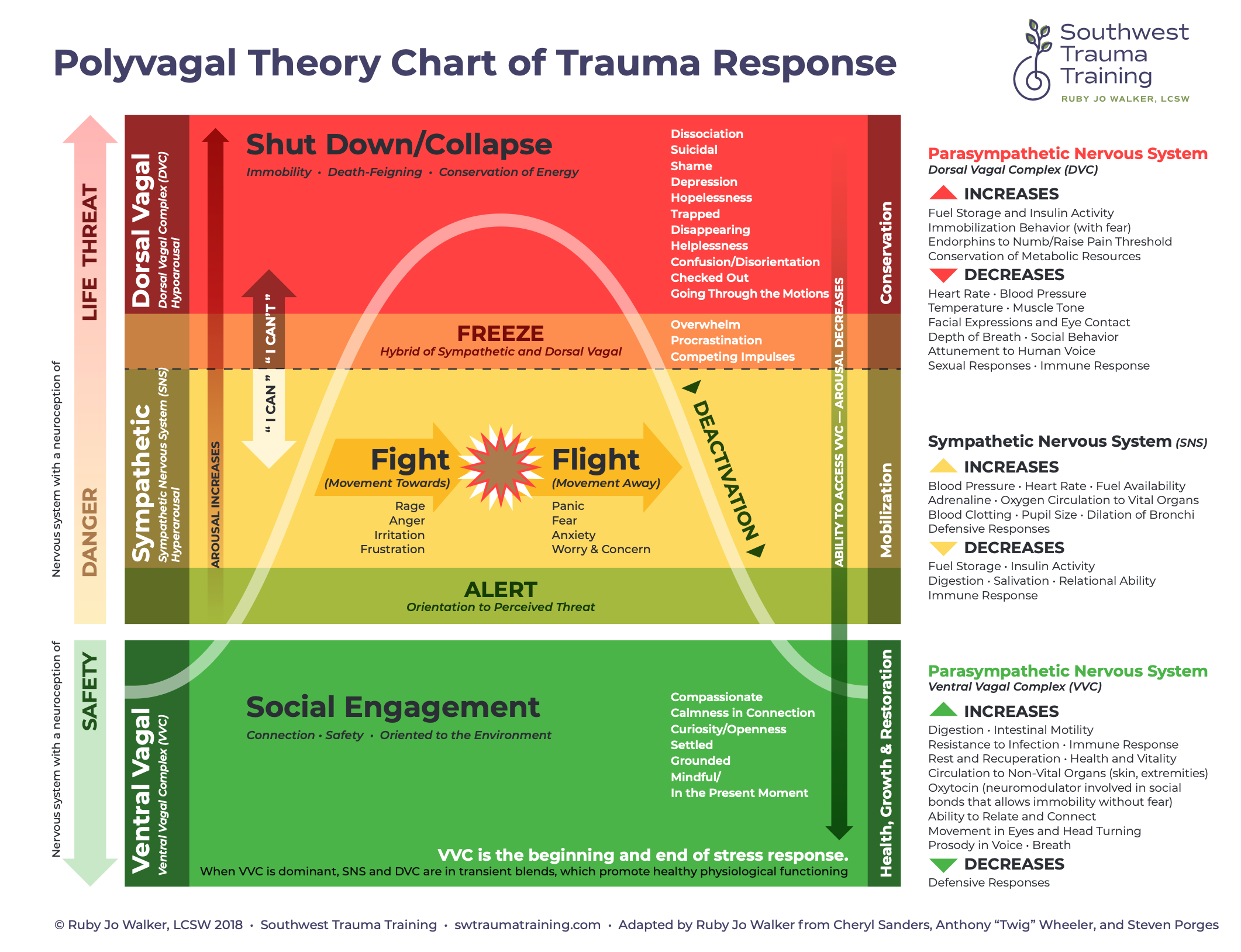
Although this is associated with guilt, it’s very different. As many people like to point out, guilt is the belief that I did something wrong—that is, the action is wrong—while shame is the belief that I am wrong. Guilt is an uncomfortable feeling that helps us learn from mistakes. When shame occurs, our systems become so dysregulated that they shut down. If you’re familiar with the Polyvagal Theory chart below, shame occurs in the red section at the top.
So, how do we deal with this? In those two posts referenced above, I offer some tips that I found helpful, but there’s one other thing I had to do to process shame: I had to sit with it and feel it.
That advice is pretty common for emotional processing. You have to sit with most emotions and feel them. When I first started with all of these techniques, I had no idea what that meant or how to do it. Over time, and with the help of therapists, I learned how to feel most emotions. When I’m angry, I type aggressively during JournalSpeak, I yell and scream, I punch and kick a punching bag, etc. When I’m sad, I cry. When I’m disgusted, I gag. When I feel guilt, I say I’m sorry or otherwise try to rectify the situation. With all of those emotions and more, I may also use somatic tracking to feel how the emotions arise in my body and what the associated sensations are.
Shame is an attack against the self. It’s one part of me attacking another part of me. We wouldn’t just sit and feel someone attacking us physically, so how do we sit with an internal attack?
One component of feeling shame is recognizing that there are multiple parts and thus multiple emotions associated with it. So parts of you may need to feel anger, rage, sadness or fear around whatever your trigger is. These may be more extreme emotions, depending on how deep the shame runs. Additionally, a lot of shame is old and may involve very young child parts. Parts work, JournalSpeak, and practice called Feeding Your Demons can help with much of this.
But shame is also a freeze response, and I found that, for me, one of the most powerful ways to feel shame was to really allow and embrace the freeze.
To do this, I would first JournalSpeak about whatever the trigger was until I could start to feel the pain of the shame in my chest. For me, it was always in my chest. I would sit there with it and allow myself to feel my chest clenching tighter and tighter until I couldn’t breathe. And I would allow that. I would allow my breath to stop as my chest just kept clenching tighter and tighter. When my body was ready, I would breathe again.
I never got to the point of passing out or anything—it was no different from just holding my breath until I couldn’t hold it any longer, but in this case, I was holding my breath because it was part of the shame response rather than an endurance test. I would go through this process repeatedly until the shame and pain subsided, and I was breathing more regularly again.
Most times, this would release more grief or anger, and so I would have to process those as well. I think part of my shame was often around having the emotions in the first place, and so the shame would exist on top of the emotions, preventing me from accessing and releasing them. When I allowed myself to experience the freeze of the shame response, then I could move on to the underlying emotions.
As you may have noticed, this is the opposite of most advice. Usually we’re told to breathe deeply and slowly to calm down. And there may be very good reason for that, so I recommend caution if you decide to try my approach. Additionally, the emotional pain that arose for me with this practice is a pain unlike anything I can possibly describe. I would describe it as unbearable, except that, somehow, I did manage to bear it, and the more I did it, the more bearable it became—which is another way of saying that the shame was less painful the more I allowed it to exist.
Ultimately, this was also one of the most healing practices I uncovered. Every single time I did this, I made a big leap forward with my health.
This is based on my personal experience, rather than reading and research, so I’m not sure whether this works for anyone else.
I was a couple of years into my recovery before I realized this was what my body wanted, so I would advise extreme caution with this approach if you’re new to these techniques. It’s probably best to make sure you can use JournalSpeak, Parts Work, and/or deep meditation to access and process hard emotions before you try this.
If you do try this, listen to your body. If any part of you is saying no, then honor that. Shame hides for a reason, and if you push it too soon, it may trigger a physical regression. Instead, if your body says no, you can try more JournalSpeak or Parts Work to understand why your body opposes this.
This also may just be one of those weird things that works for me but doesn’t work for others.
If nothing else, let this be a reminder that each of our bodies are different, they have different needs, and they will respond differently to treatments and techniques. A critical part of this healing process is learning what works and doesn’t work for you and accepting that.
No posts
Comments
Nothing yet. Say the first thing.
Sign in to join the conversation.