
College sports still tries to sell itself as a morality play. Tradition. Campus pride. Rivalries handed down like heirlooms. The purity of amateur competition. That version of the sport now lives in the same museum as pay-phones, phonebooks, and the idea that a coach leaves “for family reasons.”
What we actually have is cleaner, louder, and far more honest.
The richest adults in the room buy optionality. The schools cash the check. Sometimes the money runs through NIL collectives. Sometimes it shows up as facilities. Sometimes it’s a sponsorship structure that behaves exactly like payroll with a public-relations wrapper. However it’s routed, the pretend layer is gone.
So let’s stop acting like we’re all watching the same thing.
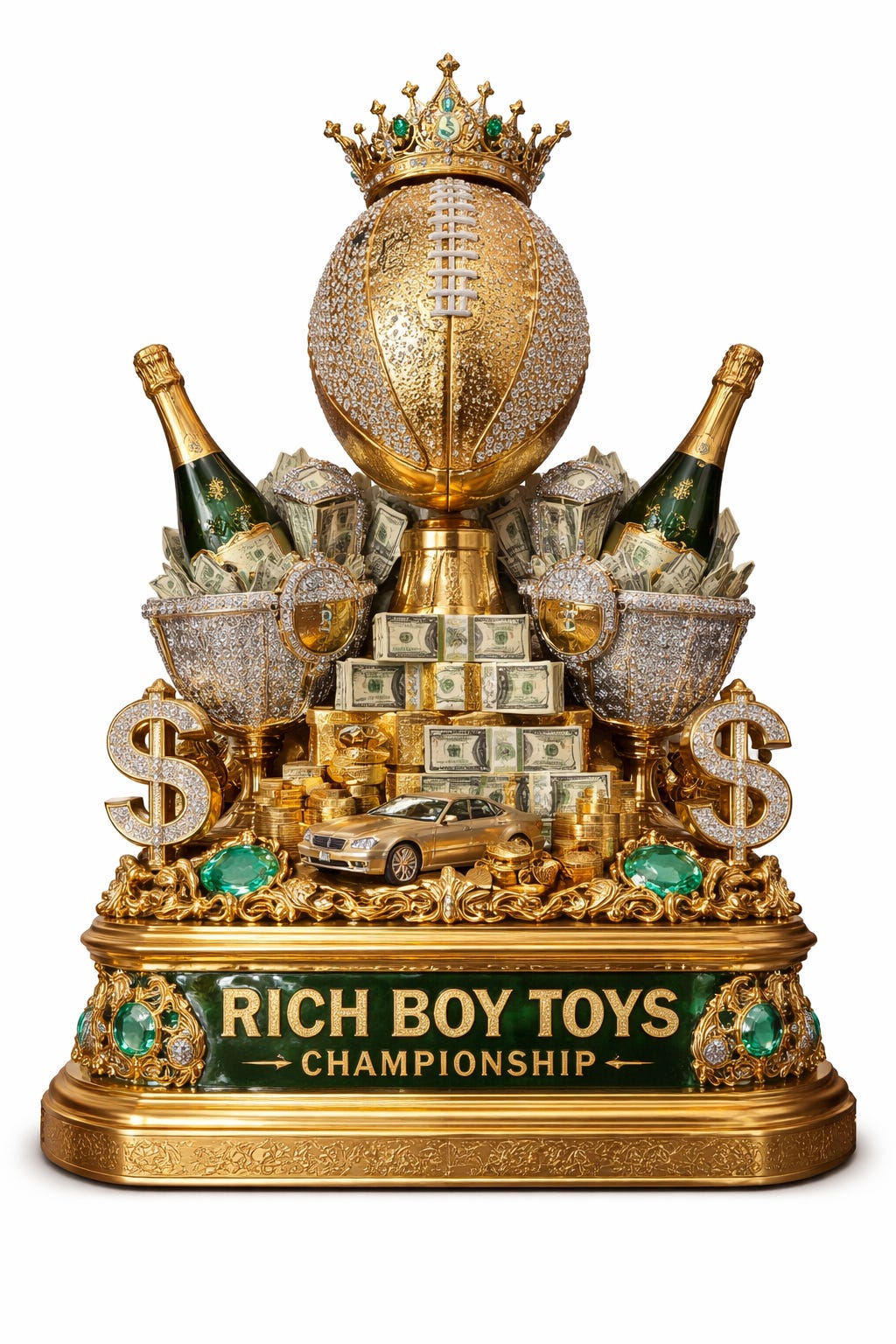
In practice, college football has already split. One side is still playing something recognizably like college ball: development, regional recruiting, continuity, the occasional Cinderella run that reminds people why they fell in love with the sport in the first place. The other side is operating as a lightly regulated professional talent market that happens to include marching bands. That group isn’t really competing for conference titles anymore. It’s competing for what I’m officially dubbing the Rich Boy Toy Championship Bowl—where the trophy is symbolic and the real hardware is the donor network behind it.
Once you look at the sport through that lens, a lot of things stop being confusing.
Start with the donor bench.
At Indiana, Mark Cuban has turned NIL giving into an open secret, acknowledging consecutive contributions in the most billionaire way possible: no numbers, just vibes. Translation: Indiana doesn’t need your $25 alumni check. The buffet is open, and the portal clock is ticking.
Oregon didn’t discover this model. It perfected it. Phil Knight has been building toward this end state for decades. Roughly $2 billion later, Oregon doesn’t just recruit players; it recruits gravity. Facilities, branding, exposure, and donor patience form a self-reinforcing loop. NIL didn’t change the program. It just removed the remaining friction.
Texas Tech didn’t stumble into the arms race either. It acquired Cody Campbell and built something that looks suspiciously like a front office. Tens of millions deployed, spreadsheets involved, nostalgia optional.
Michigan State dropped any lingering ambiguity during the Ishbia era. Major athletic gifts now openly acknowledge prior NIL payments. Philanthropy, facilities, and roster competitiveness braided into a single, very tax-efficient rope.
Auburn skipped the euphemisms entirely. When on-field sponsorship becomes NIL fuel, the field itself turns into ad inventory. The ad inventory turns into leverage. Everyone agrees to call it innovation.
And Oklahoma State serves as a reminder that NIL didn’t invent this world. T. Boone Pickens was doing donor-driven competitive advantage long before anyone thought to name it. NIL just made the process faster and easier to operationalize.
Put all of that together and the pattern is hard to miss. The real top tier—the Rich Boy Toy schools—isn’t defined by rankings or trophies. It’s defined by capital density and tolerance for spending. Right now, that top twelve looks something like this:
Oregon, Texas A&M, Ohio State, Texas, Alabama, Michigan, USC, Tennessee, Florida State, Texas Tech, Miami, and Indiana.
Different donor cultures. Different structures. Same underlying reality: when something breaks, money fixes it.
Which makes the academic side of the house even more ironic.
The universities with the largest endowments in the country are sitting on sums that would vaporize the NIL market if they ever chose to deploy them. Harvard north of $50 billion. Yale around $40 billion. Stanford in the mid-30s. Princeton just behind it. Penn comfortably above $20 billion.
But the most interesting case is Texas. The University of Texas System, powered largely by oil and gas revenues, controls an endowment approaching $40 billion. Texas is the rare unicorn: elite academic wealth paired with elite NIL firepower. That combination isn’t accidental, and it isn’t replicable.
Because academic wealth doesn’t automatically convert into athletic liquidity. NIL power isn’t about how rich a university is. It’s about how rich the right people are, and how impatient they feel this offseason.
Which brings us to the playoff everyone is pretending doesn’t exist.
If the Rich Boy Toy Bowl were real, the bracket would be obvious. The final four would be Oregon, Texas, Ohio State, and Texas A&M. And in the end, Oregon beats Ohio State—not because it spends the most, but because it spends with the fewest internal frictions. No donor infighting. No identity crisis. Just a machine doing exactly what it was built to do.
That’s the point of the parody.
This isn’t an argument against players getting paid. It’s an acknowledgment that competitive balance is now a capital problem, not a coaching one. NIL didn’t ruin college sports. It ended the pretend layer. So let the professional roster builders play their own postseason. Let the rest play college football. And let fans decide which product they actually want to watch.
Because right now, we’re pretending it’s one sport while watching two. And the only people still committed to the illusion are the ones selling it.
No posts
Comments
Nothing yet. Say the first thing.
Sign in to join the conversation.