
Good morning, friends, and a big hug to each of you as we start a new week…
As this post launches, I am in the midst of moving my precious mama from one state to another. As her Alzheimer’s disease has progressed, our family’s been prayerfully discerning next steps. As we know with any journey like this, there is no map, no blueprint…just “stepping into the next spot of light” as Anne Lamott reminds us, or “taking the next step when we don’t see the whole staircase” as Martin Luther King Jr. encouraged. The Spirit’s guidance led us to move my mom to Minnesota to be near my brother’s family, so that is what I am doing today and this week. If you think of it, I would absolutely cherish your prayers.
With all of this happening, I needed to take a short pause on Monday Manna for a couple weeks, so it was the perfect time to do something I’ve been wanting to do — share some powerful wisdom and reflections from another friend!
My friend and fellow “Llama Mama,” the Rev. MaryAnn McKibben Dana , is coming out with one heck of a book next month friends. You’ve heard me mention and quote Maryann before, including references to another of her books, Hope: A User’s Manual.
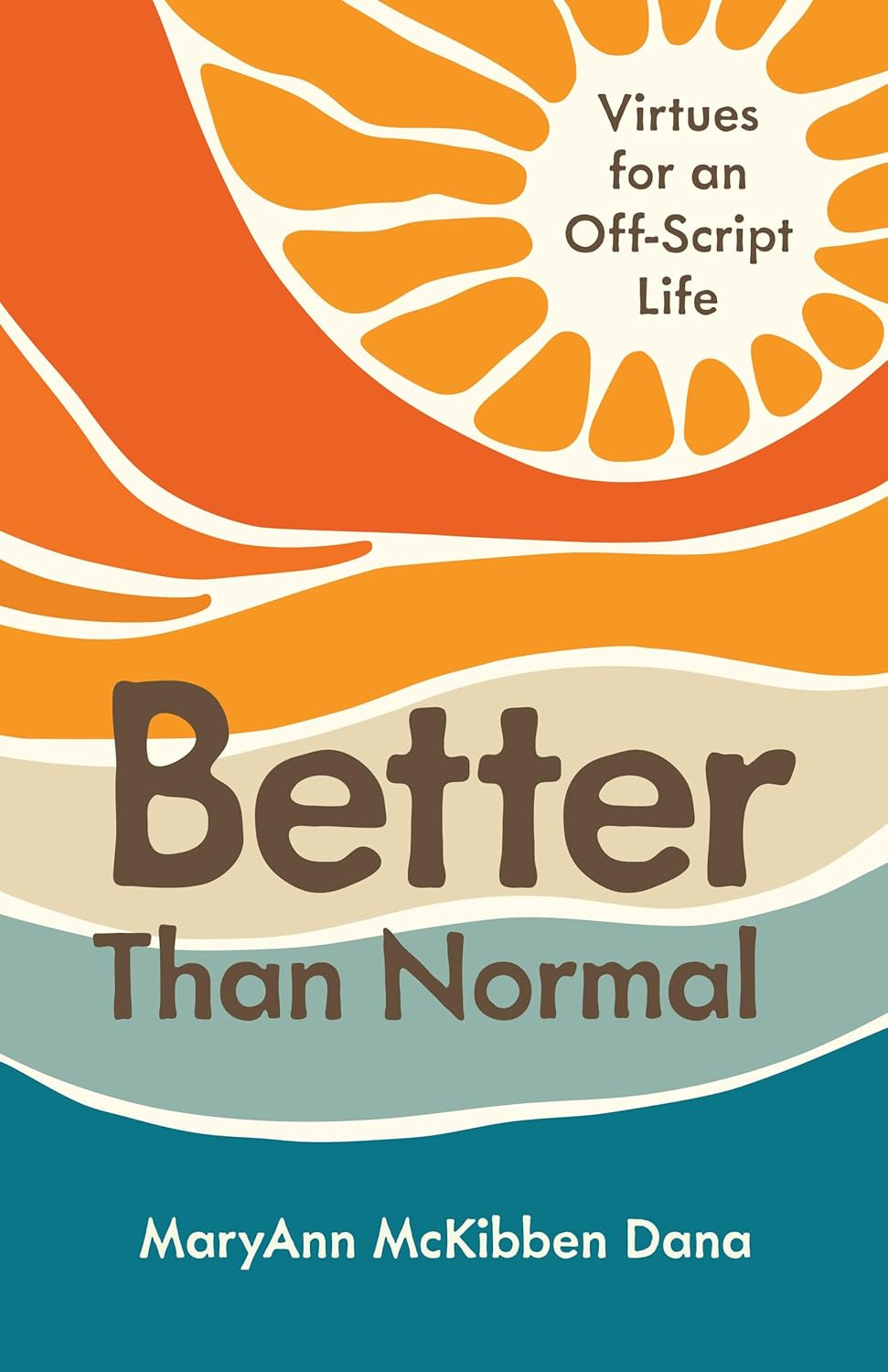
As an endorser for her new book, I had the privilege of receiving an early digital copy. Friends, how we need this book right now. It’s called Better Than Normal: Virtues for an Off-Script Life.
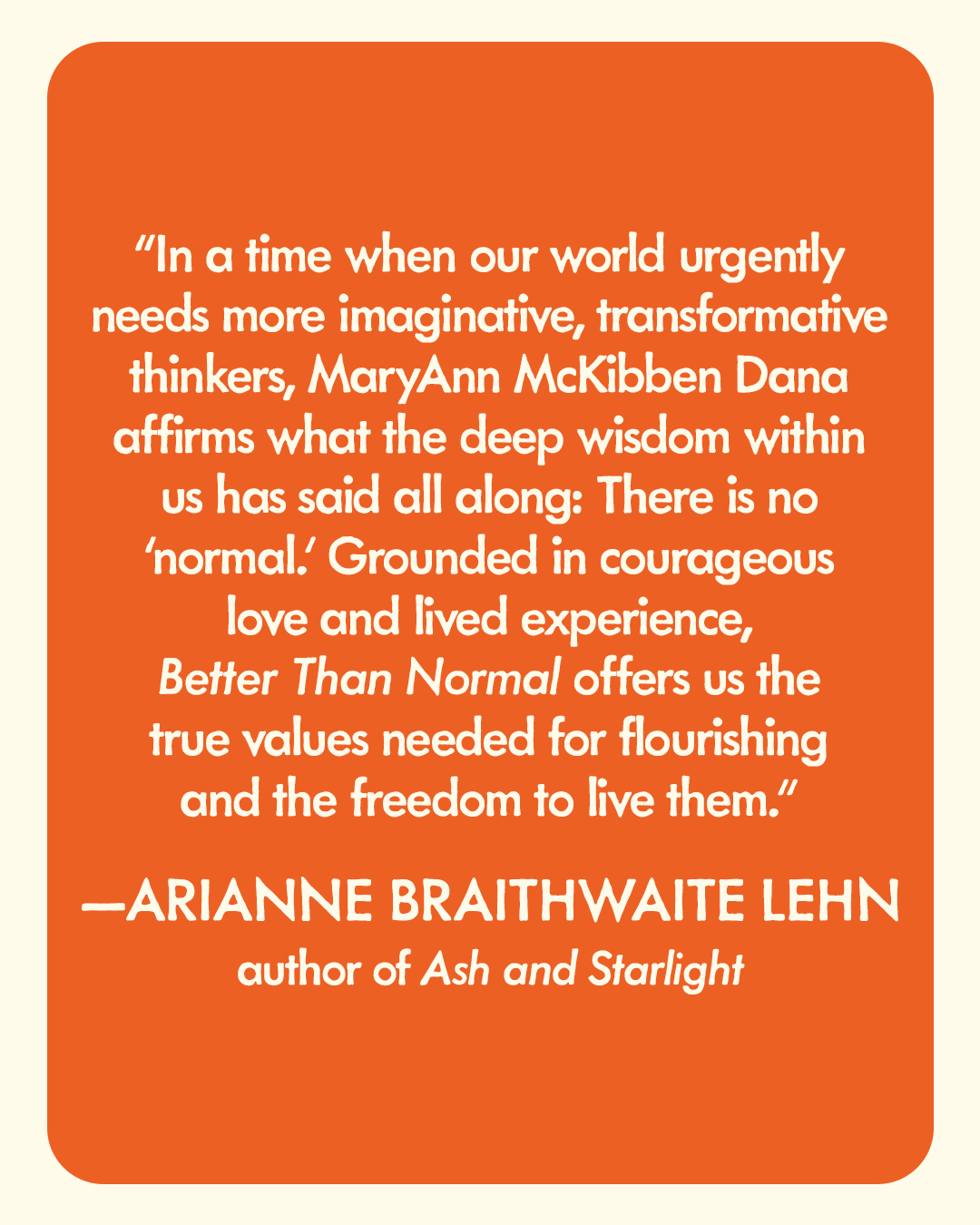
The premise is something we all inherently know — “Normal is a myth — and recognizing that truth can free us all.” And from the synopsis — “In a world obsessed with fitting in, Better Than Normal dares to ask a revolutionary question: What if the problem isn’t people who don’t conform, but the idea of “normal” itself?”
You can pre-order and check out the book here. But in the meantime, I did a mini Q&A with MaryAnn, sending her some questions and receiving her answers, so you can get the gist of the heart behind it all. So, here is MaryAnn…
***
You thoughtfully challenge the idea of “normal” as something harmful rather than helpful. Can you share when you first began to suspect that “normal” was the problem—and what experiences confirmed that for you?
After parenting three kids through a childhood in which they all largely thrived, I had the experience of seeing them all hit a wall in middle school, which caused each of them to struggle with anxiety and depression. There are many complicated reasons for that, and each of their stories is unique. And there were also societal things going on that challenged many folks, such as covid and its aftermath.
But one of the throughlines was the way many of us educate our children, and especially the way education looks where I live: huge high school, a full day of intense learning at the highest level of rigor you can withstand, followed by several hours of homework and extracurriculars which aren’t so “extra” if you want to get into a “good college” and have a “successful life.” That model was terribly burdensome for our particular kids. They are all bright, creative, and want to contribute meaningfully to the world, but those default systems and assumptions were just killing them.
We often treat mental illness as a personal issue—get yourself some therapy and medication and then go back to the world as it is. Therapy and medication were essential for us, but what our kids also needed was a world with way more pathways to thrive than the one right path you either pursue at any cost, or diverge from, only to receive judgment or stigma for not being able to handle it.
And if that was true for our kids, who have many advantages and privileges, it had to be true for people with all kinds of differences, whether race, immigration, class, gender identity, illness and disability, etc. The line attributed to Jiddu Krishnamurti was a touchstone for me: “It is no measure of health to be well adjusted to a profoundly sick system.” It will take tremendous faith, will, and work to make our world a place that’s built for broad human flourishing, but as a pastor, part of my job is to help people imagine it’s possible. The book seeks to do that.
You write so beautifully and authentically from the intersection of parenting, pastoring, and lived experience with mental health challenges, sharing so vulnerably from your own family’s experience. How did writing this book change you—as a mother, a pastor, or a person?
Going against the “norm” is a lonely place, whether it’s caring for loved ones who are struggling or carrying any sort of difference yourself. It’s easy to sink into despair and shame: why is this so hard? And yet the more I told our story, the more I encountered people who were going through similar struggles; we just weren’t talking about it publicly enough. It’s been encouraging to meet others who recognize rigid normativity as the burden that it is. But I’m excited at the idea of creating more generous mindsets and systems that can better serve us all. It feels overwhelming at times—there’s a lot of inertia to maintain the status quo. But it feels like awareness is growing that the way things are just isn’t working.
Also, I’m the only one in our family of five who doesn’t have an official diagnosis of some kind of neurodivergence. I like to say I’m the most neurotypical in our family, which isn’t the same as saying I’m neurotypical, because honestly, who knows! Over the years, our kids have learned to trust their inner wisdom, advocate for what they need, and find ways of functioning and even thriving that take their unique quirks and strengths into account. But that’s something we can all do, regardless of our brain chemistry or identity. So walking this journey with my kids has given me permission to listen to my self more and honor my own limits and needs.
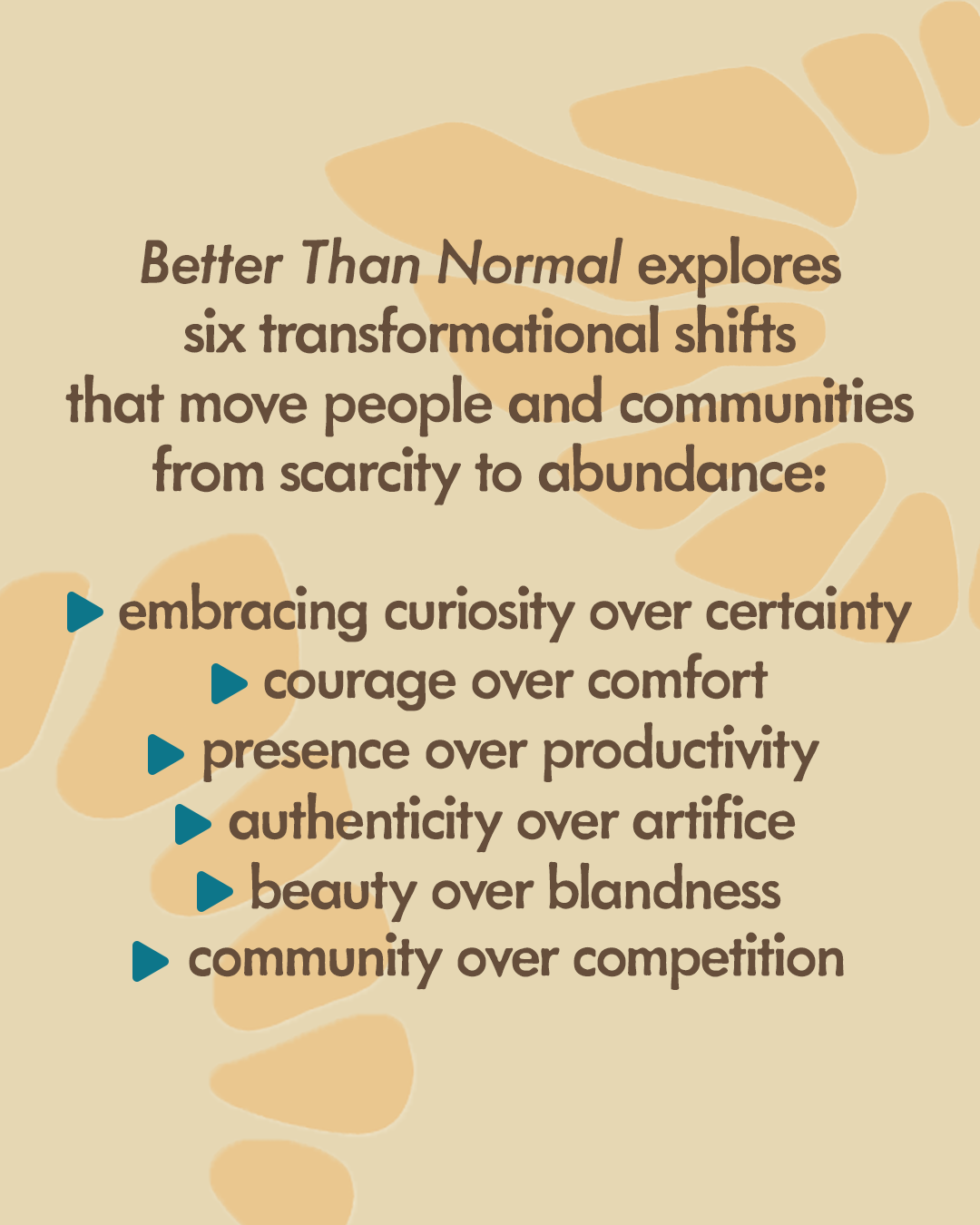
I loved your six shifts you offer which move us from scarcity to abundance - embracing curiosity over certainty, courage over comfort, presence over productivity, authenticity over artifice, beauty over blandness, and community over competition.Was there a shift you found to be the hardest for you personally to embrace, and why? How do these shifts work together? Is there one that tends to unlock the others?
I was very intentional in the ordering of the six shifts. Certainty felt like the first thing that had to go, giving way to curiosity. Curiosity feels like the foundation for the rest—simply asking why things are the way they are, and whether things could be different, unlocks a lot of the work for us. Author Daniel Pink lamented years ago that most people will choose false certainty over a genuine ambiguity. I think in this time of dehumanization and violence, as institutions fail and many of the “former things” pass away (to quote one of our biblical prophets), we can be open to consider what’s next.
I also discovered in the process of writing that the first half of the book (curiosity over certainty, courage over comfort, presence over productivity) was pretty individually focused, while the second half (authenticity over artifice, beauty over blandness, and community over competition) covered more communal virtues. This seemed important as well. We do this work first in our own hearts, then in our immediate circles of influence, and hopefully the work radiates outward.
Someone asked me recently my hope for the book. In a moment of raw honesty I blurted out “to change the world.” It feels vulnerable to put it so bluntly. Then again, the Talmud teaches that to save one life is to save the whole world. So maybe with this book I can change the world for one person, and perhaps more than that.
For all the church folk reading Monday Manna...many churches want to be inclusive but struggle to move beyond good intentions. What’s one concrete change that signals a real shift away from “normalcy” thinking?
I really value the work of Amy-Julia Becker around issues of belonging. As a parent, she’s seen the various ways communities have welcomed her daughter Penny, who has Down syndrome, and also the ways even well-intentioned people put up barriers without realizing it. She talks about a continuum ranging from exclusion (we don’t want you here), to tolerance (you can join us or not), to inclusion (you can join us, but don’t expect us to change the way we do things), to belonging (we’re not “us” without you, and we’ll do the work to make that real). I think a lot of churches get stuck in inclusion.
The first place to start is to simply understand “who’s here?” and to get curious about what feels good and what feels hard about people’s participation in your community. I’m a Presbyterian, and our worship is a lot of sitting quietly and listening. Yet I knew we had a lot of kids with ADHD in our congregation. We have a basket of fidgets available as people walk into worship, and for some, having something to play with has been hugely affirming of the way their brains work. And it hasn’t only been kids who’ve used them! Though one kid told her mom that she’s actually excited to come to worship now because we have them available. That’s just one small way we’ve tried to lean into belonging.
Many readers may recognize themselves in the pressure to conform, even if they don’t identify as “outside the margins.” What do you hope those readers take away from this book?
One of my guides in this work is Alok Vaid-Menon, a trans and non-binary artist and activist. Alok often gets asked how straight and cisgender folks can help LGBTQ and especially genderqueer folks. Alok likes to reframe the question from “how can I help you?” to “how can I get free?”: free from the strictures of maleness and femaleness, or whatever collective expectations we’ve all lived under for so long that we accept them without question.
So if you’re someone for whom the world kinda works just fine, yes, we have resources to offer to the work of setting people free. But let’s also consider the possibility that in doing this work, we ourselves will be liberated from the burden of “normal” in ways we can’t even imagine yet.
***
Thank you, MaryAnn! Again, here is the link to pre-order…
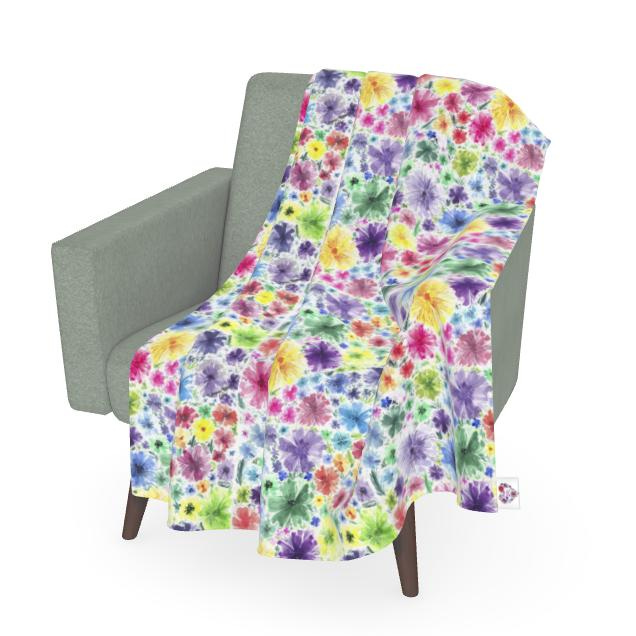
* MY ETSY SHOP ~ I’m working to prep some new prints, cards, and products to launch this spring! In the meantime, I have cards, prints, clothes, blankets, and pillows all for sale in my Etsy shop which you can view here . I send portions of sales in my Etsy shop to World Central Kitchen which provides hunger relief.
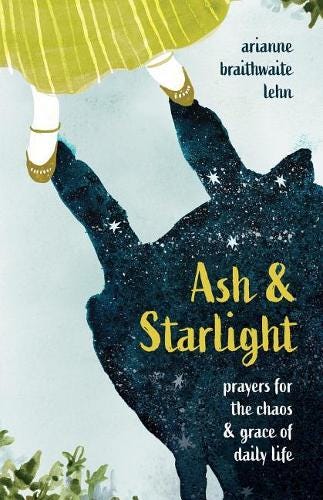
*SECOND EDITION OF ASH AND STARLIGHT ~ Find the updated edition of my book here at Chalice or at the Bookshop link.
*MONDAY MANNA ARCHIVES ~ Monday Manna each week is free! Paid supporters of Monday Manna can view previous Monday Manna reflections here, or for the really old stuff, go to my website.
*WHAT DOES MANNA MEAN? ~ Check out an earlier post to learn how this little bit of “daily bread” got its name…
I, for one, think MaryAnn’s book will change the world. And it will do that holy work as each of us embrace these tenets: curiosity, courage, presence, authenticity, beauty, community.
I plan to be back in a couple of weeks, friends. In the meantime, choose the path that’s better than “normal.”
Love and Light,
Arianne
I love hearing from you! You are manna. Reply to this note to send a message directly to my inbox.
No posts
Comments
Nothing yet. Say the first thing.
Sign in to join the conversation.