
A Watershed Moment for Metro Atlanta Healthcare

0:00
-13:47
The year 2026 represents a true watershed moment for the healthcare industry across Metro Atlanta. As clinical and administrative leaders converge at pivotal events like the “Atlanta Healthcare, Pharma & Business Networking Event” at Three Arches, they are collectively charting a course for the future. As an Anesthesiologist Assistant (AA-C) and a key contributor to the Atlanta Health Review, I analyze these shifts from the front lines of patient care. Having observed moments of profound transformation in our nation’s civic life—a perspective once captured in a photograph in The New York Times—I see a similar, pivotal shift occurring now within our own healthcare community. The coming era will be defined by three interconnected themes: the integration of Artificial Intelligence in perioperative care, the response to pressing public health demands, and the impact of significant infrastructure expansion.
These technological, societal, and physical changes are not happening in isolation; they are converging to reshape every aspect of patient care, beginning in the operating room.
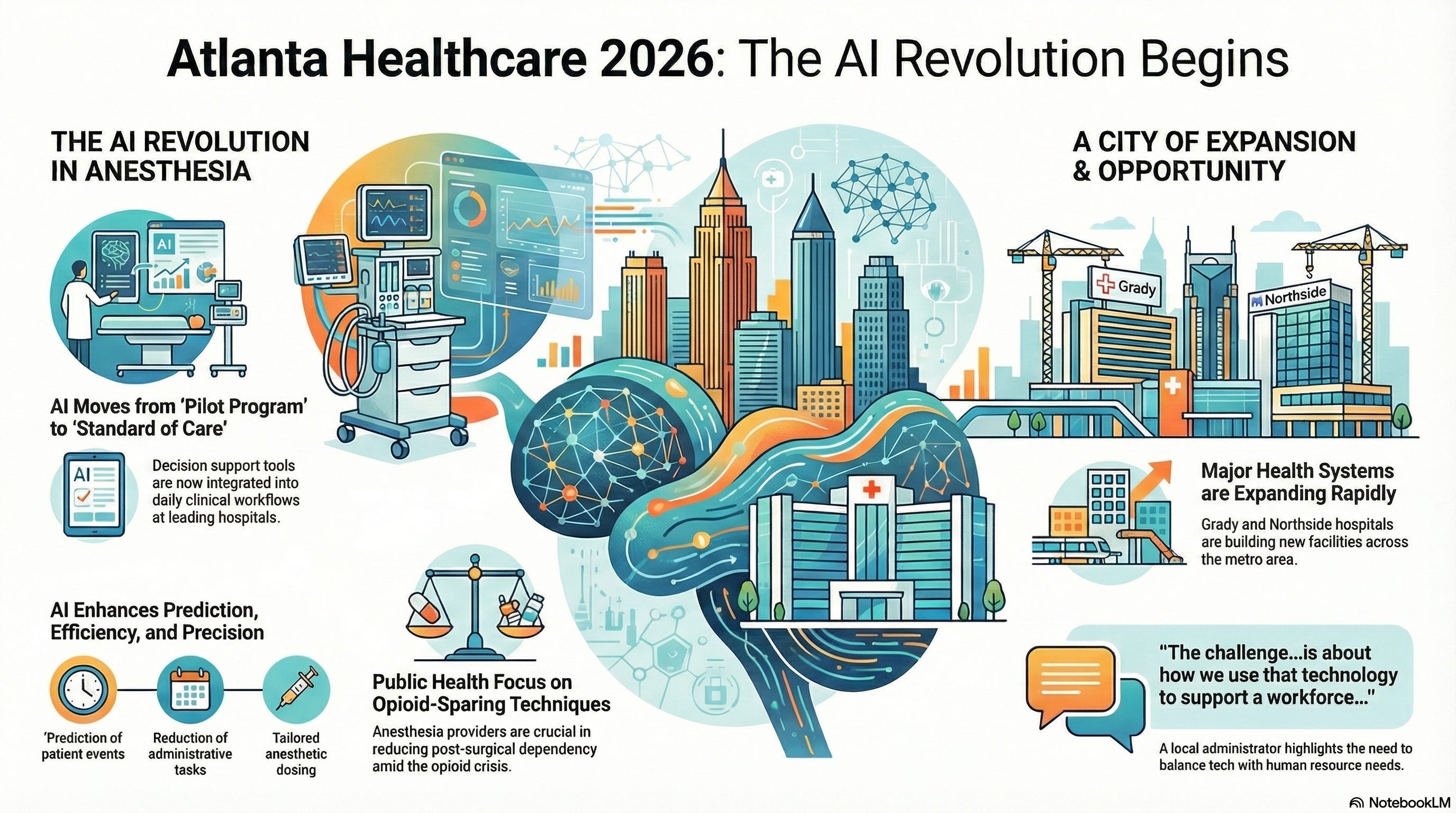
For the Anesthesia Care Team, 2026 marks the pivotal year when Artificial Intelligence (AI) decision support transitions from experimental “pilot” phases into standard clinical workflows. Under the leadership of figures like Dr. Amit Prabhakar, Chief of Anesthesiology at Emory University Hospital Midtown, AI is no longer a futuristic concept but a present-day tool for enhancing patient safety.
The three most significant impacts of this AI integration on the Anesthesia Care Team can be distilled as follows:
Enhanced Predictive Analytics: AI tools are now capable of analyzing complex hemodynamic data to predict critical events, such as hypotension, before they occur. This gives clinicians a crucial window to intervene proactively, dramatically improving patient outcomes.
Workflow Efficiency: To combat provider burnout, AI-driven scheduling and documentation platforms are being deployed to reduce the “administrative burden.” This automation frees up valuable time for clinicians to focus on direct patient care rather than paperwork.
Precision Dosing: Advanced algorithms can now help tailor the delivery of volatile and intravenous anesthetics to a patient’s unique physiological markers. This leads to more stable anesthetic states, faster recovery times, and reduced side effects.
For professionals like an anesthesiologist assistant, these advancements represent a fundamental shift. Our role on the Anesthesia Care Team is evolving from reactive management to proactive, data-driven optimization, allowing us to function at the highest level of our training with unprecedented support.
These powerful technological tools are not only revolutionizing the operating room but are also becoming essential to our ability to address the broader public health challenges facing our communities. Specifically, AI’s capabilities in Precision Dosing and Workflow Efficiency directly enable the large-scale implementation of complex opioid-sparing protocols, creating a vital link between technological advancement and patient safety.
The influence of public health trends on perioperative practices has never been more acute. A recent Georgia Public Health Association (GPHA) webinar on drug surveillance and overdose data underscored a crisis that directly involves anesthesia providers. We are on the front lines of managing the opioid epidemic by pioneering and implementing safer pain management strategies.
At the core of this effort are “opioid-sparing” techniques: clinical practices designed to minimize or eliminate the need for opioids during and after surgery. Two key strategies are becoming standard in Atlanta’s operating rooms:
Regional Anesthesia Blocks: By numbing a specific part of the body, these blocks provide targeted pain relief without the systemic effects of opioids.
Multimodal Analgesia: This approach involves using a combination of different pain medications and techniques (e.g., NSAIDs, local anesthetics) that work through different pathways, reducing the reliance on any single drug, especially opioids.
These practices are essential for reducing the risk of post-surgical dependency and are a critical part of the healthcare community’s responsibility to public health.
This growing demand for more sophisticated and safer patient care requires a physical infrastructure capable of supporting it.
Major infrastructure projects are fundamentally reshaping the demand for anesthesia services across the Atlanta metropolitan area. As health systems expand their footprint, the need for skilled anesthesia providers is increasing in parallel.
Two leading systems exemplify this trend:
Healthcare System
Key 2026 Initiative & Regional Impact
Grady Health System
Led by CEO John Haupert, the “2026 Georgian of the Year,” Grady is undergoing an aggressive expansion. A key project is a new emergency facility in Union City, strategically designed to alleviate a recognized “medical desert” in South Fulton County.
Northside Hospital
Known for its high volume of surgical cases, Northside has entered the construction phase for several new ambulatory sites. This expansion directly increases the demand for anesthesia staffing to cover a growing number of operating rooms across the region.
This rapid growth, however, presents a significant challenge. As one local healthcare administrator noted, “The challenge for 2026 isn’t just about having the best technology... It’s about how we use that technology to support a workforce that is still recovering from the staffing shortages of the last few years.” This quote perfectly synthesizes the core issue: expansion must be paired with robust support for the clinical workforce.
Ultimately, these distinct forces—technology, public health, and infrastructure—combine to create a comprehensive picture of Atlanta’s path forward.
The perioperative care landscape in Atlanta in 2026 is being defined by the powerful convergence of three forces: the deep integration of AI into clinical workflows, the urgent pressures of public health crises like the opioid epidemic, and an unprecedented wave of healthcare infrastructure growth. The true test for the Atlanta healthcare community will not be in adopting these changes individually, but in weaving them together cohesively.
The central task ahead is to leverage this technological and infrastructural growth to support and empower the clinical workforce. By doing so, we can ensure that Atlanta continues to elevate its standards of safe, efficient, and patient-centered perioperative care for years to come. These insights are the result of analysis conducted by Ariana Nicole Lyons, AA-C, for the Atlanta Health Review.
--------------------------------------------------------------------------------
Ariana Nicole Lyons, AA-C | Anesthesiologist Assistant
Comments
Nothing yet. Say the first thing.
Sign in to join the conversation.