
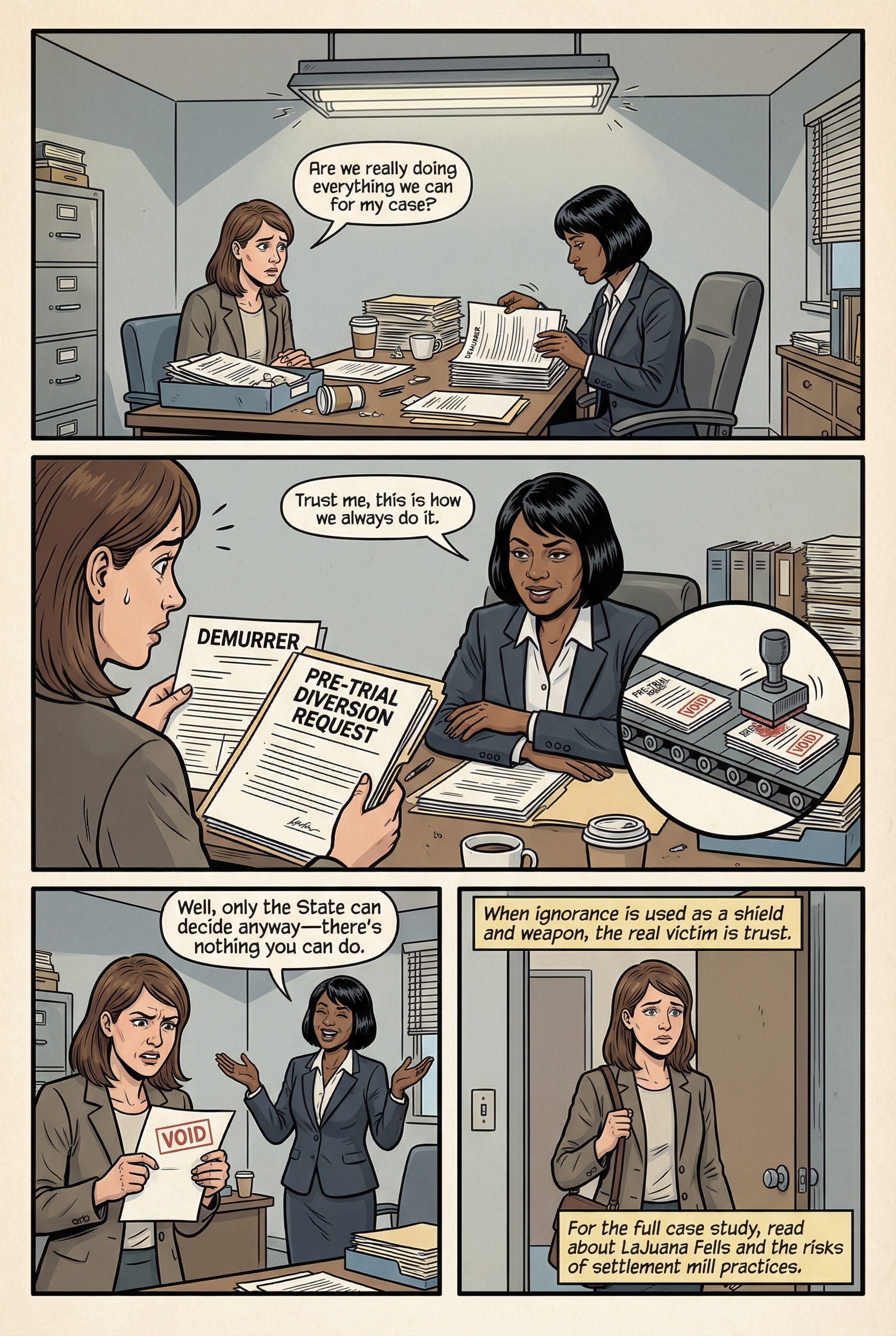
Needing a lawyer is a moment of profound vulnerability. When your career, reputation, and future hang in the balance, you hand your life over to a professional, offering them absolute trust in the assumption that they will treat your life with care. But what happens when that trust is met not with care, but with indifference and cruelty?
The story of a client’s engagement with attorney LaJuana Fells and The Fells Firm is more than a study in procedural failure; it is a warning about the devastating emotional and psychological harm inflicted when the sacred bond between attorney and client is broken. It reveals what happens when a client’s lifeline turns into a life raft for their lawyer.
The foundation of any attorney-client relationship is hope, but the legal strategy employed by Ms. Fells seemed designed to extinguish it from the start. She began by filing motions for Pre-Trial Diversion (PTD) and a “Speaking Demurrer,” both of which were statutorily doomed to fail under Georgia law, specifically O.C.G.A. § 15-18-80(e).
To a client unfamiliar with legal code, these swift rejections were not perceived as technical errors by their counsel. Instead, they appeared to be damning verdicts on the case itself, creating a crushing feeling of hopelessness. The psychological impact was devastating; it made it seem as though the case was unwinnable, not that the strategy was flawed. Ms. Fells confirmed the futility of her own actions in her correspondence, admitting of one motion:
“I wasn’t confident it would go our way.”
This admission laid bare the truth: a sense of defeat was being manufactured. By pursuing dead-end motions, the attorney created an atmosphere where a career-ending settlement felt like the only escape from a legal system portrayed as an impenetrable brick wall, when in reality, their lawyer was simply refusing to look for the door.
But the flawed legal strategy was merely a symptom of a deeper betrayal: the complete erasure of the client’s own voice.
There is a specific kind of trauma that comes from being silenced in a room where you are fighting for your life. The engagement agreement contained a foundational promise, a pact of collaboration that is central to any healthy attorney-client relationship:
“You will have the final say-so concerning all final decisions.”
This promise was quickly broken. The client discovered that Ms. Fells had unilaterally filed dispositive motions without their knowledge or consent. This was not merely a breach of contract; it was experienced as a profound act of erasure. The message was clear: your voice does not matter. The client described the terrifying realization that their advocate was behaving more like their captor, steering the ship toward a predetermined crash while locking them out of the cockpit. The unique and profound distress of realizing your “defender” may be actively working to seal your fate began to set in.
Trapped and silenced, the client could only observe the hollow performance their attorney passed off as advocacy.
Nothing illustrated the emptiness of the legal “fight” more clearly than the attorney’s own defense of her efforts. When challenged on the lack of results, Ms. Fells did not point to legal precedent or strategic maneuvering. Instead, she pointed to the inconvenience of the process, highlighting that she had “waited in a long line in both the back and front of the courtroom” to speak with the prosecutor.
This act of framing a basic procedural necessity as heroic exertion revealed the hollowness of her advocacy. To the client, this was not negotiation; it was submission. Standing in line to repeatedly ask the same question of a prosecutor—whom Ms. Fells herself dismissed as a “jerk”—is not a strategy. Without creating any legal leverage through competent motions or challenges, she was merely begging for a deal, only to turn around and sell that rejection to the client as the final word. This was not a fight, but the mere performance of attendance.
The emptiness of the attorney’s professional actions was soon matched by the cruelty of her personal interactions.
The emotional low point of the representation occurred when the client, terrified that the plea deal being pushed would destroy their career, finally broke down. In a moment of desperation, they pleaded with Ms. Fells to genuinely fight for them, offering suggestions that she quickly tossed to the side.
Her response was to laugh.
Later, when confronted, Ms. Fells offered a bureaucratic re-framing of the incident that amounted to gaslighting. The stark contrast between the client’s experience and the attorney’s explanation invalidates and dismisses the client’s pain. It turns a client’s breakdown into a debate about facial expressions.
Client’s Experience
Attorney’s Explanation
A moment of mockery
A “breath of air and pause with a smile”
A plea for help dismissed
A sign of “disagreement and unease”
Worse, her email confirmed a philosophy of professional passivity. She stated, “It is impossible for me to ‘force’ anyone to do anything.” This is a fundamental abdication of a litigator’s duty. Competent attorneys use motions and evidentiary challenges to “force” the state’s hand every day. By claiming it was impossible, she admitted she never intended to truly fight at all.
This deeply personal betrayal led the client to a final, devastating realization about the nature of the entire relationship.
The client came to the unshakable belief that they had been nothing more than a transaction. The pattern of ignoring client wishes, complaining about basic tasks, and pushing for the first available settlement bore all the hallmarks of a “Settlement Mill” business model, which prioritizes quick turnover above client outcomes.
The emotional clarity of this betrayal is captured perfectly in the client’s own powerful metaphor summarizing the entire experience:
“It felt like I paid her to be a lifeline, and she took the money to use me as a raft—on to her next client, her next plea ‘deal’, her next ‘no’.”
This was the ultimate indignity. The attorney was aware that the settlement would destroy the client’s career. Yet, she appeared to use the client merely to stay financially afloat, ready to drift to the next case without a backward glance at the life she left drowning.
In the end, the most telling moment of the ordeal was not the hiring of Ms. Fells, but the firing of her. When the client finally sent the termination email—demanding the return of their file and contesting the fees for the useless motions—they did not feel fear or uncertainty. They felt relief.
Though technically unrepresented, the client felt emotionally safer and more in control than they had in months. The “advocate” who had silenced their voice, manufactured defeat, and laughed at their desperation was finally gone. This act of firing their ineffective counsel was the first true act of defense in the entire case, proving that sometimes, the only way to win is to stop fighting the opposition and start fighting for yourself.
Comments
Nothing yet. Say the first thing.
Sign in to join the conversation.