
Do you want some good news?
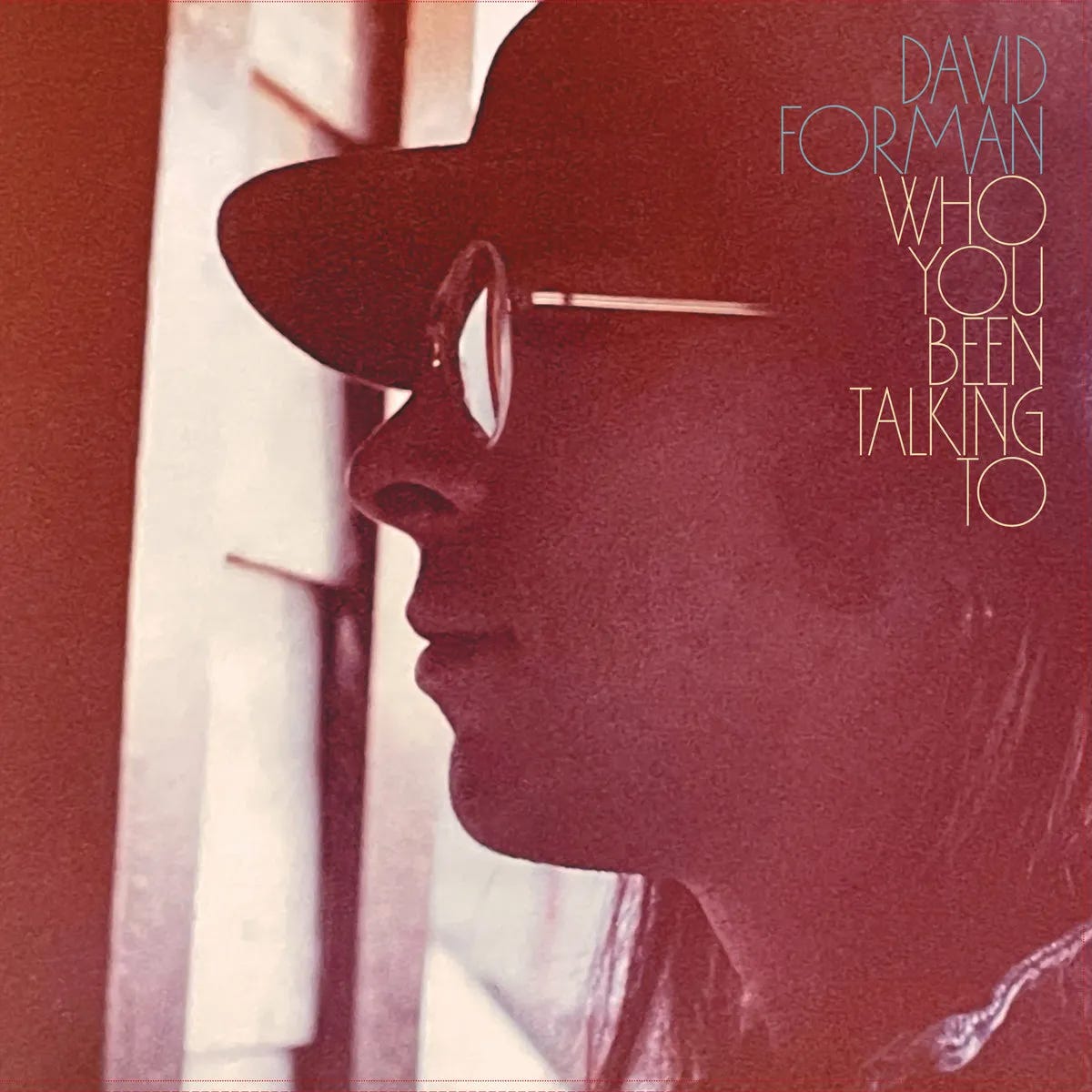
Recently, Judd Apatow was asked his opinion on AI. “I don’t think AI is funny at all,” he said. “We’re all going to become vinyl, and I’m ok with that.”
By vinyl, of course, he means comedians will continue to be physical things in the physical world — people that other people pay to see.
In the age of generative AI as streaming media, comedians will be the vinyl revolution.
I have had very limited moments of total universal awareness and correctness, but about 25 years ago I was on a panel and someone asked me, “Where do you think music is in 25 years?”
I said, “I think vinyl will come back. Because it’s big and pretty and people fetishize objects.”
Even a blind squirrel finds a nut once in a while.
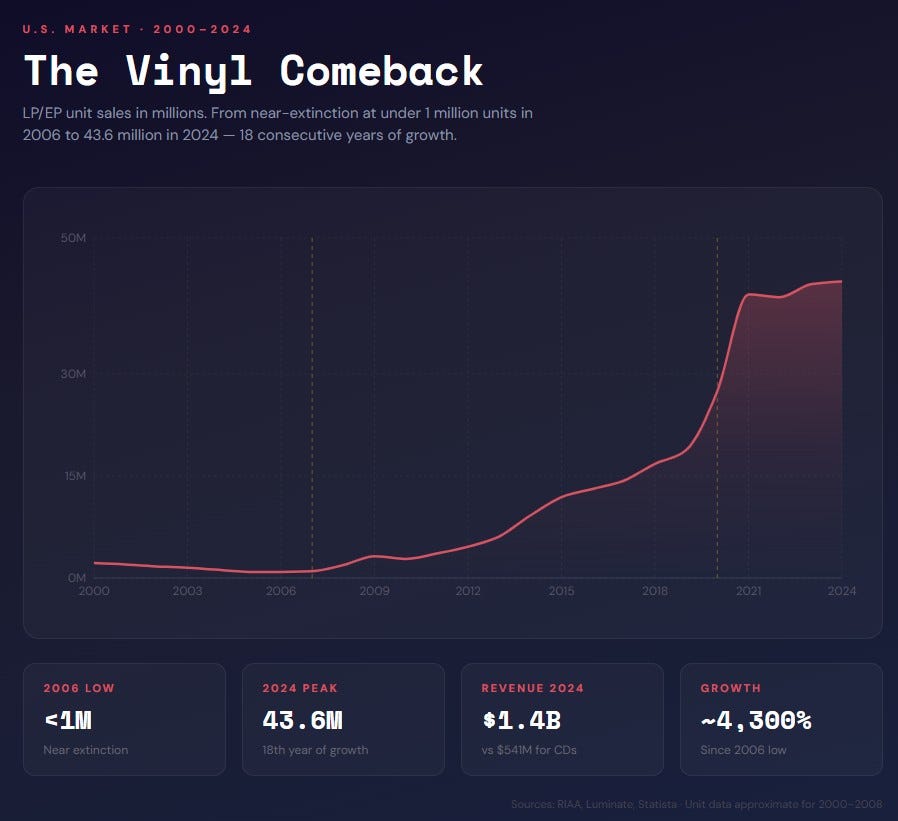
In 2006, fewer than a million vinyl records were sold in the United States. In 2024, that number was 43.6 million, generating $1.4 billion in revenue in the 18th year of growth.
Of course, that’s miles below where it once was.
The global vinyl market is projected to nearly double to $3.5 billion by 2033. Independent record stores now account for 40% of all vinyl sales, and nearly half of Record Store Day shoppers are under 35 (allegedly).
Of course all is not exactly rosy. The last report from the RIAA is from the middle of 2025, and it still paints a fairly damning picture. Streaming services dominate, and were a rare source of growth in an otherwise, seemingly slowly atrophying, market.
A few years ago I was at a bar with a bunch of folks from an old dot-com I’d worked at earlier in my career. I was talking to a guy who had moved into a flavor-of-the-month gig at a weird culture-tech startup. He was explaining what they did and I said to another friend — one of the smartest people I knew — “That doesn’t sound anything like a business model.”
He said, “They just raised $10 million.”
I guess my incredulity was sufficient that I didn’t need to ask why my company wasn’t getting anywhere near that kind of funding, despite (what I thought was) a stronger model.
He said something on the order of: “Investors back what other investors are investing in.”
In other words, I needed that type of company to get any attention. Otherwise it was going to be a hard, hard road.
In times of generational shift like we’re seeing with AI, you can either ride it out and wait for the backlash — because it’s coming, and cycles are increasingly faster — or join the mob and try to get your piece.
Thanks for reading Ghosts In The Machine! This post is public so feel free to share it.
Yesterday, I had lunch with a friend who just lost her job. Not only lost it — they just stopped paying her. For months. She eventually just walked.
“I hate AI!” she said. She’s in supply chain management and order processing. Was a valued employee at Batter Blaster. Jobs like hers are being automated.
“I’ve applied for 30 jobs and nothing. I can’t do a pivot table!” she lamented.
I had to hold my tongue from saying “Watch a YouTube video and figure it out.” That’s not a fair answer to everyone.
I feel like I keep telling the same story about my use of AI. I use it to code, because I understand product and I get operations and I get marketing. I just never could build the products myself. Now I can.
Is that fair to developers?
Ask the developer who was installed by investors and shut me out of my own company. Ask the developer who billed for time spent playing World of Warcraft. Ask the developer who hired offshore labor masquerading as U.S. full-time employees, and covered for it by claiming the work was far too complicated for management to understand — when we could see the Google Analytics dashboard just as well as him.
In my own work with AI, I guarantee I’ll hit a wall and need a real developer to help me with a middleware issue, or vet my application’s security and resilience. But now I don’t need to raise tens of thousands of dollars on speculation. Money that, the odds say, will likely go down the drain.
This new technology puts capabilities in my hands as a working American cog in the gear of capital enterprise. It lifts financial barriers to entry. It lifts class barriers. Anyone can use these tools, for good or ill. I view these as good things.
And yes, there are mind-boggling layers of class and environmental cost in the mix.
And yet the defiant kid in me refuses to get left behind.
You still need a human to architect it. To define the product. To add the art of human interaction and elegance. To impart the intangible thing a machine can never have: taste.
As the big players in media double down on slop, there’s a reckoning coming. People will not just eat the gruel they’re fed and believe it’s steak and eggs.
You already see it: AI-generated art has not crossed the uncanny valley. It’s good for stock photography, maybe. And sure, it will improve. But without actual humanity and great art to feed it, its output will be worthless. It will be the ouroboros, eating its own tail (and you know what comes out of the tail).
See the copyright issues dogging the AI industry. For good reason.
And the data tells this story with startling clarity; not just in music, but across every medium where physical things compete with digital convenience.
The U.S. print book market (as tracked by Circana BookScan reporting outlets) sold about 782.7 million print units in 2024, up roughly 1% year-over-year.
Print still accounts for over 80% of total book purchases in unit sales, although digital represents ~30% in revenue share. Readers buy physical books at a 3:1 ratio over digital (based on unit sales). In 2025 alone, 422 new independent bookstores opened across the country, a 24% increase over the prior year.
Since 2020, the number of independent bookstores in America has surged 70%, from 1,916 to over 3,200. Barnes & Noble opened more new stores in 2025 than it did in the entire decade from 2009 to 2019. Only 37 bookstores closed in 2024, a 60% drop in closures.
Now here’s the counterpoint, and it matters: reading for pleasure in the U.S. has declined over 40% since 2003. Only 16% of adults report reading for pleasure on an average day. Print sales dipped slightly in the first half of 2025.
But that’s actually the point. The people who care are caring more. They’re seeking out the independent bookstore with the hand-lettered staff picks. They’re buying the vinyl with the gatefold sleeve. They’re choosing the curated over the algorithmic. The market isn’t getting wider, it’s getting deeper.
And hopefully, it isn’t atrophying, or dying slowly like the print newspapers bookstores used to sell.
As Sam Valenti argues on Substack, an outright ban on any art that uses AI, like the one Bandcamp instituted, is a tourniquet, not a healing salve. These tools will be absorbed into the zeitgeist. We’ll develop finely tuned AI filters. We’ll learn to distinguish the handmade from the generated, just like we learned to spot auto-tune and stock photography.
The theatrical window is about to be closed by today’s Bond villain, Netflix media behemoth honcho Ted Sarandos. This will likely kill many movie theaters, reducing film to the home experience.
Sony is already making people order via cell phone at the mobile-device anathema that is Alamo Drafthouse.
The corporations only exist to corporate, and they will seek the lowest ground possible with the highest return — until everyone decides we don’t want their shit anymore.
And yes, data centers are massive environmental hogs. But if you want to help the environment, get off your computer, don’t watch Netflix, don’t stream YouTube, and minimize your time on devices. Sam Altman didn’t invent the idea of putting a data center next to a waterfall or a natural resource. All this technology eats the planet.
And if the rise of technology is another lubricant on the path to a totalitarian future — because it’s easier to control you, easier to force you to eat the slop — well, fuckin’ rise up.
Real people mostly want real things from other real people.
That’s clearer now than it’s been in twenty years. I think it will extend to physical items. I think it will extend to a marked improvement in craft. I firmly believe that AI-rendered slop will hit the wall of copyright law and human taste and dignity.
We saw a future of iPod Nanos in a million neon colors and a good chunk of that generation said, “We want vinyl records back.” We watched Amazon kill the bookstore and then 422 new ones opened in a single year. We were told print was dead and 782 million books sold anyway.
Physical things of beauty do still have a place.
This is Ghosts in the Machine and I’d love to hear your feedback.
You can reach me directly at nicholas@ghostguide.co
Like my work? Buy me a coffee!
Comments
Nothing yet. Say the first thing.
Sign in to join the conversation.