
Chasing Alpha Weekly drops every Sunday. I break down the macro signals, sector rotations, and specific trade setups I’m watching for the week ahead. If you’re new here — subscribe below so you don’t miss it.
Three weeks ago the $SOXX broke its 12-day. Then the 22-day. Now the 55-day just fell.
And while everyone is debating whether to buy the dip, South Korea is about to open Sunday night into a 12% gap down with 400,000 fresh margin calls behind them and new margin requirements that went into effect while their market was closed.
This is not a normal setup heading into a week. Here’s exactly what I’m watching — and why I think the next few weeks are going to be some of the most volatile of the year.
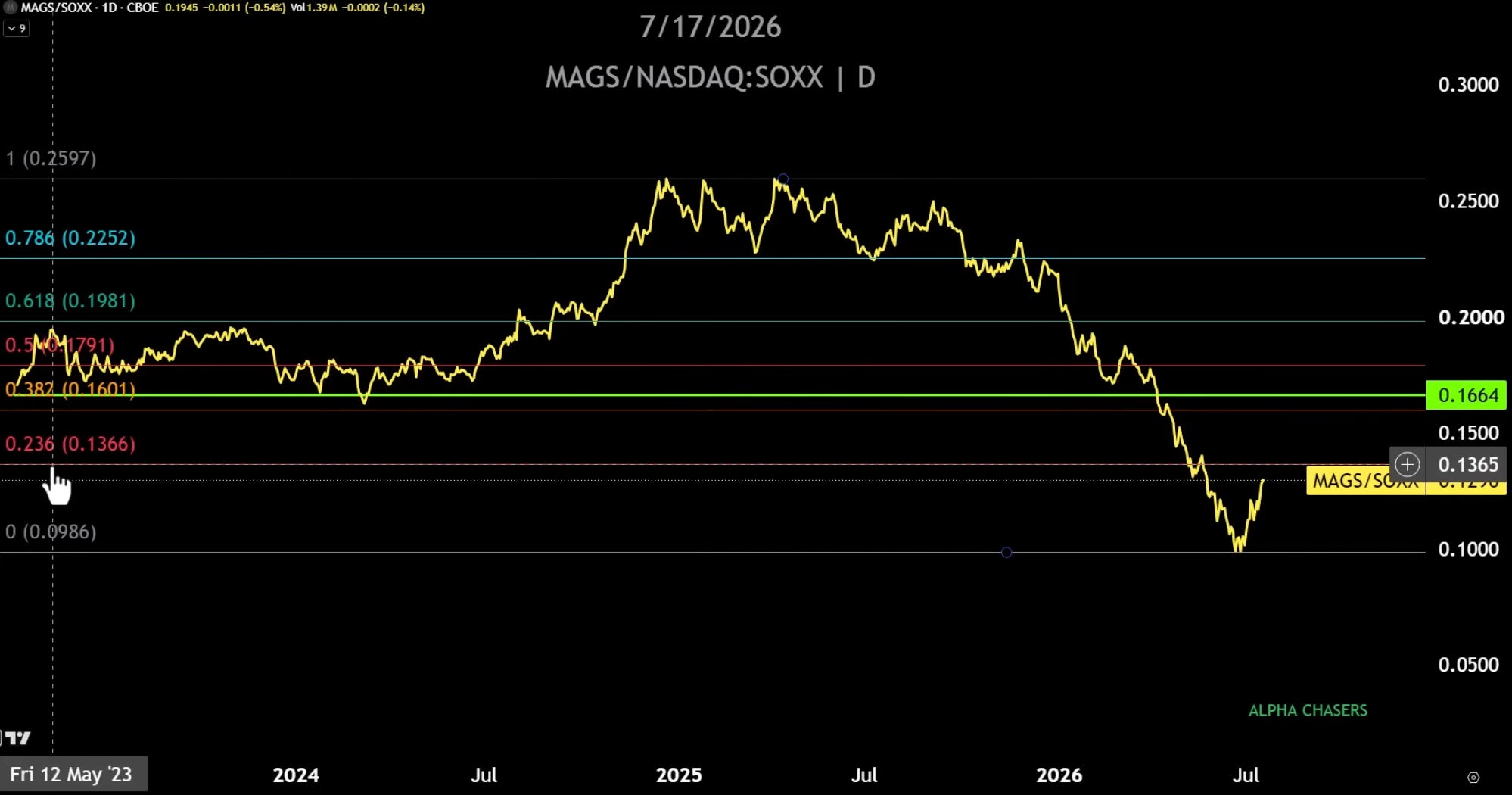
Mag 7 quietly outperforming $SOXX since window dressing ended — rotation accelerating
Refiners ($MPC, $PSX, $BLO) ripping as crude pushes back over key levels
$SPCG short exploded to the downside — new issue market signal playing out perfectly
$GOOG earnings Wednesday — capex guidance is the only number that matters for semis
South Korea Sunday night — $SKHY opening down roughly 12% from Thursday’s close
XLP vs XLY setting up to break out — needs vs wants ratio signaling increasing defensiveness
$SOXX broke its 55-day — declining 12 and 22 now converging at resistance
DRAM 1,500 level flipped from support to resistance — capping every bounce attempt
NDFI broke below 50 on Friday — more NASDAQ 100 names now below their 50-day than above
The index looks okay on the surface. Under the hood, the deterioration is accelerating.
Let me start here because I think this is the most important thing to understand before Monday open and almost nobody is talking about it.
South Korea has been acting as a leading indicator for the $SOXX for weeks. The correlation has been almost tick for tick. When Korea breaks, semis follow. When Korea bounces, semis follow. This is not a coincidence — it’s because the same underlying assets drive both markets.
Here is what you are walking into Sunday night.
$SKHY — the largest company on the Korean exchange — is going to open roughly 12% below where Korean investors went to sleep on Thursday night. That alone would be enough to create a volatile open. But it is not the only factor.
While Korean markets were closed for a holiday, two things happened simultaneously. First, there were roughly 400,000 forced margin calls across Korean retail investors — an absolutely staggering number for a single country’s market. Second, the Korean government increased margin requirements during the closure. That means investors who were already getting margin-called are now coming back to a market with tighter requirements and less ability to lever back up.
The $SOXX has been following South Korea as a leading indicator almost tick for tick. What happens Sunday night in Seoul sets the tone for Monday morning in New York. Watch it before you do anything else on Monday.
Everything this week flows through one data point: Google’s capex guidance.
Here is the framework. Last quarter Google was supposed to earn $260 in EPS. They came in at $511. An absolute blowout. Their spending breakdown was roughly 60% servers and 40% data centers and networking. The prior capex guide was $175-185 billion — they raised it to $180-190 billion. But here is the nuance most people are missing: the growth rate of that capex increase is slowing.
If Google raises capex dramatically on Wednesday, that is good for semis and bad for Google margins. If they hold it flat or guide conservatively, that is good for Google and bad for semis.
But here is the thing people keep getting wrong about how to think about Google’s spending. This is not about return on investment. This is about survival.
If a free Chinese AI model starts taking search share from Gemini, Google loses its core business. They cannot allow that to happen. So the framing of “when will they see ROI on AI spending” is the wrong question entirely. The right question is: how much do they have to spend to not lose search dominance? And the answer to that question has no ceiling.
Google is not spending to maximize returns. They’re spending to survive. Approach their capex guidance with that lens and the number becomes a lot more meaningful.
Enjoying this so far? Chasing Alpha Weekly goes out every Sunday. Subscribe below so you never miss a week. It’s free.
$SKHY opening down roughly 12% from Thursday’s close
400,000 forced margin calls plus new margin requirements = compounding pressure
$SOXX has been following Korea as a leading indicator tick for tick
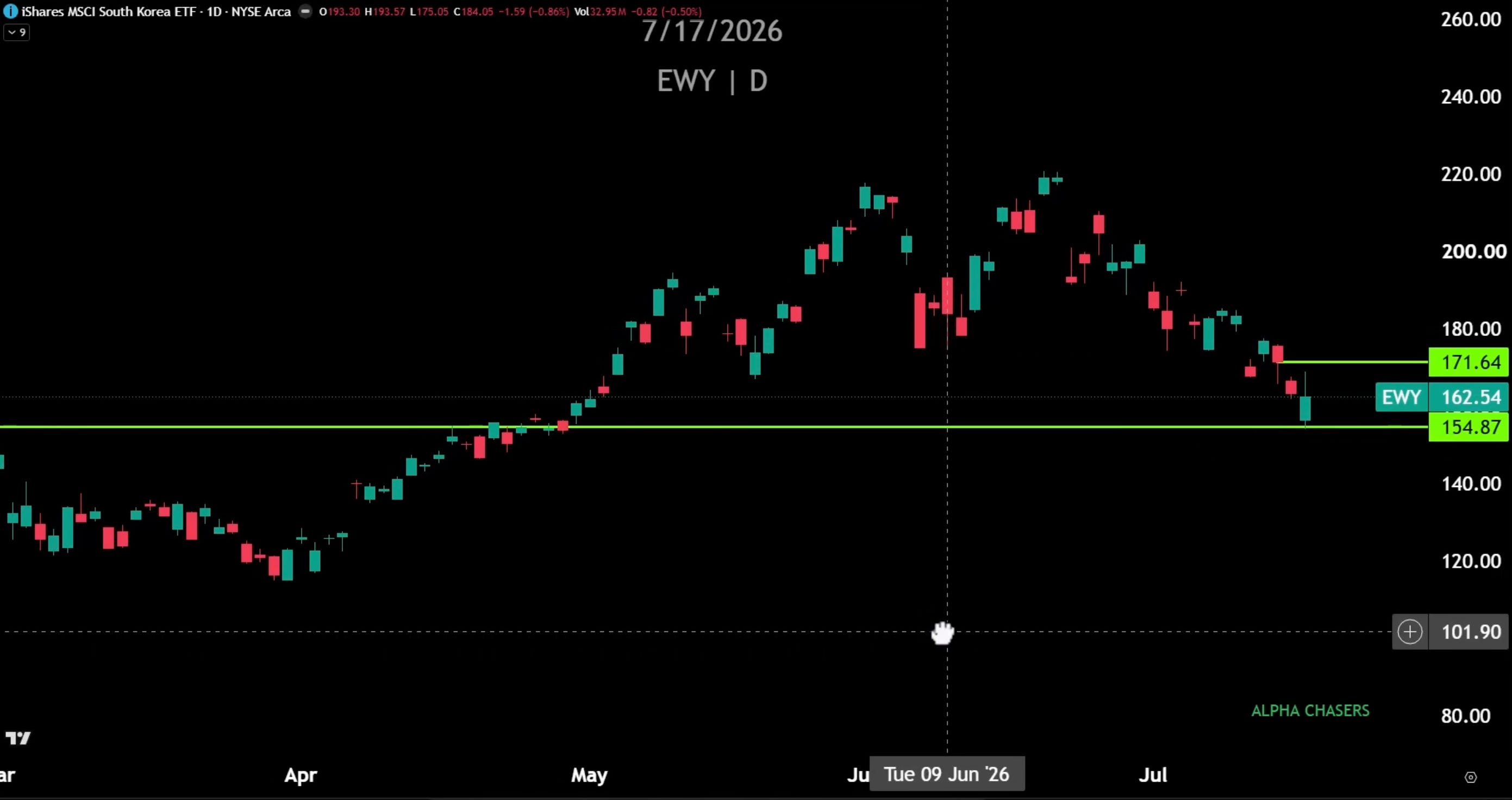
Do not make any major moves in semis Monday morning before you see how Korea opens and how it acts in the first hour. This is the single most important leading indicator for the $SOXX right now and it is being almost completely ignored.
Prior capex guide $175-185B raised to $180-190B — watch whether growth rate of increase accelerates or decelerates
60% of spend goes to servers — direct read-through to $NVDA, $MU, $SNDK, $LRCX
This is a survival spend, not an ROI spend — approach guidance with that framework
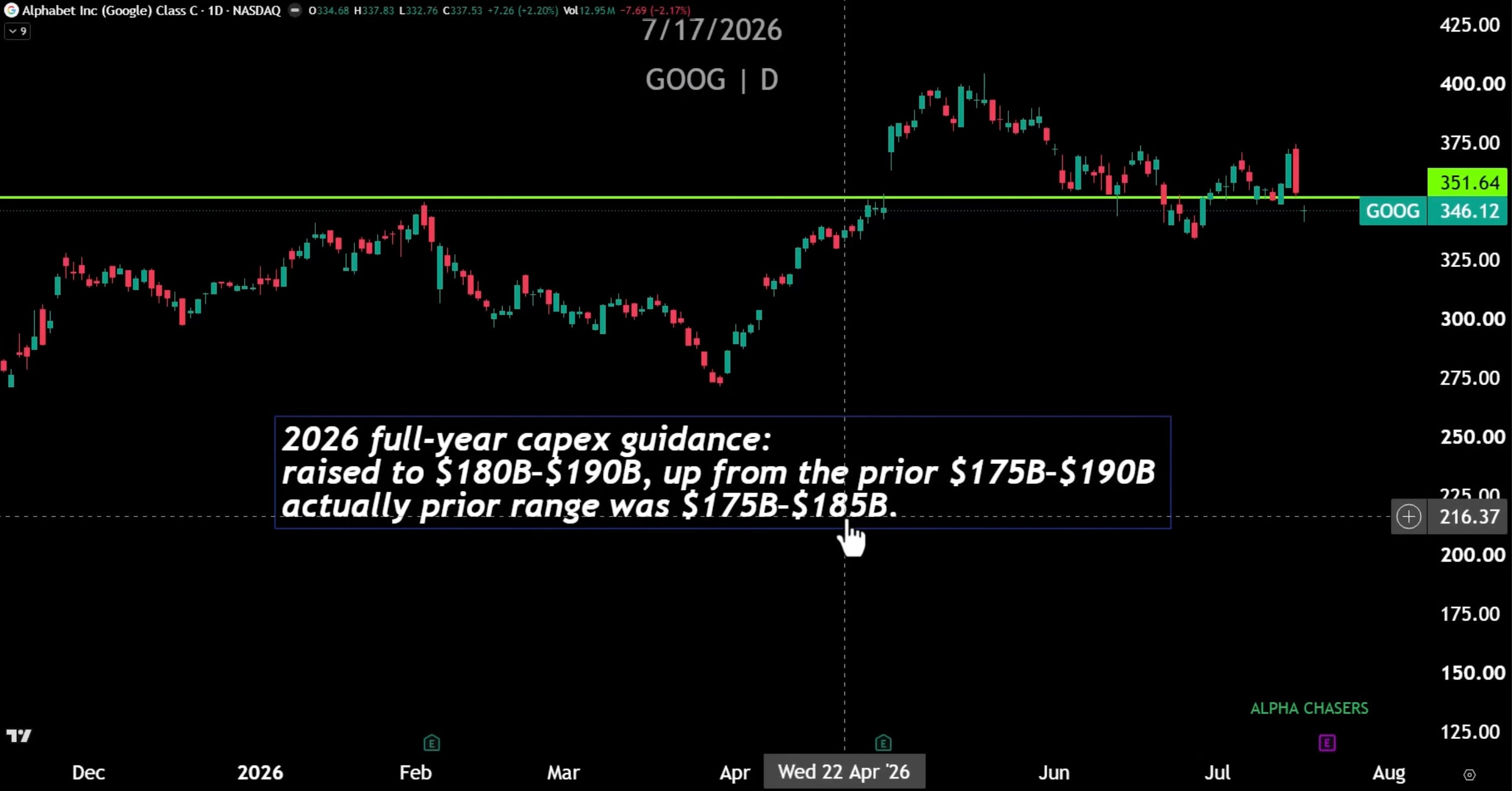
The single most important number in Wednesday’s report is not EPS. It is not revenue. It is the capex guidance number and the language around whether they see it accelerating from here.
Declining 12, declining 22, broken 55 — three confirming signals this is not a swing environment
DRAM 1,500 level has flipped from support to resistance — previous put walls now capping bounces
Friday’s massive volume was options unwind, not institutional accumulation
The training wheels came off Friday when options expired. Monday is a completely different tape. This is a day trading environment for semis right now. If you’re trying to swing trade with size against a declining index, declining sector, and declining individual names, you are fighting on three fronts simultaneously.
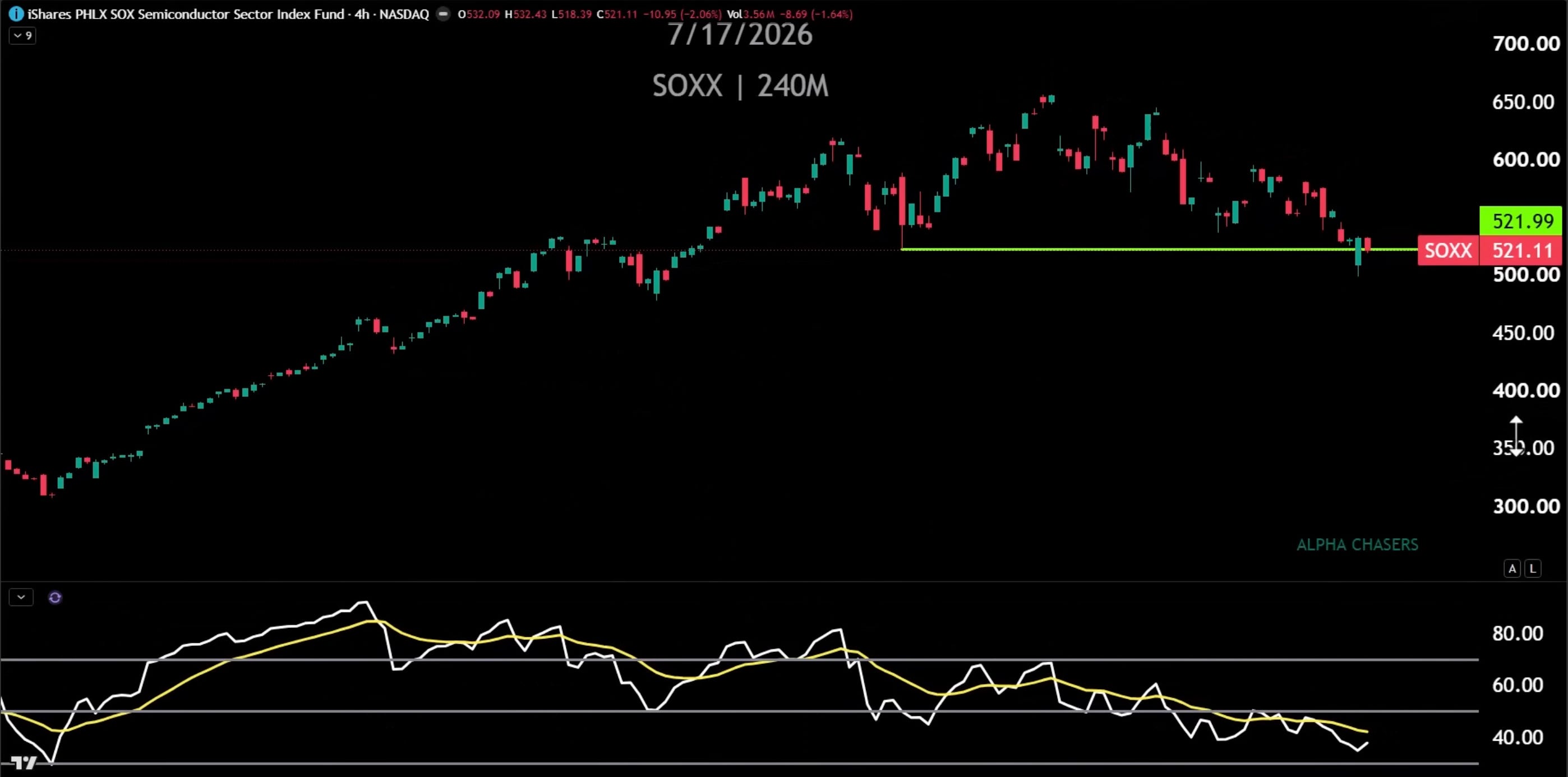
Mag 7 has been outperforming $SOXX since June 30th window dressing — this is not a one-day event
On a fib retracement of the entire Mag 7 vs $SOXX relative move, you are not even at the 23.6% level yet
The full retracement to the neckline takes you to the 38.2% level — significantly more room
People are looking at this rotation as a blip. It is not. The relative move from semis into Mag 7 has been building for three weeks and the fib levels suggest it has significantly more room to play out.
$MPC, $PSX, $BLO all breaking out as crude pushes back over key levels
The money is in refiners, not tankers and not $XLE broadly
The risk: this trade ends in a single tweet if the geopolitical situation resolves
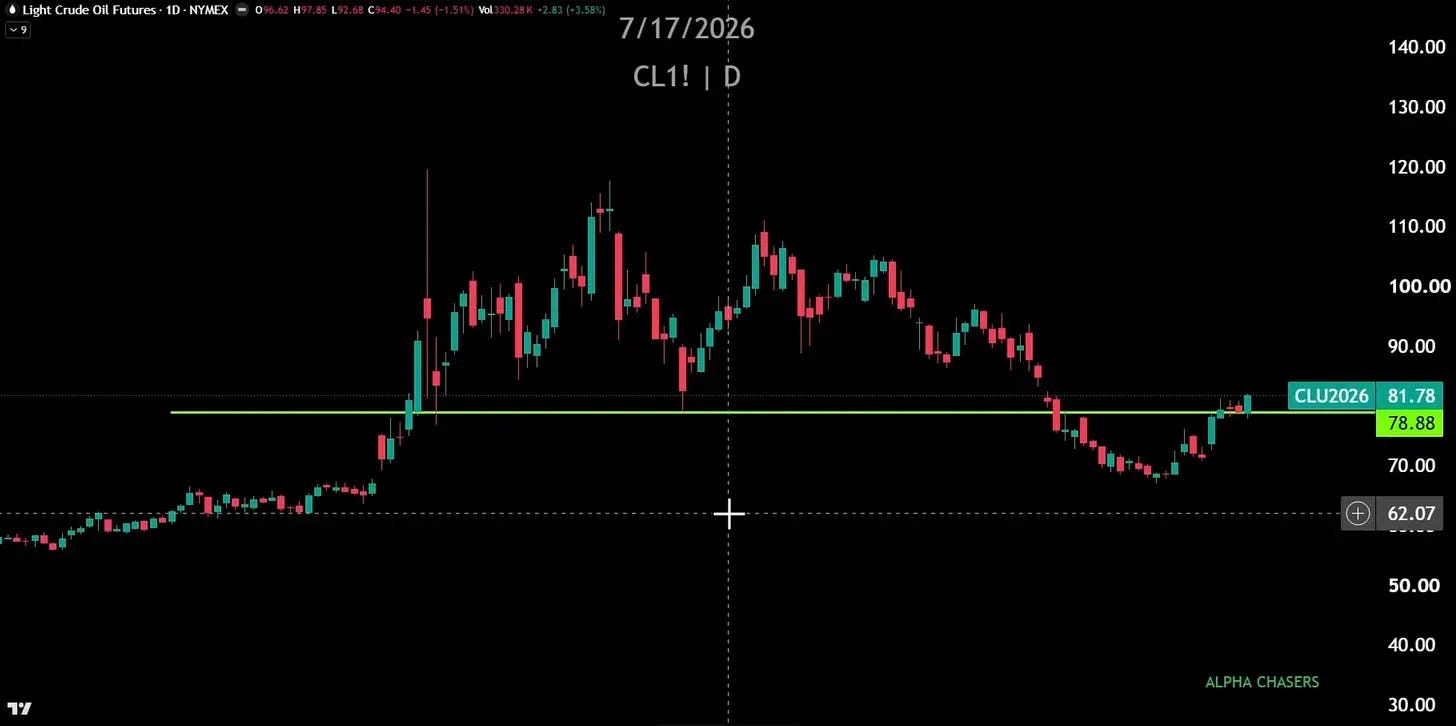
I am not personally playing this because I do not want to be holding a refiner when the news changes overnight. But if you are comfortable with the geopolitical risk, the technical setup in the refiners is clean. Just know exactly where your stop is because this trade can evaporate as fast as it appeared..
South Korea Sunday Night
How $SKHY opens and how it acts in the first hour of trading is the most important leading indicator for the $SOXX. Watch it before doing anything else Monday morning.
$GOOG Capex Guidance — Wednesday
Not EPS. Not revenue. Capex guidance and the language around whether spending accelerates. That single number moves semiconductors more than anything else this week.
DRAM Pricing Daily
Still the only true leading indicator for the semiconductor thesis. Support has flipped to resistance technically but DRAM pricing has not confirmed the breakdown yet. If pricing starts dropping, the thesis changes fundamentally.
XLP vs XLY Ratio
This is setting up to break out. If it does, the market is telling you to get more defensive immediately. Watch this closely — it has historically preceded significant market rotations.
The 12-day broke. Then the 22-day. Now the 55-day.
South Korea is walking into Sunday night with 400,000 margin calls behind them, new margin requirements they didn’t see coming, and their largest company opening 12% lower than where they went to sleep.
Google reports Wednesday and the capex number they give will either save the semiconductor thesis or accelerate the selling.
And two rotations are happening simultaneously that most traders are either ignoring or fighting — money moving from semis into Mag 7, and money moving from discretionary into defensives. Both have more room to run than people think.
This is not the week to be a hero. Change your style. Manage your size. Watch Korea before you touch anything Monday morning.
The full breakdown — including the South Korea leading indicator deep dive, the Google earnings framework, the complete DRAM technical breakdown, and why this is a day trading environment not a swing trading environment — is on YouTube now.
No posts
Comments
Nothing yet. Say the first thing.
Sign in to join the conversation.