
Everyone is focused on the wrong thing.
The market spent the entire week locked on oil, Iran, CPI, and rate cuts — whether we’re due for a pullback, whether the rally is “too extended,” all of it.
Meanwhile…
A potential Samsung strike in South Korea is quietly setting up one of the most important semiconductor supply shocks in years.
And almost nobody is positioned for it.
If this escalates, it doesn’t stay a Korea story.
It feeds directly into:
AI infrastructure
GPU demand
DRAM / HBM pricing
Semiconductor leadership
Nasdaq momentum itself
That’s why names like $MU and $SNDK didn’t just move — they accelerated.
The tape is still strong.
🔹 $SPY grinding toward highs
🔹 $NDX in trend mode
🔹 Earnings broadly beating expectations
🔹 AI + semis still dominating flows
But underneath that strength, something more subtle is happening:
Breadth is narrowing — fewer names are doing more of the lifting.
That’s the kind of environment where single catalysts start to matter a lot more than usual.
And this Samsung situation is not a small catalyst.
Enjoying this so far? Chasing Alpha Weekly goes out every Sunday.
Subscribe below so you never miss a week.
It’s easy to underestimate how central they are.
But the numbers matter:
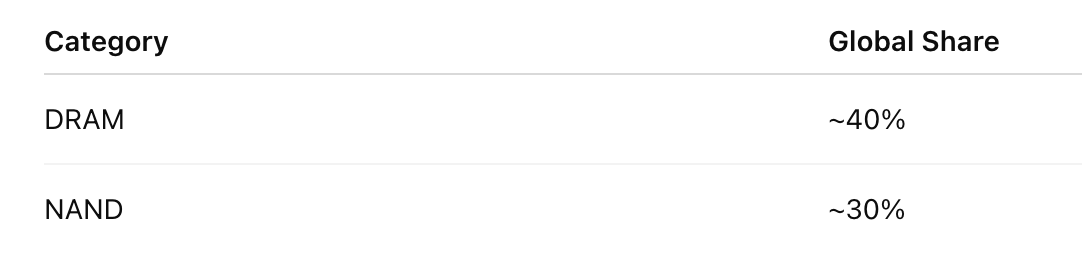
Now layer that into the current regime:
AI server demand exploding
HBM memory already tight
GPU supply chains stretched
Hyperscalers aggressively securing capacity
So when Samsung supply gets even potentially disrupted…
The entire memory pricing curve reacts.
Not gradually — violently.
At the core: labor and compensation tension.
Samsung employees are pushing for:
Higher base pay increases
Expanded profit sharing
Removal of performance caps
Alignment with competitors like SK Hynix
And here’s the critical detail:
This isn’t theoretical anymore — workers have already voted overwhelmingly in favor of strike action.
So the market is now dealing with timelines, not possibilities.
This is where everything concentrates.
🟡 May 11–12 → mediation talks
🟡 May 13 → court ruling on legality
🔴 May 21 → strike begins (if unresolved)
Each of these is a volatility trigger.
Not slowly.
Not gradually.
Overnight repricing risk is real here.
Once the market connected the dots, the flow changed.
If Samsung output is even partially constrained:
DRAM pricing tightens
HBM supply gets squeezed
AI demand shifts to alternatives
SK Hynix + Micron gain pricing power
That’s the loop.
And once that narrative takes hold:
dips stop behaving like dips
they start behaving like entries
This is not random momentum.
It’s supply shock positioning.
Micron is where this becomes most obvious.
The flow pattern this week wasn’t subtle:
Persistent dip buying
Institutional participation increasing
Re-rating of memory pricing expectations
But the key concept here is this:
The longer uncertainty persists, the stronger the positioning becomes.
That’s reflexivity.
However — and this matters just as much:
If resolution happens quickly:
Positioning unwinds fast
Momentum fades sharply
Pricing expectations reset
This is a binary volatility setup, not a slow trend.
$SNDK is a different expression of the same theme.
What’s driving it:
NAND pricing already firming
Scarcity narrative accelerating
Momentum chasing reinforcing flow
And this is where psychology matters:
Most traders assume “it’s extended.”
But in supply-driven cycles, that assumption is usually wrong.
Momentum doesn’t end when people think it’s expensive.
It ends when the supply narrative breaks.
This is the cleaner macro hedge/expressions piece.
Samsung = Korea index weight.
So $EWY becomes a direct read on outcomes.
🟥 Strike happens
Samsung pressure
Volatility rises
Semis tighten globally
🟨 Deal reached
Uncertainty removed
Capital flows back into Korea
Index relief rally
🟩 Court blocks strike
Samsung rallies sharply
Broad Korean equities squeeze
Risk-on reaction
This is not directional. It’s probabilistic.
Markets are obsessing over macro headlines.
But underneath that noise, something more structural may be forming:
DRAM pricing accelerates
Memory becomes bottlenecked again
AI infrastructure demand intensifies
Semiconductor leadership narrows further
And then the second-order effect kicks in:
The more crowded the trade becomes, the more violent the unwind later.
That’s the part most people ignore.
This is one of those situations where:
Most traders aren’t looking at it
Positioning is still early
Catalysts are clearly defined
Volatility window is coming fast
And that combination matters.
Because once headlines hit the key dates next week…
This stops being a niche semiconductor story and becomes a market-wide repricing event
These breakdowns come out weekly.
If you learned something, be sure to subscribe so you get these directly to your email inbox!
🎥 Full breakdown here:
Join the Alpha Chasers Community
For educational purposes only. Not financial advice. Do your own research.
No posts
Comments
Nothing yet. Say the first thing.
Sign in to join the conversation.