
My first recollection of The Big Lebowski was in the winter of 2002/2003. I was a freshman in high school, ritalin’ed up, and obsessed with snowboarding, and whenever I wasn’t getting crushed by homework, I played video games with friends in my parents’ basement. My house was just a few hundred yards from the soccer fields of my school and thus was the de facto hangout spot for my group of friends. Broadband internet was hardly a thing, and online gaming was merely a twinkle in a few Counter-Strike players’ eyes, so video games for me and my friends consisted of walking home after school and taking turns on a rear projection TV that may or may not have had a few cracks in it from airsoft BBs and a soccer ball impact to the left corner. As a consolation prize, and to decrease the amount of shit talking and potential sabotage by the other freshmen high school boys eager for their turn sitting in a semicircle around the two-foot-thick TV, we had set up a secondary TV. My family did not have any of the movie channels like HBO, and this was half a decade before Netflix started streaming, so we just left the TV playing Comedy Central.
That winter, during the period of our lives before driver’s licenses but with all the hormones, my group of friends and brother were completely consumed by Grand Theft Auto: Vice City. In between ripping motorcycles around a fictitious version of Miami blasting New Wave and Hair Metal on a storyline that loosely followed Scarface, I became aware of a movie unlike any other I’d ever seen. At the time of its release in 1998, The Big Lebowski had about as much profanity as any film, and in order to make it safe for cable TV, vast amounts of the dialog were changed. The film, already a drug-addled fever dream, was barely legible, and in the winter of 2003, Comedy Central played it on repeat. Combining an already convoluted film with a room full of pimple-faced boys in their last moments of innocence with machine guns, car sirens, and 80s music blasting was hardly what the Coen Brothers imagined, but that’s how I found it.
A few years later, with car keys in my pocket and having filled out my frame a bit, I gave the film another go in another basement in Portland’s West Hills. This time, in its intended form, and presumably with a hint of Sour Diesel in the air, the movie clicked. The way it looked, the simplicity of the story, the dialog—I’d never seen anything like it. The questions it made me ask about the story intrigued me as much as the film itself: How the hell did Walter and The Dude meet? What happened to the baby? Who did the Dude and Walter replace Donny with on the bowling team? I made all of my friends watch it and wrote a paper on it for my junior English class comparing The Dude’s journey to that of Odysseus in the Odyssey. I looked for that paper to include in this write-up, but it’s long gone. Throughout the process of writing the essay, I watched the film a dozen times and made my parents sit through it. If memory serves correctly, the deadbeats at the league office gave me a B or B+, but the process of writing the essay gave me a familiarity and understanding of the film that allowed me to really appreciate its subtleties.
My next real recollection of The Big Lebowski was a decade later, at a hotel in Berlin in the spring of 2013. I was in Germany for a month working on a campaign for a German insurance company based on The Burning House. A day before, I had parked my truck in long-term parking at LAX and flown to Berlin. My brother, who at the time was backpacking in the Andes studying condors, was tagging along as my plus one but had missed his flight in Buenos Aires and was going to be a few days late. The production company put me up at a hip hotel that was playing The Big Lebowski on repeat, on all of the TVs in the lobby, the elevators, and the home channel on the TVs in the rooms. Alone in a new city, with nothing to do for 72 hours, I met a group of people visiting from London at the hotel bar and had tagged along with them to a club. I passed on the pills going around the group of English financiers raging, and as the sun came up, I walked home three miles from the club to my hotel with a dead phone and just landmarks for navigation. The next day, I was hungover and jet-lagged, and in between napping and catching up on fluids, I watched The Big Lebowski in various pieces, at least a half dozen times.
Once I stopped living in my car and built the tree houses in 2014, I started watching a lot more movies. I have other favorites; Dr Strangelove, Apocalypse Now, Heavy Metal, The Dollars Trilogy, and No Country For Old Men to name a few, but I always seem to find my way back to the Big Lebowski. During summers in the mid-2010s, we would set up a bedsheet and watch The Big Lebowski on a projector linked into a Makita speaker in the bowl at the Cinder Cone. In the winter, before the studio was built at Movie Mountain, I’d watch the Big L by a roaring wood stove. During times of stress or frustration, during the height of making commercials during covid, The Big Lebowski always brought laughs and a sense of ease after days of dealing with culture vultures at ad agencies.
Despite my fondness of the Dude, I’ve always been more of a Walter guy. John Goodman’s portrayal of the disgruntled and ideological vet based on John Milius clicks with me. For those unfamiliar, John Milius is a writer and director whose persona rivaled his filmmaking prowess. He wrote movies like Apocalypse Now, Dirty Harry (1 and 2), Conan the Barbarian, Red Dawn, Jeremiah Johnson, and Big Wednesday. He once pulled a 1911 on a Hollywood executive and was blacklisted from the biz after Red Dawn came out. After being blacklisted, he wrote famous scenes in other movies, like the USS Indianapolis scene from Jaws and the opening monologue in The Hunt for Red October. The documentary Milius is amazing and worth the watch.
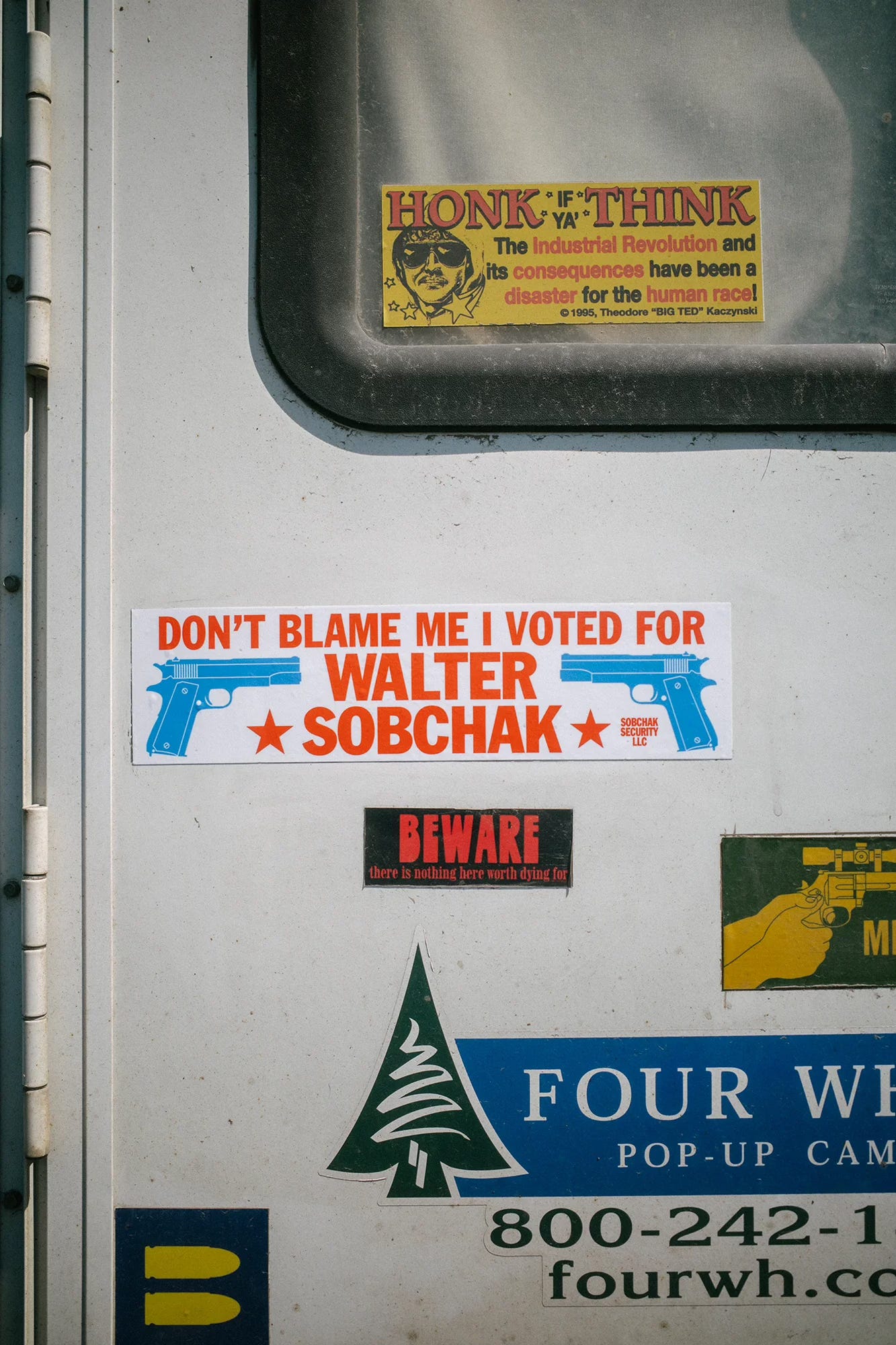
A few years ago, my friend Marshall and I started selling shirts and bumper stickers inspired by Walter’s business in the movie, Sobchak Security. In my mind, the bumper stickers are all pieces of decalcomania that would be present on Walter’s car and shirts that would be in his closet. Nothing is Fucked, Gun Control Means Using Both Hands, Don’t Blame Me, I Voted For Walter Sobchak, Give Piece a Chance, This Catalytic Converter Isn’t Worth Dying For. They aren’t for everybody, but neither is Walter.
Usually, I’ll throw a worn-out VHS version into the TV VCR I have by the bed in the treehouse. I know the trailers and the ads by heart. They’re largely other 90s independent films like The Last Days of Disco and Your Friends and Neighbors and include a PSA about ending childhood hunger. By the time Sam Elliot’s soothing voice starts, I’m locked in. Despite having watched the film countless times, each time I watch it, I pick up something new. A new piece of dialogue, a new detail of Donny’s reaction to the Dude and Walter Fighting, a nuance of Philip Seamor Hoffman’s acting. Sometimes I watch the whole thing. Most of the time I’ll start fading after the Jesus dancing scene and turn off the TV to continue later, often the next morning as I wake up. Every time, I’m satisfied. It never gets old.
This week, Lillian and I stopped by the school I went to for 6th-12th grade. The signs said no dogs allowed, but, from my recollection, neighbors would often play with their dogs in the lower soccer fields in the liminal period after sports practice but before dark. We parked on the street and took the path I walked each morning on the way to school. The fields were empty, except for remnants of blue and white flags from a track meet.
“I used to run up and down those hills for soccer practice,” I said, motioning to the hill that separated the two soccer fields in a fir tree-lined opening, and remembered varsity soccer tryouts. As I stood, quietly recollecting the highs and lows of puberty, Tim sprinted back and forth on the fresh-cut grass with an orange tennis ball lodged firmly in his mouth. The campus looked frozen in time, with the same smells, the same baseball announcing tower, and the same soccer goals stacked neatly in the corner ready for fall. I walked over to the pitcher’s mound and remembered jumping over it on my Redline BMX bike while my brother filmed and later edited a little video on the first version of iMovie.
Back at my car, I looped around and showed Lillian the house I grew up in. Baring a new coat of paint, the house was largely the same, unlike most of the area which had been transformed from a sleepy middle class neighborhood to condos, modern townhouses with black window trim and metal siding. I parked out front and peered out the passenger window, looking for differences. With the exception of my “Nothing is Fucked” sticker, my black Lexus SUV looked right at home in the suburban bustle of a Wednesday night at 7:30 with Teslas coming and going and people dressed in business casual walking their dogs. Of all the memories that flooded back from the six years that I lived there, the one that rose to the surface was the memory of sitting around the TV playing video games late at 1 am and trying to make sense of whether this was the second time this movie had played that night or if the same Bob Dylan song had really been used in two difference scenes. Like little Larry, I was 15 and not doing well in social studies, but instead of stealing Ford Torinos in real life, my group of friends and I were stealing them on a Playstation. As we drove away, I realized I was closer in age to the Dude and Walter than I was to little Larry, and I wondered what my life will be like when I am closer in age to Jeffery Lebowski, the other Lebowski. That’s what good art is; it lets you see your own life through the lens of another person’s story, and for my money, it doesn’t get much better than The Big Lebowski.
No posts
Comments
Nothing yet. Say the first thing.
Sign in to join the conversation.