
On December 12, Pierce County Auditor posted a call for volunteers to provide an “against” statement for prop 1 and 2 because “the districts did not appoint against committee members to prepare statements for the local voters’ pamphlet.”
The deadline to request a committee member appointment was less than four days later, December 16 at noon. The public had about 3 days to volunteer to write an against statement. Nobody did. So, in lieu of that, here are some reasons you should consider voting NO.
Let’s start with Prop 2, related to buying computers for students, etc. Studies show that digital learning actually hurts student progress. Sweden, one of the leading countries for educational attainment, is abandoning all digital learning in its schools. Why should we spend money to handicap our children? Here are a few studies worth looking at:
Allowing computers in classrooms decreased final exam scores by about 0.18 standard deviations compared to technology-prohibited classrooms — a meaningful reduction in academic performance. The impact of computer usage on academic performance (United States Military Academy)
Students induced to use laptops scored significantly worse on course grades than students not using laptops; prohibiting laptops correlated with higher grades. Computers and productivity: Evidence from laptop use in the college classroom
Researchers concluded access to personal computing technology was associated with worse academic results.
Findings from PISA (international student performance surveys) show that intensive computer use at school, especially for non-academic purposes, can associate with lower achievement in math and reading. Researchers noted that ineffective pedagogy or low-quality software can contribute to this negative link.
Unrestricted laptop access provides many potential distractions that correlate with lower learning engagement and outcomes.
In Tacoma Public Schools, many students spend much of their time during class and at lunch playing video games, looking at tik tok videos, or watching Youtube on their school-provided computers or their own cell phones. They often use the school-provided WIFI (presumably paid for by this levy) to do all of this.
Assignments are often difficult for students to find online because Tacoma has not invested in a user-friendly learning management software (LMS). Students have to learn a new way to submit their assignments for each teacher. Some want it emailed, some want it submitted through Synergy, some want it done on paper…Kids are often struggling just because technology makes completing assignments and turning them in more challenging.
Students often use the excuse that they forgot their computers, they forgot their charger, their battery is dead, their computer is lagging etc. This wastes considerable class time.
Funds would be better spent on encouraging parents to be involved in their child’s education, on finding unbiased and rigorous curriculum, teaching quality and targeted academic lessons and providing useful interventions.
Prop 1 is unnecessary because public schools do not spend taxpayer dollars wisely
Tacoma School District ranks in the bottom 50% of public school districts in Washington, with an average math proficiency score of 31% and a reading proficiency score of 48%, which are below the state averages. Overall, it is ranked #190 out of 306 school districts in the state based on combined math and reading proficiency testing data.
More money won’t solve the problem. Washington already spends $20,748 per-student, far above the national average.
Our neighboring state, Idaho spends $9,378 per student. Washington spends $20,748 per student. Both states have the same scale score in 4th grade math. Idaho actually beats Washington at half the cost to taxpayers.
The average private school tuition in Washington is $15,533 per year, and private schools do much better on almost every metric with less money.
According to one source, there are about 1,400 non-resident students (students whose addresses of record are out of the district) attending Tacoma school district. That means their parents do not pay property taxes and will not contribute to this levy. Why should Tacoma tax payers pay for the education of students who are not in the district? (Note it is not clear how many students who have addresses in Tacoma attend other districts.)
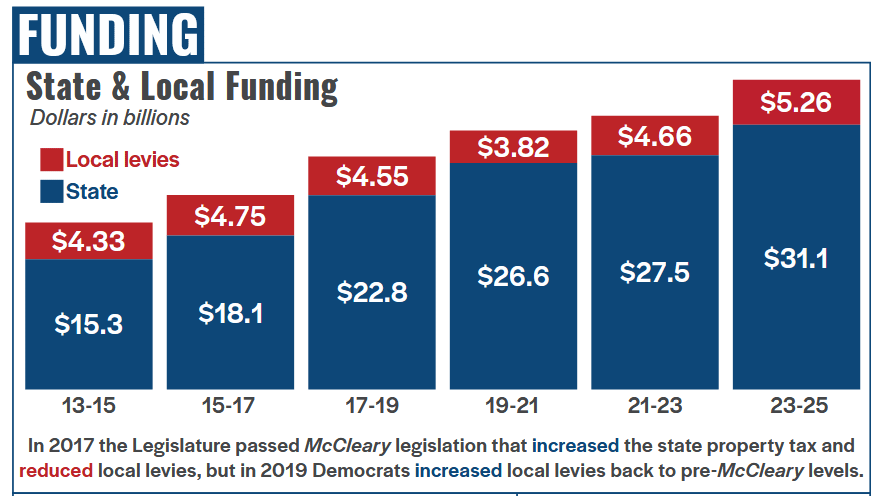
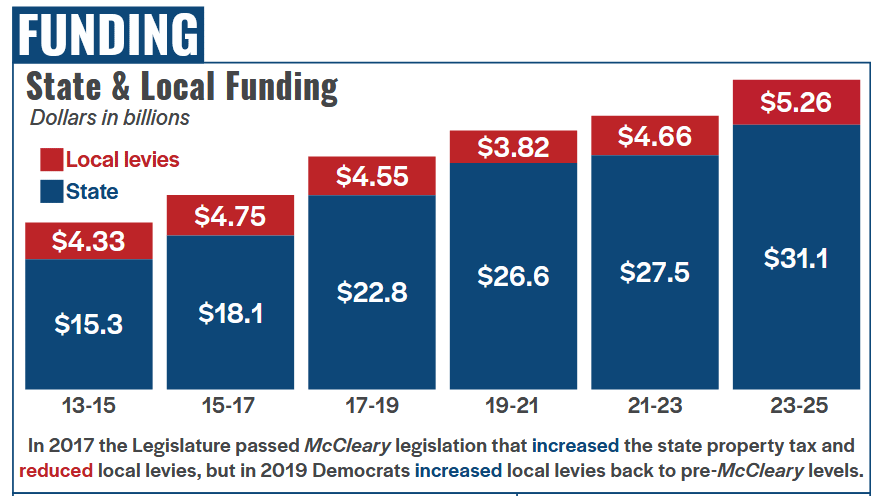
In Washington public schools, math and reading proficiency have not improved proportionally with increased spending. We’ve more than doubled our spending on education since 2013 and test scores have remained flat.
Tacoma schools spend approximately $108 million per year on free meals for K-12 students. All students, no matter how much their parents earn, get free lunch and “breakfast” (Donuts on Wednesdays, everybody! And the teachers get the leftovers.). Only about 12% of Tacomans live at or below the poverty level and need such assistance. (While much of the funding for food comes from federal and state coffers, some of it does come from local district funding.)
Spending increases alone don’t guarantee academic gains. We need better use of existing funds before raising taxes. Despite the claim that this is a “renewal,” increased property values result in increased taxes. At a time when home ownership is out of reach for so many people, we should not be raising property taxes.
Prop 1 propaganda is misleading
This levy will not impact the majority of Tacoma’s teachers, despite what the pro statement claims.
State-level analyses show spending growth has often gone toward non-teaching staff and benefits, raising efficiency concerns. Indeed, TPS does not differentiate between non-teaching staff and teaching staff. In its discussion of Prop 1, teachers are lumped in with paraeducators, “custodians and others.”
Who are the “others”? Does that include administrators, like Lincoln Vice Principal Logic Amen who wrote a rap song about shooting up a school and canceling Christmas? He also said that white women need to be aware of the problem they are birthing. He said that “the white Man is the biggest terrorist in the history of the Americas.” He should be fired. Instead, he is paid $190,000 a year. There are numerous other administrators and teachers who share his racist views and are paid even more.
Teachers are already paid through the State Basic Education funding. TPS does not disclose how many teachers will be impacted, but it can be assumed that few teachers would be impacted if these levies fail. The biggest impact would likely be on lower paid pareaeducators, custodians…and others.
Washington State already has the 2nd highest starting teacher pay in the United States. Tacoma teachers make on average $84,000–$105,000 per year. That’s in line with the average wage in Washington, which is about $95,000. This levy will not impact the majority of Tacoma’s teachers.
Tax burdens spread to renters, not just homeowners
Even though these are “replacement” levies, they will result in higher taxes due to higher property values. That means rents have to increase as landlords will pass the burden on to renters.
Some Tacoma homeowners may see noticeable monthly increases, adding to cost-of-living pressures.
Tacoma Public Schools already owes over a billion dollars on bonds. They need to manage their money better.
Equity concerns
Heavy reliance on local levies can widen gaps between wealthier and less-wealthy districts, an issue Washington has tried to address since the McCleary decision, which was overturned by liberal lawmakers.
The left-leaning bias of administrators and teachers in Tacoma public schools creates a HOSTILE learning environment for students, teachers, and families who subscribe to traditional cultural values.
These levies make up 17% of the operating budget. It will cause hardship for sure, but we need better money management. Vote NO!
Washington schools receive funding from state, local (levies), and federal sources; federal funding is a relatively small share (~13% statewide).
Despite rising funding, statewide proficiency rates declined or stagnated in recent years, especially post-pandemic.
Tacoma argues levies are necessary because state funding does not fully cover real operating costs. But the real issue is that we’re overspending on programs that actually hinder student progress.
We need structural reform and accountability, not more taxes.
Supporters believe Propositions 1 & 2 are essential to maintain school quality, staffing, safety, and technology, and to avoid cuts to programs students rely on.
Opponents believe Washington already spends heavily on education, question spending efficiency and outcomes, and are concerned about rising property taxes.
No posts
Comments
Nothing yet. Say the first thing.
Sign in to join the conversation.