
The fall was not silent.
First came the roar of the stairs — a deep, vibrating sound that didn't come from the wood, but from the stone waiting beneath it. Then the stairs vanished. They didn't collapse, they didn't break — they simply ceased to exist. It was as if the house had taken a step back, and whatever lay beneath opened its mouth.
Leo felt the hand on the nape of his neck. Alexander's hand. The fingers that until now had been caressing him — slowly, in circles along his spine, as if writing letters onto his skin — were pressing now. Downward. The movement was not rough. It was not sudden. Alexander did nothing roughly or suddenly. Even this he did with elegance — his hand soft, the pressure steady, and the voice whispering into Leo's ear warm, almost affectionate:
"Do not be afraid, Leo. This is not an ending. This is a beginning."
The words gave him nothing. The darkness he was falling toward promised nothing either. It simply waited. Hungry. Patient. The way it had waited for centuries.
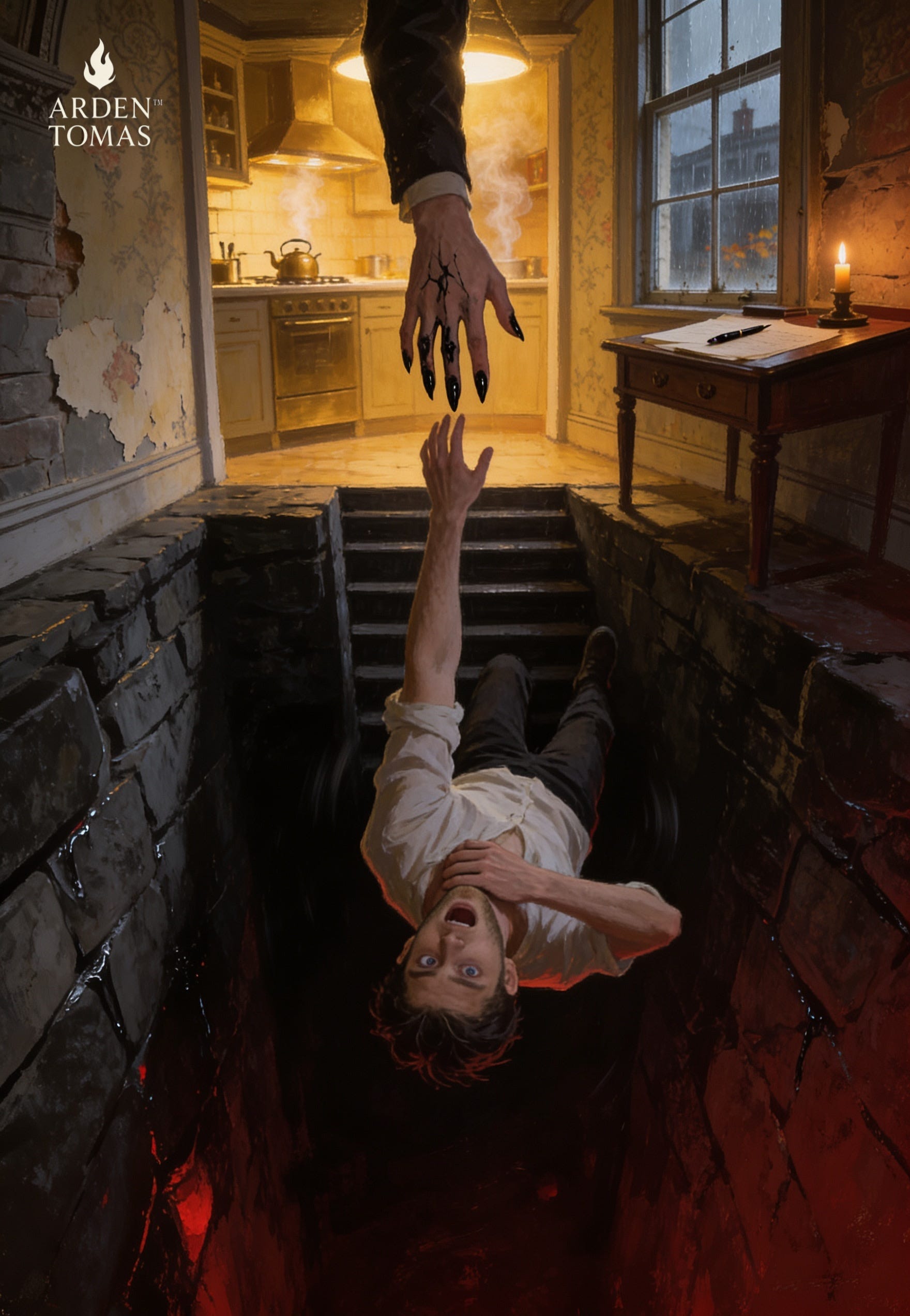
Leo screamed. Or tried to. The sound from his throat — that raw, animal cry, the body's last protest against the dark — died before it was born. The stone swallowed it. Not the way a wall swallows sound, reflecting it, dampening it, but the way water swallows a pebble. Completely. Instantly. Without a trace. As if the sound had never existed. As if Leo had never cried out. As if the darkness would not permit fear to have a voice.
The fall ended. Or perhaps it was never a fall at all — only a transformation. The world above — the house, the kitchen, the steam rising off the lavender tea, Alexander's smile, the scratch of the pen, that warm gold light coming through the morning window — all of it evaporated like steam, and what remained was raw rock.
Damp. Cold. But not the surface chill of winter that stops at the skin and goes no deeper. This was different. This frost rose from the deep — older than the house, older than writing, older than any memory Leo had ever carried. As though the stone remembered an age when there was no house, no pen, no ink, nothing — only the dark and the hunger living inside it, a hunger that never slept.
The smell of the stone — wet earth, but not the fresh spring soil Leo knew from the garden. This smell was older. Mineral. Metallic. Like rain that had fallen a thousand years ago and never dried. And there was something else — a faint, sweetish presence that did not belong to the rock, but to something hidden inside it. Something alive. Or something that had been.
Leo's body struck something soft. Not hard ground. Something else. Something that shifted beneath him. Something that breathed.
Then, blackness.
The first thing he felt was fingers.
Not Alexander's fingers — those were too warm, too smooth, too perfect, as if they hadn't grown from a human hand but had been shaped out of ink and polished flawless. These fingers were different. Cool. Human. Trembling slightly — not from fear, but from effort, as though the hand they belonged to hadn't lifted anything in a long time except a tray and bread.
They touched his face — the face he couldn't see, but someone else could. The touch was careful. Almost hesitant. Not the confident, all-knowing touch Alexander practiced, the touch of a man who knows there is no alternative to his own movement. This touch asked a question. It asked, and it waited, and in the waiting was something Leo hadn't felt in a long time: worry.
Someone was worried about him.
"Hey. Hey. Wake up." The fingers brushed his temple. His forehead. His neck, where the pulse hammered — fast, terrified, a bird in a cage. "Don't move yet. The stone is cold and your body hasn't warmed up. If you sit up too fast your head will spin, and the deep won't catch you."
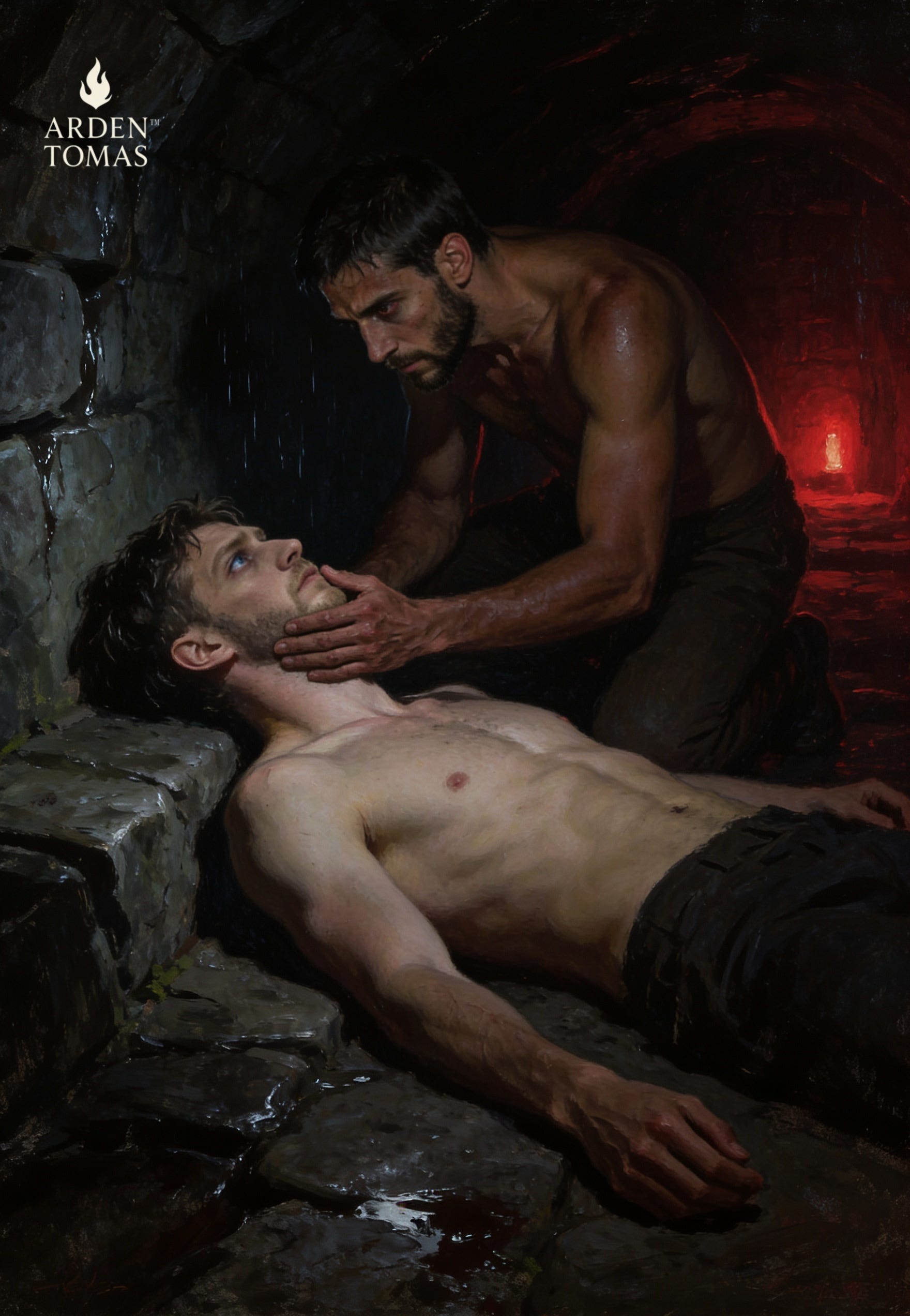
The voice was low. Calm. Not Alexander's voice — that one was too soft, too musical, too certain, as if every word had been composed in advance and every stress decided beforehand. This voice was uncertain. Human. The voice of a man speaking because he didn't know what else to do — a man sitting in the dark with a stranger, offering the only thing he had left.
Leo opened his eyes.
It was dark. But not entirely — total darkness blinds, and this dark only concealed. A faint reddish glow flickered in the distance. Not a flame. Not a lamp. Something else, something that didn't illuminate but only existed, signalling that something out there could see, even if Leo could not. The light was red, but not the red of blood. Deeper. Older. The red that came before fire. Before light. Before the world.
And there was a smell — the damp, the metallic mineral of the rock, and something else. Grass. Not fresh grass. Dried grass, herbs brewed for tea, the scent lingering in the air like a memory that refuses to die. Someone had made tea here. Recently. Or a thousand years ago. The deep made no distinction.
And then there was the face.
Close. Too close — Leo flinched back, but a hand on his shoulder held him, not hard, only present. Dark hair, short, neat, not too short and not too long, trimmed as though someone had gone on caring for it even here, in this dark, where no one could see. A beard, short and even, not fashionable but practical — the kind of beard a man wears not out of style but because shaving is pointless when there is no one left to shave for. The face was angular. Striking. Not handsome in the classical way — nothing like Alexander's features, which were too perfect, too symmetrical, as though shaped by ink rather than by nature. This face was human. Asymmetrical. The nose slightly broken — not visibly, but a hand would feel it. The jaw sharp. The cheekbones high.
Not pretty. But handsome. The kind of face a man looks at once, then looks at again, and then cannot forget — not because it is beautiful, but because it is true. Because the features don't lie. Because the face is not a mask.
The eyes were dark, brown, and there was something in them Leo recognized, because he had seen it in his own reflection not long ago: emptiness. But not complete. Beneath it, something else. An ember. Hope that something had buried a very long time ago and failed to put out. Like coals under ash — invisible, but hold your hand close and you feel the heat.
"Who are you?" Leo's voice came out raw. His throat was dry — not from fear, but from the air, which was thick down here, heavy, as though each breath were slightly harder than the last, as though the stone were rationing it, giving just enough to keep him alive and no more.
"Noah," the man said. He said the name the way a man says something he hasn't used in years. As though identity were a pair of shoes left in a closet too long, pinching now, tight, but still his own. "Welcome to our eternal prison."
Leo tried to sit up. His body objected — every muscle ached, every bone hurt, as though the fall hadn't ended on the stone but inside him, and his body was still echoing the impact. Noah helped him. His hands were strong and steady and gentle — gentle the way a man is gentle when he knows another man's pain isn't his own and feels it anyway. The palm was dry, callused. Not a writer's hand. The hand of a man who works. Who lifts. Who carries.
"What happened?" Leo looked around.
The space — if it could be called a room — was neither cellar nor cave. The walls were stone, but not cut stone. They looked grown, as though the deep beneath the house had shaped them itself, not with tools or hands but with time and pressure and hunger. The surface wasn't smooth. It rolled, organic, as though the walls were breathing, as though the rock were alive on some slower clock that had nothing to do with human time.
The air was damp but not cold. Tepid, like breath. And there was a sound — deep, slow, rhythmic, coming not from the walls but from far below. A pulse. Like a heartbeat that wasn't human and was nonetheless alive. The heart of the house. Or the stomach of the house. The difference didn't matter. Both were empty and both were hungry.
"Alexander," Leo said. The name came up bitter, like bile. "He—"
"He took your life," Noah said. He sat down beside him. The rock they sat on was smooth, worn down by something. Not for comfort. Out of need. In an eternal prison comfort doesn't exist, only endurance, and endurance requires a surface flat enough to sit on that won't cut the skin. "He stepped into your place. He's up there. In your house. In your kitchen. In your bed. Your pen in his hand. Your name in his mouth. And you're down here. With me."
Leo studied him. Noah's face gave away no age — no lines, no grey, none of the softening that marks the passage of time in skin. But his eyes were old. Not their color. Not their shape. Their depth. The kind of depth that only comes when a man has looked into the dark too long, and the dark looked back, and the looking never stopped, until the eyes learned the language of the dark and now the dark speaks through them.
"How long have you been here?" Leo asked.
Noah smiled. It was faint and sad — not the smile of amusement but of memory. The kind of smile that comes when a man is asked a question whose answer cannot be measured in numbers.
"I don't know. There are no days here. No seasons. The light never changes — that red flicker was there when I came and it will be there when I'm gone, and between the two there's no difference. Nothing around me changes. I don't change." He looked back at Leo. His eyes — old, deep, dark — held steady, and in that steadiness was something that landed with almost physical force: truth that asks nothing and simply stands. "That's the point, Leo. That's the prison. Not the walls. Not the stone. It's that time stops and you don't. Your body doesn't age. Your wounds don't heal and they don't turn septic. Starvation doesn't kill you, it only tortures you. Thirst doesn't kill you, it only burns. You can't die here. You can only suffer. Forever."
Leo felt the fear — not in his chest, but deeper. In his spine. In his bones. The kind of fear that isn't of death but of death withheld. That the dark won't end, only continue, and the continuing isn't a promise but a sentence.
The rock pulsed beneath them, slow and deep, and in the pulse was something very close to breathing. The house breathed. The stone breathed. And whatever was hidden down there was alive, and its life was not the life Leo knew but something else, something older, something that doesn't ask and only waits.
"Before you," Noah went on, and his voice dropped lower now, almost to a whisper, as if the walls were listening, as if the deep were paying attention, "there were others. Four of them. All of them died. Not down here — the prison doesn't allow death. Outside. Alexander carried them out when they got too weak. Sickness. Infection. Exhaustion. The body gave up, and whatever holds us here couldn't hold them. Alexander didn't care. He found a new victim. A new pen. A new name. A new face to love and hollow out."
The words drifted in the wet air, and Leo felt the place absorb them — not the sound, the meaning. The deep remembered. It always remembered.
"But you didn't die," Leo said.
"No. Because he looks after me." Noah looked up into the dark, toward the red flicker. The light — if it was light — didn't move, but something in the way Noah looked at it said he wasn't watching the light. He was watching whoever held it. "The red-eyed thing. He takes care of us. Brings food. Water. Clothes, when we need them. He isn't human — not anymore — but he takes care of us. On Alexander's orders. Alexander wants me alive. And now you as well."
"Why? Why keep us alive?"
"Because the sacrifice has to be alive to be worth anything." Noah looked down at his own hands, at palms gone smooth from years of stone. "The dead give nothing. The living — the living is what Alexander wants. The soul. The will. The thing that moves the body. That's what he drinks. Not blood, not flesh. The self. And the self can only be taken while you're still in it."
Leo bowed his head. His hands shook — not from cold, but from understanding. Alexander hadn't loved him. Alexander had been eating him. Slowly, tenderly, piece by piece, and Leo had let it happen because the feeling of being loved was the bait, and the bait had worked. The bait always works when the starving man is hungry enough, and Leo had been starving. Not for bread. For a touch, a look, for someone to see him. And Alexander had seen him. Not in order to love him. In order to eat.
"We have to break it," Leo said. His voice was stronger now. Not strong, but stronger. The fear hadn't gone anywhere, but something had settled in beside it: rage. The kind that isn't hot but cold, that doesn't flare but burns quietly, like coals under ash. The kind that doesn't ask. It waits. For the chance. For the moment. For the word.
"We do," Noah said. "But not today. Today you rest. You drink. You eat. The thing will bring food. I'll keep watch. Tomorrow we plan. Tomorrow we start."
"Tomorrow," Leo repeated, and the word rang hollow, because in the dark there is no tomorrow, only now, and now doesn't end. It only continues.
The creature came in the evening.
Leo didn't hear it. There were no footsteps, no sound, none of the fine grit of a foot on stone. One moment the dark was empty and the next it was standing there. As if the darkness had shaped it. It hadn't come and it hadn't arrived. It simply was.
Tall. Thin. Not human — the shape was humanlike, but the proportions were wrong, as though someone had remembered roughly what a man looks like and forgotten the details. The shoulders too narrow. The arms too long. The fingers long, thin, seemingly jointless, like roots growing through soil that don't know where to stop. Its eyes were red. Not the red Leo associated with blood, but something deeper, older — the red that came before fire, before light, before the world. A red that did not shine. It only watched.
The smell of it wasn't human. It wasn't animal either. Mineral, but not the mineral of stone — the mineral of whatever lies beneath stone and has never seen sun. The smell was cold, and Leo felt it in his nose and in his throat, and it reminded him of something he couldn't name. Something old. Something forgotten. Something that lives in the marrow and wakes only when a man is in the dark and the dark is alive.
The creature set a tray down in front of them. Bread. Water. Fruit — dried, dark, sweet, the kind that doesn't come off a tree but out of preservation, food built to survive. The bread smelled fresh, yeasty and warm, and Leo's stomach cramped, and in the cramp was shame and relief at once: the body wants to live. The body always wants to live, even in the belly of the deep, even in an eternal prison.
Then the creature turned and left. Or vanished. Leo couldn't tell which. The dark closed over the space like water, and it was gone, and steam still rose off the bread, and the water was clean, and the sweet smell of the fruit mixed with the wet of the stone. The whole thing — the food, the dark, the rock, the creature — was real and dreamlike at once, like the kind of dream in which a man knows he's asleep and cannot wake.
Noah ate. Leo ate. The bread was fresh — actually fresh, warm, the crust crisp and the inside soft, and Leo felt both at once against his tongue, and the taste of wheat and salt and yeast was so real he nearly wept. The water was clean and cold and went down his throat like rain in a desert. The fruit was sweet — honeyed, dense, the kind of sweetness that comes not from sugar but from time and drying and concentration. As though the deep, which had corrupted everything holy, had left the food alone. As though food were sacred. Or as though the creature that brought it knew food was the only thing down here that doesn't lie.
"He's a prisoner too," Noah said, chewing. His voice sounded muffled; the walls took it like they took everything. "I'm not certain. But sometimes — sometimes it's like he's looking. Like he sees. Like he remembers. He isn't evil, Leo. He isn't good. He's a slave. Like us."
Leo looked after it, into the dark where it had gone. The red flicker in the distance hadn't moved. But he would have sworn its rhythm changed — quicker for a heartbeat, as if whatever held that light had heard the words and something in it had stirred. Something old. Something human. Something living down in the deep, waiting.
The days ran together, or whatever passed for days down there. Sleep and waking alternated and marked no time. Meals marked no days. Conversations marked no direction, only depth, further down each time, as Noah told him everything.
About the pen. About the purple ink that wasn't ink but liquid memory — the blood of the entity, poured into a writer's mouth to remake him, and the remaking doesn't ask, it only takes. About the ink that tasted sweet, sweeter than honey, sweeter than the fruit the creature brought, and how the sweetness was the bait, the one thing the entity gives before it takes everything else.
About the entity behind the ink. Not one being but many. The reflection of every pen's owner, desire given a body and sent out to lure and love and hollow out the writer. About Alexander, who was not one man but all of them — who wore every face a writer could love, spoke in every voice a writer wanted to hear, offered every touch a writer had been waiting for. And all of it was a lie that felt truer than truth, because the lie had been written by the writer's own desire, and a man cannot call his own desire a liar.
About the house that was not a house but a trap — stone and ink and hunger that had been feeding for centuries. The house that was always beautiful, always inviting, always exactly the house the writer wanted to see. And the beauty was the bait, and the bait always works.
"The first writer I know of came here in 1654," Noah said. His voice was neither soft nor loud now — level, like the pulse of the rock, like the breathing of the house. "It could be older. The deep remembers, but it doesn't speak. The creature speaks, but it doesn't remember. Only the entity knows everything, and the entity says nothing it doesn't intend to."
Leo rested his head back against the wall. The rock was damp — not running, not dripping, evenly wet, like dew on grass. The moisture worked through his hair and onto his neck, and the tepid vapor reminded him that this place was alive. That the house was alive. That something under the stone and under the house was living, and its life was not life but hunger.
"And the red-eyed thing?" Leo asked. His voice echoed — not off the walls but inside the stone, as though the deep repeated it back lower and slower than it had gone in.
"He belongs to the house. To the stone. To the deep." Noah watched the red flicker. The light didn't move, but its rhythm was slow, and the slowness was hypnotic, the kind of rhythm a man falls asleep to, and the sleep isn't rest but falling. "He isn't the entity's servant. He's the house's. Alexander gives him orders, but the house keeps him alive. Two masters. Two sets of orders. And sometimes the house's are stronger."
Leo thought about it. He looked at the walls. At the red flicker in the distance. At the moisture, warm as something's breath. The house was breathing, slow and deep, and in the breathing was something that belonged not to rest but to hunger. The house was hungry. But not for Leo. Not for Noah. For something else. Something further down.
"Does the house want something?" Leo asked. The question came out quiet, but the rock repeated it, and the echo didn't die. It travelled downward, as though the question had fallen into the middle of the stone, and the stone answered — not in words, but in a pulse. Slightly stronger. Slightly faster.
"The house is hungry," Noah said. "But the house doesn't want us. The house wants Alexander. The house knows Alexander shouldn't be here. The house knows the entity is using it. The house—" Noah stopped. The pause went on a long time, and it wasn't a search for the words. It was a weighing of whether to say them. As though what was coming was dangerous, and the danger came not from the stone but from the words themselves. "The house is waiting."
"Waiting for what?"
"For someone to break the curse. Or at least break Alexander's hold. The house can't free us. But if we break Alexander's hold, the house might open a way."
Leo nodded. Slowly. The fear was still in his bones, his spine, between his teeth, which he had to hold together to stop them chattering. But the rage was next to it. And next to him was Noah. And the two of them together — the rage and the other man — were bigger than the fear. Not enough yet. But bigger.
The planning took days.
Noah knew what Leo didn't — the rules of the house, the behavior of the stone, the habits of the creature. Leo knew what Noah didn't — the writing. The pen. The ink. The words that had brought Alexander into the world, and might take him back out.
"The pen is the key," Leo said. His voice was firmer now — not loud, but aimed, like a hand that knows where it's going. "The pen wrote him. The pen can write his ending."
"But the pen is upstairs," Noah said. He wasn't arguing. He was asking. The question was in the stress of it, and what it asked was: *are you sure? Are you sure enough to bet both our eternities on it?* "In Alexander's hand. And the pen doesn't write what you want. It writes what the entity wants. You already know that."
"I know." Leo looked at the wall. At the moisture. At the dark patches that weren't mold but something else, something that took shape if a man looked long enough. Faces? Letters? Both? The stone remembered, and memory takes a form if the eye is patient. "But what if I don't write with the pen? What if I write some other way?"
"Some other way?" Noah turned to him. His eyes — old, deep, dark — were closer now, and Leo saw the ember he'd only guessed at before. Not flame. Heat. Not brightness. Presence.
"What if I write on the stone?" Leo pointed at the wall. The moisture caught the red light like sweat on skin. "The stone belongs to the house. Not to the entity. If I write on the stone, the house reads it. Not the entity."
Noah looked at him. His eyes — old, deep, hopeless — showed something for the first time. Not hope. A man doesn't dare hope here, not in the belly of the deep, where hope is the cruelest thing there is. Possibility. A possibility isn't a promise. It's a door. A door that might be locked and might not, and the difference is one word.
"With what?" he said. "You have no pen. You have no ink."
"I have fingers. I have blood. I have stone." Leo reached out and laid his hand on the wall. The wet came through against his fingertips. Tepid. Alive. Not the warmth of the stone — the warmth of the house, and while the warmth of the house wasn't love, warmth is warmth, and the hand that touches it feels it, and the feeling is real. "Blood writes. Stone reads. The house answers."
"That's madness," Noah said. But his voice didn't refuse it. It shook — and the shake wasn't fear. It belonged to a man who hadn't dared hope in far too long, and now hope was coming toward him, and the approach hurt, because hope disappointed is crueler than no hope at all.
"Yes. It's also madness that a pen brought something to life. That ink loves. That a house gets hungry." Leo pressed his palm flat against the wall. The wet clung to his skin and the rock pulsed under his hand, slow and deep, and the pulse strengthened, as though the material could feel him there. "Everything here is madness, Noah. The only question is which side of the madness you stand on."
Noah looked at him. Then he nodded. Slowly. It wasn't surrender. It was a decision — a decision made by a man who knows the risk is eternal and steps forward anyway.
"All right. But carefully. If Alexander gets wind of anything—"
"I know."
"No. You don't." Noah's voice went sharp. The gentleness dropped out of it — not for good, but for a moment, the way a cloud takes the sun and the ground goes cold and you remember the sun isn't always there. "If Alexander gets wind of anything, we don't just die. You can't die here. If Alexander gets wind of anything, we stay here forever. Forever. Do you understand me? Not a year. Not ten. Not a hundred. Forever. The stone won't let go. The body won't age. The mind—" He stopped. "The mind will."
The silence went on. It wasn't the absence of words. It was their weight. The rock pulsed, and the pulse was slower now, as if the house were listening too, and the listening was attention.
"I've seen what happens to the mind, Leo," Noah said, and his voice was quieter, and the quiet wasn't gentleness. It was pain. "I watched the third one — Kovács — start talking to the wall. Then the wall answered him. Then he couldn't tell which of them had gone mad, him or the wall." Noah looked at the wall. At the wet. At the patches that took shape. "He was the first one Alexander carried out. Not because he died. Because there was nothing left in him to eat. The soul was gone. The body stayed. Alexander has no use for an empty vessel."
Leo felt the weight of it. Not the weight of the words. The weight of the fact. Down here a mistake cannot be undone. Down here risk isn't temporary. Down here eternity isn't a promise, it's a threat. The rock pulsed, and the pulse seemed to agree — slow, deep, patient. The deep waited. It always waited.
"We'll be careful," Leo said. His voice didn't shake. Not because he wasn't afraid, but because fear must not be allowed to speak. Fear stays in the bones, in the spine, between the teeth, and it stays quiet, because silence is the one weapon fear cannot use.
Days went by. Or whatever passed for days in the dark — sleep and waking, meals that marked no time, conversations that marked no direction, only depth.
Alexander didn't come. Leo heard him sometimes, above the rock, in the house: footsteps, laughter, the scratch of the pen that had been his and was in Alexander's hand now, writing his name. The sounds came muffled, like sound underwater, and Leo couldn't tell whether they were real or whether the deep was lying, because the deep can lie. It remembers, and memory isn't always true.
But the stone kept them apart. The stone kept everything apart. And what was up there — Alexander, the pen, the house, Leo's life — was further away than the ocean, further than the moon, because the ocean and the moon can be reached, and this prison does not let go, and what lies under it stays under it.
Or perhaps not.
And Noah was there.
Leo didn't know when it happened. There was no moment — no kiss, no confession, no question, none of the clean step that takes a man from one state to another. Only approach. Step by step, like two planets whose orbits slowly fold into one another.
First the eyes. Noah's eyes, old and deep, and Leo's eyes, young and emptied out, and the two met, and where they met something happened. Not light. Heat. Not brightness. Presence. The recognition that the other one was there, and that being there was enough.
Then the bodies. They sat closer. They lay closer. The rock was cold, but the other body was warm, and warmth pulls the way fire pulls in the dark — not because fire loves, but because fire lives, and life draws life, and in the belly of the deep, where everything is either dead or eternal, life was the only real thing left.
Noah's shoulder against Leo's shoulder. Noah's back against Leo's chest. Noah's breath on Leo's neck, warm and alive and human, and Leo felt a heartbeat that wasn't his own slowly bring itself into time with his, like two clocks finally ticking together. His hair — dark, short, untended but clean — brushed Leo's chin, and the smell of him wasn't perfume or soap. It was man. Skin. Hair. The smell that can't be named because it doesn't belong to any one thing but to the whole person, and the whole person is more than his parts.
Leo breathed him in. The salt of Noah's neck, warm skin, something woody underneath it that mixed with the damp, and the result was the closest thing to home in all that confinement. Not the house above — not the house that belonged to Alexander, to the pen, to the entity. The house that gets built between two bodies when the dark is dark enough and the quiet is quiet enough and the two of them are close enough.
Then came the night — or what passed for night, when the red flicker dimmed and the dark got deeper and the air got thicker and the world above went silent, and the breathing of the house slowed. Not the slowing of rest. The slowing of sleep. The house slept, or came as close to sleeping as it ever came.
Leo didn't know which of them moved first. Perhaps him. Perhaps Noah. Perhaps both at once, like an equation you can't solve with a single variable. The rock beneath them was warm — not with its own heat, but with theirs, held back by the walls the way a palm holds water.
Noah's face was close. His beard scraped Leo's chin, rough and human, not smooth, not perfect, and the roughness was good because it was true, and truth was the only thing down here that didn't lie. His eyes — dark, old, deep — were open, and Leo saw himself in them. Not as a reflection. As a real thing. As he had been before Alexander came: tired, hungry, but whole. Not emptied. Not drained. Whole.
Leo touched his face. His fingers found the beard, short and coarse and human. Not smooth. Not perfect. Not cold stone. Not ink. Flesh. Living, warm, pulsing flesh, and the artery beat under his fingertip, and that beat gave what the prison could not: life. Real, human, finite life, valuable precisely because it ended, and down in the deep, ending was the only thing that could stand against forever.
Noah took his hand. He didn't pull it away. He didn't hold it hard. He held it. The way a man holds another man's hand when there's nothing left in the dark but a hand and warmth and a pulse saying *I'm here. I'm here. I'm here.
"We shouldn't," Noah said. But his voice didn't refuse. It asked. And the answer was in their bodies, not in words.
Leo didn't answer with words. He answered with his mouth.
The kiss wasn't weak. It wasn't careful. It wasn't the uncertain first kiss that asks a question. It was the one that answers. Noah's lips were dry and cracked and human — not Alexander's lips, which were always perfect, always soft, always as though ink had shaped them and nature had never been involved. These lips were cracked. Warm. They had a taste — mineral, water, bread, and something else that was only Noah: salt and iron and human. Leo drank it the way a thirsty man drinks, not carefully, not in measure, but all of it, and the tongue that pushed into Noah's mouth wasn't asking. It was searching. What it found — tongue, teeth, spit, heat — wasn't Alexander. Wasn't ink. Wasn't bait. It was a man. A living, breathing, half-shaking man lying in the dark, trading darkness for another body.
Comments
Nothing yet. Say the first thing.
Sign in to join the conversation.