
M/M Romance 🔞
The rain started before dawn.
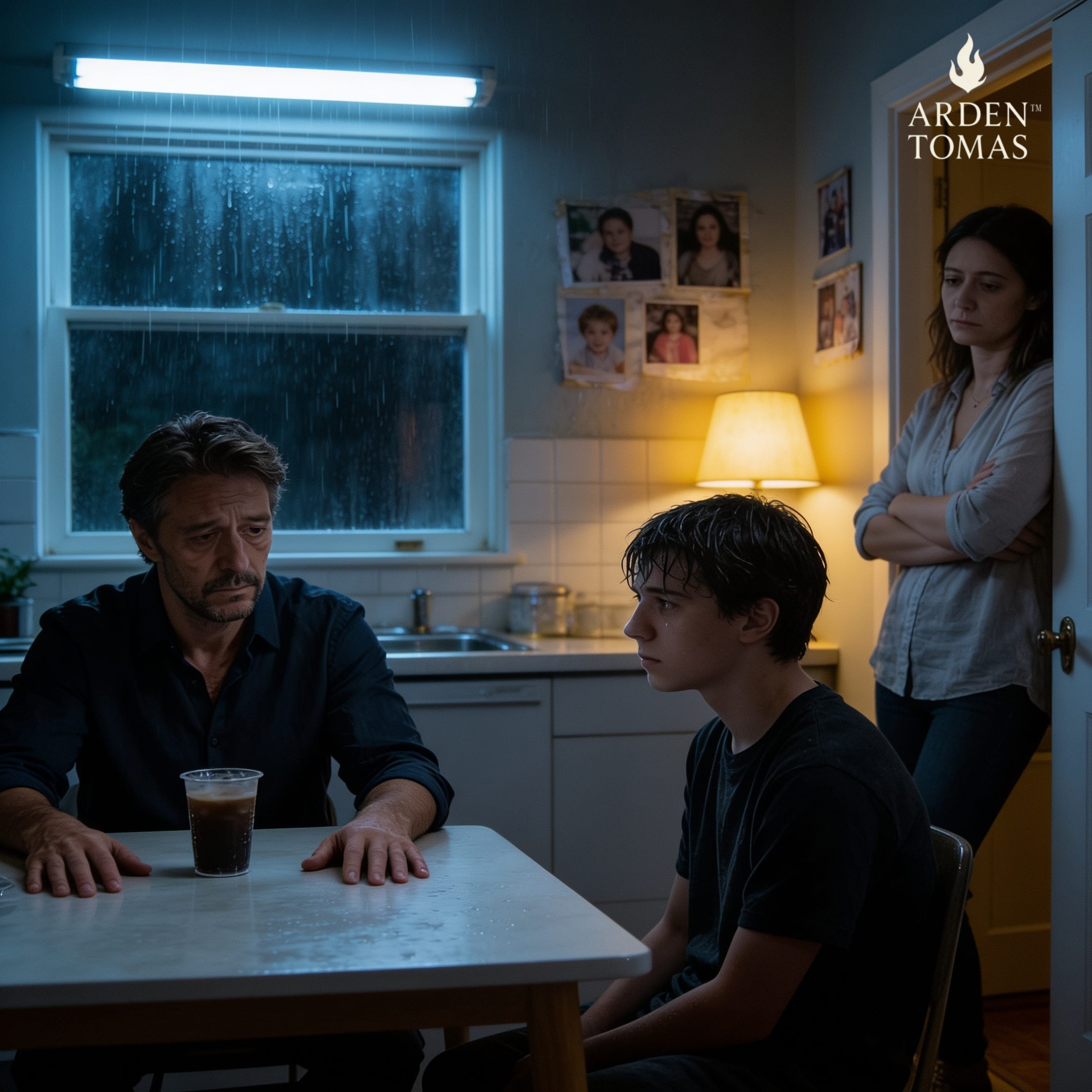
It didn't pour — it only drizzled, fine and steady, like someone who doesn't want to intrude but can't leave. The drops ran down the window glass in slow little streams, and the kitchen light distorted them into long trembling lines, like a heartbeat on a hospital monitor. Oliver sat at the kitchen table looking at the coffee Eva had poured him. The coffee steamed. The steam mixed with the smell of the rain — wet earth, wet stone, wet metal. Beyond the window the garden was dark, and the rain sat on the patio furniture waiting for someone to come and sit down.
Eva sat across from him. She wasn't eating or drinking. She was just sitting. Her hair pulled back, grey coming through in streaks that had appeared last year and stayed. Her face wasn't angry. It wasn't sad. It was the face Oliver knew — practical Eva, who had learned across sixteen years that feelings aren't for showing, they're for managing.
Her eyes were different, though. Tired. Not from the night. From the decade.
"Tell Mark," Eva said.
Oliver looked into the cup. The surface of the coffee trembled — not from his hand, but from the rain, drumming somewhere up on the roof, the vibration passing through the walls and the tabletop and the liquid and stopping in front of his hand.
"Not yet," Oliver said. "Give me time."
"Time?" Eva didn't raise her voice. She never raised her voice. "Oliver, I knew years ago. I waited. I didn't ask, I didn't demand, I didn't cry. I waited for you to say it out loud. And you said it. Now say it to him."
"He's sixteen, Eva."
"I knew when he was born." Eva looked into her coffee but didn't drink it. "For sixteen years I've known my husband isn't the man I told myself he was. For sixteen years I've carried that. It wasn't mine, and I carried it. Now you carry it."
Oliver didn't answer. The coffee went cold. The steam went. Outside the rain strengthened — the drops weren't drizzling now, they were falling, and they weren't sitting on the patio furniture any more, they were running off it. The kitchen faucet dripped — one drop, one drop, like a clock that measures patience instead of time.
"Tonight," Oliver said.
Eva nodded. She didn't smile and she didn't cry. She got up, went to the sink, and turned the faucet off.
Mark got home at six. He got off the school bus at the corner and ran through the rain to the front door. His backpack was wet, his shoes muddy, his hair plastered to his forehead. He came in and his shoe slipped on the floor — the linoleum was wet from the rain the mat hadn't caught.
"Hey, Mom," he said, and headed for his room.
"Mark," Eva said. "Sit down a minute."
Mark stopped. Turned. He saw his father at the kitchen table — in his place, where he always sat, but different now. Oliver's hand was on the table, not on the cup, and his fingers weren't moving.
Mark felt it. He didn't know what — but he felt it. The air was different. The kitchen smelled different. Not the usual onion-and-paprika cooking smell, not Saturday pancakes. Something else. Something tight. The smell of the rain and the smell of cold coffee and something Mark couldn't name — the smell of fear, which is like fresh iron, like blood, like the metal you taste in your own mouth when you're about to be afraid.
"What's going on?" Mark asked, and sat down.
Oliver looked at his son. Sixteen. Thin, tall, his face still a boy's and already a man's — soft hair on his chin, dark rings under his eyes from school and screens and being that age. His hair wet, stuck to his forehead, and a drop of rainwater running down the bridge of his nose, and Mark didn't wipe it away.
Oliver watched the drop instead of his son. The drop was easier.
"Your dad is different," Oliver said.
"Different how?" Mark put a hand on his backpack. "Are you sick?"
"No. Not sick." Oliver swallowed. His throat was dry. The coffee he hadn't drunk hadn't helped. "Your dad is gay."
The word landed in the kitchen like a glass knocked off a table that doesn't break — it just bounces once and rolls, and everyone watches to see where it stops.
Mark's face didn't change. Not right away. First came the blankness — the moment when the brain hears the word but hasn't attached the meaning to it yet.
Then it came.
"How long have you known?"
"Always."
Mark looked at his mother. Eva was leaning against the doorframe with her arms folded, and she wasn't looking at Mark. She was looking at the kitchen cabinet — the old scratched oak one Oliver had bought when they moved in, the one Eva hated and they had never replaced. Her face gave away nothing.
"Does Mom know?"
"Mom knows," Oliver said.
"Always?"
"Always."
Mark stood up. The chair scraped back across the linoleum — a sharp sound, metal on plastic. The drumming of the rain got suddenly louder, as though the house had felt the change too.
"Always," Mark said, and his voice didn't shout, it whispered, and the whisper was worse than shouting. "You both knew always. And you didn't tell me. You lied to me for sixteen years."
"We didn't lie, Mark—"
"Yes, you did." Mark's hand closed into a fist. "You lied. Every day. Every morning we sat down to breakfast and Dad smiled and Mom smiled and everything was fine — you were lying. This whole family was a lie."
"This family is not a lie," Eva said, and her voice still didn't rise, but something in it tightened, like strings pulled too close to the tuning peg. "This family is what it is. The rest — that's your father's business and mine, and it isn't yours."
"It isn't mine?" Mark stepped to the kitchen wall.
Photographs there. Mark at five on the beach. Mark at ten in the school play. Mark at thirteen with his father on the lake. The photographs were slightly warped from the damp, and Mark's own reflection looked back at him from the glass — distorted, stretched, not him.
"It isn't mine? I'm your son. I'm the one who walks into that school every day, where they pull my name apart because I'm not sporty enough, not loud enough, not hard enough. And now? What happens now, when it gets out that my dad's gay?"
"That's our business, Mark, not your classmates'—"
"It's easy for you!" Mark was shouting now. "It doesn't matter to you any more! You don't go to that school! You don't sit in that locker room when the others start talking! You're not the one they call kitten because you can't lift enough! And now? What are they going to say now? Kitten's dad is a faggot — that's what's going to happen. That's what they're going to say. And you won't be there. You won't hear it. You don't know what it's like."
Oliver stood up. The coffee cup was in his hand — he didn't know when he'd picked it up. He set it down. The small knock of it was quiet, but in the silence after Mark's words it was loud as a gunshot.
"Son—"
"Don't," Mark said. "Don't call me son. Not now."
He turned. The backpack stayed on the floor. His shoes left prints on the linoleum — muddy, wet, leading to the door like a trail someone had dragged and not finished.
"Mark, wait," Eva said.
"Son, please," Oliver said.
Mark didn't stop. The front door opened — the outside air came in, wet and cold, the smell of rain and wet grass and concrete, which in rain is always different, always sharper, always more bitter. The door slammed and the sound went through the kitchen, and the photographs on the wall shivered.
Oliver ran to the door and pulled it open. Mark was already across the yard — the bike was against the garage wall, wet, the chain rusted, the wheels muddy. Mark grabbed it and got on and pushed off, out through the gate, down the road, gone.
"Mark!"
The boy didn't turn around. The bike's light wasn't on. It was dark — the clouds, the rain, the hour. Mark's shape got smaller and smaller, and the sound of the wheels — tick, tick, tick — faded, and the rain swallowed it.
Oliver stood on the doorstep. The rain fell on his face. It was warm, not cold, and that was worse than cold would have been, because warm rain doesn't punish you. It only strokes your face. And Oliver didn't want to be stroked.
Eva came and stood beside him. She didn't touch his arm.
"I'm going after him," Oliver said.
"I'll drive," Eva said.
The headlights cut two yellow wedges into the rain that didn't get through the water so much as break on it and scatter, and the surface of the road was oily and shining, and the trees on either side were black and wet and dripping.
Eva drove. Silent, gripping the wheel, her eyes on the road. Her hands were shaking, and Oliver saw it, and said nothing.
Inside the car the rain was duller — even, rhythmic, like a heart that doesn't want to beat but has to. The smell: wet upholstery, wet shoes, the faint remainder of Eva's perfume, which she had put on that morning and the rain had mostly taken, so that only the base was left — musk and wood.
"Call him," Eva said.
Oliver got out his phone. His hand slipped on the screen — wet, sweating, shaking. Mark's name on the display: Mark — a bicycle emoji Mark had put there himself at thirteen when he got his first smartphone, and Oliver had never deleted it.
Ringing. Ringing. Ringing. Voicemail.
"He's not answering," Oliver said.
"Call again."
Ringing. Voicemail.
Ringing. Voicemail.
Ringing. Voicemail.
"Where is he?" Oliver stared through the windshield, but the rain erased everything — the landscape, the road, the trees, the future. "Where is he, Eva?"
Eva didn't answer. The car turned onto the hill road — the one that climbed above the town, narrow and winding, trees on one side and dark and nothing on the other. The headlights swept the asphalt: wet, mud-streaked, the white lines washed out and barely visible.
Then Eva saw it.
"There."
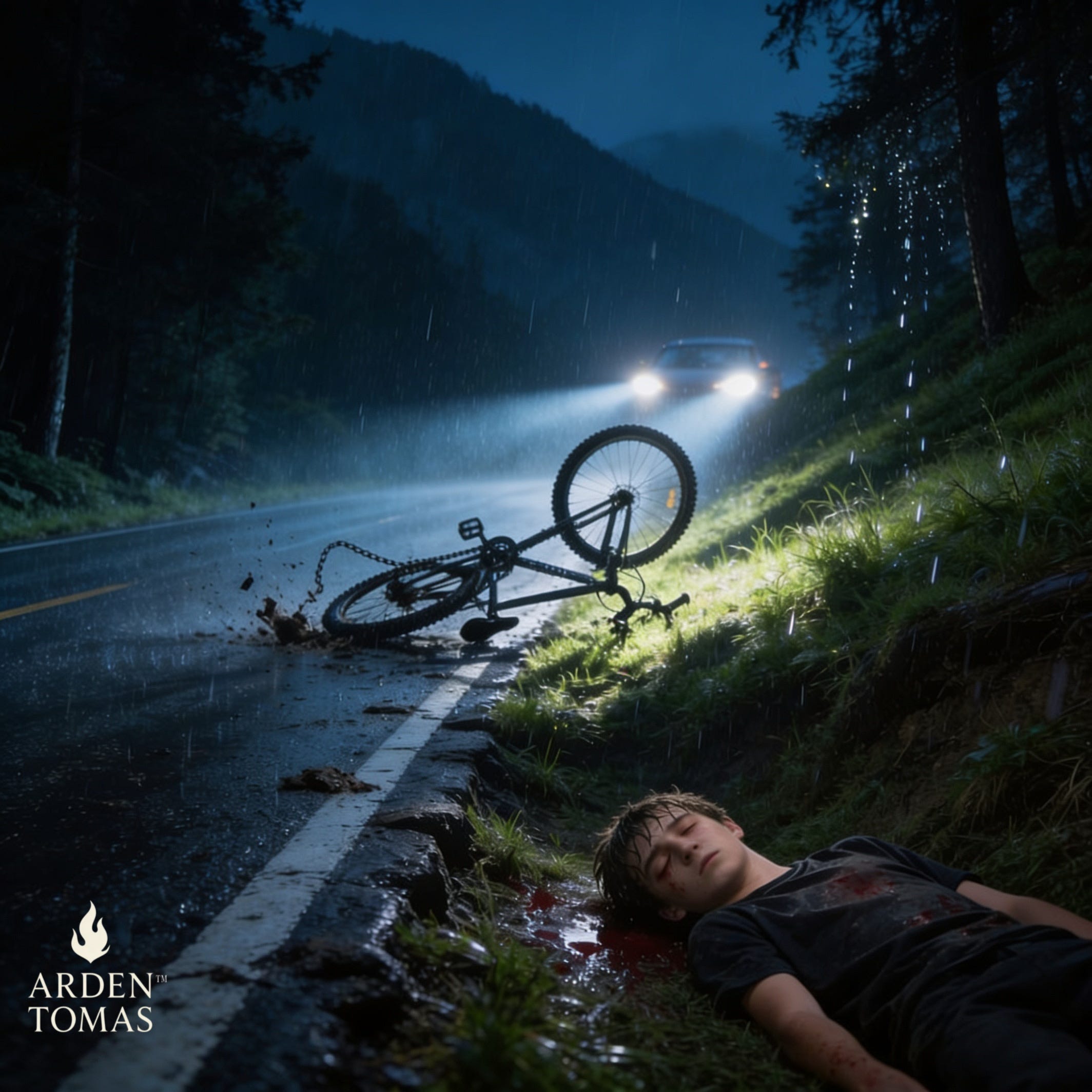
The bike lay at the edge of the road. Its wheels pointed upward like a beetle flipped onto its back. The chain was off. The handlebars bent. Raindrops on the frame — small, clean drops that didn't know the bike wasn't going anywhere.
Oliver had the door open before the car stopped. The rain hit his face and he didn't feel it. He ran. His feet slipped on the asphalt — his shoes weren't muddy, weren't wet, weren't right, weren't ready for any of this, but he ran, and reached the edge, and looked down the slope.
It was dark. The headlights didn't reach — only the first few yards, and there, in the grass and the dirt and the mud, Mark was lying.
"MARK!"
His voice came back at him — the hillside gave it back, the trees gave it back, the rain gave it back, and it got quieter and quieter and died, and no answer came.
Oliver went down the slope. The grass was slick, the mud slowed him, his shoes filled, his trousers soaked to the knee, and his hands went out ahead of him — grass, stone, branch, earth — and then he touched him. Mark's arm. Cold. Wet. Not moving.
"MARK! Son! MARK!"
Eva was behind him — down the slope, her phone's flashlight in her hand, and the light shook the way her hand shook, and the light found Mark's face.
The left eye swollen shut. The right eye open, but empty — not looking, not seeing, just open. His nose bleeding, the blood mixing with the rain, running down his cheek, staining the ground red, and the rain washing it, and more blood coming, and the rain washing it again, over and over, two things that couldn't stop each other.
Oliver went down on his knees. They slid in the mud. He put his hand on Mark's face, carefully, very carefully, and under his palm the boy's skin was cold and wet, and Oliver felt the rain on his own face and couldn't tell whether it was rain, and didn't care.
"Mark… please… son…"
Eva knelt beside him. The phone lay on the ground with the flashlight pointing up, and the light caught the falling rain — small dying stars that went out before they hit the ground.
"Call an ambulance," Eva said.
Her voice didn't shake. Her hands did, and Oliver understood that Eva's voice didn't shake because if it did she couldn't speak, and if she couldn't speak she couldn't help, and Eva always helped. Always. Even now. Even here, in the mud, in the rain, between the blood and the water, Eva was what she had always been: the one who holds the threads when everything else comes apart.
Oliver reached for his phone. His hand shook. The screen was wet. The line dropped and he dialed again and it rang and a voice answered, and Oliver didn't know what he was saying — the words wouldn't come, his mouth was open and no sound came out — and Eva took the phone out of his hand, and Eva said it: the address, the name of the road, the hillside, her son, her unconscious son.
And Oliver just knelt there and looked at Mark's face, and the rain, and the blood, and the rain, and the blood.
Hospitals always smell the same. Disinfectant, bleach, something chemical that doesn't belong to anything that belongs to living — not flowers, not coffee, not rain, not earth. The smell of death and life at the same time, and you can't tell which one you're in.
In the waiting room the fluorescents were blinding — even, cold, merciless, casting no shadow, permitting no darkness, showing everything. Oliver didn't want to see everything.
Eva sat beside him. They weren't holding hands. They weren't talking. There were others in the room — an old man coughing, a young woman on her phone, a child asleep in her mother's lap — and Oliver hated all of them, because they weren't here, weren't waiting for his son, weren't the ones whose lives had stopped. The hatred was stupid, and he knew it was stupid, and he couldn't stop it.
The clock on the wall ticked. Every second was a year. Every minute a decade. Oliver looked at his shoes — muddy, soaked, one lace snapped, the end of it hanging like a sentence nobody finished.
Then the doctor came. Young — thirty or so, tall, short hair, calm eyes. His coat was white, and Oliver hated the whiteness too, because white is clean, and nothing was clean.
"Mark Ashworth?"
"Yes," Oliver said, and stood, and his legs shook.
"Concussion. Contusions to the body, the limbs, the face. No internal injuries. Nothing broken. The CT is clear. We're keeping him overnight for observation. He may wake up, but don't let him move around much."
Oliver sat down. He didn't answer. The words — concussion, contusions, no internal injuries, nothing broken — floated above his head like the balloons they tie to the beds on the children's ward, and Oliver couldn't catch them and couldn't let them go.
"Can I see him?" Eva asked.
"Yes. One person."
Eva looked at Oliver. She didn't speak. She got up and went down the corridor, and Oliver watched her go — straight-backed, steady, her shoes not slipping on the linoleum, her hair not wet, her clothes not muddy. Eva was always like this. The one who doesn't fall, doesn't slip, is always on her feet. And Oliver hated himself for hating that, and loved her for it, and couldn't work out which was worse.
Eva disappeared down the corridor. Oliver was alone in the waiting room. The clock ticked. The fluorescents burned. The old man coughed.
Oliver looked at his palms — the palms that had touched Mark's face, that had felt the mud, that had felt the blood. There was nothing on them now. Clean, dry, empty. And that was worse than if the blood and the mud were still there, because at least that would have proved he'd been there, that he'd found him, that none of it was imagined.
Ten minutes. Fifteen. Twenty. Then Eva came back.
"He's awake. He's asking for you."
Oliver stood. His legs didn't shake this time. Now he had to walk. Now he had to be strong, because his son had asked for him, and you answer your son. Oliver was the one who left, who lied, who is gay, who is the reason his son was lying on a hillside — Oliver was that man, and Oliver had to go.
The corridor was long. The fluorescent light got harsher at every door, and the linoleum squeaked under his shoes, and the smell — disinfectant, bleach, and something sweet that isn't sweetness but medicine, dressings, painkillers, the smell that comes off a person when the person has stopped feeling anything.
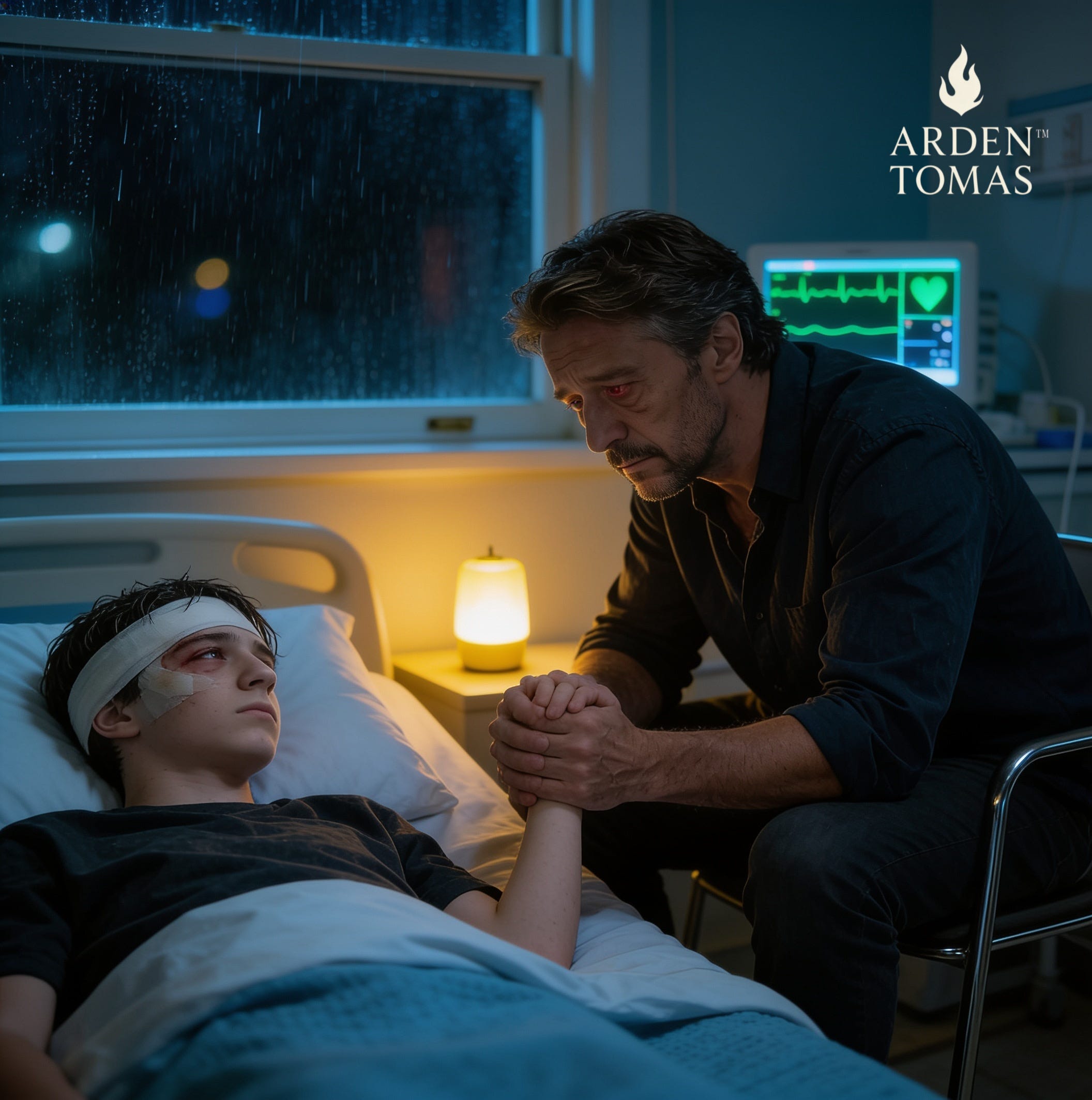
Oliver stopped at the door. It stood half open. The room was dark — only a bedside lamp burning, yellow, faint, like candlelight, and on the bed Mark was lying.
He was small. The hospital bed was large and Mark was small in it — sixteen, thin, his face bandaged, the left eye swollen shut, the right eye open. And the right eye was looking at Oliver.
The monitor beeped — even, slow. A heartbeat with nowhere to hurry to, because the boy was alive, and life doesn't hurry.
Oliver sat down beside the bed. The chair was metal and cold, and one leg scraped on the floor, and the sound was sharp in the quiet.
Mark didn't speak. Oliver didn't speak. The monitor beeped. Outside the rain fell, quieter now, as though it had worn itself out, as though it had understood that this wasn't a night to be loud on.
Oliver looked at his son. The son he had made sixteen years ago, lied to for sixteen years, loved for sixteen years — and the love had never been a lie. Never. But the lie had lain down beside it, and the love hadn't been enough, and the lie hadn't been enough, and nothing had been enough.
Mark's hand lay on the edge of the bed. Oliver put his own over it. Mark's hand was cold — the hospital cold, the rain cold, the shock cold.
Oliver closed his palm around it.
Mark didn't pull away.
They didn't talk. They didn't need to. The monitor beeped. The rain fell. The bedside lamp burned. The boy was alive. The father was there.
That was everything, and it wasn't nothing, and it was everything.
Oliver came out of the room and stood in the corridor. The fluorescents burned. The linoleum squeaked. The smell of disinfectant was everywhere — in the walls, in the air, on his skin, as though the hospital weren't a place at all but a smell that gets into a man and won't let go.
And then it came.
Not quietly. Not gracefully. Not the way they show it in films — one tear, one sigh, one look away. The way it comes in life: ugly, loud, broken open.
Oliver hit the wall with his fist. Once. Twice. Three times. The wall was hard and his hand hurt and the pain was good, because pain was something, and nothing was nothing, and it was the nothing Oliver couldn't stand.
"This is me," he said. "I did this. Because of me."
His voice didn't shout. It whispered. And the whisper was worse than shouting, because shouting lets it out and whispering keeps it in, and Oliver was in it and couldn't get out.
His knuckles were bleeding — the skin split, the blood on the wall, and on the white wall the blood was very red. Oliver looked at it. It was his blood, and not his son's, and that was worse.
Eva was standing at the end of the corridor.
She didn't come closer. She didn't speak. She didn't tell him it would be all right. She didn't tell him it wasn't his fault.
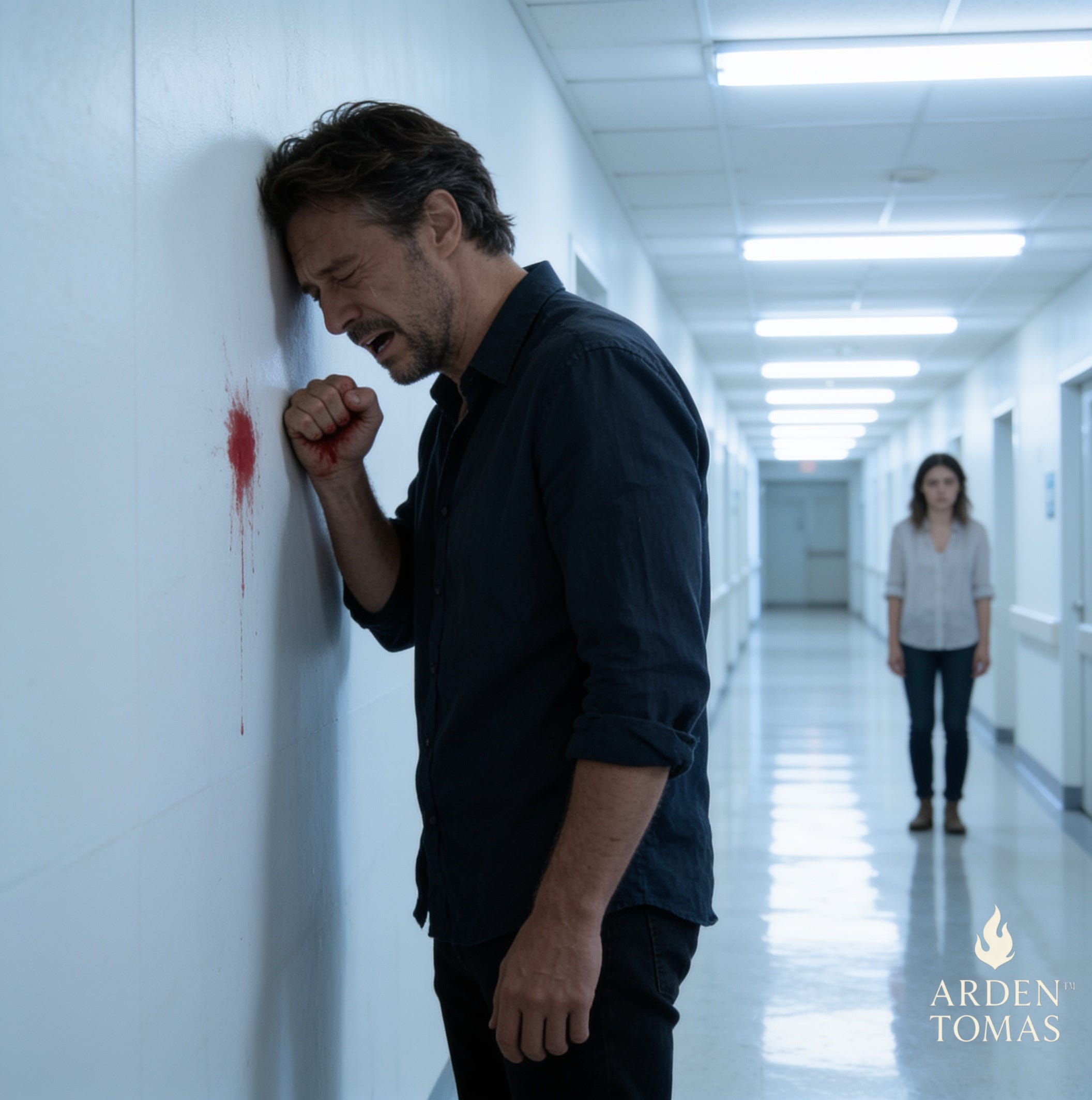
She stood, and watched, and her face wasn't hard, and it wasn't cruel, and it wasn't angry. It was tired. The tiredness that had been on her for sixteen years and was only showing now, here, under a hospital fluorescent that showed everything.
Oliver put his forehead against the wall. The wall was cold. The paint was smooth. His shoulders shook and his hand hurt and his head hurt and his chest hurt and there was nothing left that didn't.
Eva stayed where she was.
And the rain fell.

Comments
Nothing yet. Say the first thing.
Sign in to join the conversation.