
The Golden Cage – Chapter II: The Chains
Nimaatre
The heat of the day pressed down on Thebes like the hand of a god who does not lift it.
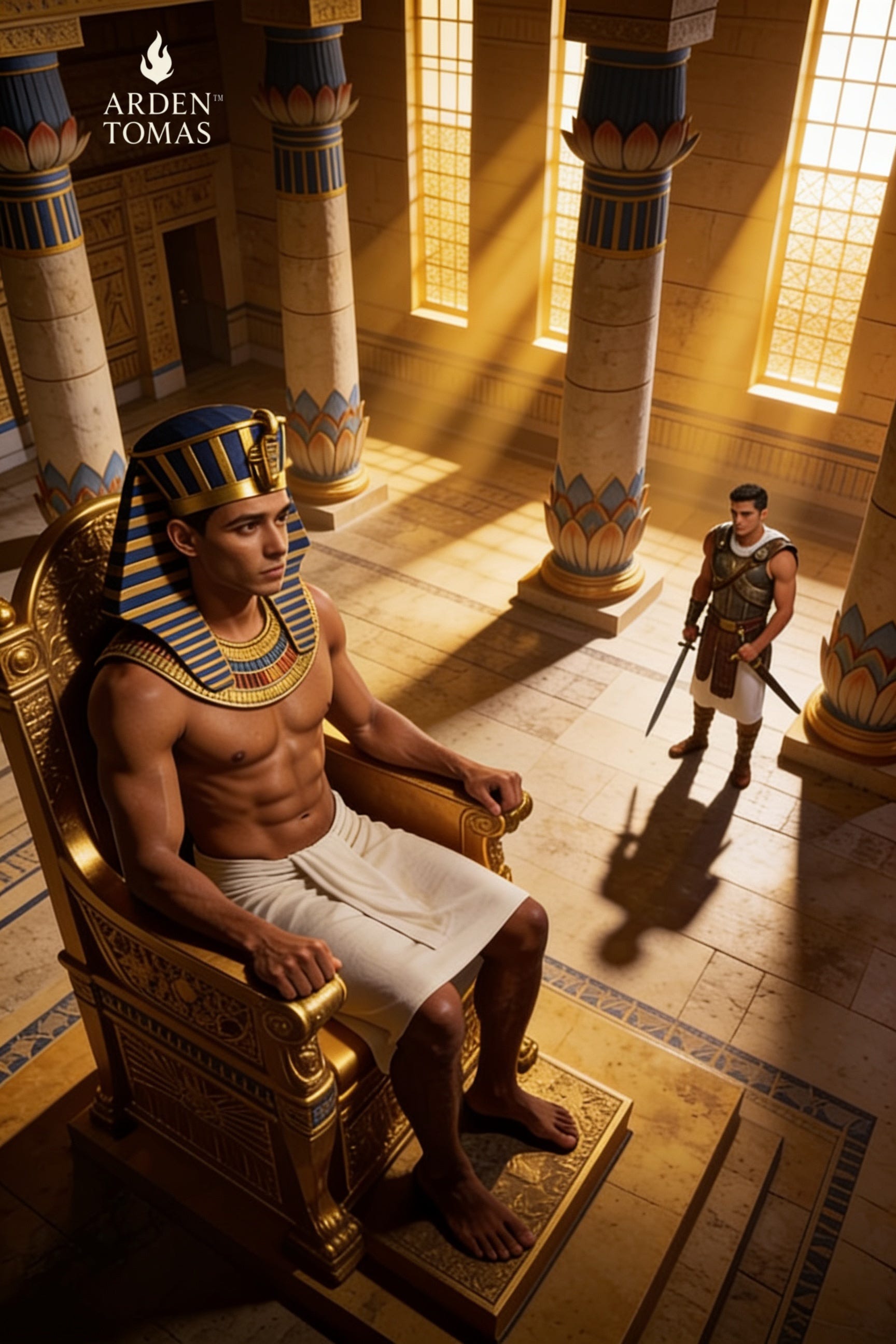
Nimaatre sat in the audience hall — not the throne room, but the larger chamber where the affairs of the empire were conducted in daylight, where the columns of papyrus and lotus rose to the cedar ceiling, where the light entered through high windows and fell upon the polished floor in golden shafts that moved with the sun like the fingers of Ra himself.
The reports were not good.
The flooding of the Nile had come late this year. The fields along the river’s edge had waited too long for the silt, and when the water finally came, it came unevenly — too much in the north, too little in the south. The granaries of Thebes were half-full. The granaries of Memphis were worse. The temple estates — the vast lands owned by the priesthood of Amun-Ra — had taken their share first, as was their right, as was the agreement between the dynasty and the priests that had held for three hundred years. But the people’s share — the share that fed the laborers, the craftsmen, the builders, the slaves — was thin.
Nimaatre knew what thin rations meant. His father had taught him before he died — not in words, but in the way he governed. A hungry people is a dangerous people. A hungry slave is a blade without a sheath.
The vizier Horemheb stood before the throne, his papyrus scroll in his hand, reading the reports in a monotone voice that filled the hall like the buzzing of flies. Horemheb was old — not ancient, but worn, like a stone step that has been walked on too many times. His face was lined, his eyes sunken, and his voice carried the weariness of a man who had served three Pharaohs and was now serving a fourth.
“—and the laborers of the western quarry have refused their morning rations for the third day, Your Majesty. The overseer reports that the slaves demand double grain, citing the temple estates’ distribution as precedent. When denied, they ceased work. The quarry is at a standstill. The blocks for the extension of the Karnak temple complex remain uncut.”
Nimaatre’s hand rested on the armrest of the throne. Not gripping — not yet. Resting. The stillness before the storm.
“And the overseer’s response?” Nimaatre asked. His voice was the Pharaoh’s voice — measured, deep, the voice that fills a room without rising.
“The overseer applied the rod, Your Majesty. Three slaves were beaten. One died.”
Silence. The hall was silent — not the silence of the throne room, which was intimate, enclosed. This was the silence of power. The silence that falls when a god hears of death and does not react.
“And after the beating?”
“The work did not resume, Your Majesty. The slaves retreated to the quarry’s edge and refused to move. The overseer requests additional guards from the garrison.”
Nimaatre looked at Horemheb. The vizier’s eyes were on the floor — the floor, always the floor, as if the truth lived in the granite and not in the air. Nimaatre wanted to grab his chin and force his face upward. Look at me. See me. But he did not. The Pharaoh does not grab. The Pharaoh sits. The Pharaoh listens. The Pharaoh decides.
“Send the garrison,” Nimaatre said. “Not to beat. To contain. I want the quarry sealed. No one enters, no one leaves. No food, no water. Three days. If they return to work, they eat. If they do not —”
He paused. The pause was not hesitation. It was the weight of the word before it falls.
“—then they are no longer my concern.”
Horemheb bowed. The scroll rustled. The scribes scribbled. The hall exhaled.
Nimaatre’s hand on the armrest. Not gripping. Resting. But the knuckles were white.
Behind him — three paces behind, at the column where the bodyguards stood — Nakhtmin did not move. But Nimaatre felt him. The way you feel the wall behind you in the dark. The way you feel the edge of a cliff beneath your feet. Not because you see it — but because your body knows it is there.
The audience continued. The reports of the south — the Nubian tribute, the gold shipments, the garrison reports from the second cataract. The reports of the east — the trade routes through the Red Sea, the incense and the frankincense, the ambassadors from Punt. The reports of the north — the delta, the Mediterranean, the Libyans pressing at the western border.
Nimaatre sat. Listened. Nodded. His face did not move.
But his mind — his mind was not in the audience hall. His mind was in the quarry. In the dust. In the bodies of the slaves who had refused to work, who had chosen the rod over the grain, who had looked at the overseer and said no. Nimaatre understood the no. He understood it in his bones, in the marrow of his spine, in the place where the crown sat heaviest. The no of a man who has nothing left to lose is the most dangerous sound in the world.
Because Nimaatre knew that sound. He heard it every morning, in the silence before the priests arrived. The no that lived in his own chest — the no he never spoke, the no he swallowed like stones, the no that sat in his stomach and never dissolved.
He was a slave. The most powerful slave in the world — but a slave nonetheless. The crown was his chain. The throne was his quarry. The priests were his overseers. And the rod — the rod was the divinity they pressed upon him every morning, the mask they painted on his face, the god they forced him to be.
He understood the slaves.
And that understanding was the most dangerous thing in the room.
Nakhtmin
The garrison was dispatched before sunset.
Nakhtmin watched from the palace wall as the soldiers marched west — fifty men, bronze spears, leather shields, the dust rising beneath their sandals like the breath of the desert. They moved in formation, disciplined, the rhythm of their march echoing off the stone walls of the western city. The people on the streets stepped aside. The merchants fell silent. The children stopped playing and watched with wide, dark eyes.
Nakhtmin had seen slave revolts before. Not many — not in his five years of service, which had been spent in the palace, behind the columns, in the shadow of the throne. But his father had told him stories. The revolt of the quarry slaves in the reign of Nimaatre’s grandfather — two hundred men who broke their chains and stormed the temple estate, killing the overseer and three guards before they were cut down. The revolt of the palace servants in the reign of Nimaatre’s father — less violent, more cunning, a poisoning that killed two priests and sickened a dozen more. The revolt that never made it into the official records — the one his father spoke of only at night, only at home, only in whispers: the revolt of the bodyguard itself, three generations ago, when the royal guard turned against the Pharaoh and the dynasty nearly fell.
“Slaves revolt for one reason,” his father had said, sitting in the doorway of their house, the evening air warm on his scarred arms. “Hunger. Not just of the body. Hunger of the soul. A man who is fed but not seen will still break his chains. A man who is seen but not free will still reach for the rod. The body is the last thing to starve. The spirit starves first.”
Nakhtmin had not understood these words then. He was young. He was a soldier. He saw the world in formations, in commands, in the clean geometry of the shield wall and the spear line. The spirit was not his concern. The body was his concern — the Pharaoh’s body, which he protected with his own.
But now — standing on the palace wall, watching the garrison march west, the dust settling behind them like a veil — Nakhtmin thought of the Pharaoh’s hand.
The hand gripping the armrest. The stillness that was not calm but containment. The Pharaoh had heard the report of the quarry slaves, and his hand had gripped the gold, and Nakhtmin had seen it, and in the grip he had read something that discipline could not name.
The Pharaoh understood the slaves.
Not as a ruler understands his subjects — from above, from the throne, from the distance of power. But as a man understands another man. From within. From the same hunger. From the same chains.
Nakhtmin’s hand tightened on the hilt of his sword. Not because of the slaves. Not because of the revolt. But because the man he was sworn to protect — the man whose body was his duty, whose life was his purpose — was a man who starved. And Nakhtmin could not feed him. Not with grain. Not with water. Not with the thing the Pharaoh actually needed, which was not food but freedom, and freedom was the one thing a bodyguard could not give.
Because a bodyguard is also a slave. A slave to duty. A slave to discipline. A slave to the three-pace distance that he may not cross.
The sun was setting. The sky over the western desert turned from gold to copper to blood. The garrison’s dust had settled. The city was quiet — the quiet before the night, when the markets close and the lamps are lit and the people retreat to their homes and the streets belong to the shadows.
Nakhtmin turned from the wall. The Pharaoh would be in his private chambers now — the evening ritual, the undressing, the removal of the crown, the washing of the kohl, the moment when the god became a man again. The bodyguards were not permitted in the private chambers. The Pharaoh’s body was holy — the priests washed it, anointed it, clothed it for sleep. The bodyguard waited outside the door.
But tonight, Nakhtmin did not wait.
Not because he broke the rule. But because the Pharaoh summoned him.
The messenger — a young servant, breathless, his feet bare on the stone — found Nakhtmin on the wall.
“Your Majesty requests your presence,” the servant said. “In the private garden. Not the chambers.”
Nakhtmin looked at the boy. The boy looked at the floor.
“The private garden?”
“Yes, lord. He dismissed the priests. He dismissed the servants. He wishes to be alone.”
Alone. The word was a contradiction. The Pharaoh wished to be alone — and summoned the bodyguard. The man who wished to be alone did not summon. The man who wished to be unseen did not call for the one who saw him.
Nakhtmin sheathed his sword and went.
Nimaatre
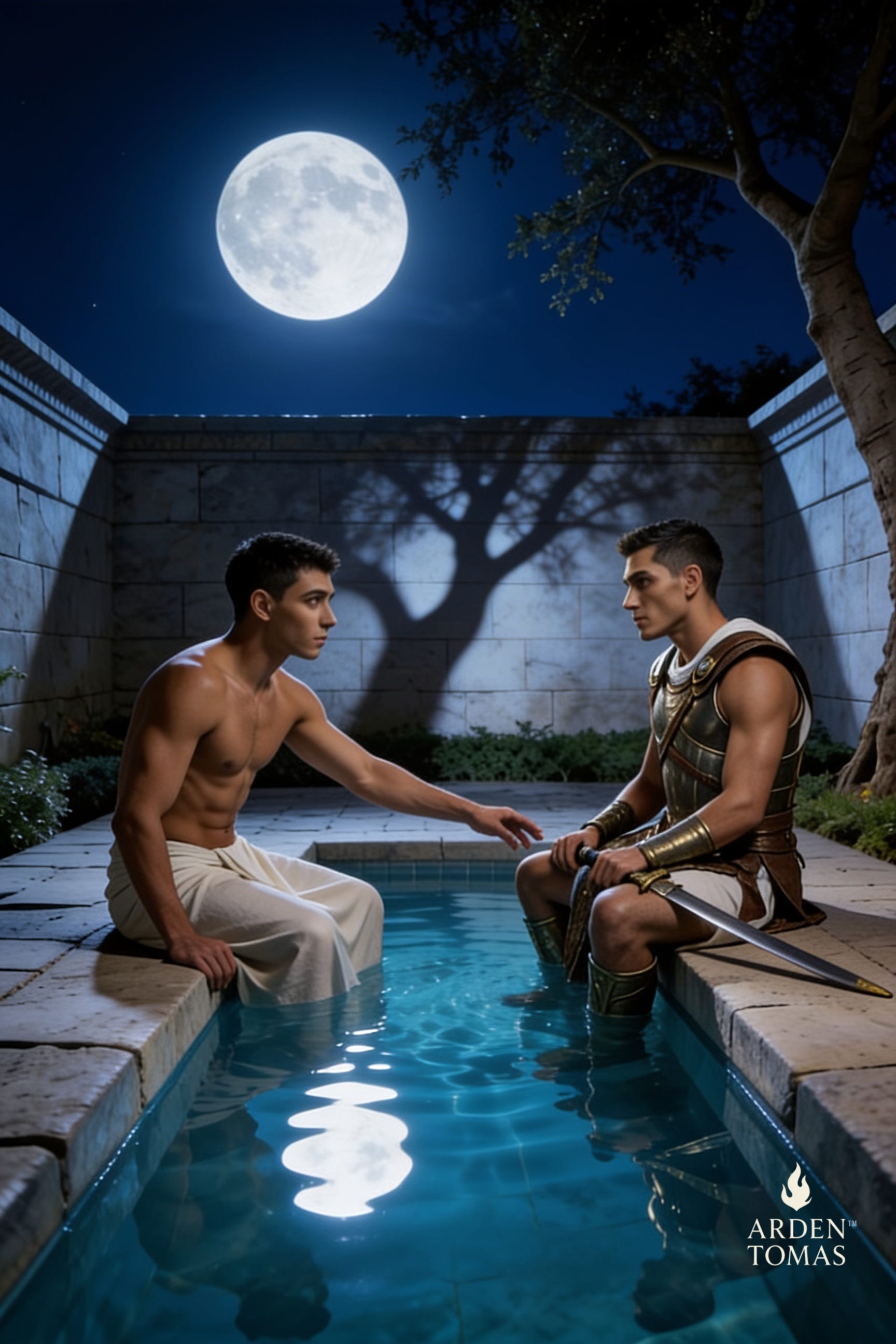
The private garden was a courtyard behind the Pharaoh’s chambers — a small square of earth enclosed by stone walls on four sides, open to the sky. A pool of water in the center — not large, just enough for one person to sit in, fed by an underground spring that kept it cool even in the worst heat. Around the pool, lotus flowers grew in clay pots, and a single sycamore tree cast its shadow across the water. The walls were painted with scenes of the afterlife — the weighing of the heart, the ferryman, the field of reeds — but at night, in the moonlight, the paintings were invisible, and the garden was just a garden. Stone, water, earth, sky.
Nimaatre sat by the pool. The crown was gone. The collar was gone. The kilt was gone. He wore a simple linen wrap around his waist, and his body — his bare, bronze body — was visible in the moonlight. The kohl was washed from his eyes, and without it, his face was younger, softer, the sharp lines of the god dissolved into the rounder curves of the man. His hair was oiled but unbraided, falling to his shoulders, black against the bronze of his skin.
He looked at the water. The moon reflected in the pool, and the reflection was perfect — not like the Nile, which carried the reflection broken and moving. Here, in the still water, the moon was whole. Complete. Unbroken.
Nimaatre was not whole. He had not been whole for a long time.
The footsteps came from the corridor. Heavy. Resolute. The soldier’s stride. Nakhtmin.
Nimaatre did not turn. He spoke to the water.
“Sit.”
Not a command. Not the Pharaoh’s voice. A word spoken by a man who is tired and wants company but does not know how to ask for it.
Nakhtmin did not sit. Discipline did not allow for sitting in the Pharaoh’s presence. He stood — three paces behind, at the edge of the pool’s light, where the moonlight met the shadow of the sycamore.
“Sit,” Nimaatre repeated. This time, the word was softer. Almost a plea. “The god is sleeping. Tonight, there is only the man.”
Silence. The silence of the garden was different from the silence of the throne room — it was alive. The water lapped gently against the stone edge of the pool. The sycamore leaves rustled in a breeze that came from nowhere. Somewhere, beyond the walls, a night bird called — a long, descending note, like a question without an answer.
Nakhtmin sat.
Not beside the Pharaoh — that would have been too close. He sat at the edge of the pool, a body’s length away, his legs folded beneath him, his sword laid across his knees. The bronze armor caught the moonlight and threw it back in cold, silver fragments. His face was in shadow — the sycamore’s leaf-shadow falling across his cheek, his jaw, his neck.
Nimaatre looked at him.
Not the way the Pharaoh looks at a subject — from above, from the distance of power. He looked at him the way a man looks at another man in the moonlight. Openly. Without the mask. Without the crown. Without the kohl. Without the weight.
“The quarry slaves,” Nimaatre said. “What do you think of them?”
Nakhtmin did not answer immediately. The question was not a ruler’s question — it was a man’s question, asked in the dark, where the god could not hear.
“I think they are hungry,” Nakhtmin said.
“Is that all?”
“I think they are tired.”
“Is that all?”
Silence. The water lapped. The bird called. The sycamore rustled.
“I think they are right,” Nakhtmin said. The words came slowly, like stones pulled from a riverbed. Each one heavy. Each one placed with care. “A man who works must eat. A man who eats must work. When the balance breaks — when one gives and the other takes — the chain breaks too.”
Nimaatre looked at the water. The moon’s reflection trembled — a fish, moving beneath the surface, disturbing the stillness.
“The chain,” Nimaatre repeated. “Do you know what it is to wear a chain, Nakhtmin?”
“No, Your Majesty.”
“Don’t lie to me. Not here. Not tonight.”
Nakhtmin’s hand tightened on the sword’s hilt. The knuckles showed white — the same white as the Pharaoh’s on the golden armrest. The same fear. The same containment.
“I know what it is to serve,” Nakhtmin said. “I know what it is to stand where I am told to stand, to look where I am told to look, to be what I am told to be. I know what it is to not exist.”
The words hung in the air between them — heavy, true, dangerous. A bodyguard does not speak this way to the Pharaoh. A bodyguard does not name the chain. A bodyguard does not admit that he wears one.
But the moonlight was on them, and the god was sleeping, and the garden was just a garden, and the two men were just two men.
Nimaatre nodded. Slowly. The nod was not the Pharaoh’s nod — the regal, measured inclination of the crowned head. It was a man’s nod. The nod of someone who has been heard for the first time.
“Yes,” Nimaatre said. “You know.”
Silence. But the silence was different now. Not the silence of distance — the silence of proximity. The silence of two men who have said what should not be said, and the saying of it has brought them closer than three paces, closer than the throne room, closer than the column — to the edge of the same pool, beneath the same moon, in the same dark.
Nimaatre’s hand — the hand that had gripped the golden armrest, the hand that had shown white knuckles to the bodyguard who read hands — moved. Slowly. Across the stone edge of the pool. Toward Nakhtmin. Not reaching. Not grasping. Just moving. The way the Nile moves toward the sea — not because it chooses, but because it must.
Nakhtmin saw the hand. The bronze fingers, the moonlight on the skin, the small scars from the training that the priests never saw. He saw the hand, and his body — his disciplined, trained, soldier’s body — tensed. Not in fear. In want. The want that the weapon-master had warned him about. The want that comes when you look, and seeing, you feel, and feeling, you reach.
Nakhtmin did not reach.
His hand stayed on the sword. The jaw tight. The eyes — the eyes that had broken the rule, that had looked when they should not have — the eyes stayed on the water. On the moon’s reflection. On the fish that moved beneath the surface, disturbing the stillness, refusing to be calm.
Nimaatre saw the refusal. Not the refusal of the bodyguard — the refusal of the man. The man who wants but does not take. The man who looks but does not touch. The man who stands at the edge of the pool and does not enter.
Nimaatre withdrew his hand. Slowly. The way it had come. Back to his own side. Back to the stone. Back to the distance.
“The quarry slaves will be dealt with,” Nimaatre said. His voice was changing — the Pharaoh’s voice returning, the mask sliding back, the man retreating behind the god. “The garrison will contain them. If they return to work, they will be fed. If they do not —”
“The chain will not break,” Nakhtmin said. Not finishing the Pharaoh’s sentence — answering it. His voice was low, steady, but beneath the steadiness, there was something else. Something that trembled like the water in the pool when the fish moved beneath.
“No,” Nimaatre said. “The chain will not break.”
Because the chain never breaks. Not for the slaves. Not for the Pharaoh. Not for the bodyguard who sits at the edge of the pool and does not reach.
The moon climbed higher. The shadow of the sycamore shifted. The water stilled. The fish sank to the bottom, where the moonlight could not reach.
“You may go,” Nimaatre said.
Nakhtmin rose. The sword in his hand. The armor catching the light. The face in shadow. He bowed — not the deep bow of the courtiers, but the slight inclination of the soldier. The bow that says: I serve. I obey. I go.
But at the corridor’s entrance, he paused. Not turning — discipline did not allow for turning. But pausing. One heartbeat. Two.
“Your Majesty.”
“Yes?”
“The slaves — they are not the only ones who are hungry.”
The words were barely audible. A whisper. A breath. The kind of words that are spoken in the dark and then denied in the light.
Nimaatre did not answer. But his hand — the hand that had reached across the stone — his hand trembled. On the stone. In the moonlight. Alone.
Nakhtmin walked into the corridor. His footsteps faded. The garden was silent again. The water. The sycamore. The moon.
Nimaatre sat by the pool. Alone. His hand on the stone where Nakhtmin had sat. The stone was still warm.
He closed his eyes. The god was sleeping. The man was awake. And the man was hungry.
Nakhtmin
The quarry broke on the third day.
Not the slaves — the slaves broke first, on the second. They had knelt at the quarry’s edge in the white heat, their tongues swollen, their eyes crusted, and when the overseer came at dawn on the third day with the grain, they crawled to it. They ate. They went back to the stone. The blocks for Karnak were cut, and the empire continued, and the scribes recorded that the matter had been resolved.
What the scribes did not record: four men did not crawl. Three had died in the night of the second day, and one had died at midday of the third with the grain already in his mouth, his body too far gone to keep it down. The overseer had their bodies dragged into the desert and left there, because the burial of a slave costs grain that the granaries did not have.
One of the four was named Ptahmose. He had a brother in the palace kitchens.
That was how it travelled. Not by proclamation, not by messenger — by the route that news always takes in a house where half the people are invisible. A water-carrier told a laundry slave. A laundry slave told a cook. The cook said nothing at all, for two days, and on the third night he did not sleep.
Nakhtmin knew none of this.
He was at his post — the corridor outside the Pharaoh’s chambers, the morning hour, the moment before the priests arrived. He heard it before he saw it. The sound of running feet — not the measured tread of soldiers, but the chaotic, desperate pounding of bare feet on stone. And beneath the running, another sound: shouting. Not words — not yet — but the raw, animal sound of voices that have been silent too long and now break free.
The first slave came around the corner of the corridor. A young man — barely twenty, his body thin, his skin dark with dust and labor, his eyes wild. In his hand, a bronze knife — not a soldier’s blade, but a kitchen knife, stolen from the Pharaoh’s own kitchens. The blade was short, crude, but it caught the lamplight and flashed, and the flash was a promise.
Nakhtmin drew his sword.
The slave saw him. The wild eyes found the bronze armor, the sword, the soldier’s stance, and for a moment — a fraction of a heartbeat — the slave hesitated. The body wanted to run. The body wanted to fight. The body did not know which.
Then more came. Behind the first — five, ten, twenty. Men and women. Kitchen slaves, cleaning slaves, laundry slaves. Their hands held whatever they had found — knives, broom handles, broken pottery, stones. Their faces were not the faces of warriors. They were the faces of the starving. Not starving for bread — starving for something the bread could not give. Starving for the thing that breaks when a person has been invisible too long and decides to be seen.
Nakhtmin stood in the corridor. His sword drawn. His body between the slaves and the Pharaoh’s door. Behind him — the door. Behind the door — Nimaatre. Sleeping. Unguarded. Unprotected. The god who was a man, lying in his bed, wearing no crown, no armor, no mask.
The first slave charged.
Nakhtmin moved. Not thought — moved. The sword came up, the blade flat — not to cut, but to deflect. The kitchen knife skittered off the bronze and clattered on the stone. The slave stumbled. Nakhtmin’s shield — the leather and bronze shield on his left arm — came forward, and the slave fell back.
But the others came.
Two from the front. One from the side — a woman, her hair wild, her eyes red, a broken jar in her hand, the jagged edge aimed at his face. Nakhtmin’s shield caught the jar — it shattered, the pottery cutting his forearm, the blood hot and immediate. He did not feel it. His body was the body of a soldier — trained, disciplined, the shield wall, the spear line, the geometry of combat that his father had taught him and his father’s father before him.
But there were too many.
The corridor was narrow — two men wide, no more. Nakhtmin held the front, his sword and shield working in the rhythm of the shield wall, deflecting, pushing, containing. But the slaves pressed — not with skill, but with the weight of desperation. Bodies pushing against bodies. Hands reaching past the shield. Fingers clawing at the armor, at the leather straps, at the sword arm.
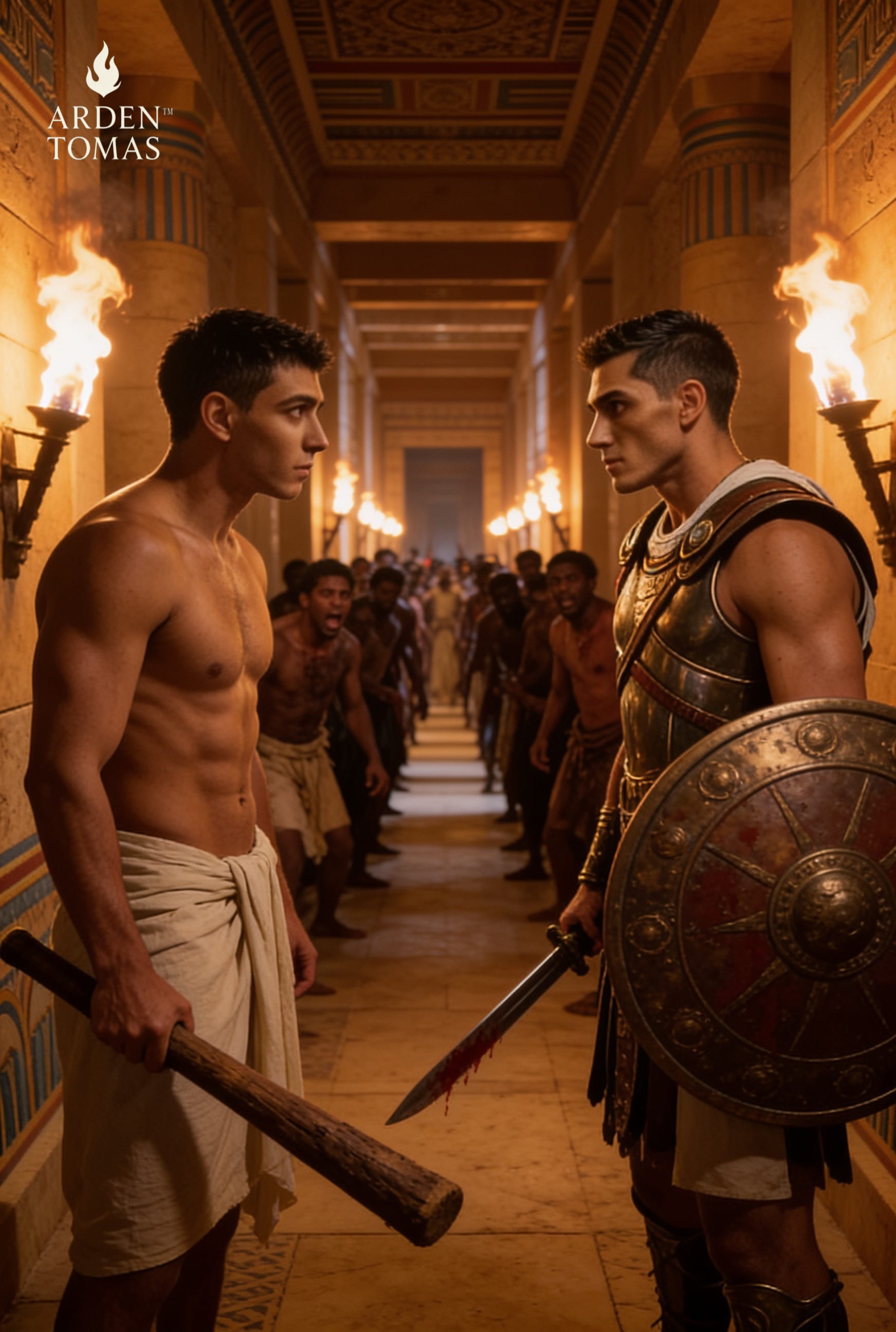
A knife — not the kitchen knife, a sharper one, a bronze blade — found the gap between the bronze plates at his shoulder. The cut was deep. Nakhtmin grunted — not a scream, a grunt, the sound a soldier makes when the body is hurt but the mind is still fighting. His sword arm dropped — not from pain, but from the shock of the cut, the muscle seizing, the blood running down his arm and dripping from his fingertips onto the stone.
And the line broke.
A man came past the shield — an older slave, grey at the temples, a butcher’s cleaver in his fist, and the cleaver was already coming down toward the place where the sword arm had been.
Nakhtmin did not decide. The body decided.
The sword came up under the arm — the short thrust, the one his father had drilled into him ten thousand times in the practice yard, the one that requires no space and no beauty and no thought. It went in beneath the ribs and came out again, and the old man’s face changed — not to pain, but to surprise, the specific, terrible surprise of a man who has spent his life being nobody and is astonished, at the end, to discover that he can die.
He fell. The cleaver rang on the stone. And Nakhtmin, who had held a sword for eleven years and had never once used it on a living body, stood over him in the narrow corridor with the blood on the blade and understood that he had crossed something that could not be crossed back.
The slaves saw it too. The press faltered.
“Your Majesty!” Nakhtmin shouted. Not a call — a warning. The only warning he could give.
The door opened.
Nimaatre stood in the doorway. No crown. No collar. No kohl. The linen wrap around his waist, his body bare, his hair loose, his eyes — his black eyes without the kohl, without the mask — wide open. Not with fear. With something else. Something that Nakhtmin had never seen in the eyes of a ruler.
Presence.
Not the presence of the god — the majestic, distant, hollow presence of the Pharaoh on the throne. The presence of a man who has heard the sound of fighting and come not to command but to stand. To stand beside the man who stands for him.
“Get back inside,” Nakhtmin said. Not Your Majesty. Not the formal address. The words of a man speaking to another man. The words of a man who is afraid — not for himself, but for the one behind him.
Nimaatre did not go back inside.
He stepped forward. Into the corridor. Into the fight. His body — the body the priests never saw, the body trained in secret, the muscles shaped by combat practice in the private courtyard where no one watched — his body moved. Not like a soldier — Nakhtmin’s body was the body of a trained fighter, disciplined, precise. Nimaatre’s body was the body of a man who had been taught to fight and had never fought, and the difference was visible in every movement: raw, unpolished, but strong. Desperately strong.
His hand found a fallen broom handle — the wood smooth, the length sufficient. Not a sword. Not a spear. A stick. But in his grip, the stick was enough.
He stood beside Nakhtmin. Not behind him. Beside him. Shoulder to shoulder. The Pharaoh and the bodyguard, the god and the shadow, the man and the man — in the narrow corridor, facing the slaves.
The slaves saw him.
The effect was immediate. Not because of his skill — the broom handle swung wide, missing the first slave by a hand’s breadth. Not because of his armor — he wore none. The effect was his face. His bare face. The face without the crown, without the kohl, without the golden mask. The face of a man.
The young slave with the kitchen knife stopped. His wild eyes found Nimaatre’s face, and in the face, he saw something he did not expect. Not a god. Not a ruler. A man. A man standing in a corridor in his sleeping wrap, holding a stick, bleeding from a cut on his arm where a piece of pottery had caught him, his chest heaving, his eyes wide.
The slave’s hand trembled. The knife lowered.
“My Pharaoh —” the slave said. Not a shout. A whisper. The whisper of a man who has been invisible for twenty years and now sees — for the first time — that he is not the only one.
“You are hungry,” Nimaatre said. His voice was not the Pharaoh’s voice. It was the man’s voice — the voice from the garden, the voice that had asked the bodyguard to sit. “I know. I know you are hungry.”
The corridor was silent. The slaves — twenty, thirty, pressed into the narrow stone passage — stood. Their weapons hung in their hands. Not lowered. Not raised. Suspended. The moment between the decision to fight and the decision to stop.
“I am hungry too,” Nimaatre said.
The words fell into the corridor like stones into still water. And the ripples spread.
The young slave’s knife clattered to the floor. Then another. Then another — six, eight, a dozen, the sound of bronze and pottery on stone travelling backward through the press like a rumour.
But not all of them.
At the back of the corridor, a man did not move. He was thin, perhaps thirty, his forearms scarred with the old burns of a kitchen fire, and he was looking not at Nimaatre’s face but at the body on the floor between them — the old man with the cleaver, face down in his own blood, one sandal come off.
“My brother died in the quarry,” the man said.
Nimaatre turned toward the voice. “What is your name?”
“You sealed the gate. Three days. No water.” The man’s voice did not rise. That was the worst of it — it did not rise at all. “He was still alive on the second day. If the gate had opened on the second day he would be alive now.”
“What is your name,” Nimaatre said again, and this time it was not a question, and it was not a command either. It was closer to a plea.
The man did not give it.
He came forward. Not fast — he was not a fighter, he had no idea how to be fast — but forward, over the fallen weapons, past the men who had dropped them, the knife held low and wrong, straight at the bare chest of the Pharaoh of the Two Lands.
Nakhtmin had one heartbeat in which to choose.
He could have used the shield. He knew it afterward, in the guard quarters, in the dark, for the rest of his life: there had been a shield on his left arm, and the man was slow, and a shield would have been enough.
He used the sword.
It was not a soldier’s decision. A soldier calculates. Nakhtmin did not calculate — he saw a blade travelling toward the bare skin of a man he had watched by a pool in the moonlight, and everything in him that was discipline went out like a lamp, and what was left was older than discipline and did not care what it cost.
The blade went through. The man’s weight came down onto it and drove it deeper, and Nakhtmin held him up on the bronze for a moment because there was nowhere for him to fall, and their faces were very close, and the man looked at him with no hatred at all — only that same astonishment, the second time in one morning, the discovery that a nobody can die.
Then he slid off and lay beside the old man with the cleaver, and it was over.
Nobody else moved. The corridor was full of the smell of blood and lamp oil and the sour smell of frightened people. Somewhere behind the press a woman was making a sound with no shape to it.
Nimaatre lowered the broom handle. He looked at the two bodies on the floor of his own corridor. Then he looked at Nakhtmin — at the sword, at the blood on it, at the blood running from his shoulder — and something passed over his face that was not gratitude.
The garrison came four minutes later.
Nimaatre
The soldiers were efficient. They were always efficient. The slaves were bound at the wrists in a line and taken down through the servants’ stair, and the corridor was washed, and the bodies were carried out through the kitchen gate so that they would not pass any door that a priest might use.
Nimaatre stood in his chambers and let them dress him.
The linen. The kilt. The collar. The armguards. The oil in the hair, the kohl at the eyes, the crown last of all, set on the head by the High Priest of Amun with the prayer that had been said over every Pharaoh of the House of the Sun for three hundred years. The cut on his forearm was cleaned and bound and covered by the armguard, and after that it did not exist.
By the second hour the god was awake and sitting in the audience hall, and Horemheb stood before the throne with a scroll in his hand.
“The matter of the palace slaves, Your Majesty.”
“Yes.”
“Thirty-one taken. Two dead in the corridor. The instigators are identified — the kitchen staff, chiefly. There is a brother of one of the quarry dead among the dead here, which explains the source.” The scroll rustled. “The Overseer of the Household requests the customary sentence. Execution before the western gate, at midday, with the household assembled to witness.”
The hall waited.
Nimaatre heard, very distinctly, the sound of a kitchen knife hitting a stone floor. And another. And another.
“They surrendered,” he said.
Horemheb’s eyes were on the granite. “Yes, Your Majesty.”
“They laid down their weapons. Of their own will. Before the garrison arrived.”
“Yes, Your Majesty. That is what the bodyguard reports.”
“Then there is a case for clemency.”
“There is a case, Your Majesty.” The vizier did not look up. He had served three Pharaohs. He knew precisely how to lose an argument in a way that wins it. “There is also the western quarry, which returned to work on the third day because it believed the gate would not open. There are eleven thousand slaves in the estates of Thebes, and this morning thirty-one of them walked to the door of your bedchamber with knives. If they walk away from that alive, Your Majesty, then what they will have learned is not that the Pharaoh is merciful.”
Silence.
“What will they have learned,” Nimaatre said.
“That it can be done.”
The incense drifted. The scribes waited with their reeds above the wet papyrus.
Nimaatre thought: I could refuse. He is one old man with a scroll. I am the living image of Ra and the Lord of the Two Lands, and if I say the word they will walk out of the western gate and go back to the kitchens.
And then: and in a month there will be knives in every corridor in Thebes, and the garrison will burn the servants’ quarter to the ground, and I will have killed four hundred people in order not to kill thirty-one.
The chain does not break. The chain stretches. And it is the man at the end of it who chooses which way it snaps.
“Midday,” Nimaatre said. “The western gate.”
“And the household assembled, Your Majesty?”
“The household assembled.”
Horemheb bowed. The scroll rustled. The scribes wrote it down, and what they wrote was: a disturbance among the palace servants, suppressed; the guilty punished according to custom. Nothing about a broom handle. Nothing about a Pharaoh in a sleeping wrap. Nothing about the words.
I am hungry too.
He had said it and they had believed him. That was the part he would carry. They had put down their knives because a man had told them the truth, and the truth had bought them exactly four minutes, and then he had signed for their deaths in the same voice he used for grain shipments.
He had not lied to them. That was somehow worse. Everything he said in that corridor had been true, and it had made no difference at all, because the man who said it was wearing the same body as the god who could not un-say the rest.
The audience continued. The Nubian tribute. The Libyans at the western border. The delta.
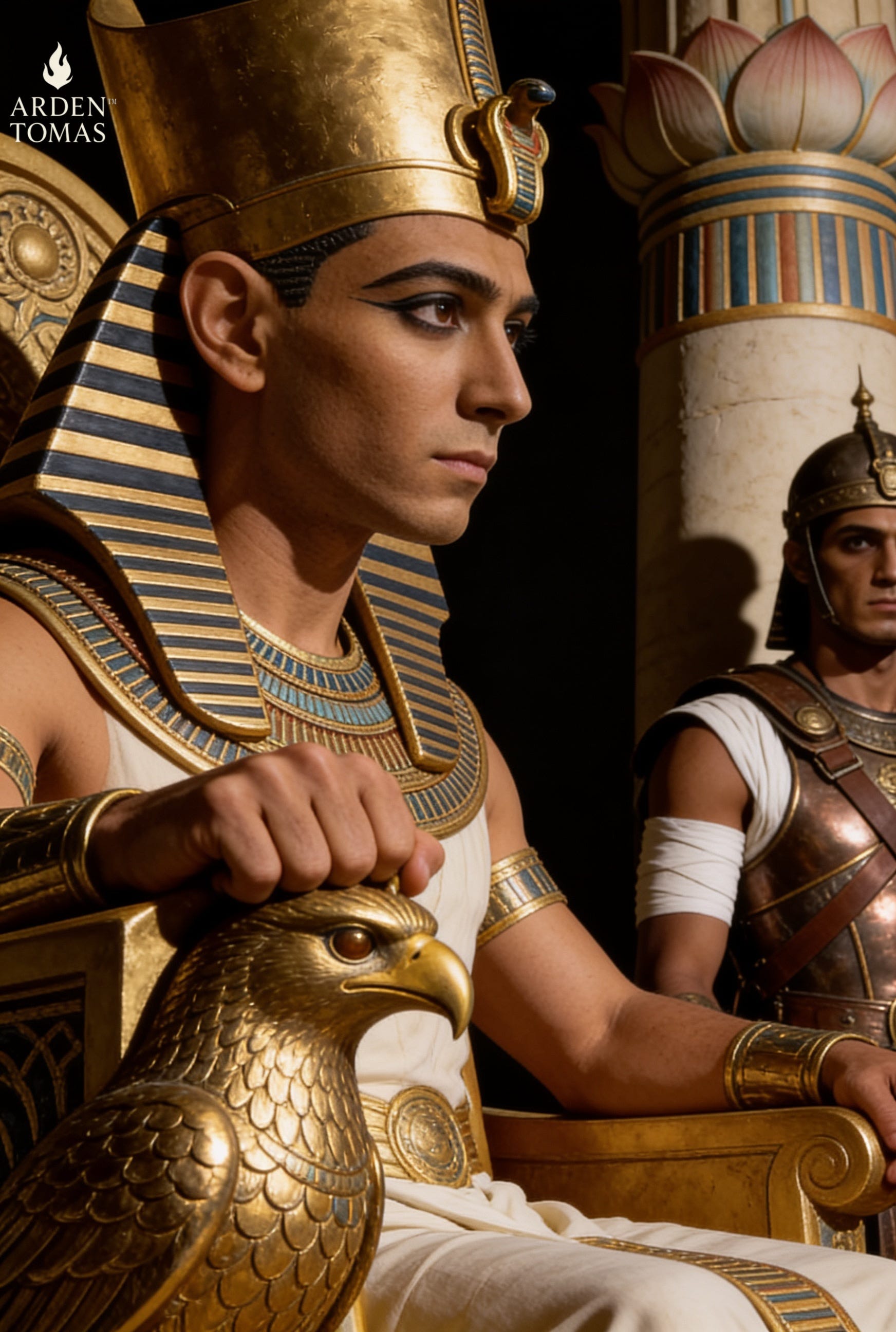
Nimaatre sat on the throne with the crown on his head, and his hand on the golden armrest closed slowly, and went on closing, until the falcon’s head cut a line into his palm that would still be there in three days.
Behind him, three paces behind, at the column, Nakhtmin stood with his shoulder bound beneath the armor and did not move.
Nimaatre did not look at him. He would not be able to look at him for a long time.
Nakhtmin
The physician bound the wound on his shoulder. The cut was deep but clean — the bronze blade had missed the bone and the major vessels. The arm would ache for a week. The scar would remain.
At midday he stood in formation at the western gate with the rest of the guard, because that was where the guard stood, and he watched twenty-nine people die in the order in which they had been bound. The young one with the kitchen knife was fourteenth. He did not look for the Pharaoh’s face on the balcony and he did not look away from the ground, and afterward he could not have said which of those two things he had done.
He sat that evening in the guard quarters — the low stone building behind the palace, where the bodyguards lived between shifts. The room was simple: a cot, a table, a lamp, a weapon rack. The walls were undecorated stone. The floor was packed earth. The window looked out on the western desert, where the sun was setting, and the sky was the color of blood and gold.
His father sat across from him. The commander of the bodyguard — an older man, broader, his face scarred, his arms thick, his eyes the same sharp, kohl-rimmed eyes as his son’s. He did not speak. He watched. The way old soldiers watch — not with concern, but with assessment. Measuring the wound. Measuring the son.
“Your first,” his father said. Not a question.
“Two.”
“Two, then.” His father nodded slowly. “You will dream about the second one. Not the first. It is always the second.”
Nakhtmin said nothing.
“You fought well.”
“I fought.”
“The Pharaoh fought beside you.”
Nakhtmin did not answer. His hand — the hand that had held the sword, the hand that had bled — rested on his knee. The bandage was white against the bronze of his skin.
“A Pharaoh does not fight,” his father said. “A Pharaoh commands. A Pharaoh stands behind the shield wall. A Pharaoh does not stand in the corridor in his sleeping wrap with a broom handle.”
“He did.”
“And you let him.”
Nakhtmin looked at his father. The old soldier’s eyes were not angry. They were something worse. They were afraid.
“He stepped forward,” Nakhtmin said. “I did not let him. I could not have stopped him.”
“You could have. You should have. That is your duty. Your duty is not to fight beside him — your duty is to fight instead of him. Your body is his shield. Your life is his armor. If he fights, you have failed.”
The words hit like the bronze blade — deep, clean, cutting the muscle. Nakhtmin’s jaw tightened. The hand on his knee curled into a fist.
“He spoke to them,” Nakhtmin said. “He spoke, and they put down the knives. No sword did that. No shield.”
“And by midday they were dead anyway.” His father let that sit in the room. “So what was it worth, what he said to them?”
Nakhtmin had no answer. That was the thing he would take to his cot and lie awake with: that the truest sentence he had ever heard a man speak had cost twenty-nine people the four minutes in which they might have run.
“The second man,” his father said. “The one who came at him. You had a shield.”
Nakhtmin’s head came up.
“I have been doing this for thirty years, boy. I read the report.” His father’s voice did not rise. “You had a shield on your left arm and a slow man with a kitchen knife in front of you and you used the sword. Any of my men would have used the shield. You used the sword because in that moment you were not guarding a Pharaoh.”
Silence. The sun set. The room darkened. The lamp flickered.
“Be careful, my son.” His voice was not the commander’s voice now — it was the father’s. The voice that had sat in the doorway and spoken of slaves and hunger and the spirit that starves first. “The weapon-master told you: if you look, he dies. You looked. And now you have bled beside him, and his blood is on your arm, and yours is on his. And the blood is a chain too. A chain that is not bronze, not iron — but flesh. And flesh chains are the ones that cut deepest.”
Nakhtmin looked at the window. The desert was dark now. The stars were coming out — the same stars that shone over the garden, over the pool, over the sycamore tree where two men had sat in the moonlight and one had reached and the other had not.
“I know,” Nakhtmin said.
His father rose. The commander’s posture — straight, heavy, the weight of the bodyguard on his shoulders. He walked to the door and stopped.
“The Pharaoh is not a man,” he said. “He is the god. The god does not have hunger. The god does not bleed. The god does not stand in corridors with broom handles. What you saw today was not the man — it was the mask slipping. And when the mask slips, the danger is not to him. It is to you. Because the one who sees behind the mask is the one the dynasty cannot allow to live.”
He left. The door closed. The room was dark. The lamp was the only light.
Nakhtmin sat. His hand on his knee. The bandage white. The scar red beneath it.
He closed his eyes. And behind the closed eyes — not the corridor. Not the broom handle. Not the bare face or the words.
The western gate at midday, and the fourteenth in the line, and a Pharaoh on a balcony with a crown on his head, watching, and not looking away either.
Nakhtmin opened his eyes. The lamp flickered. The stars shone through the window.
He could not unsee. He could not unbleed. He could not unknow.
The chain held. The chain always held.
But the scar was there. And the scar was his.
45% off the annual subscription!
Monthly subscription: first month free!
Both offers are valid until midnight (CET), August 10th.
Don't miss out!
Get an exclusive 45% off an annual subscription 🏳️🌈

Comments
Nothing yet. Say the first thing.
Sign in to join the conversation.