
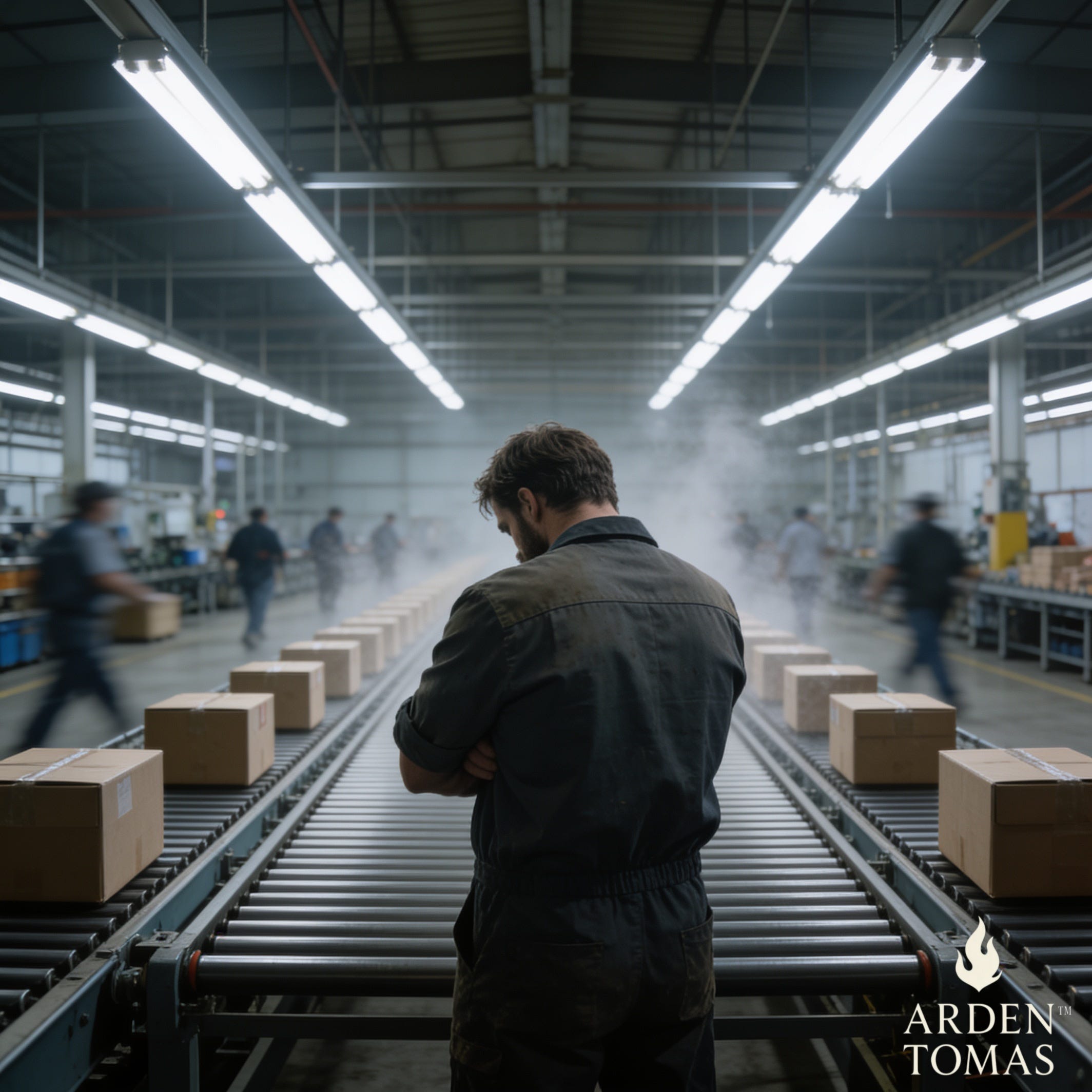
The factory hums. Fluorescent light, conveyor belt, set-top boxes moving down the line at a rate of four hundred an hour, and my hands know what to do without me.
I check the output logs. I sign. I stamp. I tell Gábor his station is running slow and he speeds up. I tell the new one — I don't know his name yet, three weeks and I haven't learned his name — that the seal has to sit flush or the whole batch comes back. He nods. The line moves. The boxes pass.
Twelve hours. Sometimes fourteen. I take every hour they offer me.
The dream comes at two in the morning.
A man's hands on my hips. A man's weight on my back. Stubble against the back of my neck and a mouth at my ear saying something I can't hear but understand completely. My body opens. Not just my body — some door I keep locked all day swings wide and what comes through it isn't shame.
It's relief.
Finally.
I wake to the dark and I am hard and wet, and Réka is breathing beside me, heavy and slow, seven months of weight pressing her into the mattress.
Three steps to the bathroom.
Three steps, and each one is a decision. The floorboard by the wardrobe creaks — I've known that for four years and I still forget. I stop. She doesn't move. I go on.
The door. The light. The cold.
I pull down my underwear and there it is. The white smear. The proof of who I am when I'm not guarding it.
Cold water in the sink, because hot water makes noise in the pipes. Soap. My hands working the fabric while I watch the door in the mirror. Rinse. Wring. Hang it behind the door on the hook where it will be dry by six.

The hook. I bought that hook for towels.
I stand there naked in the light and look at my own face and it belongs to someone I don't know.
Réka is seven months pregnant and we have not touched each other in seven months.
She is sick constantly. Nausea that never lifts, vomiting that arrives without warning, a body at war with the thing it's making. She leans over the toilet and I hold her hair back and bring her water and rub her back, and I am good at it. Present. Careful. Everything a man should be.
Two people being sick in the same flat. Only one of us has a name for it.
She reaches for me sometimes. Her hand finds mine in the dark and I let it stay there and I think: this is enough, this should be enough, why isn't this enough.
It isn't, because what I need is a man's mouth on my mouth. A man's voice saying my name.
The way Tibor said it.
I have not let myself think that sentence in a long time. It gets out at night, when the beer's worn off, and there's no wall left to keep it behind.
Tibor is dead. That is a finished thing, a thing I have carried and set down and picked up again a hundred times, and I thought I had made my peace with it. But this isn't grief. Grief has an end. This is something else — the fact that he was the only person alive who ever heard the sound I make. Not Réka. Not anyone since. That sound went into the ground with him and I have not made it once in four years, awake.
Only asleep. Only for men with no faces.
I start drinking again.
Not spirits. Beer. Cheap, cold, bought on the way home in a plastic bag that cuts into my fingers. I drink it in the kitchen with the light off while Réka sleeps.
One is nothing. Two is a Tuesday. Three and the edges go soft.
And here is the part I understood immediately and have never said out loud to anyone:
I don't drink to feel better. I drink to stop dreaming.
It works. That's the terrible thing about it. Six beers and I go under like a stone and there's no man's hands, no mouth at my ear, no white smear at two in the morning, no three steps and the creaking floorboard and the cold water. Just black, and then the alarm.
So it works. It works exactly as intended.
It's just that the mornings cost more than the nights did.
Five o'clock. The alarm goes through my skull. The room tilts when I sit up. My hands shake — not badly, not visibly, but I know. My mouth tastes of yeast and something worse underneath it.
I go to work. I always go to work.
Because the boxes don't care. The line doesn't care. The quota doesn't care what I dreamed or didn't dream, and there are eleven men who need me to stand at the front of that line and know what I'm doing.
By ten the shaking stops. The body forgives faster than the mind.
By four I am counting the hours to the shop.
Ferenc sees it first. My deputy — a quiet man, watches more than he talks. He stands next to me while I go through the logs and he says it without any preamble at all.
"Boss. Are you drinking?"
The word sits there between us. Such a small word.
He isn't asking because he doesn't know. He's asking because he wants me to be able to say it.
And I understand, standing there with the clipboard in my hand, that this is a door. That it has been opened deliberately, by a decent man, and that all I have to do is walk through it.
"No," I say. "I'm fine. Just tired."
He looks at me for a second longer than he needs to. Then he nods, and takes the logs, and goes back down the line.
That was the door. There won't be another one for a while. People only open them so many times.
Comments
Nothing yet. Say the first thing.
Sign in to join the conversation.