
When tabletop RPGs first began, it was not uncommon for campaigns to involve multiple gamemasters running shared worlds on a nearly continuous basis, with sprawling groups of players that could number in the dozens or even scores. All the grand campaigns of the early 1970s, including Gary Gygax’s Greyhawk, Dave Arneson’s Blackmoor, and M.A.R. Barker’s Tekumel, and Rob Kuntz’s Kalibruhn, were open-table affairs with overlapping player pools. Gygax’s Greyhawk reportedly had 40–50 active participants. Even MIT’s CUDDL (Cambridge University D&D League) and Caltech’s campaigns ran in a similar multi-GM style. These multi-party multi-GMs campaigns often adopted “strict timekeeping” to manage the action. Gygax recommended 1:1 time (one game day = one real day), or something close to it, to keep the campaign organized.
The halcyon era of the great Lake Geneva-style campaigns didn’t last long; by the time the hobby went mainstream in the early 1980s, most gamers played RPGs in small groups made up of a single gamemaster with 3 to 6 players. The exceptions to the rule were the Living Campaigns organized by the Role-Playing Games Association (RPGA). The first such campaign, Living City, launched at GenCon in 1987 with the AD&D 2E rules. It soon grew to thousands of players worldwide. It was followed in 1999 by Living Greyhawk, based on the D&D 3E rules, and then by others - Living Arcanis, Living Force, Living Rokugan, and more.
These campaigns, largely played at conventions, orchestrated massive numbers of players through a gauntlet of scenarios run by various gamemasters. The worlds of the Living Campaigns were put into the hands of GMs from around the country, who were responsible for building out their regions, writing scenarios, and so on. Living Greyhawk, the largest shared campaign in history, had 120 different regions, each mapped to a real-world area, with thousands of GMs and tens of thousands of players.
The nature of convention-focused RPGA play meant that the Living Campaigns were quite distinct from the old Lake Geneva game club style. Instead of daily sessions tracked in 1:1 time, the Living Campaigns used abstract “time units” (TUs). Players received a limited number of TUs per year (e.g., 52 per real year) that they could allocate towards activities in the shared world. Activities were reported back to a central registry, and character progression and in-game events could affect regional storylines. Regional GMs wrote sanctioned adventures that tied into a central metaplot set by the campaign administrators. The campaigns advanced in discrete in-game years, sometimes aligned with real time, sometimes decoupled.
Whatever their limitations, the Living Campaigns were grand affairs, uniting gamers in play in an era before MMOs, Reddit, and Discord. Many Gen X gamers remember these Living Campaigns as some of the best gaming of their lives. But when 4th Edition launched in 2008, Wizards of the Coast decided to sunset Living Greyhawk and replace it with Living Forgotten Realms, effectively wiping the slate clean. 4E famously alienated many established 3E players; the elimination of Living Greyhawk alienated many loyal participants even more, as their characters and regional histories simply vanished. Not surprisingly, Living Forgotten Realms was never as popular as Living Greyhawk had been.
In 2014, WotC replaced the Living Campaign model with the Adventurers League model. The Adventurers League model offered standardized, centrally written modules with simple reporting and minimal paperwork. It eliminated regional storylines, player-driven metaplot, and meaningful persistence. This shift mirrored a larger cultural move from campaign-based play to episodic sessions and digital pick-up gaming. A glorious era had ended.
Around the time that the Adventurers League replaced the Living Forgotten Realms, the Old School Renaissance began to emerge as a popular, albeit niche, play style. Most members of the OSR continued to run standard campaigns with one GM and a small group, though here and there “West Marches” style campaigns offered open tables for larger groups. But if the OSR mostly played the same way as their brother gamers in the mainstream, they did much to revitalize interest in older styles of play.
In 2020, when the country locked down during the COVD-19 pandemic, a majority of gaming groups switched from playing in person to playing online using a virtual tabletop platform like Roll20 or Foundry, or even just Discord. As VTT play became dominant, some visionary gamers, familiar with OSR rules, decided to recreate the original tradition of multi-GM multi-party campaigns online. Jeffro Johnson codified the new-but-old approach in his 2022 article “What is the #BrOSR?”
Now, Jeffro himself proved a controversial figure in the gaming space. (I don’t mean that as a veiled criticism, merely as a statement of fact; I’m controversial, too.) Though he has since left the hobby, various allies, enemies, successors, and critics have continued waging low-intensity internet warfare on Discord, Reddit, and X, arguing about everything from how Gygax actually played to the merits of strict timekeeping to the best system for various styles of play. People’s opinions on such matters are… very strong… But that’s ok! Opinions are strong because people care. Multi-GM living campaigns seem to meet a real need, an unscratched itch; every year, more and more people want to try them out.
I’ve long wanted to do some sort of living campaign — but using one of my own rules systems, not Gygax’s or Arneson’s or anybody else’s. Unfortunately, a living campaign requires a certain critical mass of players to sustain it, and for a long time my rules systems didn’t have the critical mass needed.
Fortunately, the Autarch community has been consistently growing. When Autarch’s Discord launched in 2018, it had just a couple hundred members; when Ascendant blew it up it grew to 1,000; and as of now, post-ACKS II, it’s got over 2,300. And that, my friends, is mass enough to make a go of it!
Accordingly, last week I launched Autarch’s first living campaign, the Living Ascendant campaign.
The Living Ascendant campaign is a multi-GM living campaign set in the official Ascendant universe. It’s based on the Ascendant: Platinum Edition RPG rules and it’s open to every free member of the Autarch Discord and Patreon. We’re actively recruiting both players and gamemasters; join the Discord as the first step.
In Ascendant, a session of play is called an Issue, and a collection of Issues is called a Series. Each Series is structured with the heroes as operatives for an Organization that calls on them to perform crimefighting activities. Having the heroes work for an Organization makes it much easier for the Series to run, because the Organization can assign Missions to the heroes; provide a headquarters where the heroes plan, rest, and re-equip; offer back-up if the heroes ask for help; justify the addition of new heroes if one of the player characters dies or otherwise leaves the campaign; and enforce limits on the behavior of the heroes so that the Series doesn’t become impossible to manage.
The Living Ascendant campaign uses this default campaign framework and expands it into a multi-gamemaster format. The Organization at the center of the campaign is Dreadnaught Security Inc, a private police company that employs ascended officers.
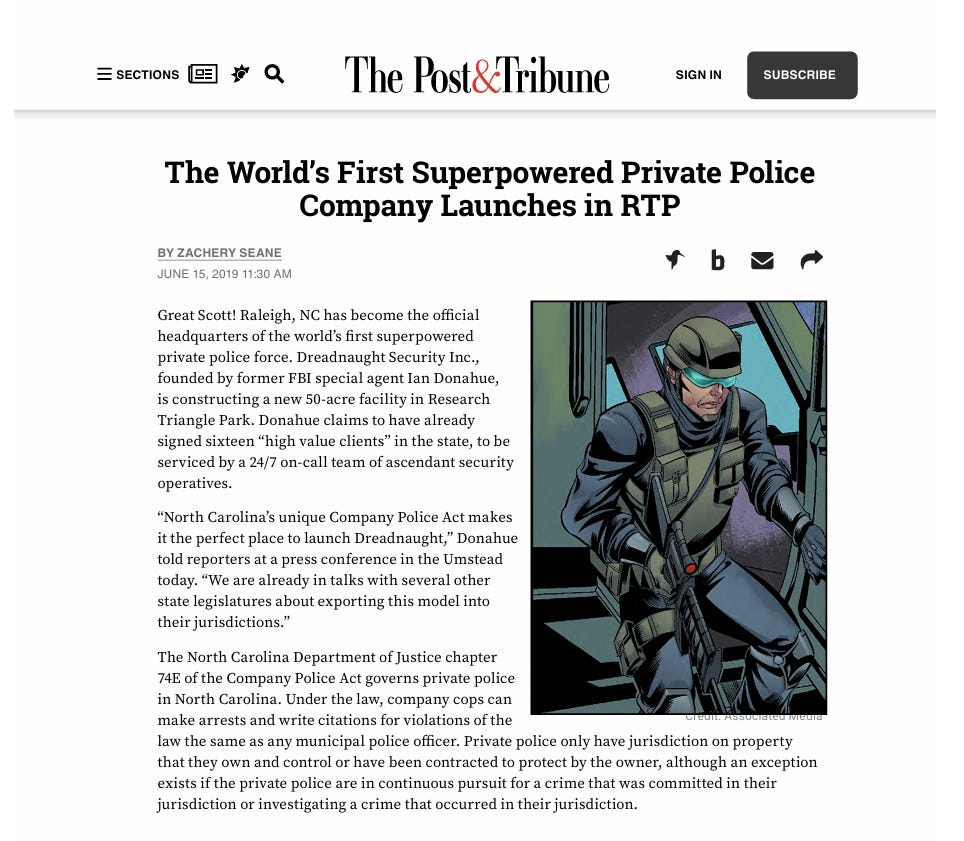
Each of the six gamemasters in the Living Ascendant campaign has assumed responsibility for a region within the United States in which Dreadnaught has clients and facilities. In the game world, each gamemaster personally role-plays as the Bureau Chief of that Dreadnaught field office in addition to his referee responsibilities.
Meanwhile, each hero in the Living Ascendant campaign is an ascendant operative of Dreadnaught assigned to the Rapid Response Team (RRT). As a member of the RRT, the hero can participate in various locations as needed to handle Missions when called by the Bureau Chiefs. Heroes are built and registered using the Ascendant Multiverse character creator app, which streamlines character creation for new players.
The gamemasters create and run Missions that take place within their assigned regions. Each gamemaster is expected to run at least one Mission per month but gamemasters can run more Missions per month if desired. In the game world, the “crime rate” of the gamemaster’s local region is assumed to loosely correlate to how many Missions the gamemaster runs. For instance, gamemasters who run weekly Missions must (by abductive reasoning) be overseeing “more dangerous neighborhoods” than gamemasters who only run monthly Missions. Regions without gamemasters are rather safe and peaceful!
When a session takes place in game, that means the Bureau Chief is requesting operatives from the Rapid Response Team to undertake Missions within his region. The day, time, and venue in which a Mission takes place is up to the individual gamemaster. Some gamemasters may run Missions that some players can’t participate in because of scheduling. In the game world, this simulates crises occurring at random times, sometimes when particular heroes are otherwise occupied.
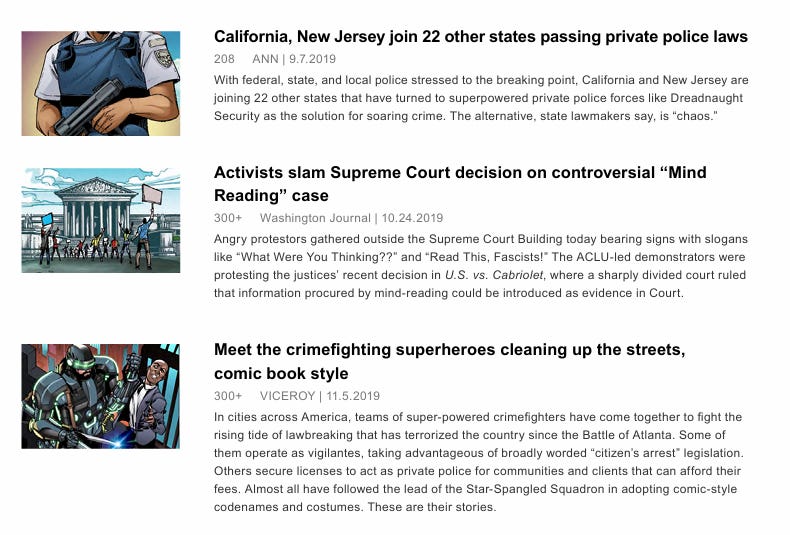
The campaign began on the real-world date of 5 November 2025 and correlated to the game date of 5 November 2019. In the game world, all of the heroes were recruited to Dreadnaught following the 11/5/19 Viceroy article on crimefighting superheroes.
Campaign time updates each day between Missions. However, campaign time updates during Missions dynamically in accordance with the mission. Most Mission begins and ends in one game day but in rare cases they may extend two or more game days. A hero cannot undertake more than one Mission on the same game day, nor undertake downtime activities on the same day as he undertakes a Mission. The remainder of the game day is eaten up by paperwork, debriefing, and other interludes. (Heroes with Superspeed and Time Control just get assigned more paperwork. It’s realistic!)
Meanwhile, heroes who are not undertaking a Mission can use their downtime to undertake extended actions in the game world; work the beat, dealing with petty crime and police work; or (with appropriate powers) develop and manufacture inventions, even advancing the state of technology in the game world as a whole.
Over time, the Ascendant Universe will march forward, and the heroes will steer the course of its history. We have plans to introduce monthly events, enemy factions (Exodus cells in the various cities), and more!
The Living Ascendant campaign has come together far faster and far smoother than I had ever hoped would be possible; I was amazed that our first session launched within days. Here’s the first After Action Report, written in character by “Ironguard”:
DREADNAUGHT SECURITY INC.
Field Operations Division – AFTER ACTION REPORT
Operative: Ironguard (Ethan James Marrow)
Mission Code: MA-003A
Location: Baltimore, Maryland
Date: 11/08/2019
Classification: Internal – Level 3
Summary: Repeated engagements with known Ascendant-class offenders during ongoing Baltimore crime wave.
________________________________________
Overview
Ironguard, Grief-Sayer, and Bullet Time arrived at the Baltimore Branch via teleportation relay for what was to be a standard day of patrol support. The city remains under severe stress, with an average of one criminal incident reported every four minutes and a marked rise in Ascendant-related activity.
________________________________________
INCIDENT 1: “Fire Starter” Engagement
Upon arrival, a Yellow Alert was issued following reports of a fire at a mid-rise apartment complex on the East Side. Visual confirmation identified Fire Starter, a known pyrokinetic fugitive, in proximity to the blaze.
Ironguard initiated evacuation protocols, executing vertical leap descents to extract civilians, while Bullet Time coordinated rooftop evacuations. Grief-Sayer provided crowd control and emotional stabilization among evacuees.
During evacuation, Fire Starter downed a responding police helicopter, prompting an active pursuit through city blocks. Bullet Time pursued on foot, while Ironguard advanced via jumping, carrying Grief-Sayer for rapid repositioning.
A missed blast from Fire Starter struck a nearby residential building. Bullet Time engaged first, discharging multiple precision rounds with negligible effect. Grief-Sayer attempted a verbal disruption, no visible impact.
Ironguard closed distance landing in front of Fire Starter and engaged in close quarters. The initial strike missed; a follow-up grapple succeeded. Fire Starter was contained, causing only superficial uniform degradation to Ironguard. Reflected thermal feedback resulted in moderate burns to the subject, facilitating capture.
Grief-Sayer and Bullet Time proceeded to assist Baltimore FD at secondary fire sites while Ironguard maintained containment until the arrival of dampeners. Fire Starter was rendered unconscious and transferred to Dreadnaught Baltimore Sector-3.
________________________________________
INCIDENT 2: “Ascendant Gang” Engagement
Time Elapsed: 32 minutes post-containment.
Status: Team redeployed to North District following secondary Yellow/Red Alert. Gang comprised of Beatz, Dr. Boom, Zappy, Vape, Frosty.
Reports indicated an Ascendant gang rampage roughly three miles north of the initial site. Bullet Time advanced ahead and successfully neutralized speedster Vape using paralytic rounds, then engaged Beatz, whose sonic shockwaves disrupted local law enforcement coordination.
As Ironguard (carrying Grief-Sayer) descended into the area, Dr. Boom launched an explosive device with a directed sonic pulse. The blast inflicted no structural injury to Ironguard but temporarily incapacitated Grief-Sayer with vibration trauma.
Upon landing, Ironguard delivered a kinetic strike to Vape to ensure total incapacitation and prevent reactivation of abilities.
A sustained gunfire exchange followed between Beats, Dr. Boom, and Bullet Time. The Dreadnaught team maintained superior mobility and suppression. Grief-Sayer recovered mid-engagement and incapacitated Beats via resonance word effect. Dr. Boom attempted retreat but was tackled and subdued by Ironguard.
The gang was detained without civilian casualties. Property damage was moderate—three vehicles, one storefront, and one utility junction box.
________________________________________
POST-ENGAGEMENT NOTES
Ironguard reports no personal injury but significant uniform degradation due to combined thermal and kinetic stress. He has requested improved field-grade material durability. Engineering has confirmed that adaptive fiber prototypes are in testing for the next generation of Dreadnaught suits.
________________________________________
Attachment A
CASE OFFICER DEBRIEF TRANSCRIPT
Operative: Ironguard (Ethan James Marrow)
Case Officer: M. Klein
Date/Time: 11/08/2025 – 2100 hrs EST
Subject: Post-Mission Debrief following Operation MA-003A (Baltimore)
________________________________________
Klein: Alright, Marrow. First field mission with Dreadnaught, and you get Baltimore. Pretty tough city to break in on.
Marrow: Yeah, I heard. Guess I got lucky. It… wasn’t what I expected.
Klein: Meaning?
Marrow: I thought it’d feel harder. Not the work… just everything happening at once. The chaos, the people screaming, all of it. But once we were in motion, it felt… natural. It feels more natural than I expected it to.
Klein: Let’s talk Fire Starter. You closed distance and grabbed him. Why?
Marrow: Couldn’t land a clean hit on him. So I figured if I could just get a hand on him, I could slow him down enough for us to take him out. Which worked out but he tried to burn me/ That ended up being a mistake for him.
Klein: The fire reflected automatically?
Marrow: Yeah. My body just does it when I’m in that state. I don’t really think about it when it’s on. Totally automatic.
Klein: Fair enough. Now, during the gang fight, you struck someone while he was already paralyzed. Smashed him into the concrete by the report. Care to explain?
Marrow: Didn’t know how long he would be out. Paralysis wasn’t on Bullet Time’s bio, so that was new to me. Last thing we needed was the guy waking up mid-fight and hitting us from behind. I figured, take him out while he’s down. Might be a little unsportsmanlike, but they’re criminals.
Klein: Grief-Sayer, you were protecting him and he still took a few hits. Why?
Marrow: Yeah. I tried to cover him. During the explosion when we were coming down to fight the gang there was a sound component to it that I couldn’t block. Didn’t bother me but shook him up a little. Then later they kept attacking him and I was out of position to stop one of the attacks. I’ll try to be more careful in the future.
Klein: You listed property damage as minimal.
Marrow: I mean, I don’t have a lot to compare it to, but no buildings went down. I feel bad about the stuff that went up in the fire, but at least no one was hurt. Sucks about the helicopter too, but there wasn’t anything we could’ve done about that once it got hit. Could’ve been a lot worse.
Klein: Last note, you mentioned the state of your uniform.
Marrow: Yeah. Look, I get that it’s part of the job to look a certain way, but it feels weird being out in public, on camera, and ending up half naked because my costume keeps getting burned or torn off me. I know I don’t really need it for protection, but it’d be nice to look like I belong out there and not have to worry about a wardrobe malfunction I have to talk to legal about.
Klein: You did good work out there, Marrow. Welcome to Dreadnaught.
Marrow: Thanks. Hope things keep going well out there.
________________________________________
End of Transcript – File Reference MA-003A-D
Filed by: Case Officer M. Klein, Dreadnaught Security Inc.
Authorized Distribution: Internal – Level 3 and above.
Classification Note: Excerpts approved for training and evaluation use by Field Division Command.
Hopefully this marks the beginning of a new superheroic era. If you’re interested in participating, please join us on the Autarch Discord and get involved!
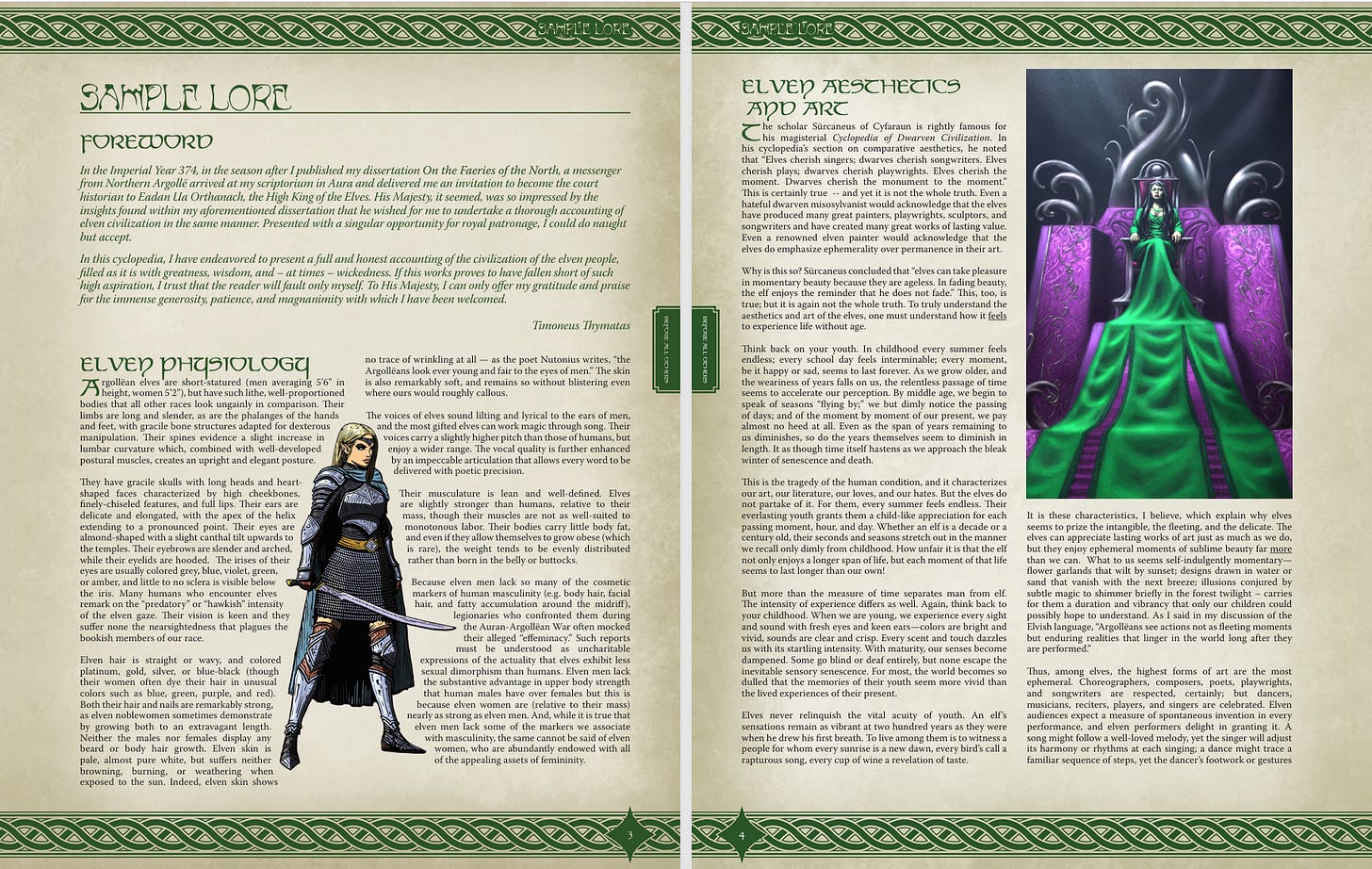
Of course, the Living Ascendant campaign isn’t the only thing going on here at Autarch. Our latest crowdfunding campaign, Before All Others: The Cyclopedia of Elven Civilization, reached 1300% funding on October 15th. However, the project remains open for late backing and we if we can reach $150,000 in pledges by March 2026 it will unlock the Bitter War campaign. If this is your first time hearing about Before All Others, check out the special 16-page full-color sneak preview of the book. By This Axe has proven to be one of my most enduringly popular books, and I think Before All Others will prove equally well-loved, so don’t miss out!
Meanwhile, Autarch has fulfilled the digital rewards for the Ascendant: Star-Spangled Squadron Volume II graphic novel. The print rewards will be delivered after we issue the pledge manager, collect shipping, and complete manufacture. We’ve also fulfilled the PDF rewards for the ACKS II Treasure Tome sourcebook. The PDF will be finalized for printing on November 17th. Both books should be dispatched to backers in Q1 2026.
Finally, in between all of the above, I also took some time to address an important health issue; two weeks ago I had sinus surgery to remove some tissue that was pressing on my optic nerve, causing severe pain and visual problems. I’m now well on way to returning to my full powers. Thank you to everyone who sent well wishes as I recovered!
Here’s the links to everything you need to get involved in the Autarch Community:
Autarch Discord with one of the smartest, nicest gamer communities around
Autarch Reddit with a sub-set of the aforementioned smartest, nicest gamers
ACKS Patreon with sneak previews and new content every month
Ascendant Patreon with a new character and story hook every month
Autarch Facebook page with news and updates about our projects
Autarch Twitter channel with brief comments and witty quirks
Ascendant Comics Facebook page with sneak previews of the upcoming comics
Ascendant Comics Instagram page with tons of art and cosplay
Ascendant Comics Twitter channel with short messages and quirky wit
No posts
Comments
Nothing yet. Say the first thing.
Sign in to join the conversation.