
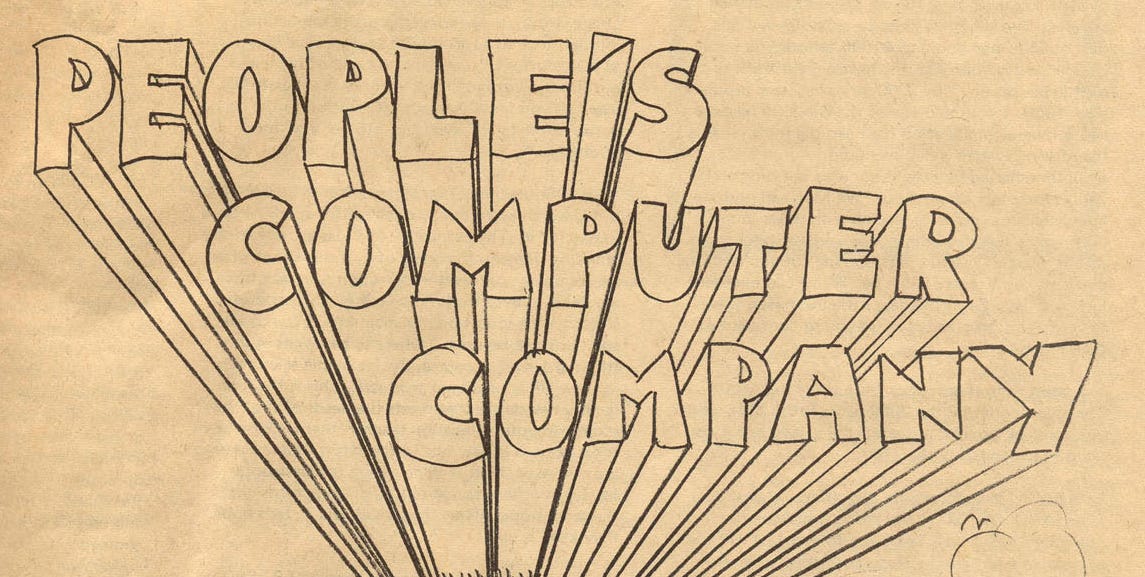
In 1972, a new publication was announced with the following call to action (and whose strange formatting I tried to preserve as much as possible):
Computers are mostly
used against people instead of for people
used to control people instead of to free them
time to change all that —
we need a . . .
People’s Computer Company
The People’s Computer Company published a newsletter related to “recreational computing” as well as being involved in computer education and general computational literacy. The very first issue had so much: it highlighted a physical space where you could go to actually play with a computer, examined BASIC code and how to understand it, provided pointers to some recommended literature, and more. As it noted, part of its goal was “about having fun with computers” and they really tried to deliver.
And the People’s Computer Company was doing this all beginning in 1972, when personal computers were not even a reality yet. The Altair 8800 wasn’t released until 1975, and the triple release of the Apple II, Commodore PET, and Tandy Radio Shack TRS-80 wasn’t until 1977. And yet, the folks of the People’s Computer Company realized both the power of this technology as well as its peril. We need machines with great abilities but also great humanity.
But we have forgotten this wisdom of the People’s Computer Company: that computers are for people. Or as is noted in Halt and Catch Fire, “computers aren’t the thing. They’re the thing that gets us to the thing”:
This desire—to make computers work for us rather than at cross-purposes—is one of the reasons I’m part of the group that wrote the Resonant Computing Manifesto. We need computing experiences that enrich us and make us the best versions of ourselves, rather than something very much the opposite. And AI even has the potential to help with this.
But it seems, more and more, that everything we do in the tech world is just about more. More AI, more engagement, more optimization. The world of tech feels like it is bending the wrong direction. We pursue technical sweetness without regard to its end goals. As per the Resonant Computing Manifesto:
And so, we find ourselves at this crossroads. Regardless of which path we choose, the future of computing will be hyper-personalized. The question is whether that personalization will be in service of keeping us passively glued to screens—wading around in the shallows, stripped of agency—or whether it will enable us to direct more attention to what matters.
An efficient and passive life is not an examined one.
My friend Peter Scoblic recently wrote about the idea of “imposed artificiality”. An excerpt:
5. The companies racing to incorporate AI in their products are removing choice. They are no longer providing tools. They are imposing mandates. Which is different.
6. AI is becoming IA—Imposed Artificiality.
7. Hanging on to the “human” in the age of AI requires that we choose which choices we retain control of. This meta-decision is critical, yet we are skipping right over it.
This seems to me to be the underlying issue, the one that lurks beneath much of what we talk about when we argue about AI. These tools can be great and democratizing and powerful. But we need resonant and human experiences, and they must be ones that are chosen and not imposed: ones that get us to the thing, but only as long as the thing is decided with deliberation and freedom.
So we need to remember the message of the People’s Computer Company. Because technological history is not just for nostalgia; it is for wisdom. In the spirit of the People’s Computer Company, we need organizations that foster communal and convivial computing experiences like Folk Computer, ones that strive to make the work of software fun and delightful like Val Town, and ones that create space for learning about programming like the Recurse Center. We need to make it more likely that we can use computers the ways that we want to, and not the ways that we have been forced to do so.
Computers are for people. Don’t ever forget that. ■
And for more in line with this approach to computing, please check out The Magic of Code.

I was on the Infinite Loops podcast again! Why the Future Belongs to Curious People:

Found at MSCHF: “There is someone whose full-time job is to create the equivalent of a collegiate curriculum. They curate all of these topics, and those are the inputs.”
Cf. outlier roles needed in organizations.
The Enchanted Systems Roundup
Here are some links worth checking out that touch on the complex systems of our world (both built and natural):
🜸Where is it like to be a language model?
🝤 Building a Procedural Hex Map with Wave Function Collapse: “Procedural medieval islands from 4,100 hex tiles, built with WebGPU and a lot of backtracking.”
🜚 The Landscape Architecture of Auroras on Demand
🝳 3D Risk Game: “I’d mentioned I had an idea years ago for 3D Risk, using magnetic pieces & a steel globe. He thought it sounded amazing, so I quietly started working on what would be his Christmas gift.”
🝤 Conway’s Game of Life, in real life
🜹 The Man Who Made the Front Page Twice: “Two photographs, one atop the other, showing a guy in a distinctive jacket. One, naming the man pictured, and heralding him as a boon to his community. The other, flagging the guy as a heretofore unidentified scofflaw.”
🝊 Dither Explorer: intriguing tool.
🝤 Hitting the jackpot: “William Gibson’s disturbingly plausible 21st-century slow disaster”
🜹 For the Love of Science: YouTube series by Nicholas Christakis on the “craft of science.”
Until next time.
Comments
Nothing yet. Say the first thing.
Sign in to join the conversation.