
Overwhelmed. If you ask me how I’m doing these days, the answer is usually “overwhelmed.” And then some disclaimer about how I don’t really have the right to feel overwhelmed because everyone feels overwhelmed, right?
Still, I beat myself up when I move the same to-do list items from one day to the next day to the next week to month to year. I scold myself for being lazy and distractible. Could the issue be that there is just Too Much going on? No, it certainly must be that I am Not Enough.
The overwhelm is mostly tolerable until I get to the back half of my menstrual cycle. Then my emotional landscape turns volcanic, perpetually on the verge of total meltdown. When I do explode it feels like Pompeii, my sudden rage instantly baking everyone around me in hot ash, preserving the outburst forever in time as part of my children’s core traumas.
Recently things got pretty dire. Like multiple days in a row of me completely losing my shit over small things like broccolini. I started to fantasize about creative custody arrangements, ones where we don’t divorce but my partner and I still rotate days with the kids. Like he would have them for a few days and then I would have them for a few days and then we’d all be together for a few days. Honestly I don’t think it’s a terrible idea.
Not quite ready to restructure our lives, I thought I’d try out a couple stints of solitude: partly to preserve my own sanity, and partly to protect my family. A couple of dear friends were going out of town in February and graciously offered up their homes for me to stay in. Five nights alone out of the house across two trips.
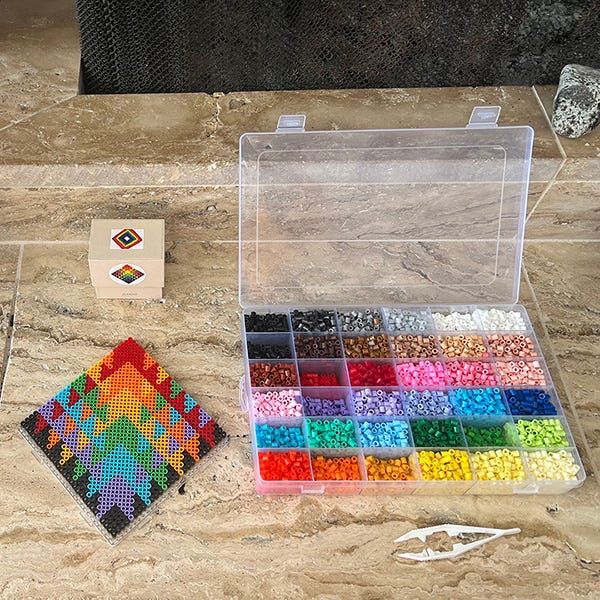
I brought along my computer so I could work, as well as notebooks, sketch books, markers, watercolors, reading material, no less than three tarot decks, all of my Rainbow Squared decks, and a yoga mat. I brought enough easy food so I didn’t have to think about acquiring any once I got there. And then I just lived. Wake up and do what I want before setting down to work. Go on long walks. Let myself play spontaneously with their art supplies.
It was glorious.
I’d like to say I return from retreats like that rejuvenated and refreshed. But the escape is harm reduction. While I’m there I can finish thoughts! I can make elaborate plans about my art practice with action steps that seem so doable! I don’t have meltdowns! But when I am back in my regular chaos I am as overwhelmed as ever and don’t even know where to begin.
It’s a bit of a come down.
There is just always such a backlog of things that could use my attention that I could bounce between them forever before getting to the projects I know I want to be moving forward. And when even that gets overwhelming, I find myself picking up my phone. I used to associate procrastination with poor time management. But now I better understand my procrastination as a form of emotional regulation.
I used to only play puzzle games. My personal favorites are of course the NYT Games (Wordle and Mini Crossword especially), Threes (which I actually can’t let myself open anymore because I can’t put it down), and the sensational color sorting games I Love Hue and I Love Hue Too (as you might guess, I am pretty good at these). Instead of an endless scroll, phone puzzles give you a discrete experience of accomplishment. Your body remembers that you’re capable of finishing something, and then you can get right back into whatever task you needed to self-soothe before tackling.
But recently I have moved beyond phone puzzles to a more of a gamey game, a Nintendo game, one I picked up again after years of retirement.
Pokémon GO.
Like a puzzle game, you can open the phone app, get a quick hit of dopamine, and then turn it off. The game is set up to spend little chunks of time rather than lose yourself for hours. Still, collecting digital monsters seems like the definition of a waste of time, even a little embarrassing. So how did I find myself here?
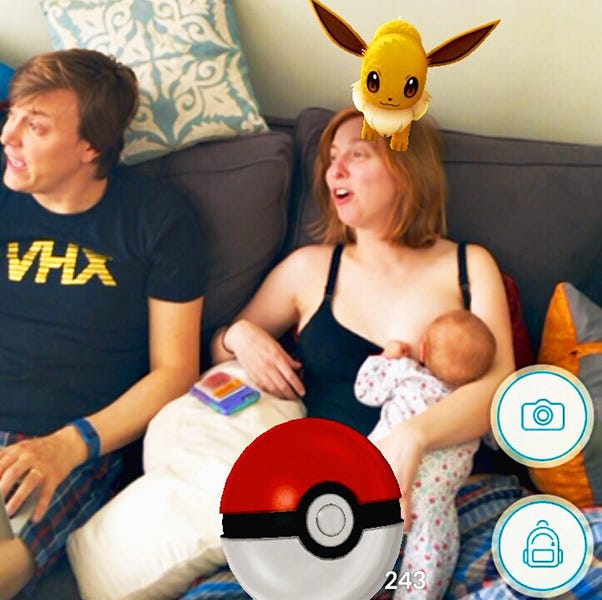
Pokémon GO was released almost a month to the day that D was born, July 2016. Almost instantly it felt like everyone was either playing or talking about how everyone was playing. I wanted to see what all the fuss was about so I made an account, choosing a user handle to affirm my new identity: PokemamaDrama69.
Pokémon GO was one of the first forays into large-scale augmented reality, and still probably the largest. You explore in actual space to find and capture Pokémon on your phone, with more of them clustering in public so that you actually have to leave your house.
As brand new parents, a game we could play while walking with an infant strapped to our chest was a strange little godsend. Walking had already been one of our favorite pastimes. This game gave our walking an added layer of purpose, or at least an added layer of fun.
And it really was so stupidly fun, meeting up at all the tourist spots or down by Ocean Beach to try and catch monsters with our friends and amiable strangers. It felt like the game dropped some sort of social veil. That our phones could actually connect us, like this shared hallucination could actually bring humanity together.
That first Halloween as parents we even dressed up as Pokémon GO. I was a Pokéball, the thing you toss at to catch your Pokémon. Justin decided to be a…finger. You know, because you use your finger to swipe in the game?
Clearly we needed to dress D herself as a little Pokémon, and once we thought about it there was really only one correct option.
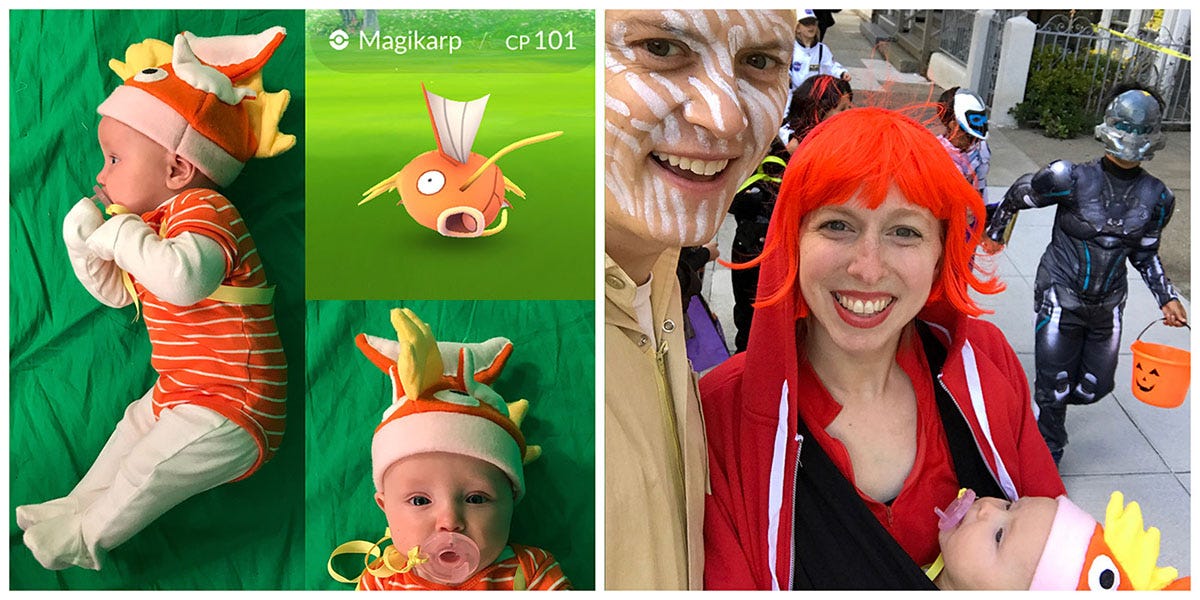
Magikarp is a goldfish on land. It just kind of…flops. Famously useless in battle. But the thing about Pokémon is that most of them evolve. You have to accumulate enough of them first though, each time earning what the game calls “candy” until you have enough to make the evolution possible.
Most Pokémon require a manageable amount. Twenty-five, maybe fifty.
Magikarp takes 400.
Which means catching the same fish over and over and over again. Orange, orange, orange, orange, for days and weeks. And then one day, your goldfish can become something else entirely: a massive, violent creature. Gyarados.
After all the repetition, the transformation itself isn’t gradual. It’s abrupt and profound. Which is how it felt to imagine our tiny baby eventually turning into an adult, which may as well have been a flying dragon for all we knew back then. The days are long but the years are short, they say, and even if we didn’t know what was waiting on the other side we did know this phase wouldn’t last.
Just like the Pokémon GO craze wouldn’t last. I naturally stopped playing the game, as most people did. Some time in early 2017 I opened the app again and saw new creatures I didn’t recognize. I had already made so much progress on collecting the first set of 151 that it felt like starting over. After that I closed the app and basically didn’t open it again for eight years.
By Summer 2025, I had a second kid who was six years old. My friend Miju (who incidentally dressed up as Polywhirl for Halloween all the way back in 2011) had just started playing Pokémon GO with her own son. E begged me to reboot my old account, and after some internal struggle over the app’s constant location tracking, I relented. PokemamaDrama69 is back on the scene! Though I might have chosen a different username if I had actually thought I’d be playing with a kid one day…
And this kid quickly comes to know way more about the game than I do. He studies a book of Pokémon like it is scripture, marking it up with a self-defeating amount of post-it notes, memorizing names and evolutions and types that I can’t keep straight. He starts talking about Pokémon in the morning before he even says hello.
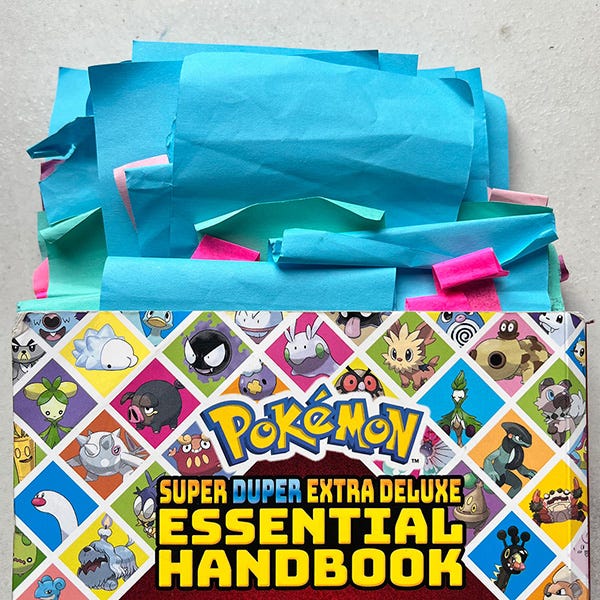
In 2016 the fun was that everyone was playing. In 2026 the fun is bonding with the people that are still playing. This includes other parents with their kids but also my friend Jimmy, and even E’s own school teacher.
We also encounter other players in the wild. E and I were once conspicuously sitting down in the middle of the sidewalk on a busy street staring at my phone, furiously swirling and swiping. A man walked by and asked: “Pokémon?” He happened to be catching a bus to go to a live Pokémon meet-up. We scanned each other’s QR codes and became “friends” in the game.
Like so many other things that peddle in chance—divination systems included—Pokémon is a synchronicity generator. It lends that delicious feeling that the world might open slightly if you pay attention to it, like The Universe winking at you. While the game rewards you for daily diligence, your habit is also reinforced by rare and special encounters. These are of course designed to keep you playing. But that time Miju and I dragged our children across Berkeley campus hoping for the legendary phoenix Moultres only to encounter one the moment I said we were leaving honestly felt a bit like grace.
It’s not all good feelings. At home we’ve got some actual Pokemama Drama, now with my daughter. D knows more about Pokémon than she would care to admit, but she’s not really inside that world with E and I. She feels alienated by our love of the game and this shared language, maybe even resentful. The game takes place in real time and real space, but that’s precisely its shadow side: taking you out of the shared present into a digital reality.
The game also encourages some compulsivity. Is there a Pokémon out there now? How about now? Just one more, just catch one more. Then your role becomes like a little librarian, cataloguing your top Pokémon and transferring the ones you don’t have space for based on scores that you have to do research to even understand.
That is some of its appeal though, this organizational task. It’s another reason my brain likes this game. In Pokémon, my collection feels manageable. I know exactly where everything goes. That has never been true for me in real life.
“What’s your favorite Pokémon?” is one of E’s most frequent questions.
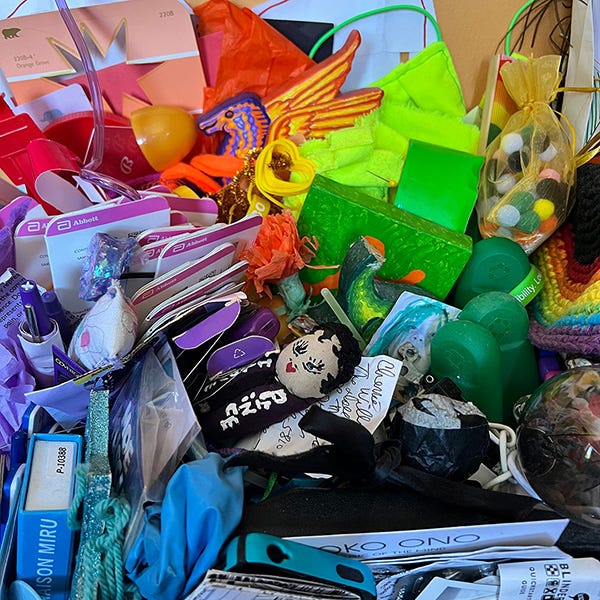
Mine are what I call the trash monsters. One is a rainbow pile of crystals and toxic sludge that eats garbage (Alolan Muk). The other is a colossal heap of discarded toys (Garbodor). Each Pokémon has a “type,” and both of these are Poison.
This fact is somewhat unsettling to him. In a world filled with beautiful mythical beasts, why would his mom choose…trash?
I have always loved a pile. And battled them, too.
I suppose you could say I collect stuff. You might call me a hoarder, except that I am an artist, so it’s all potential material. Ask Marie Kondo, artists get special dispensation. I am really good at squirreling away precious things, whether they go on my altar, my other altar, my trash altar, or boxes of objects that were once on my altar. But then the pile just keeps growing, endless tiny objects and pieces of paper that the kids bring home: parts of toys, chunks of fuse bead projects, report cards, worksheets, flyers, valentines. Then there is the adult stuff: unopened mail I need to sort, opened mail I need to file, documents, holiday cards, event ephemera. All these things get put in piles and then sorted into boxes until there are too many that I can no longer put off a reckoning.
The reckoning usually arrives abruptly, a sudden urge. Around the time I was too triggered by broccolini to be around my family, I found myself consolidating a dozen separate piles and boxes together into one truly giant box. I taped a piece of paper on it that said “SORTING IN PROGRESS.” Then I let the box sit for a couple months.
Around the spring equinox, the day before I initially planned to share this piece, I felt the next sudden urge to actually sort this consolidated mass. Procrastination at its finest!
Inside one of the boxes I found a rolled up poster I didn’t remember. When I pulled it out, it was another relic from the end of 2016: the wall text for One Tiny Painting a Day, Seven Days a Week for Seven Weeks, the piece that was the impetus for Rainbow Squared. It features prominently in the background of this photo that lives on the About page of my website, but until now I hadn’t really read it again.
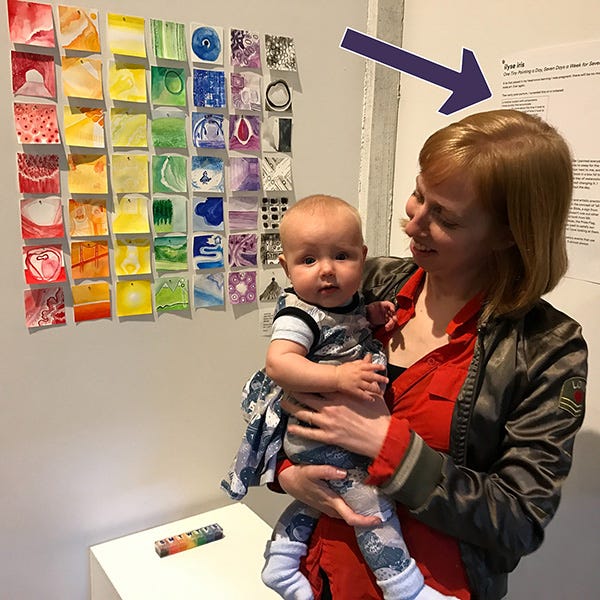
In it I had transcribed this postpartum post-it note:
a modular project with components
made quickly that accumulate
→ it’s more about the time it took to
make & the kind of time it took to
make than the final productsomething anyone could do with
20 min (10? 5?) each day
digital?
fabric?
drawing?
satisfies the getting things done voice &
squeezes in time for productivity
So instead of a pure channel for creativity, is the impulse at the heart of this very project actually productivity?
As if having and raising a baby weren’t productive enough in and of itself? What is that “getting things done voice” if not some internalized, capitalistic taskmaster, determining my self-worth based on my artistic output?
I can hear the logic of it though, and it has its own brilliance born of desperation. Small pieces done consistently, becoming something larger over time. The body of work builds slowly but steadily. Task by task, moment by moment.
In a fucked up way, “squeezing in time for productivity” is also exactly what Pokémon GO did in my life around the exact same time, and even more so what it’s doing now. When I’m playing the game with E at least we’re bonding, but I can’t pretend I don’t also play it when I’m alone. When I play while I am waiting in line at the post office or even biking, it’s not procrastination. It’s more like what the kids call “maxxing,” trying to get everything I possibly can out of every in-between moment, hyperloading the present.
My “getting things done voice” is still here and louder than ever. And if I’m honest, the moments when my emotional pressure most threatens to explode are precisely the moments when we are trying to get things done. Get dressed, get out the door, go from one activity to the next to the next to the next. The overwhelm comes from the doing, from the frenzy of activity.
And it’s not just the daily tasks. There are larger decisions hovering too, the kind that could rearrange everything if I let them. I can feel them waiting at the edges, pushing in closer, gathering energy. Maybe that’s why I let myself get caught up in the small, endless tasks. They may push me to the brink but they are less daunting than making life-altering decisions.
No wonder I want to flee to a controlled environment where the monsters are cute and easy to organize, where you are always on a trajectory to level up. Real change doesn’t track neatly into a progress bar though.
I keep thinking about Magikarp, about how long it can seem like nothing is changing before it suddenly does. Even if the transformation is instantaneous, it was building all along.
Still, before it happens transformation doesn’t always feel like growth. Sometimes it just feels like something is about to give.
So until then Pokémon GO is also a form of escape. When other apps and even my own inbox are terrifying portals into what is going on in the actual world, the game is a corner of my phone that is safe. Perhaps it’s no accident that this game came out right when the news cycle began to get truly dystopian in the first place, the months before Trump was first elected.
So while I guilt myself for the cumulative hours I’ve spent on this objectively stupid game, I can still remind myself that I am not doing it because I am lazy. I am doing it because I am scared. Sometimes that lends enough self-awareness to just close the app. And sometimes it lets me cut myself some slack and have some fun, because it really is.
Maybe something is already on its way to evolving.
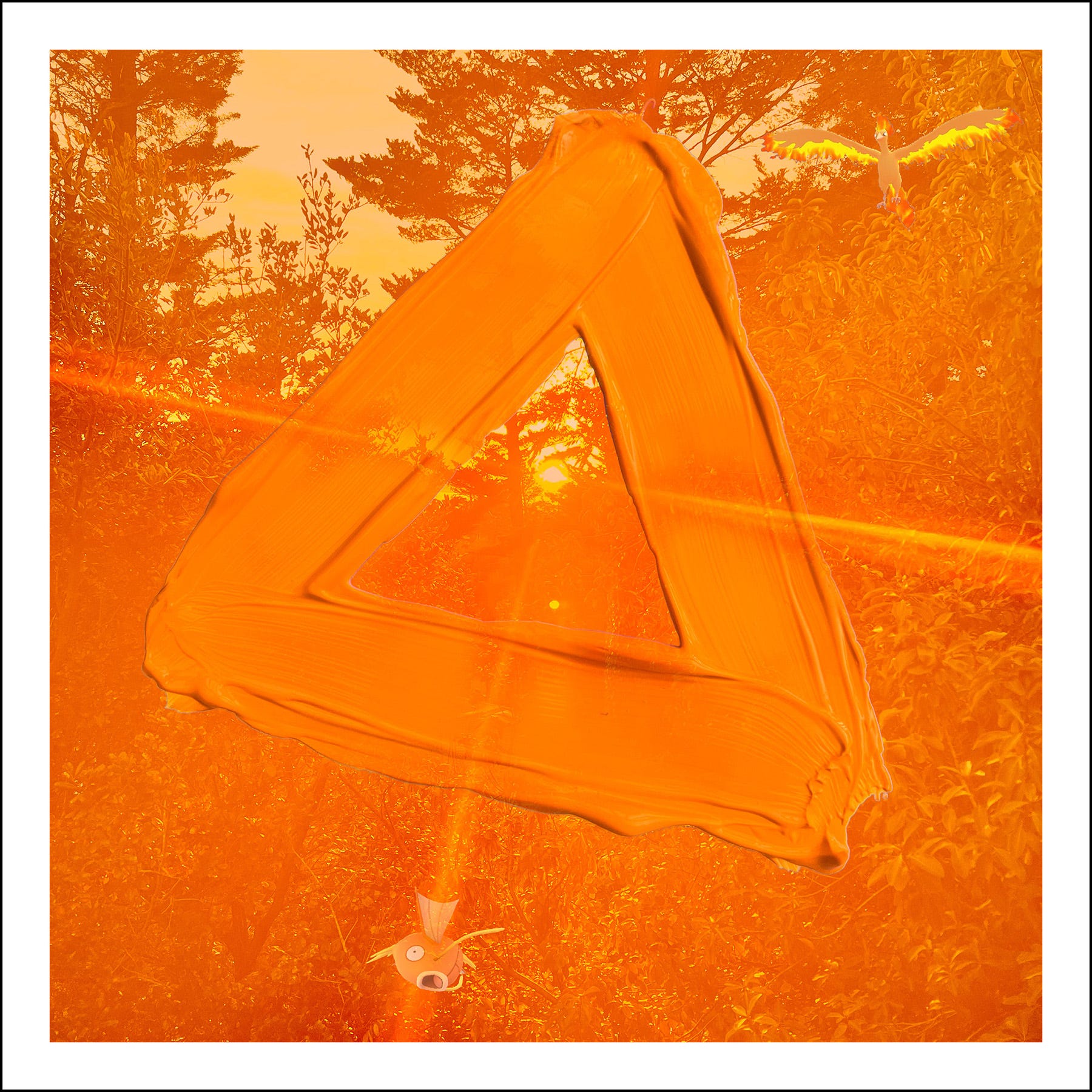
The double colors are the Major Arcana of the Rainbow Squared deck. When a color doubles, it intensifies, becoming both itself and something more. It can reveal a tension within the color, or dissolve the binary entirely.
Orange is the second color of the spectrum, the first true shift where color begins to change. Suspended between Red and Yellow, it carries movement, transition, life force in motion.
In Orange Orange, creation and destruction are not opposites but twins. They feed each other, often impossible to separate. Eros and Thanatos, braided together.
Orange represents the creative impulse: not only artistic, but the force by which you shape a life. What are you building, moment by moment? What is trying to move through you? Where are you letting that movement flow, and where are you holding it back?
Transformation rarely arrives out of nowhere. What has been building quietly and repetitively reaches a point where it can no longer remain as it is. Change may appear sudden, even violent, but it is almost always the result of long accumulation.
What are you in the process of building? What has been accumulating all along? What might you be afraid to let change? Are you feeding what you want to grow, or keeping something small?
Orange Orange is also a card of proliferation, growth that multiplies: flowers, fungi, cells, memes, data, waste, resentment. Proliferation creates piles, those strange forms of abundance and excess, accumulation and collapse. The more you have of something, the less it means. A pile’s dark magic makes it less than the sum of its parts. Or, under the right conditions, something else entirely: compost heats, breaks down, and becomes soil.
Sometimes transformation requires breakdown. The caterpillar dissolves before it can form again. The phoenix rises from what has already burned. Creation becomes destruction becomes creation again.
Orange Orange carries heat, fire. Rage, desire, sex, anxiety, all forces that do not wait for permission. They arrive as urgency, as compulsion, sometimes as eruption. This is the strange fire of Orange Orange: the slow accumulation that becomes sudden transformation. The spark that becomes a blaze. The flopping fish that becomes a dragon.
This card is also the ninth. Nine has a peculiar property: it dissolves back into the whole. Add it to other numbers and it disappears, leaving what was already there. Nine doesn’t add; it reveals.
In Tarot, the ninth card is The Hermit, the figure who steps away from the overwhelm to see clearly. Solitude here is not absence or loneliness, but perspective. A necessary distance from the pile.
When you step back, can you see what is accumulating? What is revealed when you stop trying to manage every piece? Orange Orange asks you to notice what is building, what is burning, and what is ready to change.
![A kid holding up a protest sign thats says "IF YOU ARE [ice] THEN WE ARE [fighting] [fire] [rock] [steel]" with symbols instead of words for the types. In Pokemon, Ice type are weak to Fighting, Fire, Rock, and Steel types.](https://substackcdn.com/image/fetch/$s_!6tAR!,f_auto,q_auto:good,fl_progressive:steep/https%3A%2F%2Fsubstack-post-media.s3.amazonaws.com%2Fpublic%2Fimages%2Ffbd9cae0-adbf-4838-8056-459809368d4c_600x600.jpeg "A kid holding up a protest sign thats says "IF YOU ARE [ice] THEN WE ARE [fighting] [fire] [rock] [steel]" with symbols instead of words for the types. In Pokemon, Ice type are weak to Fighting, Fire, Rock, and Steel types.")
Comments
Nothing yet. Say the first thing.
Sign in to join the conversation.