
Everyone is talking about “slop.” But what is slop really? Here is a tentative answer, in the form of a working definition:
Slop: media designed to deliver frictionless and amusing short-term stimulus, rather than to inspire more frictional forms of emotion and/or reflection.
“Friction” here is meant as a more efficient term for the subjective experience of mental discomfort brought on by thoughts that are inconsistent, confusing, or complex.
Though not a necessary or sufficient condition, inspiring discomfort of this kind is a common property of good art, whether visual, written, or otherwise. Art often has something to teach us, and good art convinces us to ingest its teachings, even at the cost of some mental strain.
Slop is media designed (intentionally or not) to do the exact opposite, to suppress or smooth out aesthetic and cognitive tension of exactly the sort that demands we reflect. It is media optimized to hold our attention and to do precisely nothing with it to the greatest extent possible.
Absent any serious inhibitions to our agency or autonomy, most of us are choosing to consume slop every day, often for multiple hours at a time. This would seem an unattractive choice from a disinterested, rational perspective. It would seem even more unattractive, arguably, than a similar, if more science-fictional choice known for its unattractiveness: to enter ‘the experience machine’ from philosopher Robert Nozick’s famous 1974 thought experiment.
“Suppose,” Nozick writes, in his book Anarchy, State, and Utopia, “there were an experience machine that would give you any experience you desired.”
Superduper neuropsychologists could stimulate your brain so that you would think and feel you were writing a great novel, or making a friend, or reading an interesting book. All the time you would be floating in a tank, with electrodes attached to your brain. Should you plug into this machine for life, preprogramming your life’s experiences? … What else can matter to us, other than how our lives feel from the inside? (p. 42-43)
Nozick’s, and indeed most moral philosophers’ assumption has long been that few if any would choose to enter the experience machine (“we learn that something matters to us in addition to experience by imagining an experience machine and then realizing that we would not use it,” p. 44).
The thought experiment is meant as an argument against ‘hedonism about well-being,’ the idea that our lives are good or bad purely in virtue of our experiences of pleasure and pain. Were hedonism about well-being true, we’d be fools not to enter the experience machine, since it allows us to max out on pleasurable experiences (and to ‘min out’ on painful ones). But given most have strong intuitions against entering the machine (or so many philosophers have claimed), hedonism must be false by modus tollens. There is something disconcerting about leaving ‘the real world’ behind, even for a vastly more pleasant false one.
It is striking that without even the promise of moderate pleasure, much less unrealistically intense pleasure, most of us now enter our own sort of experience machine for, on average, several hours a day, hours that add up over the course of our lifetimes, until, by the end, they’ve turned into years. Reframed as its own thought experiment, this more realistic machine is somehow both more subtle and more off-putting than Nozick’s original:
The Inexperience Machine: you may enter for several hours daily a machine that displays, on a screen inside, a fluctuating menagerie of audiovisual experiences ranging from the trifling to the grotesque. Upon exiting the machine, you will forget all but a narrow slice of what you heard and saw. To enter is to commit these hours to the machine every day for the rest of your life.
Between the experience and inexperience machines, I would argue that the former is the more attractive choice. The experience machine at least trades reality on the whole for a greatly more pleasurable alternative. But the inexperience machine does little besides cleave apart and empty out the one reality that we have.
That so many of us have entered the inexperience machine—not in a thought experiment, but for real—would come as a shock to the late 20th century ethicists (including Nozick himself) who intuited that Nozick’s machine would so offend our attachment to the real that even the promise of experiencing, say, an impossibly passionate love affair, or winning every Nobel prize at once, could not seduce us to enter.
Our new digitally suffused unreality is a dramatic object proof that they were wrong. We are in effect making the same trade with a large proportion of our time, while getting much less in return. While it is difficult to say how much of what we consume counts as “slop,” U.S. adults now spend an average of 8 hours a day on video consumption alone.
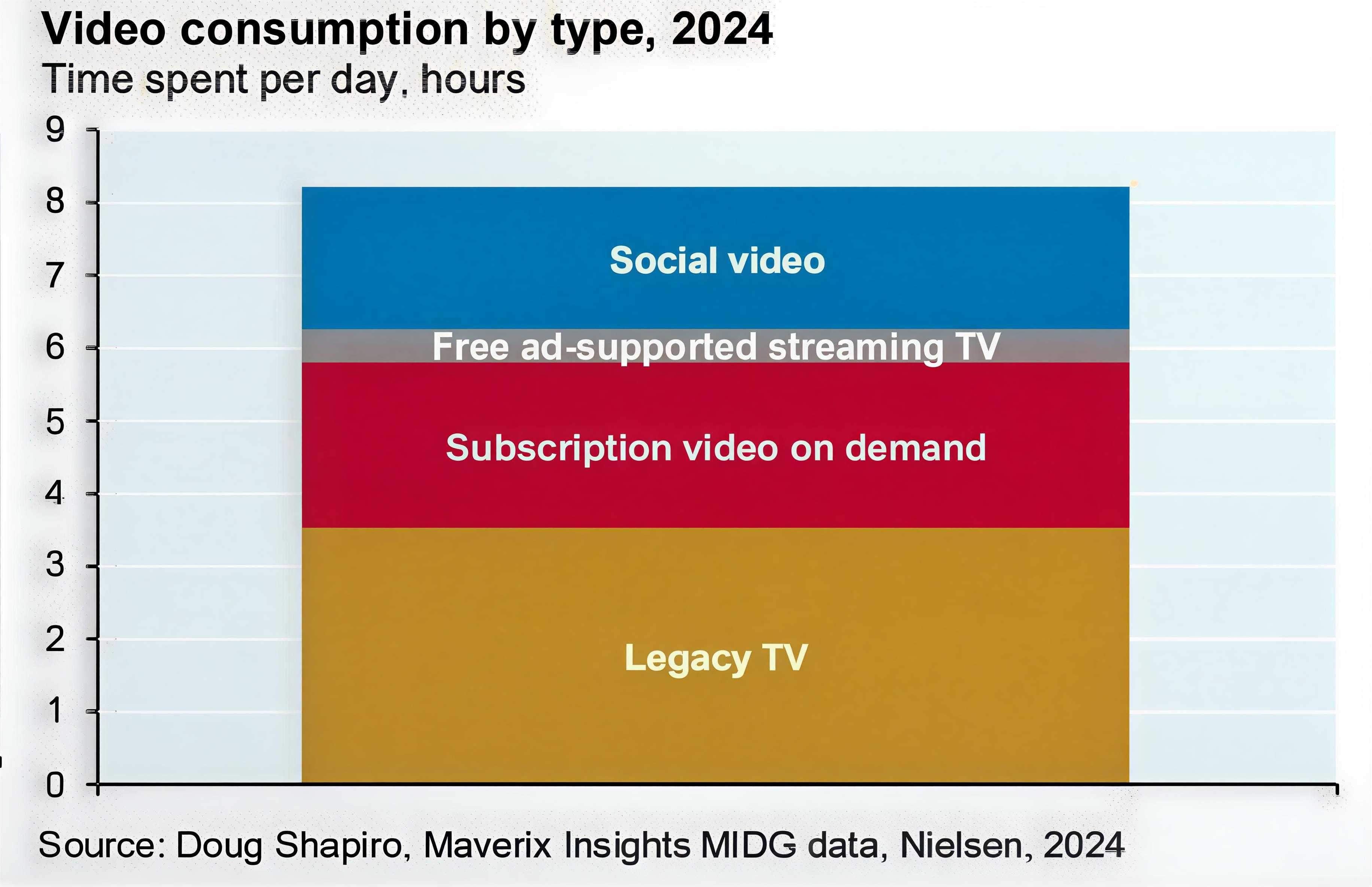
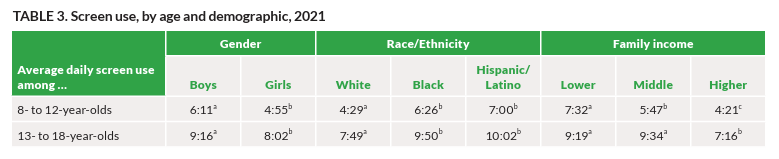
It is not just the raw time commitment that is galling here, but also how it is stratified. Raw averages mask stark inequalities in the video consumption of different groups. A privileged few, for instance, still consume little digital media at all. And among those with more typical diets, some are much more modest consumers than others.
The education nonprofit Common Sense’s 2021 report on “Media Use by Tweens and Teens” found that children of families making $100,000 or more a year spent 2-3 hours less on screens than those of families making less than $35,000 a year, and 1-2 hours less than those with yearly incomes in the middle.
Similarly, while it is widely discussed that increased digital media consumption over the last 15 years has coincided with declining literacy and numeracy scores across age groups, it is less discussed that these declines have not been equally distributed.
In its 2023 Adult Skills report, the OECD found that declines in average literacy and numeracy over the previous decade were “largely due to falls among the lowest performing adults” (p. 22 - 23). International PIAAC test results bear this out, and the U.S.’s domestic results on both the PIAAC and the NAEP show a similar pattern.
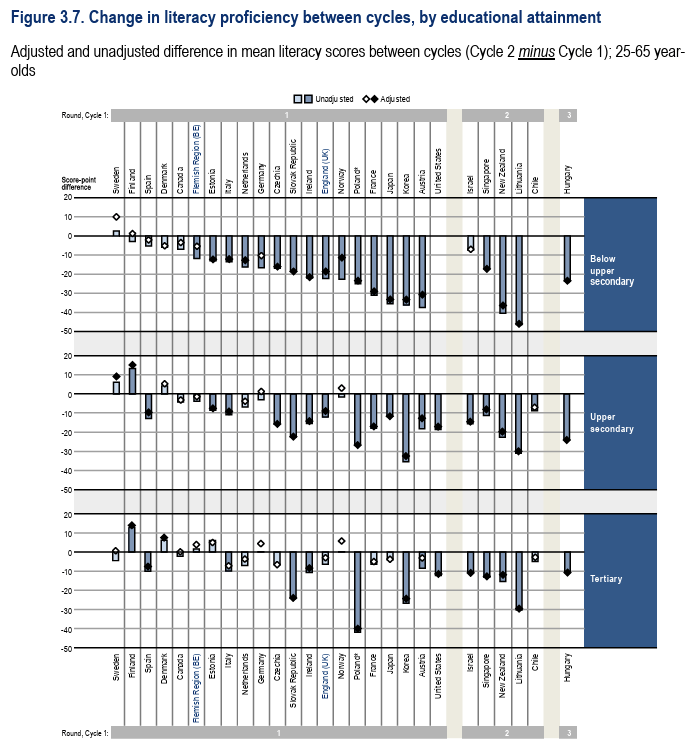
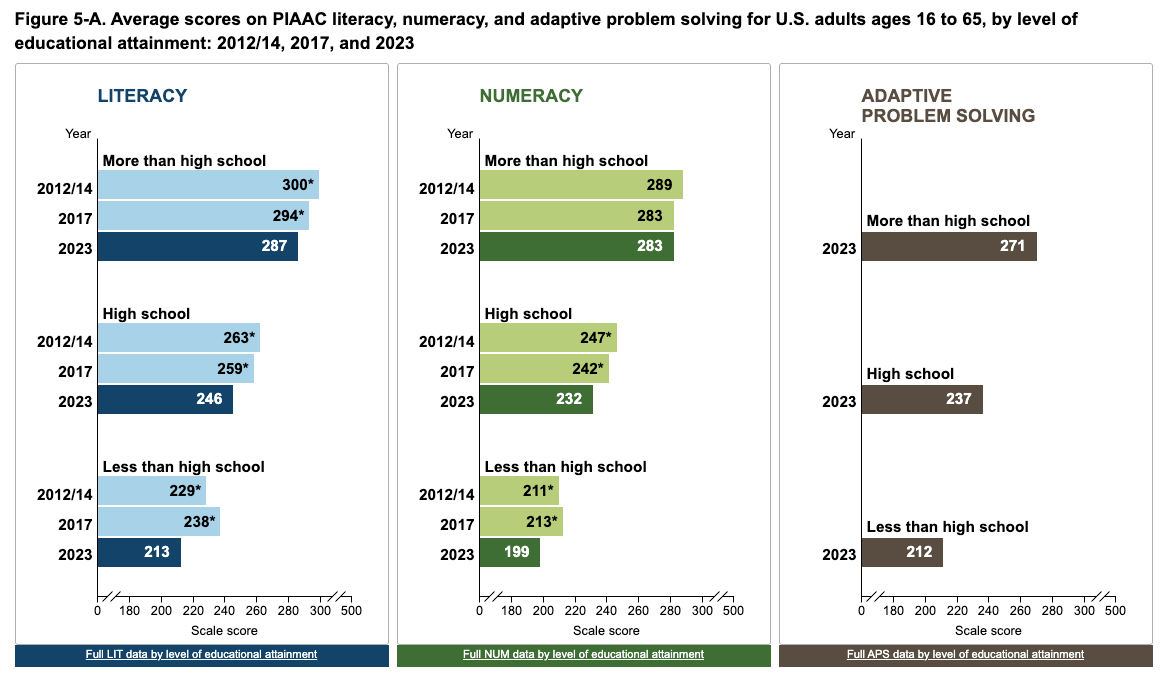
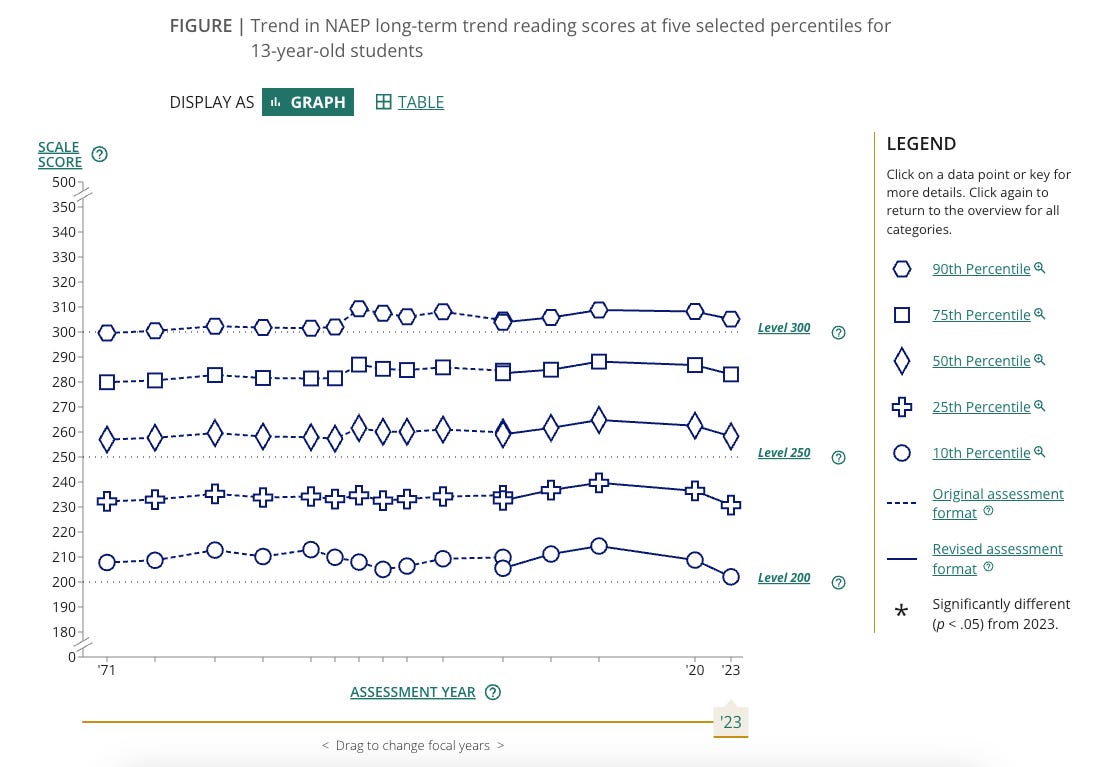
Across all these figures, so-called “brainrot” has hit the lowest performers the hardest (yes, I am eliding some complex causal questions here, but the evidence that digital media consumption explains these trends gets stronger by the day). While the high-achieving have not been immune, they have better resisted some combination of the inexperience machine’s allure, and its stultifying effects.
Others haven’t fared so well, though, and even for high-achievers, things could very well get worse. For context, the data above largely precede the rise of so-called “AI slop.” Generative AI has made it much easier to create content optimally designed for shallow attention-seeking. The result has been a Biblical flood of often bizarre and disturbing content (see below for some classic entries in the genre; the first has 166 million views, the second 414 million).
Putting aside that videos like these are currently traumatizing unsuspecting children on an industrial scale, more, and more addicting content probably also means more brainrot. If so, then the educational and intellectual hierarchies reflected above are likely to keep growing.
They will do so even if sturdier social barricades soon stem slop’s rising tide. Much of the damage has already been done, and it will continue to compound as its young victims age into cognitively impaired adults. That was the conclusion of a little-noticed 2022 review article in the Journal of Integrative Neuroscience. “We hypothesize,” write the authors, “that excessive screen exposure during critical periods of development in Generation Z will lead to mild cognitive impairments in early to middle adulthood resulting in substantially increased rates of early onset dementia in later adulthood.” They go on to predict that
from 2060 to 2100, the rates of Alzheimer’s disease and related dementias (ADRD) will increase significantly, far above the Centres for Disease Control (CDC) projected estimates of a two-fold increase, to upwards of a four-to-six-fold increase … [enough to] result in widespread societal and economic distress and the complete collapse of already overburdened healthcare systems in developed countries. (pg. 1)
While some have and will resist the inexperience machine, opting instead to use the wider digital ecosystem the way once-vocal cyber-idealists assumed they would—to learn, to connect, to find like-minded people—far more are set to whittle their minds away drinking long and deep from the slop trough.
It doesn’t take a sage to see the future that this portends: one of aggressive, and fast-rising cognitive inequality, borne not of hardship or oppression, but a garish digital rollercoaster even the smallest children are tall enough to ride. While rising wealth inequality has long been a fixture of our political economy, rising cognitive inequality may soon rival it for structural significance.
Nozick was wrong to assume that no one would want to enter the experience machine. He thought that “we want to do certain things, and not just have the experience of doing them” (p. 43). But humans are rarely moved by abstract philosophical reasoning. More often, they are moved by a mix of biological drives and low-grade psychological heuristics. Hence the spate of experiments finding that, when people are asked if they would enter the experience machine, their answers hinge on trivial aspects of how the question is posed.
Rats will give up food, to the point of starvation, for successive hits of electrodes attached to their neural reward centers. We are more similar to them than the ideally rational agents of much analytic philosophy. We are climbing into the inexperience machine in droves, choosing streamers over friends, cooking videos over cooking, and pornography over sex. We are choosing slop, which goes down easy, over edifying friction.
The latter may soon become the exclusive provenance of a new cognitive elite. There would then be little to stymie the U.S.’s ascendant techno-authoritarianism. Sooner than we’d like to think, we may be less participants in politics than points on a scoreboard, jockeying between whichever faction has the best short-form propaganda. What was once a republic may soon be reduced to a field of manipulable atoms bouncing around digital space, our behavioral parameters wiggling at the whims of the highest bidder.
Resisting this outcome means reintroducing friction into our lives, the friction of seeing and meeting strangers, of learning, of holding strong to our civic commitments. The crisis of slop consumption is of a piece with a more general crisis of risk aversion, one shaping everything from early parenting to post-college career development to socializing among adults—a kind of cradle-to-grave program for turning out pampered neurotics. The rise of always-at-hand digital entertainment is an essential part of this program, since it means we can always trade something challenging, but good for us, for something both comfortable and pointless.
Nozick’s opposition to the experience machine was so strong that he considered plugging into it to be a “a kind of suicide” (p. 43). He was anticipating the ideas of someone who would at first seem a strange bedfellow, namely the author David Foster Wallace, who had this to say—in 1996 no less—about the future of electronic entertainment:
… the technology is just gonna get better and better and better and better. And it’s gonna get easier and easier, and more and more convenient, and more and more pleasurable, to be alone with images on a screen, given to us by people who do not love us but want our money. Which is all right. In low doses, right? But if that’s the basic main staple of your diet, you’re gonna die. In a meaningful way, you’re going to die. (Lipsky, p. 86).
To the extent you agree with Nozick and Wallace, the choice to leave the inexperience machine becomes painfully simple: life is better spent living than dying by a thousand virtual cuts.
Arachne is a reader-supported publication. To receive new posts and support my work, consider becoming a free or paid subscriber.
Comments
Nothing yet. Say the first thing.
Sign in to join the conversation.