
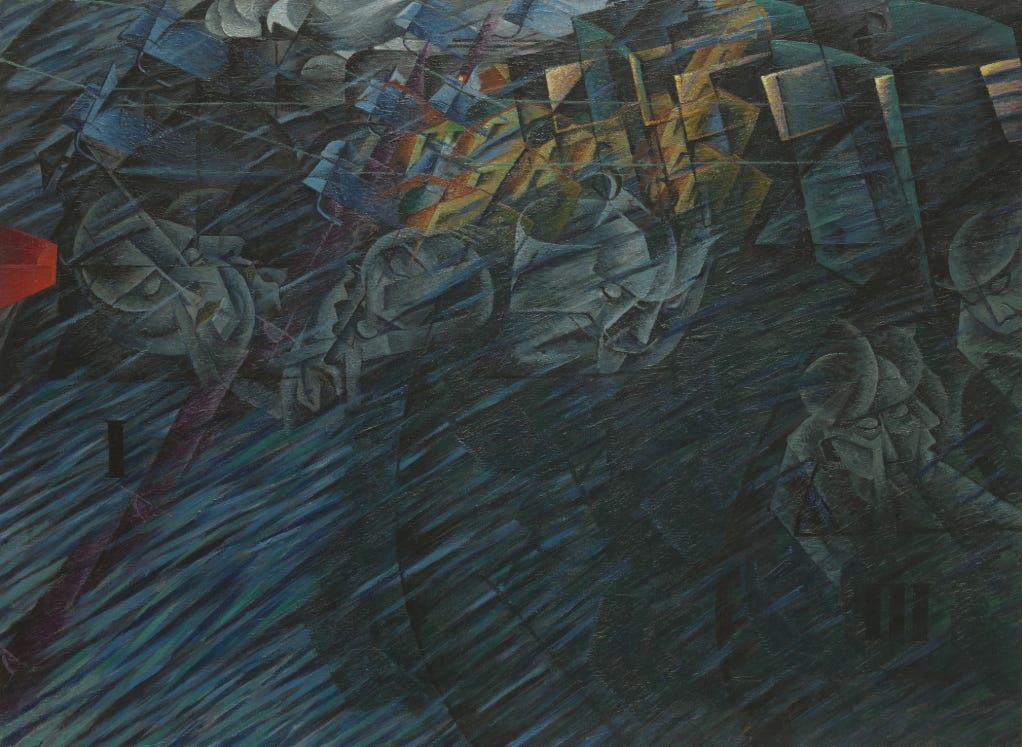
I recently read F. T. Marinetti’s “The Foundation and Manifesto of Futurism” for the first time. The Italian Futurists—Marinetti being the movement’s predominant artistic voice—came to prominence in the early 20th century, and were known for their celebration of the dynamism and virility of the modern world, in particular as manifested by technologies of transport and warmaking—automobiles, steamships, planes, tanks, bombs, bullets.
The Futurists, while mainly an artistic movement, were also known for deploying their art in the service of fascist politics. Marinetti returned from World War 1 a twice-decorated veteran and leveraged his newfound public image into the foundation of the Partito Politico Futurista, the Futurist Political Party, which was absorbed into Mussolini’s National Fascist Party in 1919.
The Futurist manifesto has a more personal, narrative character than most political writings of its kind. Its first paragraph reads more like literary fiction than fascist propaganda:
We had stayed up all night, my friends and I, under hanging mosque lamps with domes of filigreed brass, domes starred like our spirits, shining like them with the prisoned radiance of electric hearts. For hours we had trampled our atavistic ennui into rich oriental rugs, arguing up to the last confines of logic and blackening many reams of paper with our frenzied scribbling.
From here, the scribblers, soaked through with liquor and strange, new ideas, climb into Marinetti’s 1908 Fiat and speed through the streets of Italy until, after nearly colliding with two cyclists, they flip the car into a ditch. For all the overwroughtness of Marinetti’s prose, his reaction to this incident is admirably, if disturbingly informative of Futurism’s basic ideals and psychic underpinnings:
O maternal ditch, almost full of muddy water! Fair factory drain! I gulped down your nourishing sludge; and I remembered the blessed black breast of my Sudanese nurse … When I came up—torn, filthy, and stinking—from under my capsized car, I felt the white-hot iron of joy deliciously pass through my heart. (trans. R. W. Flint, 1971)
Put a different way: Futurism is defined by its sexually charged revelry in the frenzied, machinic violence of the modern world, by drunkenly careening into a ditch ensconced in metal, by getting a racist, Oedipal hard-on while you do it.
Though it has been superseded by the more professionalized, technocratic futurisms of Silicon Valley, there is something of Italian Futurism still with us. In the aftermath of this latest act of high-profile political violence, the assassination of MAGA acolyte Charlie Kirk, America is beginning to feel a bit like Marinetti’s car, speeding out of control, driven by a small group of chaos agents who revel in the aesthetics of extremist violence.
As of my writing this, we do not know who shot Charlie Kirk. But it would be a good guess that they are not a disciplined operator with a well-worked-out theory of change. They are probably, like Thomas Crooks, like Luigi Mangione, like Vance Boelter, lonely, suffering from some kind of mental illness, and influenced by some eclectically extreme backroom of the contemporary internet, or at best their own scattered, misshapen attempts to make sense of a world seeming to skate by without them. By killing or trying to, by seeing that, whether they lived or died, their actions would be blasted into the public sphere by the same vast, modern machine that incubated them, these men found a surefire path to reenter the world again, to crash their speeding cars into ditches, to force themselves, newly muddied, into the wakeful eyes of the inevitable, gathering crowd.
I want to get out of Marinetti’s car. I also want, but know I can never fully ‘get out’ of the contemporary internet, as colossal and impressive a machine for prosecuting modernity’s conflicts as has ever been, and perhaps ever will be built. And yet, it of course won’t do to answer Marinetti by banning cars or any other of modernity’s technological wonders. It will only suffice to reassert rational, public control over them.
But in the aftermath of what is sure to be one of the most explosive killings of a public figure in America since the turn of the century, that may become a much more remote prospect. Many on the right are already gearing up to exploit Kirk’s assassination in order to repress their political enemies. The conglomerates that have swallowed the internet whole have for the most part become their allies, their CEOs having already lined up to pay tribute to our dear leader. The scope of Marinetti’s metaphor hardly seems apt. A car is too quaint, too small, for the contemporary modern imaginary, with it’s A.I. apocalypses and fantasies of social collapse.
Perhaps we are careening through space in a titanic starship, cowering in small metallic rooms, vomiting into wastepaper baskets, our faces washed in blue light from flashing, touch-screened consoles. “I condemn in the strongest terms the violence that has broken out on deck 5,” a lone woman types furiously. “My prayers go out to Kirk, his wife, and the son and daughter that survive him.”
There is hoarse yelling from the floor above. An alarm is screaming red. Maybe you can do something to slow this all down, assuming it can be stopped. But what if it can’t? The sinister thought occurs: maybe it is better to prepare for after. Why not be one of the few who stands back up, bloodied, but beaming, in the wreckage of the crash?
No posts
Comments
Nothing yet. Say the first thing.
Sign in to join the conversation.