
There’s an Ayah in the Qur’an that most of us read quickly, nod at, and move on from. It’s a long ayah, almost like a list of traits and qualities. But if you slow down and check every word, you’ll notice something that is kind of strange:
The Ayah is Surah Al-Ahzab, 33:35:
إِنَّ الْمُسْلِمِينَ وَالْمُسْلِمَاتِ وَالْمُؤْمِنِينَ وَالْمُؤْمِنَاتِ وَالْقَانِتِينَ وَالْقَانِتَاتِ وَالصَّادِقِينَ وَالصَّادِقَاتِ وَالصَّابِرِينَ وَالصَّابِرَاتِ وَالْخَاشِعِينَ وَالْخَاشِعَاتِ وَالْمُتَصَدِّقِينَ وَالْمُتَصَدِّقَاتِ وَالصَّائِمِينَ وَالصَّائِمَاتِ وَالْحَافِظِينَ فُرُوجَهُمْ وَالْحَافِظَاتِ وَالذَّاكِرِينَ اللَّهَ كَثِيرًا وَالذَّاكِرَاتِ أَعَدَّ اللَّهُ لَهُم مَّغْفِرَةً وَأَجْرًا عَظِيمًا
“Indeed, the Muslim men and Muslim women, the believing men and believing women, the obedient men and obedient women, the truthful men and truthful women, the patient men and patient women, the humble men and humble women, the charitable men and charitable women, the fasting men and fasting women, the men who guard their chastity and the women who do so, and the men who remember Allah much and the women who do so — for them Allah has prepared forgiveness and a magnificent reward.”
Read it again, slower this time, and count.
There are exactly ten qualities listed. Submission. Faith. Obedience. Truthfulness. Patience. Humility. Charity. Fasting. Chastity. Remembrance of Allah (Dhikr).
Nine of them are listed without any modifiers or quantifiers, so they are just mentioned and left alone: Allah doesn’t say “the abundantly charitable,” or “the frequently fasting,” or “the deeply patient.” Charity is just charity. Fasting is just fasting. Patience is just patience. Each quality stands on its own, unmodified, unqualified .. as if the noun itself is enough.
Then we reach the tenth, the last one on the list, and the pattern changes. It isn’t “those who remember Allah.” No. It’s “those who remember Allah much.” وَالذَّاكِرِينَ اللَّهَ كَثِيرًا. One single quality, out of ten, gets a quantifier. And it isn’t charity. It isn’t fasting. It’s remembrance of Allah: dhikr.
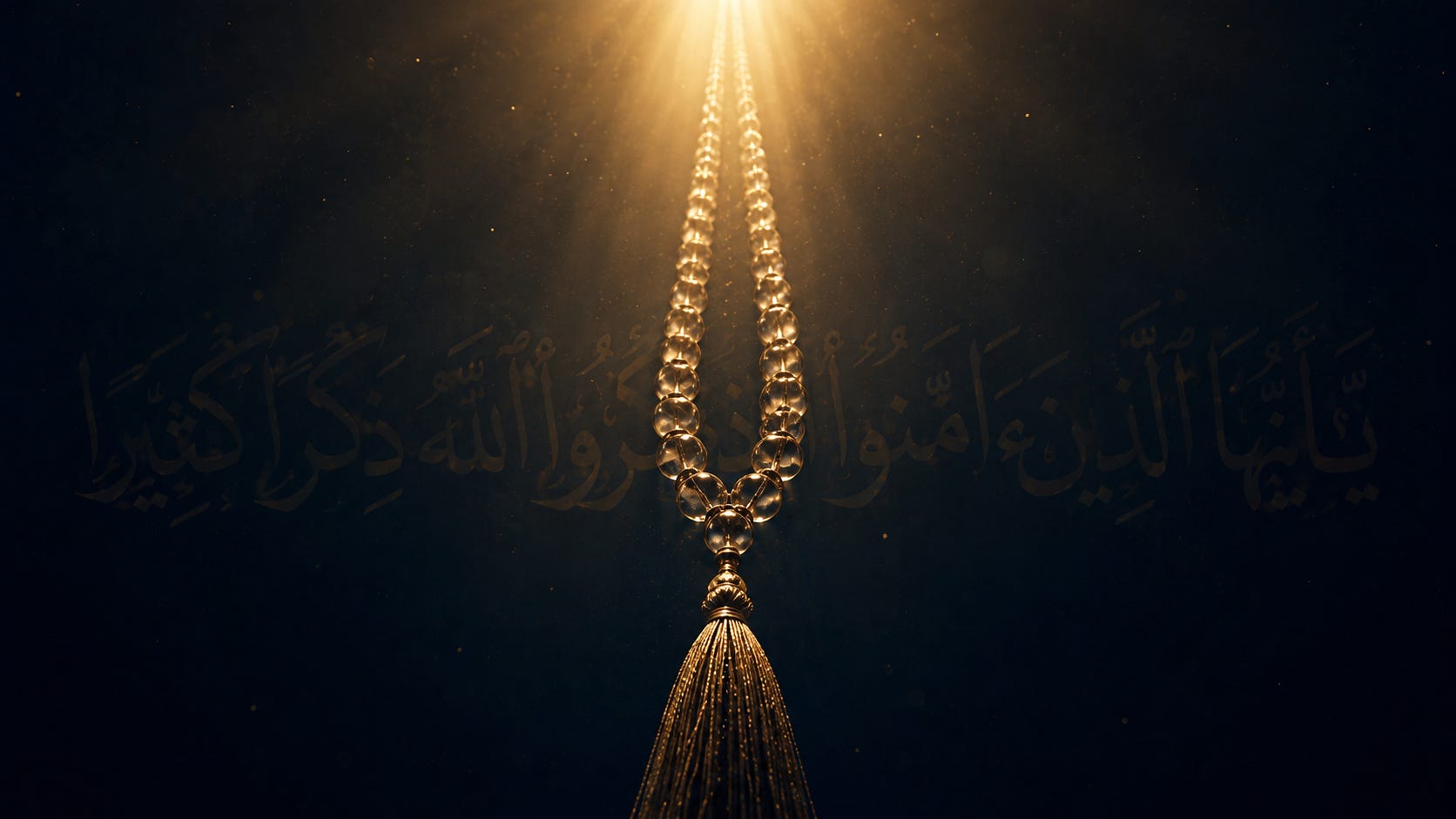
That’s not an accident of phrasing. The Qur’an is not a casual book; it doesn’t pad sentences for rhythm, it doesn’t prioritize what words sound like. When a word appears once in a list of parallel structures, it’s there to be noticed, and for you to consider it and ponder over it.
And this is not an anomaly .. Actually, if this were the only place the word showed up attached to dhikr, you could call it a coincidence. It isn’t.
When Allah answers the prophet Zechariah’s request for a sign, He doesn’t just grant it, He attaches an instruction to it:
واذكر ربك كثيرا وسبح بالعشي والابكار
“And remember your Lord much, and glorify Him in the evening and the morning.”
A prophet receiving a miracle is, simultaneously, being told to multiply his remembrance. And he wasn’t the only one …
Moses and his brother Haron, heading toward the Pharaoh, describe their own mission in the same terms:
كي نسبحك كثيرا ونذكرك كثيرًا
“That we may glorify You much and remember You much.”
Not glorify and remember. No. Glorify much and remember much. Two prophets, walking into the most dangerous confrontation of their lives, frame their purpose around abundance of remembrance, not just its presence.
Then comes the general command, addressed to everyone who believes, not to prophets facing trials:
يا أيها الذين ءامنوا اذكروا الله ذكرًا كثيرًا
“O you who believe, remember Allah with much remembrance, and glorify Him morning and evening.”
Again .. not just remembrance of Allah. Much remembrance.
And the Qur’an doesn’t only tell you what abundant dhikr looks like. It tells you what its absence looks like, too. Among the traits used to describe the hypocrites:
ولا يذكرون الله الا قليلا
“They do not remember Allah except a little.”
Scarcity of remembrance isn’t framed as a minor habit to improve . . it’s listed as a marker of hypocrisy itself.
Perhaps the most striking instance is the one tied to combat. In the Ayah instructing believers on how to face an enemy in battle, the command isn’t simply to stand firm.
يَا أَيُّهَا الَّذِينَ آمَنُوا إِذَا لَقِيتُمْ فِئَةً فَاثْبُتُوا وَاذْكُرُوا اللَّهَ كَثِيرًا لَّعَلَّكُمْ تُفْلِحُونَ
“O you who believe, when you meet a force in battle, stand firm and remember Allah much, that you may succeed.”
In the single moment where a human being is least likely to have the presence of mind for anything beyond fighting and strategy, the Qur’an asks for much remembrance of Allah, not a passing thought, but abundance, precisely when it would seem the easiest to miss and hardest to sustain.
But why?
Here’s what makes the emphasis make sense once you sit with it: dhikr is the only act of worship on that entire list .. really, in the entire structure of Islamic worship .. with no built-in ceiling. Prayer has a fixed number of rak’as and fixed times. Requires wudu, following certain conditions. Fasting has a fixed month, fixed hours, fixed conditions for who is exempt. Charity is bound by what you own. Hajj happens once in a lifetime as an obligation, and you follow a set of rules and commands. Every other act of worship comes with a natural structure and set of rules. Dhikr has none of that.
It needs no (wudu’) ablution, no direction of qiblah to face, no money, no physical exertion, no appointed hour, not even any rules or conditions. It can happen while you walk, while you wait, while you drive, while you can’t sleep, on the battlefield, even at leisure. There is, quite literally, no ceiling on how much of it a person can do .. which means it’s the one worship where “much” isn’t just possible, it’s the entire point.
That may be exactly why it’s singled out. The other nine virtues are bound by circumstance: you can only be as charitable as your wealth allows, only fast as much as the law permits, or health can take. Remembrance is bound by nothing but your own willingness, which makes “much” the only honest standard to hold it to. It does not EVER require you to move your mouth!
What Abundance Actually Measures:
There’s a quiet logic running underneath all of this: the amount of someone’s remembrance isn’t really a measure of effort. It’s a measure of love, and love isn’t manufactured.
A person doesn’t decide one day to remember Allah constantly the way they might decide to run a mile every morning. It happens, gradually, as a kind of tawfiq .. an enabling from Allah that follows from Allah’s love for a person, not a discipline imposed on Him by their own willpower. Which means frequent remembrance isn’t just a sign of piety in the abstract. It’s closer to a signal: a person remembering Allah often is a person Allah has, in some sense, drawn close.
That reframes the whole Ayah. It isn’t a checklist where dhikr happens to be item ten. It’s a closing note that tells you what to watch for in yourself .. not how much you fast, not how much you give, but how much you remember Allah. Everything else can be measured by capacity. This one is measured by closeness.
وَٱذْكُرُوا۟ ٱللَّهَ كَثِيرًۭا لَّعَلَّكُمْ تُفْلِحُونَ
“And remember Allah much, that you may succeed.” 62:10
No posts
Comments
Nothing yet. Say the first thing.
Sign in to join the conversation.