

There is a pattern that becomes difficult to ignore after repeated presence inside capital allocation rooms, particularly during periods where fundraising conditions tighten and attention becomes more constrained, more selective, and more sensitive to how funds behave when outcomes are not yet resolved.
Allocation tends to form earlier, in the space between meetings, updates, and moments of partial information, where interpretation is still active and where funds begin to take shape in memory through how they communicate, how they hold uncertainty, and how consistently they preserve or shift their internal framing across time.
What becomes visible in that space is that relationships between LPs and GPs begin to develop relational structure long before they become explicit in allocation decisions. These structures are not formalized, yet they persist, and they repeatedly influence outcomes that are later explained through rational post-hoc language.
During more constrained fundraising cycles, this effect intensifies. Fewer signals, higher stakes, slower feedback loops, and increased reliance on narrative continuity all contribute to a stronger dependence on how funds are experienced over time rather than how they are evaluated in isolation.
In that context, certain recurring relational patterns appear across funds and LPs with enough consistency to be named.
Attachment styles provide a useful way to describe these patterns- as stable structures through which capital relationships form under uncertainty.
Secure Attachment
Some funds develop continuity in a way that allows them to remain stable across cycles of both strong and weak performance. Their communication retains internal coherence regardless of outcome variability, and their explanatory framing remains consistent even when conditions shift.
LPs do not need to reconstruct understanding of these funds each time they reappear in allocation discussions. The internal model remains intact across time, and new information is absorbed without disrupting the structure that already exists.
Within LP-GP interaction, this creates a relationship where allocation feels like continuation rather than reconsideration.
Anxious Attachment
Some funds shape engagement through variability in presence and communication rhythm. Updates carry disproportionate interpretive weight, while absence introduces uncertainty that begins to occupy the space of analysis before new information arrives.
Attention becomes sensitive to timing. Visibility becomes structurally important. The fund is experienced through fluctuations in signal intensity rather than through a stable internal representation.
In LP-GP interaction, allocation pressure becomes entangled with communication cadence, where interpretation depends as much on when something is said as on what is being said.
Avoidant Attachment
Some funds maintain clarity without creating interpretive dependence. Their communication is structured, contained, and sufficient for decision-making, while remaining outside the internal narrative structure of the LP.
These funds remain fully legible, yet they do not become embedded in the cognitive model through which long-term allocation memory is formed.
In LP-GP interaction, the relationship remains functional, with low narrative absorption and stable informational sufficiency.
Disorganized Attachment
Some funds begin with strong coherence, often driven by clear directional framing or persuasive narrative structure. This early clarity forms quickly and strongly, shaping initial conviction.
Over time, subsequent information introduces discontinuities that do not resolve into a stable revision of understanding. Instead, the internal representation of the fund shifts across cycles, producing multiple versions of the same entity depending on when it is observed.
In LP-GP interaction, each new interaction reactivates a different interpretive state, rather than reinforcing a single stable model.
Across these patterns, what remains consistent is that allocation decisions are frequently preceded by the formation of an internal representation of the fund that emerges during periods of uncertainty, long before formal evaluation is completed. These representations are shaped less by structured analysis and more by accumulated exposure to behavior under incomplete information.
They persist because they become the primary reference structure through which later analysis is interpreted.
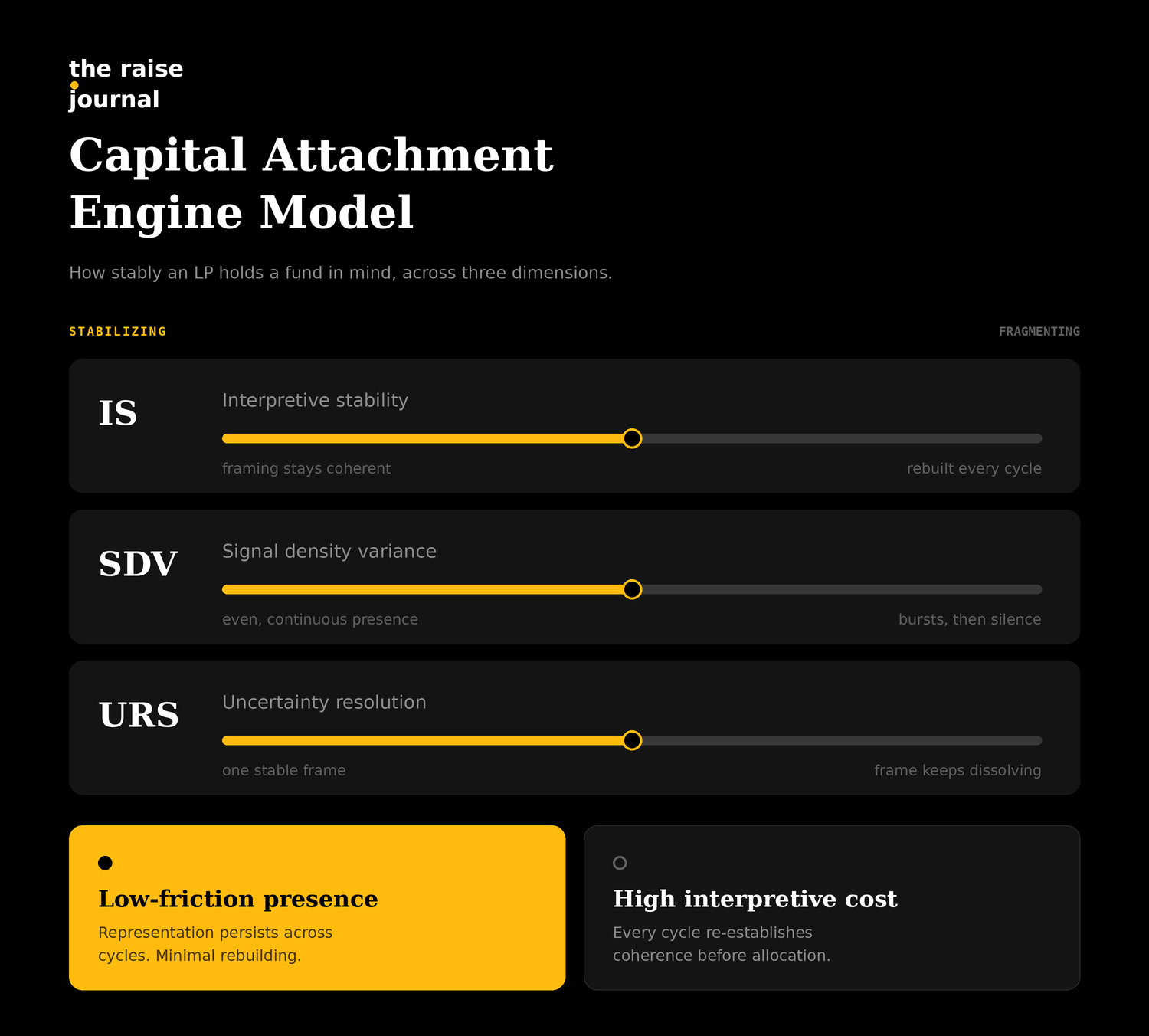
This observation led to the development of a model intended to make this structure explicit.
Continue Reading
What’s inside the full piece:
The three dimensions at the core of the model: Interpretive Stability, Signal Density Variance, and Uncertainty Resolution Style, and what high vs. low looks like for each.
Why allocation behavior tracks the stability of an LP’s internal representation of a fund, not isolated swings in performance.
How the distribution of your communication (steady and even vs. irregular high-intensity bursts) shapes how memory forms and attention holds across cycles.
What happens to interpretation when outcomes are delayed or incomplete, and how your resolution style either reinforces or fragments the way LPs hold you in mind.
The system behavior that emerges when the three dimensions align, and what breaks when they don’t.
A practical diagnostic for locating where your fund currently sits inside LP memory, and where friction in your allocation relationships is most likely originating, no scoring required.
How LPs can turn the same lens inward to understand why some funds stay easy to hold and others demand repeated analytical effort before conviction returns.

Comments
Nothing yet. Say the first thing.
Sign in to join the conversation.