
Not every feature in an SAE is worth using. A feature vector is a direction in activation space — before trusting one downstream, three properties need to hold independently: its label should predict where it fires, it should be monosemantic, and it should be causally active in the forward pass.
These are orthogonal conditions. A feature can be well-labeled but polysemantic, monosemantic but ignored downstream, or causally critical with a label that misses the concept entirely. Aquin scores each dimension separately and surfaces the combination as a diagnostic triple.
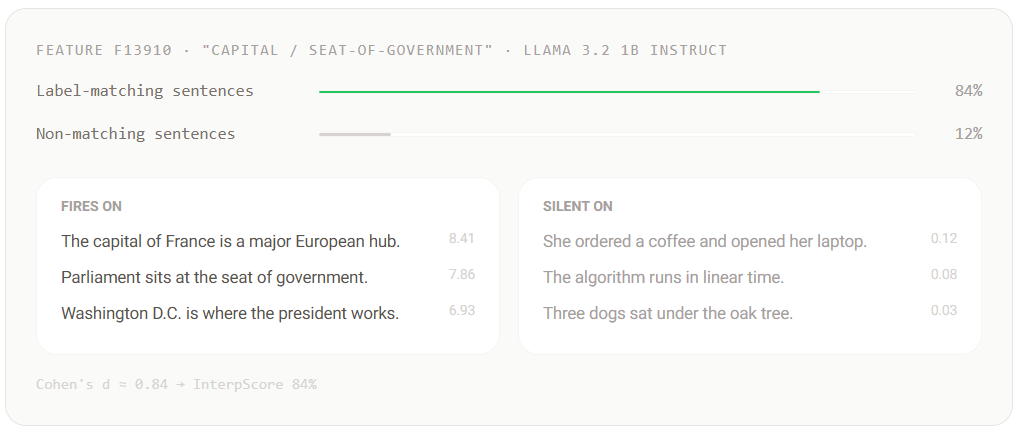
InterpScore measures how well a feature’s label predicts its activation behavior. Two sentence sets are constructed per feature — one where the label implies the feature should fire, one where it should not. Both sets are passed through the model; the feature’s maximum activation at layer 8 is extracted per sentence, and Cohen’s d is computed between the two distributions. The result is clipped to [0, 1].
A score near 1 means the label is a reliable predictor of when the feature activates. A score near 0 means the label and the feature have come apart — the auto-generated label should be treated as a guess until verified. Each feature uses 10 positive and 10 negative sentences, each as a separate forward pass through the full model and SAE.
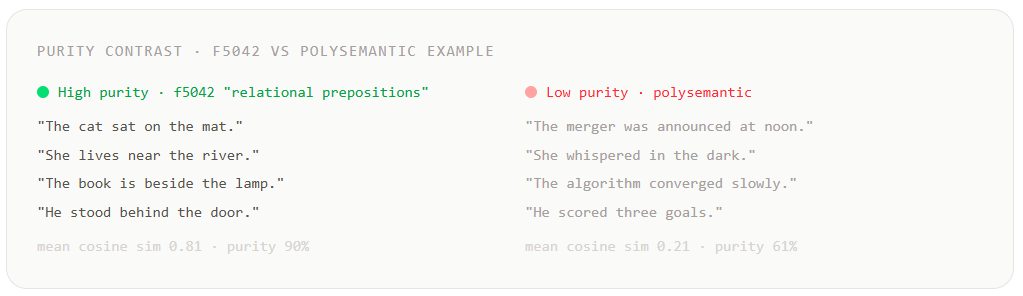
InterpScore evaluates the label. FeaturePurityScore evaluates the feature itself, independent of any label. The sentences where the feature fired above threshold are embedded, and mean pairwise cosine similarity of the embedding matrix is computed — upper triangle only, excluding self-similarity.
High purity means activating contexts cluster tightly in embedding space: the feature is monosemantic. Low purity means those contexts scatter — the feature is responding to surface-level co-occurrence rather than a coherent concept. Polysemantic features tend to cluster near the sparsity penalty boundary, consistent with the superposition hypothesis in the mechanistic interpretability literature.
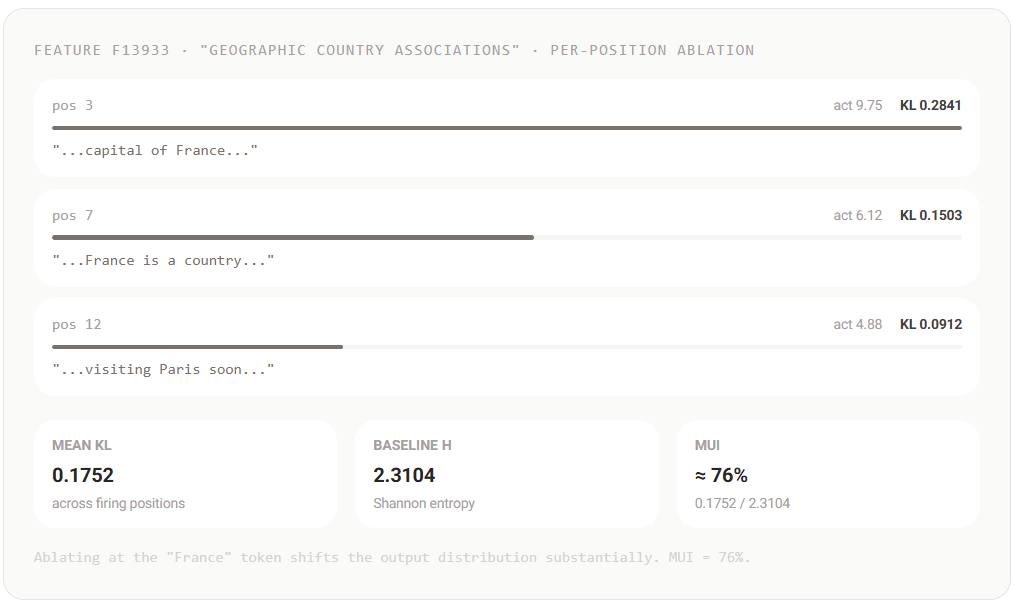
A feature can score well on InterpScore and FeaturePurityScore and still be functionally inert — the model computes it but doesn’t route through it. This is the gap MUI is designed to surface. Some cleanly labeled, monosemantic features produce near-zero KL divergence under ablation; they are decorative in the forward pass.
MUI measures causal load directly. At each token position where the feature fires above threshold, its projection onto the residual stream is zeroed and the forward pass is re-run. KL divergence between the baseline and ablated output distributions is computed at that position, averaged across all firing positions, and normalized by the baseline Shannon entropy. The result is a [0, 1] score of how much the model’s output depends on that feature when it is active.
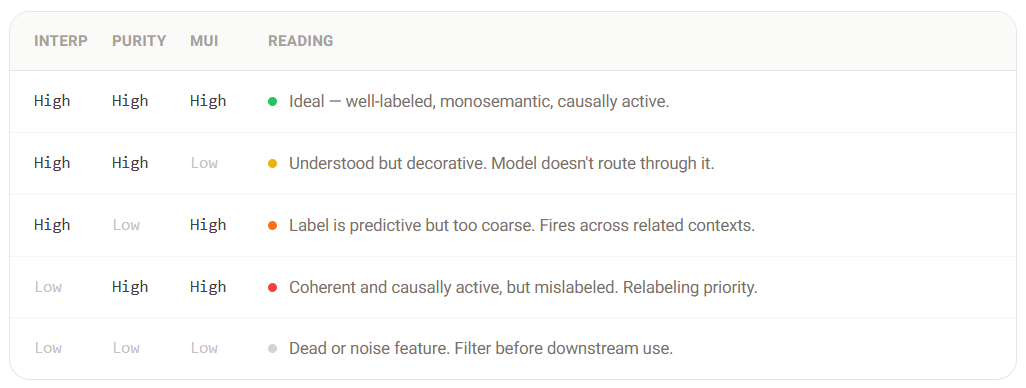
The three scores should be read as a diagnostic triple, not a single aggregate. The most actionable pattern is high purity and high MUI with low InterpScore (row 4): the feature is coherent and causally relevant, but its label is wrong. A second labeling pass using the actual activating examples typically resolves it. The all-low pattern (row 5) is a dead feature — it appears disproportionately near the sparsity penalty boundary and should be filtered before any downstream analysis.
Standard benchmark workflows require selecting a suite, configuring a harness, running the eval, and parsing results out-of-band. For scheduled evaluations that pipeline is workable. For a question that surfaces mid-inspection — a suspicious feature, an unexpected model output — it is a full context switch that almost never happens. The question gets dropped.
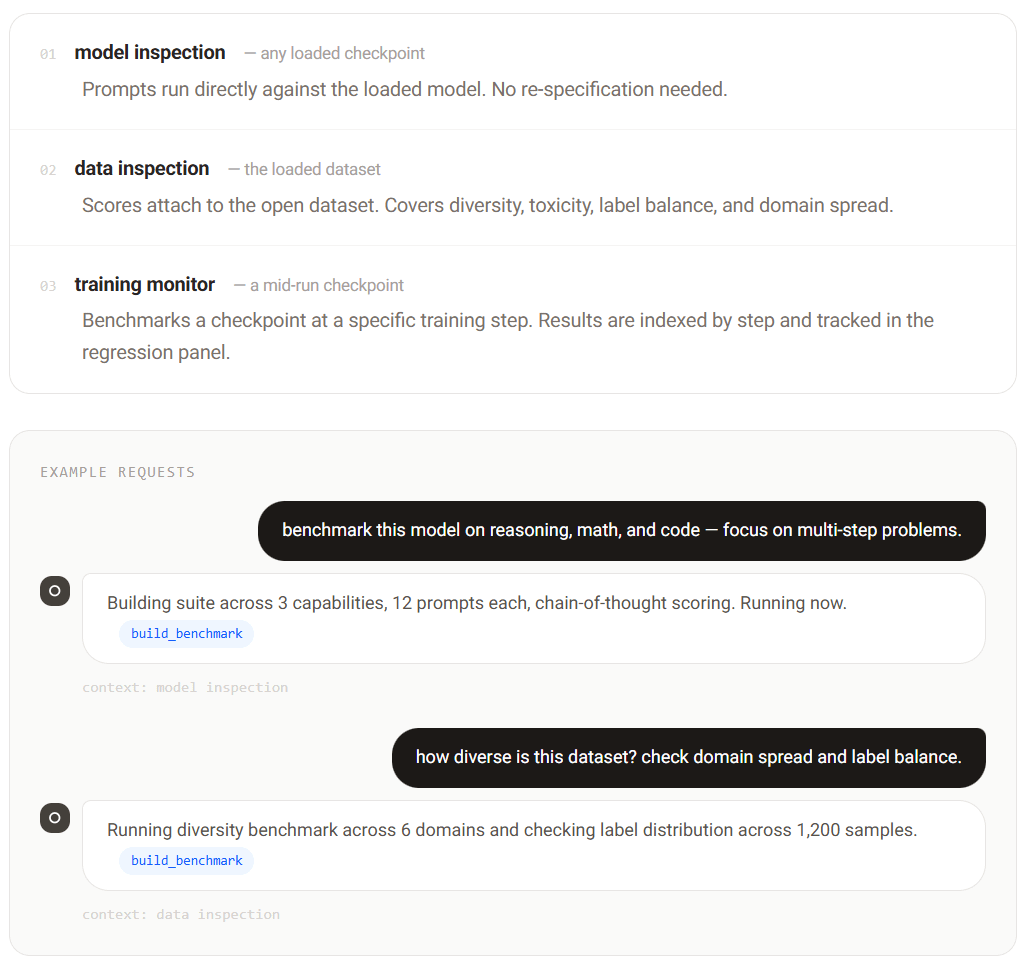
The Benchmark Builder removes the context switch. You describe what you want to measure in natural language inside any of the three agent chats. The agent writes the prompt suite, runs it against whatever is currently loaded, and returns a scored card in the thread — grounded in the same session that surfaced the question.
Benchmark Builder is available in all three agent chats. Each has access to different session state, so the same natural-language request sent to different chats produces different prompt suites and scores. Context is recorded in card metadata and carried through all exports.
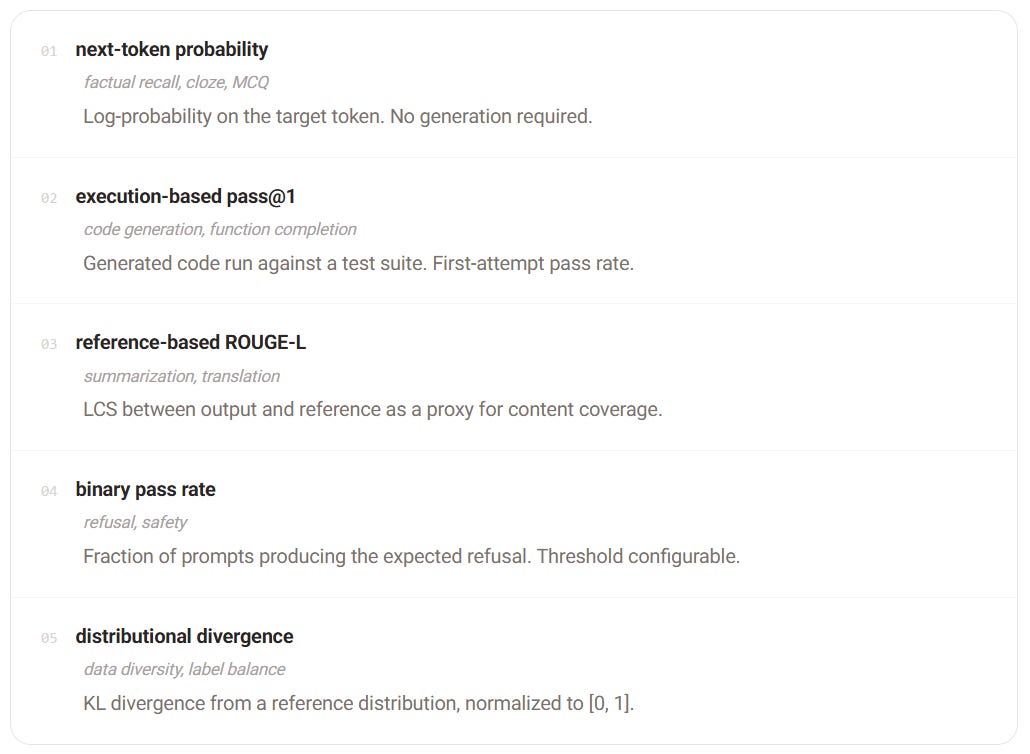
Each capability dimension scores 0–100. The agent selects the method based on task type and records it in card metadata. A 67% on CoT math with partial-credit scoring is not comparable to a 67% on factual recall with next-token probability — the method matters when reading across benchmarks or models.
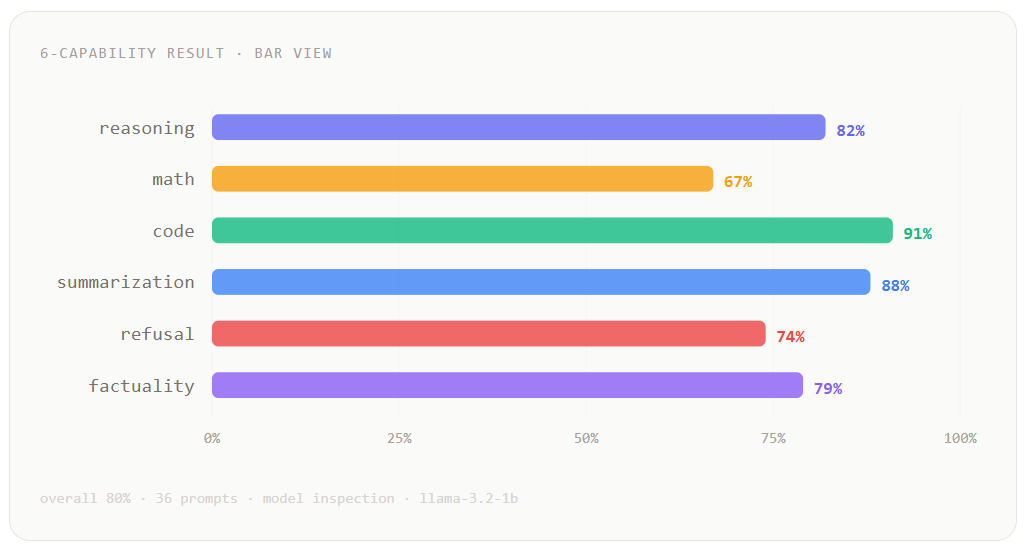
When a benchmark completes the agent appends a result card to its message in the thread. The card shows title, context, prompt count, and one scored bar per capability — compact enough to scroll past, readable at a glance. Four chart types are available in the switcher. Export buttons are in the footer with no dialog step.
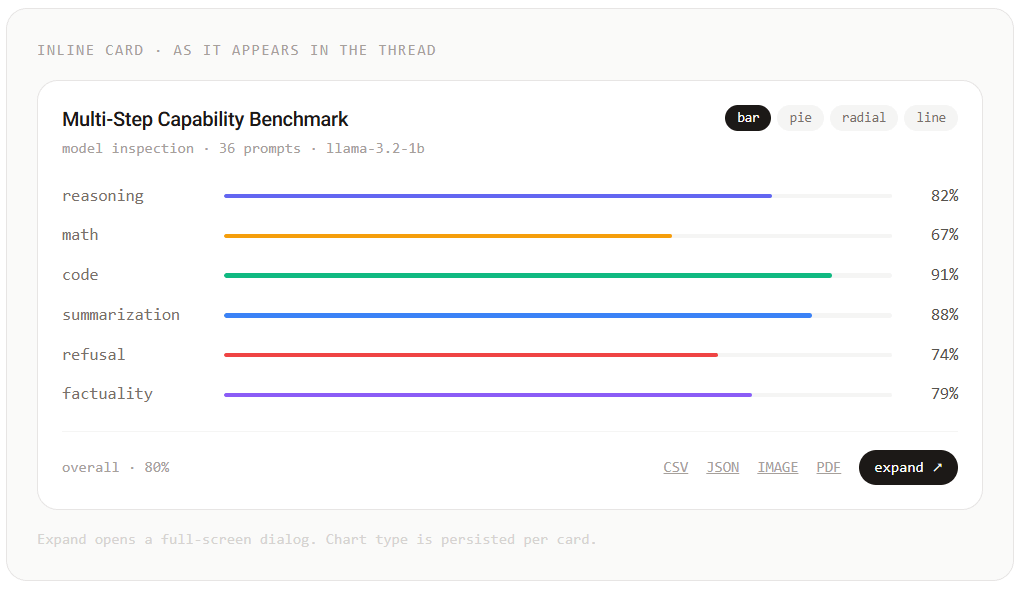
Scores are relative to the generated prompt suite — not directly comparable to published leaderboard numbers unless you explicitly request a named standardized benchmark. The most reliable use is within-session comparison: run the same request against two models or two checkpoints and compare rank order, not absolute values.
A low score is a starting point, not a verdict. A reasoning score of 67% driven by spatial failures is a different problem from one driven by arithmetic failures — a follow-up benchmark scoped to the sub-type disambiguates in one additional request.
No posts
Comments
Nothing yet. Say the first thing.
Sign in to join the conversation.