
“It’s nice to believe, when you think Tim McGraw.” This week, we’re going line-by-line through Taylor Swift’s “Tim McGraw” (debut, 2006) — her very first single. We trace a Chevy truck down some back roads, argue about whether “that’s a lie” means something different by the end of the song than it did at the beginning, float (and mostly reject) a death theory, and land on why a 16-year-old writing about one summer might be one of the most quietly ambitious songwriting choices of her career.
Apple Podcast Subscribers can now listen ad free with a paid subscription!
🫶 Thank you for reading and listening. We’re a fully independent podcast: we write, produce, edit, and promote every episode ourselves, no team behind us.
If you’re able to support that with a paid subscription, here’s what it gets you: bonus episodes, our full Extra Credit archive, extra subscriber-only content, and a real say in what we cover next.
First 50 annual members get 40% off with our Wi$h Li$t Discount
Get our Wi$h Li$t Annual Discount
Listen on Apple Podcasts? Paid subscribers there get ad-free episodes, early access, and bonus episodes too
Become an Apple Paid Subscriber
💚 Engagement matters: a paid subscription isn’t the only way to help. Leave us a review on Apple or Spotify, drop a comment, subscribe for free, tap the heart, or send this to a Swiftie who’d love it. Every bit of it helps us reach more listeners and keep making the show!
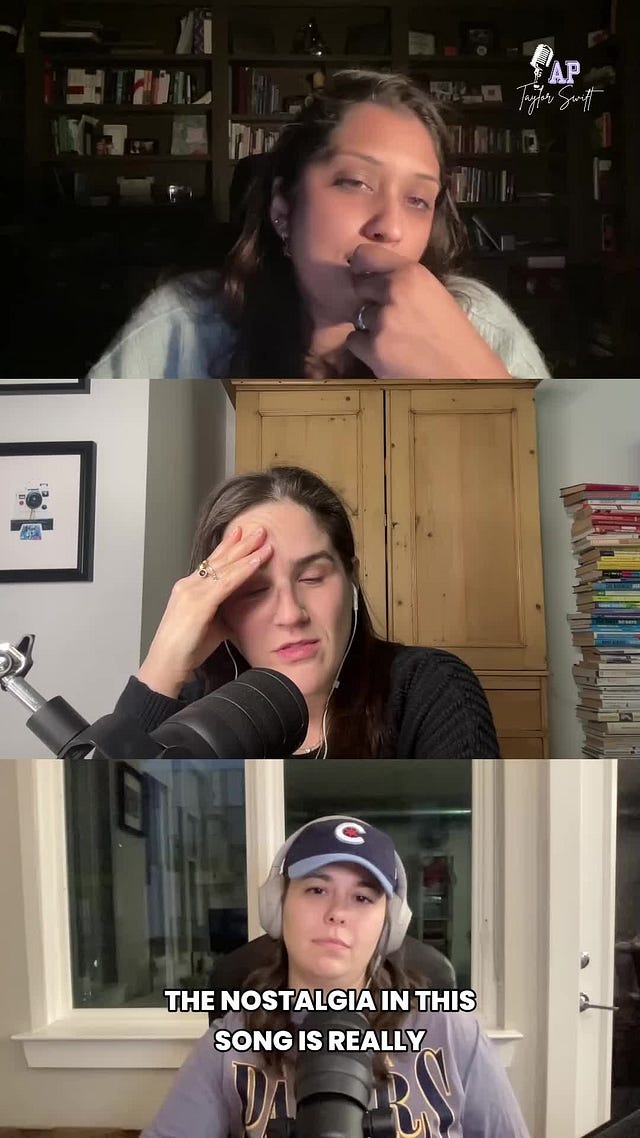
 Tiktok failed to load.
Enable 3rd party cookies or use another browser
Not sure where to start listening?
With over 130 original episodes, it can be hard to find exactly the episode you want to listen to. So we’ve created Spotify playlists by era and theme to help you find the perfect AP Taylor Swift episodes to listen to!
🤠 Debut Era ⭐ Fearless 🎆 Speak Now 🧣 Red 🌃 1989 🐍 reputation 💗 Lover 🪩 folklore 🍂 evermore 🕕 Midnights 📖 TTPD ❤️🔥 Showgirl
Book Episodes (Books, shows, movies) | Literary Theory & Rhetorical Device Episodes | Theme Episodes
This Week’s Extra Credit by Jenn
In this week’s episode, we discuss quite a bit how important the summer is to the story. By emphasizing the fact that this was a summer romance, we all felt like it squarely placed the story’s speaker somewhere in the high school, maybe college, age range. Unfortunately, unless you are a teacher or in other fields, summer breaks aren’t really a thing once you graduate. Now, I am writing this Substack on July 31st (two whole days in advance of publishing, so obviously I’m crushing it this week), which means that my Instagram feed is FULL of people posting about how it’s almost time for “salt air” and the “rust on the door.” In our conversation, I briefly referred to “Tim McGraw” as “august V1” (we discuss “august” more in our summer themed ep!). And since I am writing this right at the beginning of the month of August, I thought it would be a good time to compare these two iconic summer romance songs!
Summer Nights
Ok I can’t even begin to discuss these summer romance songs without acknowledging that every time I think about them, I actually first start singing “Summer Nights” from Grease. I just need you all to know that, and now you do, so we can move on.
The story of all of these songs (including the one from Grease) is similar. There is a summer relationship that they both know ends at the end of the summer (Grease, of course, offers a twist with the rest of the story). Summer romance is absolutely a classic plot. You get The Summer I Turned Pretty as a more recent example all the way back to the Beach Party movies from the 60s.
As a season, summer is often associated with freedom. School is out. It’s the season between planting and harvesting. People are outside more, and they are often wearing less clothing. It’s lighter for longer during the day. It is often presented as this liminal space where normal rules don’t apply and magical things can happen. And then for our summer romances, as the summer turns to fall and the leaves die, so often does the romance. This story is exactly what both “Tim McGraw” and “august” explore.
Right There Beside Him All Summer Long
Both songs are from the POV of someone who is absolutely enthralled with a boy. In “Tim McGraw,” she sings “When you think happiness / I hope you think that little black dress / Think of my head on your chest.” While this line is specifically a wish for how the boy remembers the summer, it is also a clue for how the singer feels. The definition of happiness was them, together, with her head on his chest.
The singer of “august” is similarly besotted with her summer boy: “Your back / Beneath the sun / Wishing I could write my name on it.” Despite the time limitations of summer, the “august” singer is so attached to this boy that she wants to put her name on him as if to mark him as belonging to her. She is, in fact, so head over heels that she is willing to sacrifice her other social plans in order to be available for him should he call: “Cancel plans just in case you’d call / And say ‘Meet me behind the mall.’” As an adult, I see a lot of problems with that decision, but hey that’s teenage summer love for you.
And Then The Time We Woke Up To Find That Summer Gone
The love was there, but summer eventually has to end. So not only do both of these songs highlight the intensity and sweetness of a summer love, they also both explore the heartbreak and pain of the summer ending and realizing that the relationship didn’t have legs.
In “Tim McGraw,” she acknowledges in the first stanza that the summer is over: “And then the time we woke up to find that summer gone.” That tells listeners right away that this song is looking back on the ended relationship. We get the story of their romance while knowing right from the beginning there is no happy ending. She emphasizes the pain of the summer ending by pointing out that once summer was over she couldn’t stop crying, but she was at least grateful that he wasn’t there to see how heartbroken she was: “September saw a month of tears / And thankin’ God that you weren’t here / To see me like that.” Listeners actually don’t get a ton of information about this boy, but the implication here is that the breakup was simply a byproduct of the summer ending and our singing returning home. She’s implying here that he would have been devastated to see her heartbroken. So perhaps they were a good match, but simply not in the right place to pursue things.
“August” gets much more complicated. In the broader lore of folklore, “august” is one of three songs from the different viewpoints of three members of a love triangle. Exploring all of that is a whole other essay (and here is one someone else wrote that covers it well!), but what you need to know for this comparison is that “august” is from the POV of the other women. So while she is truly infatuated with the boy in her song, our singer was never destined to end up with him, because he really is in love with someone else. Outside of that broader context, we can still see this truth in one of the most repeated lyrics of the song: “you were never mine.” This song forces a listener to wonder whether the relationship was doomed because it was a summer love or because he never was really her love. Perhaps it’s a bit of both. Either way, with the larger context, the boy in “august” definitely doesn’t come out looking as good as the boy in “Tim McGraw.”
It's Hard Not To Find It All A Little Bittersweet
In this week’s episode, we also discussed quite a bit the nostalgia of “Tim McGraw.” In the song itself, she reveals that the present-day singer is writing this song three years after the summer when she had this romance. So even within the song, we get the sense of nostalgia. However, outside of the song itself, millennial nostalgia is real right now. Our queen, Hilary Duff, is on tour this summer, and I am seeing so many women just killing it with their 2000s era outfits for the concert. We are officially at an age where we are seeing our childhoods come back as “retro,” which is a fascinating experience.
I bring up nostalgia, because summer romances have a distinct nostalgia to them. Taylor wrote about summer romance when she was a teenager and theoretically in the era of her life where she could experience them. That makes sense. However, she also wrote about it again many years later. It’s not just Taylor, The Summer I Turned Pretty took the world by storm when the book was adapted into a tv show, and it wasn’t just high schoolers who were watching it. Something about the freedom of summer continues to call to us, even as adults, and while I don’t see a real summer break in my future, thankfully I have Taylor’s music that helps me at least FEEL like I am back in that era. Great art can really do so much for us!
This is absolutely a P.S. moment, but I just want to point out that I am wildly annoyed that colons are becoming an AI signal. I was never a big em dash user, but I love a good colon. So just know that I wrote all of this on my own without AI writing any of it. I just like using colons, and I refuse to give them up.
AP Taylor Swift Podcast is a reader-supported publication. To receive new posts and support my work, consider becoming a free or paid subscriber.
Comments
Nothing yet. Say the first thing.
Sign in to join the conversation.