
“Nice to meet you, where you been? I could show you incredible things...” In this deep dive episode, we revisit one of Taylor Swift’s most iconic satirical masterpieces. From the enchanted references that bookend her career to the Shakespeare allusions hidden in plain sight, we explore how “Blank Space” operates as both brilliant satire and surprisingly authentic commentary on complex womanhood. Join us as we unpack the magic, madness, heaven, and sin of a song that dared to ask: what if we owned the narrative instead of fighting it?
Apple Podcast Subscribers can now listen ad free with a paid subscription!

🫶 Thank you for reading and listening. We’re a fully independent podcast: we write, produce, edit, and promote every episode ourselves, no team behind us.
If you’re able to support that with a paid subscription, here’s what it gets you: bonus episodes, our full Extra Credit archive, extra subscriber-only content, and a real say in what we cover next.
First 50 annual members get 40% off with our Wi$h Li$t Discount
Get our Wi$h Li$t Annual Discount
Listen on Apple Podcasts? Paid subscribers there get ad-free episodes, early access, and bonus episodes too
Become an Apple Paid Subscriber
💚 Engagement matters: a paid subscription isn’t the only way to help. Leave us a review on Apple or Spotify, drop a comment, subscribe for free, tap the heart, or send this to a Swiftie who’d love it. Every bit of it helps us reach more listeners and keep making the show!
 Tiktok failed to load.
Enable 3rd party cookies or use another browser
Not sure where to start listening?
With over 130 original episodes, it can be hard to find exactly the episode you want to listen to. So we’ve created Spotify playlists by era and theme to help you find the perfect AP Taylor Swift episodes to listen to!
🤠 Debut Era ⭐ Fearless 🎆 Speak Now 🧣 Red 🌃 1989 🐍 reputation 💗 Lover 🪩 folklore 🍂 evermore 🕕 Midnights 📖 TTPD ❤️🔥 Showgirl
Book Episodes (Books, shows, movies) | Literary Theory & Rhetorical Device Episodes | Theme Episodes
This Week’s Extra Credit by Jodi
This summer as we dig into our own vault of episodes, we are also looking back to some older Substack posts that we want to highlight again. The post below was originally written by Jodi in September of 2025 and is normally accessible with a Paid After School Subscription, which gets you full access to our Extra Credit Archive plus additional episodes.
“Got a long list of ex-lovers, they’ll tell you I’m insane”
The year is 2014. Every headline about Taylor Swift reads like the next:
“Breaking Hearts and Climbing Charts” - Elle Magazine
“How to beat the breakup blues” - Cosmopolitan
“Her men, her moods, her music” - Vanity Fair
Every new relationship was fuel for speculation. Every breakup was tabloid catnip. Swift’s story was written not by her own hand, but by magazine editors and gossip columnists; told not in her music, but instead across headlines. For years, every headline became the new reality of Taylor Swift’s story.
When someone writes your story for you, you’ve lost control of the narrative. Most people in this position would fight back defensively, issuing statements and strategic denials to “set the record straight.”
But what did Taylor do?
Taylor saw the caricature she was being molded into in the press and took control of the pen herself to write (and right?) the story.
The Psychology of “Blank Space” Narrative Control
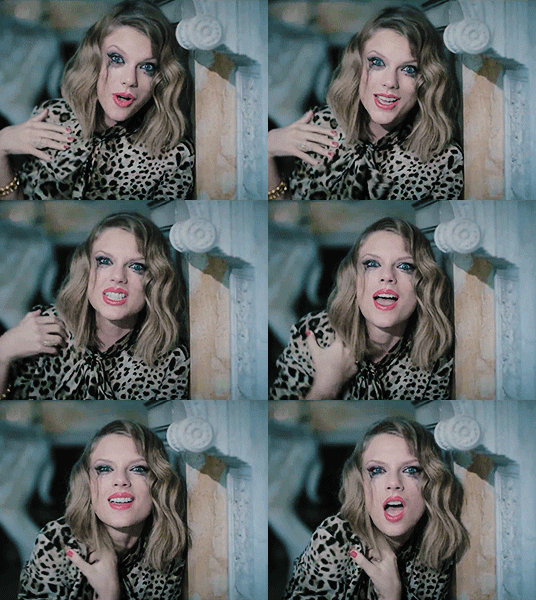
“Blank Space” is Taylor taking the media’s caricature and making it her own satirical performance. Rather than denying the accusations or pushing back on the criticism, she forced people to confront how cartoonish their characterization had become by embodying exactly who they said she was. Instead of defending her character or denying the perception, she leaned right into the commentary:
“Love’s a game, wanna play?” = Leading with the criticism of her love life
“I can make all the tables turn” = Owning the narrative around manipulation and control
The music video pushed it even further. Taylor played a literal psycho girlfriend—cutting up photos, smashing cars, and wielding kitchen knives. She made the caricature so over-the-top that anyone watching had to laugh at how ridiculous the whole narrative was.
Why Satire Works When Defense Doesn’t
When I think of “Blank Space,” the first thing I think of is satire—how Taylor used the “crazy ex-girlfriend” character the media portrayed her as, and subverted and exaggerated it. Turning criticism into satire let her wrest control of the narrative—instead of being a character in someone else’s story, she became the author of her own story and could make it any genre with any ending she wanted. Choosing satire, as we talked about in our Satire episode, creates a commentary on both the crazy ex-girlfriend trope as well as the media’s portrayal of women: why doesn’t a man who dates a lot get characterized and criticized the same way as a woman?
The brilliance of Taylor’s approach wasn’t just that she owned the narrative. It’s that she demonstrated complete self-awareness about how narratives work, and used satirical commentary to reshape and reframe the narrative. Before “Blank Space,” Taylor was the subject of other people’s stories about her love life, portrayed as a the crazy ex-girlfriend. Instead of focusing the story on the antics or instead of denying them completely, this satire becomes a reflection back to the audience, forcing us to think about how we portray women in the media. The narrative shifts from criticism of Taylor to criticism of ourselves—why are we so entertained by these stories of “crazy” women? Why treat women this way, but not men? Have we ever thought about what might justify or explain an ex-girlfriend’s behavior, or is she always the villain, the ex-boyfriend always a victim?
Taking Back the Glitter Gel Pen
Owning and shifting a narrative sometimes means asking questions instead of providing answers. Denying, justifying, or validating a narrative—like the crazy ex-girlfriend one Taylor found herself in—keeps you a character in someone else’s story. Reshaping the narrative by forcing the audience to ask questions about themselves means Taylor took back the pen to author her own story.
While most of us don’t have gossip blogs and magazine headlines writing our story for us, we’ve all likely had times when someone else has taken control of our narrative. Maybe you were the subject of schoolyard gossip as a kid. Or campus rumors in college. Perhaps someone at work shared “news” about you that they received third-hand, and suddenly, you’re branded as difficult, dramatic, or not a team player (not that I’m speaking from experience or anything).
There comes a time in most people’s lives when we become the unwilling subject of someone else’s story. Perceptions and personas we work hard to craft through our own careful actions, words, and behaviors get distorted or misinterpreted. Having someone else write our story feels vulnerable, defenseless, and helpless. Whether it’s rumor or gossip, speculation or perception, losing control of your narrative is one of the most disempowering experiences there is. But we can all find ways to regain control of our own narratives. “Blank Space” reminds us that sometimes the most powerful response isn’t to deny the narrative, but to own it so completely that we force everyone else to question why they believed it in the first place.
AP Taylor Swift Podcast is a reader-supported publication. To receive new posts and support my work, consider becoming a free or paid subscriber.
Comments
Nothing yet. Say the first thing.
Sign in to join the conversation.