
“I joined a cult.” Over the last year, I’ve been cheekily dropping this into conversations. Considering the twists and turns my life has taken in the last decade, some may have seen this as inevitable. The truth is, I joined The Leading Edge, a conscious community of 150 people worldwide, established a couple of years ago by Substacker Tom Morgan.
I could interview each of our Members for the podcast to keep us riveted for years, and maybe today’s pod drop is the beginning of just that. LE Member Lizzi Cutler reached out to me because she had a story to share. A story that began with ayahuasca, deepened with San Pedro and 5-MEO-DMT, and culminated in the discovery of what she can now accept as her gift: intuitive analysis.
I’m grateful to Lizzi for unpacking the decade of psychedelics and integration that encouraged her to step into the role of an IA in the age of AI. Lizzi works with business leaders to better understand what lies beneath the mountains of data now available to them, so they can resource effectively.
This episode is for those of you who have always felt like you’re tapped in. that psychedelics have been integral in revealing a gift you longed dismissed as impossible. or possibly your intuition is feeling more on point, but you don’t know how to work with it. I talk to people like you more and more frequently.
I hope you enjoy this episode, and please lmk if you want to hear more stories from women like Lizzi. Women who’ve embraced the magic that in previous generations would’ve had them burned at the stake or labeled as crazy.
Take care,
April

Episode Summary
What actually happens after the ceremony ends? In this episode, April sits down with Lizzi Cutler to explore psychedelic integration and intuition beyond the peak experience. From ayahuasca integration to 5-MeO-DMT, Lizzi shares how plant medicine didn’t “fix” her—but instead revealed who she already was. The conversation moves through grief and identity, including the emotional reality of not becoming a mother, and expands into how intuition can be applied in unexpected places like business and leadership. This episode will help you understand how to integrate psychedelic experiences into daily life, trust your intuition, and rethink personal growth as an ongoing, nonlinear process.
🔵 What You’ll Learn
Psychedelics don’t fix you—they reveal patterns you’re already living inside
True ayahuasca integration happens over years, not days or weeks
Intuition isn’t mystical—it’s a skill that can be applied to leadership and hiring
Grief and identity are deeply intertwined, especially around missed life paths
Intuitive leadership may be the missing link in building aligned teams and cultures
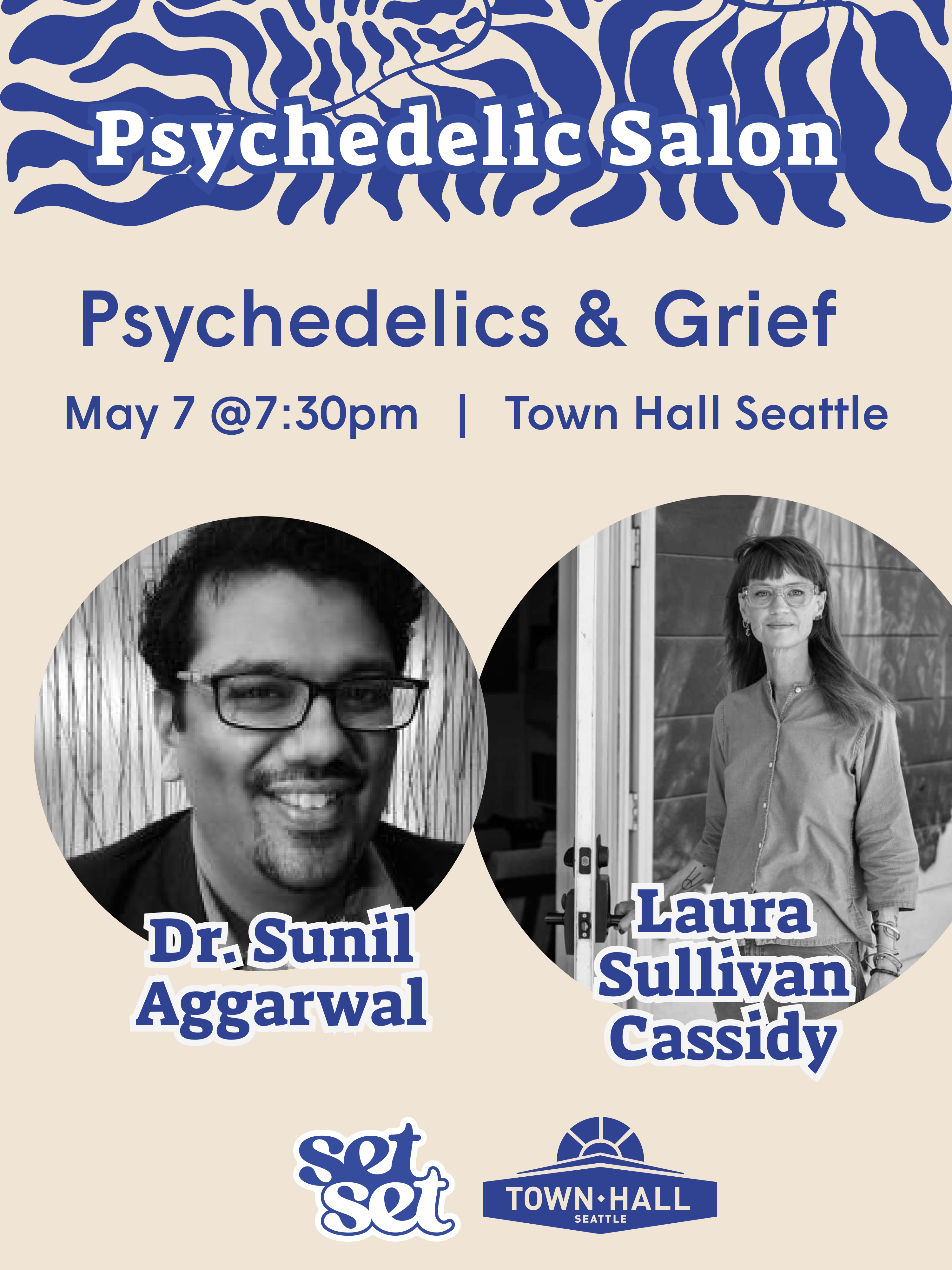
Thursday, May 7th, join us for this season’s final Salon Psychedelics & Grief at Town Hall Seattle
Grief is one of the most universal yet isolating experiences we endure—and psychedelics may offer a path through it. This Salon explores how psilocybin, MDMA, and 5-MeO-DMT support those navigating loss. Attendees will gain insight into the science and integration practices that support emotional processing in the context of grief.
Featuring Dr. Sunil Aggarwal, a physician in hospice and palliative medicine, with a Right to Try petition with the DEA. Joined by Laura Sullivan Cassidy, a grief work facilitator, death doula, and team member at Recompose, who writes the Substack Griever’s Ball.
🔵 Episode FAQs
What is psychedelic integration and intuition?
Psychedelic integration and intuition refer to the process of applying insights from plant medicine experiences—like ayahuasca or 5-MeO-DMT—into everyday life, while learning to trust your internal guidance system. Integration is less about the experience itself and more about how you live afterward.
What does ayahuasca integration actually look like long term?
Ayahuasca integration often unfolds over months or years. It involves recognizing patterns, shifting beliefs, and making real-life changes in relationships, work, and identity—not just reflecting on the ceremony itself.
Can plant medicine healing “fix” emotional or psychological issues?
Plant medicine healing is not a quick fix. Many people report that psychedelics reveal underlying patterns rather than resolve them instantly. Lasting change typically comes through ongoing awareness, integration, and personal responsibility.
How do you integrate psychedelic experiences into daily life?
Learning how to integrate psychedelic experiences into daily life can include journaling, therapy, honest communication, and behavioral changes. The goal is to translate insight into action—especially in relationships, decision-making, and self-awareness.
What is intuitive leadership?
Intuitive leadership involves using both data and internal awareness to make decisions. This can include reading team dynamics, understanding emotional patterns, and making hiring or strategic choices based on alignment—not just credentials.
Can intuition really be used in hiring and leadership decisions?
Some leaders use intuition in hiring and leadership decisions to assess culture fit, communication style, and team dynamics. While it doesn’t replace data or experience, it can complement traditional decision-making processes.
How are grief and identity connected in personal growth?
Grief and identity are often linked, especially when it comes to unmet expectations or missed life paths. Processing grief—like not becoming a parent—can reshape how someone understands themselves and their purpose.
Do psychedelics enhance intuition, or reveal it?
Many people describe psychedelics as revealing intuition rather than creating it. The experience may help remove limiting beliefs or mental noise, making it easier to recognize instincts that were already present.
Become a Paid Subscriber to access the first 4 weeks of Micro-Psyched’s microdosing plan.
Paid Subscribers may also access the full Microdosing for Midlife series plus:
monthly Member call
monthly Members-only post
Subscriber-only access to the Member Chat
🔵 Featured Guest
Lizzi Cutler is an intuitive coach who works at the intersection of perception, pattern recognition, and leadership—helping individuals and businesses align with their deeper truth. lizzicutler.com | Instagram - @lizzicutler
🔵 Resources
Episode 115: Understanding 5-MeO-DMT and Non-Dual Experiences
Psychedelic Salon at Town Hall Seattle
Women in the Wild - Looking for an IRL microdose/low-dose psilocybin experience in Seattle with other women? Applications are open for the May 9th and September 26th gatherings.
🔵 Timestamps
[00:00] Intro, disclaimer, and April’s context on consciousness + intuition
[01:00] Introducing Lizzi Cutler and the theme of integration
[02:00] Psychedelics and grief + upcoming salon context
[03:00] Lizzi’s early work: yoga, meditation, and intuitive sensing
[04:00] Naming subconscious patterns and how change begins
[05:00] April’s narration: awareness, observation, and the double slit experiment
[06:00] Applying intuition to business, hiring, and leadership
[08:00] First ayahuasca invitation and entering ceremony work
[09:00] Ayahuasca + San Pedro explained (context + risks)
[10:00] First ceremonies: “feeling nothing” and frustration
[10:30] Dieta explained: preparation, digestion, and intuition
[12:00] First breakthrough experience and community bonding
[13:00] Divorce, feeling “broken,” and seeking transformation
[14:00] 30–40 ceremonies later: what ayahuasca actually revealed
[15:00] “Own your power” and letting go of imitation
[16:00] The apprenticeship dynamic + April’s ethical commentary
[18:00] Surrendering to intuition and first real validation
[19:00] Bringing intuitive work into real-world practice
[20:00] Shifting from personal coaching to stress + behavior change
[21:00] Breakthrough moment: intuition applied to business
[22:00] Alignment, investing, and intuitive due diligence
[23:00] Oneness, source, and early 5-MeO insights
[24:00] Psychedelics don’t give gifts—they reveal them
[25:00] Intuition as a natural ability vs learned skill
[26:00] 5-MeO-DMT explained + non-dual awareness
[26:30] “I am enough”: the end of the “I’m broken” narrative
[27:00] Embodiment, love, and kintsugi (wholeness through integration)
[28:00] Integration over time + relationships and emotional growth
[29:00] Building an intuitive business model (CEO-focused work)
[30:00] “Intuitive analysis” and reading organizational culture
[31:00] AI vs intuition: human pattern recognition
[32:00] Leadership decisions, restructuring, and team alignment
[33:00] Working with investors, philanthropy, and impact
[34:00] Money as energy + alignment in giving
[35:00] Closing reflections + where this work is going
[36:00] Outro + resources + psychedelic grief salon
🔵 Transcript
April Pride: [00:00:00] Hey, this is April, and this show, SetSet, discusses psychedelics. It’s intended for audiences 21 and over. Also, I am not a medical expert. If you are looking to engage with psychedelic substances, please consult your physician before doing so.
April Pride: Welcome back to the show. I’m your host, April Pride, and today’s conversation is one I’ve been looking forward to for a while. You see, in the last year, joined what I lovingly refer to as a cult. It’s not. It’s called The Leading Edge, and it is 150 individuals across the globe. We’re all connected by our curiosity around consciousness and the modalities that we can tap into that allow us to better understand our own, to better understand how we can affect the consciousness of others in a positive way, of course.
And at the root of all of that for me is [00:01:00] better understanding how I can connect with my own intuition. So to speak with Lizzi Cutler, who is an intuitive analyst, has been something I’ve been anxious to do for quite a bit. And her work sits at the intersection of perception, pattern recognition, and something harder to name but easy to feel when you’re in it.
Lizzi has this rare ability to see people, not their resume but the underlying architecture of who they are. And what’s fascinating is how that ability sharpened over time, not through traditional training, but through her experiences with plant medicine, particularly ayahuasca and San Pedro.
What I appreciate about Lizzi’s story is that it doesn’t follow a neat arc. It’s nonlinear, it’s uncomfortable at times, and it’s deeply human. It’s about grief, not just of what’s happened, but of what didn’t happen. It’s about identity, timing, and what it means to come into your own power without outsourcing it to someone else.
Underneath all of that, this conversation is really about integration, what it looks like to live with what you’ve seen, not just [00:02:00] chase the next experience. But before we get into it, let’s go back to grief. This Thursday at 7:30 PM at Town Hall Seattle is our final psychedelic salon for this season, Psychedelics and Grief.
And I will be joined by Dr. Sunil Agarwal and Laura Sullivan Cassidy to discuss this topic, one that I believe is driving so many people to seek psychedelic medicine, not to learn how to get over their grief, get through their grief, but to live with it and to live with it in a way, that honors the loss that they are now integrating into their way of being.
This is certainly a topic that is personal for me. If you’ve been listening to this podcast for a while, then you know that I’ve experienced my own grief after the dissolution of my marriage, in the last five years and the resulting loss of a future that I’ve been planning with my partner for over two decades for our family.
So no matter what is driving your grief, join us. If you’re in Seattle, we’d love to see you in person. If you’re not in [00:03:00] Seattle, you can live stream I’ll link to learn more about this week’s salon and how you can buy tickets in the show notes of today’s episode.
Okay, let’s get into it.
Lizzi Cutler: Before Ayahuasca. Before Aya, I was a yoga and meditation teacher.
And I was doing some, I called it like energy work, energy coaching, where I could test up where people had blocks and show them how to shift it. So it might have been a fear of being confident or a fear of being ignored or those kind of things, which I still do some of that, but it’s obviously much cooler now.
And what I’m really focusing on now is, but I’ve always been able to see somebody see their face, whether it’s a picture or in person, and know who they are, like know the sort of the sole imprint.
And I’ve started acknowledging it in a much different way post Aya, where I’ve said okay, how do I use this for the greater good?
And I started doing it with people one-on-one as a coaching modality where I can sense what’s [00:04:00] the thing that’s holding you back? You have probably been feeling it you entire life, but not recognized, A, that it was unique, B, that it was holding you back in any way, or C, how to shift it. So whatever the resistance is or whatever the old program is, I put words to it.
our conscious mind recognizes what our subconscious is vibrating on.
Starts to shift. Once the thing is observed, it automatically changes. And then I help people work through that.
April Pride: Before we move on, I want to pause on something Lizzi just said because it’s subtle, but it’s foundational. When she talks about naming a pattern, putting language to something that the subconscious has been holding, the awareness, observing it, that’s not just a coaching tool.
If you’ve been reading my Substack, particularly the 12-week Microdosing for Midlife series from last year, then you know , that’s actually how change begins. The moment the conscious mind recognizes what the subconscious has been running in the background, something shifts.
Change [00:05:00] begins with awareness, not because you fixed it, but because you’ve seen it, and observation in itself is powerful. There’s a concept in physics called the double slit experiment. At its most basic level, it shows that particles like electrons behave differently when they’re being observed versus when they’re not.
Unobserved, they act like waves, fluid, undefined, full of possibility. Observed, they collapse into a fixed state like particles, measurable and specific. When something in you is unobserved, a belief, a pattern, a reaction, it stays fluid, automatic, almost invisible.
It runs the show without being questioned. But the moment you observe it, really see it, it collapses into something concrete, something you can name. And once you can name it, you can work with it. That’s the shift Lizzi is pointing to. Not forcing change, but creating awareness that naturally begins to reorganize what’s underneath.
And from there, the work isn’t about chasing another breakthrough. It’s about [00:06:00] integration
Lizzi Cutler: Now I’ve brought it to the next layer where I’m working within businesses.
So I’m working with the leadership team or A CEO individually, where I’m able to look at pictures of who are you hiring and who are they? Who is this person that you’re hiring? Not what’s on the resume, not what are their skills, but what are they truly here for? What is their vibrational imprint?
So what are their strengths, their weaknesses, their blind spots, their insecurities, their communication style, their love language? What triggers them and how will they recover best to say, okay, here’s my existing team. How do I make sure that they’re as happy as they can possibly be and they have the most job satisfaction as possible.
And also as a leader, how do I develop them in a way that’s gonna benefit the entity of this business that I’m running? And also working as a team. So this manager is triggering this person. How do I shift that?
No. And this is what’s trippy. I just need a photo.
For [00:07:00] whatever reason, when I see the photo, it’s a little bit like I empath it, but it’s more that I sense the tone of the frequency and then the words come outta my mouth.
And. So this is applicable with hiring or people who are fundraising or they’re investors and they’re looking at founders that they’re gonna invest in.
It’s like I give them the due diligence that’s under the data. So the essence of who somebody is, which is I would say, significantly critical in any of these decisions, right? In any business you’re in, it’s about who the person is, not what they say they can do for you. And I think we’ve all worked for and worked in companies where one misaligned person in the team can destroy a lot.
And cost a lot. So I’ve taken the gift that I would say Aya and San Pedro have really helped me hone in on and own. I think those medicines helped me lovingly shove my face in, you have this thing now do it and talk [00:08:00] about it and own it ‘cause you’ve been doing it.
So I was working with a really incredible intuitive who became my soul sister, best friend. And she said, we’re doing Aya this weekend, you should come. And my initial response was, you guys are fucking crazy.
And from that I did a bunch of research called people I trust and asked them to do research for me to see is this crazy, should I not do it?
I ended up going, and the first weekend, the way that this person led his ceremonies was it was offered three nights and three mornings where we would do I at night, San Pedro in the morning, three nights in a row. So it was usually Thursday, Friday, Saturday, and we would leave on Sunday.
April Pride: are you doing full doses of Each time? Yeah.
Lizzi Cutler: Yeah.
April Pride: is there an issue with tolerance by the third one or is it not hitting as much?
Lizzi Cutler: I don’t know is my answer. Of course always did all three nights when I could and all three mornings because that’s who I am. If someone says You could do this, or here’s the full dose, I’m gonna be like, let’s fucking go.
April Pride: Before we go further, I [00:09:00] want to pause and give a little context here because Lizzi is referencing something that can sound intense if you haven’t been in these spaces. Ayahuasca is a traditional Amazonian , plant medicine brew typically made from the
banisteriopsis caapi vine.
Combined with other plants containing DMT. It’s known for producing deeply introspective, often emotional or visionary experiences. San Pedro, also called Huachuma, is a cactus native to the Andes. It contains mescaline and tends to be experienced as more heart-opening, expansive, and outward-facing compared to ayahuasca’s inward psychological depth.
In some ceremonial traditions, especially in Western adaptations, you’ll see these medicines used in close proximity. The idea is that ayahuasca can bring up material while San Pedro helps integrate it in a more embodied relational way. That said, this isn’t a traditional pairing across all indigenous lineages, and it’s important to recognize that stacking multiple medicines like this is a modern [00:10:00] interpretation, one that varies widely in safety, intention, and context.
Lizzi Cutler: The first two nights I was like, I don’t feel anything.
I would, take a double dose of the Aya and not feel anything or so I thought, and people were puking and crying and running back and forth to the bathroom and it was all very dramatic around me and I was like, what is going on. I feel nothing.
Which was real frustrating.
April Pride: did you, complete the dieta before?
You just heard me mention something called a dieta. A dieta is a preparatory protocol often recommended before working with certain plant medicines, especially ayahuasca. Traditionally, it can involve dietary restrictions like avoiding alcohol, caffeine, processed foods, salt, sugar, and animal products, as well as limiting sexual activity and reducing external stimulation.
The intention behind a dieta is twofold. On a physical level, it helps reduce potential interactions with the medicine. And on a psychological and energetic level, it’s about creating space, quieting the system so you can actually hear what’s coming [00:11:00] up. I believe that this is true in our day-to-day lives too, right?
The more, quote, noise that we put into our system, the more distraction in our digestion, which is where our second brain is. Our third brain, if you think of our heart as also being part of our thinking, then it is harder to hear what our intuition is trying to tell us. You’ll see variations of this across different medicines.
It’s not a one-size-fits-all, and not every ceremony requires it, but the underlying principle is consistent. Preparation matters, just like it matters in our everyday life. The better we take care of ourself and our digestion, where 90% of our serotonin receptors are in our gut, the more likely it is that we can connect with our own intuition, that we can hear what’s coming up, that those signals are clear.
So I encourage you to think about your digestion as one part of your set and setting when you are engaging with psychedelic medicine, including microdosing on a daily basis.
Lizzi Cutler: A [00:12:00] little bit like I, in this guy’s protocol, was no animal proteins before, no salt.
But that first time that I did it, man, I held fast.
Like he said, no nail polish. I took all my nail polish off. Okay. I, we had to wear whites, so I was like, I was in it and I wanted to be an A student.
And the third night I did feel this out of body loud, visual, intense experience of it felt like I was flying on a leaf, like a magic carpet.
And I kept saying whoa. Stop. I don’t know what’s happening. It felt like vines were crawling through me. And then all of a sudden it stopped and it was this thing of are you in or are you not? Is your guard up or do you wanna do this? You wanna dance with us?
I was hooked. the community of everybody being together in the room sitting around the circle and eating after the San Pedro in the morning. There was this very lovey kumbaya, a little culty kind of a vibe to it where it’s like trauma bond of oh my God, we all went through this hard thing.
It’s so the community of it felt so [00:13:00] great. And so I would fly back and forth ‘cause it was out of town. This was happening in Salt Lake City. Every time we were doing it, I was in for all three. And, there were even times where somebody was there and had an amazing night and couldn’t afford to come back, and so I would pay for her.
Because I was like, this is just the coolest, most amazing thing I’ve ever seen. I felt, and I was watching people get off, pharmaceutical meds and really having these profound experiences.
April Pride: And why, what were you, what was your intention? , Why did you finally say yes to your friend?
Lizzi Cutler: I was coming out of a divorce and I was completely convinced that I was broken because there was something fucked up about me with the way that I was in relationship with men. So that for sure needed to be fixed in order for me to find a true loving partner and.
That I would, again, fix whatever was broken in me that wasn’t allowing my career to jump to the next level. Like I kept waiting for this tipping point that if I can access some magic [00:14:00] skill or some magic power, a flip will be switched on and suddenly I’ll have this like amazing following, either from my yoga career or my meditation.
Like something will happen and I’ll be Lizzi Cutler. And finally, it’ll all be in play.
I didn’t know how fucked up that was at the time, and frankly it was five MEO that taught me out of that one. and what I was experiencing in all of those Aya journeys, and I probably ended up doing like somewhere in the thirties or forties.
Of Aya and San Pedro ceremonies over a year and a half. And I took a big break. And then I did a few more after. And every time I would learn something, I really did.
I would see some piece of myself e either I was being shown where I was of like, Hey Lizzi, this is what you’re choosing to believe.
Do you wanna keep this belief? ‘ cause this is not serving us? And there were definitely nights where I was in that energy or that frame of mind, and I would start in my mind working on people [00:15:00] the way that I thought I wanted to work on people if I were in charge.
Of the ceremony or the room, or I were an apprentice or whatever. If I were able to do it, I would be doing this and I would be doing that and and she would say to me, then fucking do it. Then go do it. and she would say to me like, what are you doing?
First of all, it hurts your arms to hold ‘em up like that your arms are tired and what are you doing?
I was trying to emulate the other practitioners that I saw around me who were very physical and I was so enamored by their skill or what I thought their skills were, and I thought they were so far above me and on these pedestals that I was like maybe if I act like them, then people will wanna work with me more.
Or then I’ll turn the switch on that I’m waiting to turn on. And all these apprentices and all these different, the person pouring the messaging that I was consistently getting for 10 years at that point was Own your power. Every intuitive I saw every Reiki person, every muscle testing , everything that I did.
It was those words, own your power. And I would say back, I don’t [00:16:00] know what to own. I don’t know what that means. I don’t know what I’m not owning.
April Pride: When you’re like, oh God, got it. Yeah.
Lizzi Cutler: It was like June of 2017.
Maybe halfway through this Aya excursion that I was on. I was laying there and on when I had picked the guy facilitating up from the airport, we were driving, we had this conversation where he said, I need you to own that. You’re an apprentice. I need you to own that.
That you’re gonna be pouring one day and you need to give up everything in order to receive everything back. And I was like, I don’t know, man. I don’t know that I wanna be pouring, I don’t know that this is my life. This doesn’t, it didn’t feel like it resonated whatsoever. I was his admin, I was selling the things out, I was coordinating, I was collecting, I was doing all the things and still paying for every ceremony.
April Pride: Okay, I need to take a moment and put a fine point on what Lizzi just said, and she doesn’t use this word in the episode, but when we were recording, she did use this word. He is a shaman. She was selling [00:17:00] out his ceremonies. She was doing the admin
she was doing all the coordination, she was not being paid and she was still paying to participate in his ceremonies. If you find yourself working unpaid for somebody, please know that that is not necessary in order to be on the good side of the medicine. Your time is valuable. Your resources, including your network your friends, are valuable, and I would push back on any leader in the psychedelic space asking you to work on their behalf without compensation.
In order to participate in ceremony and not have to pay is a true gift. At the very least, that is a gift that you deserve if you are in reciprocity with both [00:18:00] the medicine and the person who is serving the medicine.
Lizzi Cutler: And in that ceremony, it was when I drank twice, didn’t feel a thing. I was like, I could drive a car right now. This is so maddening.
And I was laying on my mat and saying, oh, that chick at the end of the row, her knees all fucked up. And I could see these gears that were out of alignment. And in my mind, playing with what I would wanna do to get her back in alignment, was what I was seeing. And then the next morning she came up to me after ceremony and she said, AYA wanted me to say thank you, Lizzi, the lizard.
And to tell you that the trick is to surrender to the flow. She goes, but I don’t know what that means. And I was like I do. Everyone calls me lizard. My name is Lizzi. My favorite Phish song is The Lizards. And the line in that song is, the trick was to surrender to the flow.
So Aya is telling me that worked like that I was actually doing something there and I just need to surrender and let this move through me.
I was one of those yoga teachers at the [00:19:00] end of the class I would say to people in Shavasana, if you guys are cool with it, I’m gonna try to do some energy work and let’s see what happens. They started practicing this thing that I had been doing in ceremony, and people were like, oh my God, I’m so calm.
Something just lifted, I’m lighter, , and that was what really started me owning maybe there’s actually something here. Maybe this isn’t about me going learning other modalities and practicing them, but maybe this is about I need to, there’s something here,
April Pride: right? It’s not outside of me.
Lizzi Cutler: I really kept thinking I had to be indoctrinated into someone else’s practice because surely they knew more than I did.
And I would just say, what was on my mind in the picture? .
And they would like, their jaws would drop. And I was like let’s keep playing. Show me someone else that I don’t know. Let’s see what this is. And so I was doing this kind of one-on-one, but it was more about. Helping an individual. And I thought maybe I’ll help people stop smoking or I’ll help them like lose weight or these really 3D things.
Yeah. And what people were saying to me was, you’re [00:20:00] changing the way I’m responding to stress. I can’t quit my job. I’m a lawyer, I’m an investment banker. I can’t quit, but I can’t handle the stress anymore. I don’t know what to do. You have too many bills that you’re responsible for to just leave your job and go live in the woods.
But if we change the trigger and we change the way that you are energetically responding and telling yourself the universe works, then we can change all of it. Where the client doesn’t trigger you so hard and the fear of not being good enough isn’t triggering you so hard. And there’s magic in that.
I was actually at a wedding and I went to a wedding by myself knowing no one else at the wedding. Okay. And sat next to a stranger who said, what do you do? And I said, I’m an intuitive. And he said, what the fuck does that mean? And I said, if you show me a picture of somebody, I know who they are, what they are, what they’re all about, I’m an evidential medium.
If you show me a picture of someone who’s past, I’m doing the same thing. I’m reading the essence of who they are. I show him a couple things and he’s like, why the fuck aren’t you working for me? I’m like what do you do? He’s I think he’s in fundraising for a private equity firm and he’s can you read people before I [00:21:00] go into the meeting? I’m like, oh yeah, I’ve done that for people before. .
And he’s holy fuck man you should be doing this for businesses.
And I was like, I should be doing this for businesses. What am I doing?
And then I really started narrowing it down okay, if I’m doing it for businesses, who do I wanna be doing it for? Who do I wanna be working with?
To me it felt if I could work with, a company like PatagonAya. Or a company that as far as I know is doing great for the world or great for their employees, even if I don’t understand what they’re selling or what they’re creating, but they’re an incredible place for their employees to work.
So like an investment firm that’s investing in environmental safety and those kind of companies. My dream is to work for Mackenzie Scott and help her know that where she’s giving her money away, or the best places to give her money away.
And what I’ve said is , it’s not that I’m replacing due diligence, I’m just speeding up your due diligence because
I’m just telling you where to look, right? This is where they’re going to stumble a little bit. This is [00:22:00] where if if this roadblock happens, this is how this person’s likely to respond.
And so let’s get the mentor in place where we can solve for X before the issue happens. Fire out before it comes. ‘cause in every other way, they’re gonna work amazing with the team, but let’s support them in a way that’s actually helping and move whatever the goal is for the whole business ahead,
Why I feel like I gotta believe in the business. Yeah. ‘ cause if I’m helping it move forward, wanna, like karmically, I wanna be aligned.
Like how the way that birds, like one will turn, but they all turn at the same time. And that they’re actually one organism just. Separate bodies, what we see as separate bodies, but they’re actually one thing, and that all of humanity is actually just one glob.
We just can’t see the glob. That ball of source, what I experienced, what I think as of today is that ball of energy, we all exist within that.
April Pride: Yes. And energetically, if there’s, if you’re, if you, it’s something a [00:23:00] sus you’re not probably putting the right energy. Whether you know it or not. You’re there, you’re being paid, you wanna do a good job, but you’re still like, I don’t know if this is for the greater good. I don’t know.
Lizzi Cutler: I remember my first five MEO having this moment of this is what home feels like. This is what source feels like. This is who you are. This is unconditional love. my friend Michelle put it was, AYA shows us in her experience, AYA shows us where we are and who we are. five MEO walks into your house, gives you a hug. Asks you to leave and then rearranges all the furniture and then you come back in and you’re like, holy fuck, this is way better. This is sourced. This is everything. This is oneness.
April Pride: Have you seen other people tap into maybe what we would call other worldly gifts because of the medicine?
Lizzi Cutler: I thought Aya was gonna fix me. You’re broken, you need to be fixed. Aya kept showing me who I am. So Aya kept finding different ways to meet me where I was, to show me in a [00:24:00] way that I could absorb it.
And I think my friend Michelle had better faith in me than I did, but showing me in ways that I could actually implement and integrate it to show me, Hey, you’re believing this thing. That’s total bullshit and this is actually who you are. And then I would watch people around me left and right and center who were tapping into, different skills and a lot of their own intuition.
And not that she was giving us the gift of intuition, but it felt like more clearing the belief that we didn’t have it in the first
April Pride: place. Yes. So I think, you’ve heard this, you’re being reminded of who you are.
Lizzi Cutler: A hundred percent. Yeah. And I really felt like when I try to teach intuition to others, I usually say the thing that’s so easy for you is your gift.
And someone I had a really hard time using the word gift and it was actually, Someone said to me, we can all play tennis. Like we can all go out there and learn how to play tennis. But certain people have a more natural gift towards it. Yeah. Where Serena still had to practice like [00:25:00] a beast, but she was more naturally inclined. She had a gift for the game.
Tiger had a gift for the game. You have a gift for this intuition piece. Aya was showing me that over and over again. And it just took me all that time to understand it and to play with it and to practice it. And then, and then it was five MEO that really showed me, and like the way that I can say it, it was the first session that I did, it showed me intellectually.
I am unconditional. Love and it showed me in a way that I will hopefully never forget and is imprinted, my brain feels changed.
April Pride: And you embody, you embodied it. Yes, I
Lizzi Cutler: embodied it. Yes. Thank you.
April Pride: Yeah.
If you want to learn more about 5-MeO-DMT, I go deeper into this in episode 115 of this podcast, where I sit down with two practitioners who walk us through the significance of 5-MeO-DMT often called 5. It’s described as an endogenous molecule, meaning it’s found naturally in the human body and other mammals.
Unlike classic psychedelics that create visual or narrative [00:26:00] experiences, 5 is often described as non-dual, more about dissolution than imagery. It’s less about what you see and more about what falls away. If you’re curious, that episode, it’s a good place to start, and I’ll link to it in today’s show notes.
Lizzi Cutler: And like I just started saying out loud in the middle of the ceremony I am enough.
I am whole, I am complete. Finally the lights went off. That was the thing, that was the power that I was waiting for of holy fuck, I’ve never been broken. And I literally sat up in the ceremony when I came down and I looked at them and I was like, you gotta be fucking kidding me.
Like all these years thinking I was broken. What the fuck, man?
And I remember, so it was this woman and her husband, and they were this incredible dynamic of masculine, feminine, caring for me in this ceremony. And when it clicked of the oneness and the unconditional love, and I felt what I call the source.
I opened my eyes and I saw him and he had this harmonica and he was literally skipping around my living room. And [00:27:00] I looked at him and he chuckled and bowed at me like, there you are, welcome. And I was like, you knew this? And they’re like, Uhhuh, welcome home. And so that was my first experience with it.
And then I knew I needed, there was something still missing. And so I went in and did it again a month later. And it moved into my heart. And it was like, okay, we intellectualize this. I’m a very heady person, as I said, like the overthinking is loud. And so it first got into my head and then it was like, okay, now let’s move down.
‘cause your third eye is in your heart. Like this whole brain thing is silly. This is your eye. This is how you see. It’s like this again, this completion, I can never think of the word, but the Japanese thing where they put the gold in the broken vase.
April Pride: kintsugi
Lizzi Cutler: Just as amazing, just as mind blowing, but oh, hi. Holy fuck. I love you and I’m allowed to love you. Oh. I didn’t know I wasn’t loving you. That’s owning your power. I fucking love you more than anything else. And I’m allowed to. And it was like profound love.
April Pride: I wanna say [00:28:00] how great it is that it’s taking you 10 years to integrate everything you’ve learned. Because that’s something that I emphasize with people. This is ongoing integration is how you are weaving what you learn and psychedelic experiences and breath work journeys, whatever the case may into your life.
That takes a long time.
Lizzi Cutler: It’s still happening, right?
In my business i’m only using this gift for the people that feel aligned and that I don’t have to prove what intuition is.
Someone said you should create a PDF explaining to HR what intuition is and how it works and I was like, that’s an amazing idea in the 3D world. I’m just not, I don’t feel aligned with that and so thank you. That’s a great suggestion. No.
April Pride: You said HR department, but you’re not being hired through hr, I would imagine.
Lizzi Cutler: No. And that’s not even really what I’m looking for.
I’m working with mid to small size firms where it’s the CEO that hires me. And I, when you
April Pride: go in with a group with a team, [00:29:00] or do you really just work with one person to help them lead?
Lizzi Cutler: Mostly just one person. And then that one person lets the info leak.
They’ll say I had this assessment done on these people.
This is what this woman came up with, and the rest of the team’s what the fuck are you talking about? Where, how, what do you mean? They’re slowly being introduced to me i’m calling it intuitive analysis.
April Pride: What is the comparison of you to AI? Because you were talking about how you go in and you read, right?
But you’re, yeah, which is what it’s doing in terms of patterns intuitive analysis is IA It’s
Lizzi Cutler: so good.
April Pride: So do something with that. But I feel like it’s kind of the opposite of AI, but it is not different in some ways.
Lizzi Cutler: It’s the human form of it, right? It’s as quick it’s not that it doesn’t take me long because I can do a quick read and then I do a deep dive.
The way that I like to start is if April you called me and said, I want you to work for my business. [00:30:00] I would do a one-on-one with you. I call it an energy alignment where I can feel you out and get you back into alignment. And then I would do two reads for you, meaning two of your employees, that you know really well.
So you can see the quality of the work that I’m gonna bring to the table.
Even though you know them so well, I’m most likely gonna put words to things that you’ve known but haven’t been able to put your finger on. And once I say it, you’re like, oh, fuck yeah. And then I’ll do a separate session looking at the organization as an entity. And it allows me to go from small, medium, large, and I’m putting words to all the things that there’s no way for a computer to know because it’s all of the. Non-tangible, non-data oriented and really impactful and important information.
That without that, I don’t care how good your product is, the company’s not gonna thrive if the culture doesn’t thrive.
And I’m reading the culture, so that is a really cool thing to do. The IA instead of AI
April Pride: I do feel [00:31:00] like you are, you’re gonna compliment the rise of ai. I, I believe, because we will, some people will lose their ability to connect with what they feel because they’re leaning too heavily on the machines.
Yeah. You know? And so, and that’s okay.
Lizzi Cutler: Yeah.
April Pride: But for someone like you that has this gift
should be called on, right?
Lizzi Cutler: The thing with AI that I. Deeply respect and understand that most business owners right now are in this moment of total panic of how do we keep up with AI?
What, who am I gonna have to let go of? Do I let go of the right people? Am I bringing in people that are gonna be able to incorporate with AI and understand it? And again, that’s something that’s so nuanced that I can see this person is critical to your culture, so you can’t lose them. But if you put them in this role, they’ll be more impactful.
And this person’s gonna be really good at the AI thing ‘cause their brain works this way, but they’re gonna need this [00:32:00] type of a leader. I’ve heard business owners say, I basically have to completely deconstruct my company and then rebuild it, and I don’t know who to keep and who to leave.
That’s what’s keeping people up at three in the morning, and that’s where I come in really handy. I need to know the organization and what the intention and the energy of the organization wants to be. I can see how it all needs to fit together. I don’t think AI can do that.
April Pride: It can, but not in a way that is, qualitative.
Lizzi Cutler: Part of my insecurity was I can’t play in that game. ‘cause I haven’t worked in that game. I can’t work with investors ‘cause I’ve never invested.
And then I was like, no, they don’t need me to invest. They need me to do what I’m really good at and I’m as good at this as they are at investing.
So this is where it felt like a leveling up for me of again, owning my power, owning who I am. I’m working with huge donors and either family foundations [00:33:00] or people really looking to put their money to use in a way that feels aligned human basic rights and equality and women’s rights and environmental protection and standards human growth, saving humanity, focusing on love, focusing on development.
That’s where I would love to put this, it’s not lost on me, that people running incredible businesses who are feeding 30 to 50 families are also doing that.
I do work with, private equity firms and VC firms but really I am most useful with people who are either hiring a bunch of people, restructuring or investing, fundraising, giving money or asking for money.
Helping people who are giving money away and wanna make sure it’s going to the right place or asking for money. That’s what we’re looking for. And want it to be easier and a little more,
April Pride: just make sure it’s aligned really. Because there’s more money to give away than there ever has been .
Lizzi Cutler: And understandably, like the people giving a lot of money away wanna know that it’s being put to use in the way that it’s being [00:34:00] sold.
April Pride: , Money is energy. Don’t give that to somebody who is just gonna
Not use it for good.
Lizzi Cutler: It does feel really I feel hopeful and it feels good to be like the river is starting to flow this way. Like there are more of us that are stepping online, being like, oh, I have this gift.
Who needs help? Who’s doing cool shit, who’s doing good stuff. I wanna help. Yeah. Put me in coach. How can I serve?
April Pride: Totally.
Lizzi Cutler: Yeah. And to all of like your audience and you. If anybody has any other ideas on how I can be using this for the greater good, I’m all ears.
No, I have to do it, i’m totally open. If there’s something else that you think I can be doing, please feedback
April Pride: on. Yeah, I will think about that. I also think it’s gonna find you.
Lizzi Cutler: I do too. And I feel like I’m on the cusp of it, like it’s getting closer and closer, which feels fun.
April Pride: Thank you. I’m so happy.
Lizzi Cutler: Thanks for having me. This has been so great and I love chatting with you.
Thank you.
April Pride: Thank you for your time.
Thank you for joining us. To learn more about Lizzi and how to work with her, visit her website, Lizzi, that’s L-I-Z-Z-I, Cutler, C-U-T-L-E-R.com, which, I’ll link to in [00:35:00] today’s show notes. And before you go, again, I would like to invite you to join me for the final Psychedelic Salon of the season, Psychedelics and Grief, featuring Dr. Sunil Agarwal, a physician in hospice and palliative medicine who has filed a right to try petition with the DEA, and Laura Sullivan Cassidy, a grief facilitator, death doula, and writer of the Substack Grievers Ball.
Grief is one of the most universal and isolating experiences we move through, and this conversation explores how psychedelics like psilocybin, MDMA, and 5-MeO-DMT may support emotional processing in the context of loss. We’ll talk about the science, but also the lived experience, the integration, the meaning-making, and what it looks like to be with grief, not bypass it.
You can find tickets and more details in today’s show notes. Thank you so much, and take care.
[00:36:00]

Comments
Nothing yet. Say the first thing.
Sign in to join the conversation.