
This podcast episode is a Psychedelic Salon recorded live on April 2, 2026, at Town Hall Seattle, and as you’ll learn in my introduction, this topic is personal to me. I was inspired to ask Dr. Amanda Downey to share more about her work at UCSF Eating Disorders Program after the overwhelming response to my original post on disordered eating last year.
Dr. Downey sheds light on the current status of psilocybin for eating disorders, the challenges to greater access, and what’s at stake for patient recovery without expanding funding.
The information shared here is for educational purposes only and does not constitute medical advice. Psilocybin remains a Schedule I controlled substance under federal law. Nothing here should be interpreted as a recommendation to use any substance outside of a legally sanctioned clinical or therapeutic context. If you or someone you know is struggling with an eating disorder, please contact the Alliance for Eating Disorders Awareness helpline at 1-866-662-1235.
If you’ve lived with an eating disorder, what would meaningful support have looked like when you needed it most? 👇 Let’s talk about it in the comments.
Also, keep scrolling to learn about my beloved coca plant and a recent Tim Ferris podcast that covers its natural effects on energy, focus, and mood. Plus final days to join me this Saturday in the Bay Area for Psychedelics & the Whole Self with Stephanie Karzon Abrams of @galileahealth.
Take care,
April
🔵 Episode Summary
Eating disorders are the deadliest psychiatric illness we have. Someone in the United States dies of one every 52 seconds, and two of every three people who get conventional treatment never fully recover. Anorexia nervosa has had no new FDA-approved treatment since the 1990s. That is the ground this conversation stands on, and it is why I sat down with Dr. Amanda Downey at Town Hall Seattle. Dr. Downey is a pediatrician and psychiatrist at UCSF and a lead investigator on an active Phase 2 trial studying psilocybin for anorexia in young adults. We talk about why her trial enrolls caregivers as participants, what psilocybin might reach that decades of treatment have not, and where the science is still honestly uncertain. This one is close to me. I recovered from anorexia myself, and I know how little the map has changed.
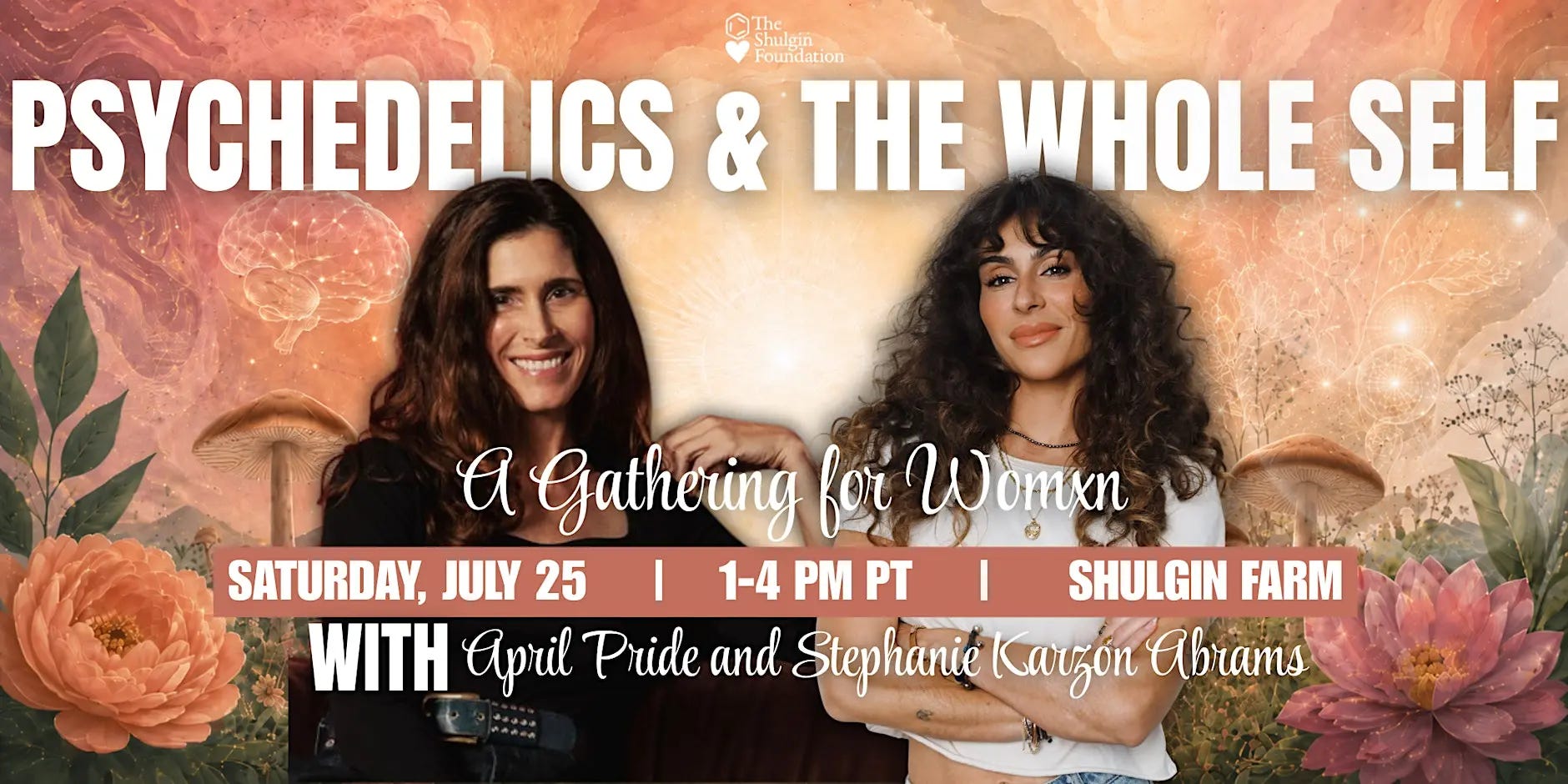
Join Steph K and April for this curated experience at Shulgin Farm, home to the chemistry lab of Sasha Shulgin, who held a DEA-exempt license and first synthesized MDMA. Also at the farm, Sasha’s wife Ann developed protocols for integration with MDMA et al., psychedelic compounds created in the lab. A historic setting to welcome 50 people for this womxn-focused event, ideal for practitioners and anyone navigating the presence or absence of female hormones.
🔵 What You’ll Learn in This Episode
Why anorexia nervosa carries the highest mortality rate of any psychiatric illness, and why treatment has stalled for so long.
How UCSF designed a psilocybin trial around a medically fragile population, including real-time cardiac monitoring and the hypoglycemia risk UC San Diego flagged first.
Why caregivers enroll as trial participants, and why a family system often has to change before a young person can.
What cognitive flexibility and the default mode network have to do with why researchers think psilocybin might help.
Why psilocybin’s results may prove more durable than ketamine’s, and why that matters for a chronic illness.
What harm reduction really means for parents considering an extralegal session at home.
After tracking my sleep over the last couple of months, I’ve determined that my prescribed stimulant meds are negatively impacting my sleep. My doctor has told me for years to expect this as I age, but rather than simply reduce the dosage, I want to compare the effects of coca leaf, microdosing LSD, and Vyvanse on my sleep and managing my ADHD. Stay tuned!
🔵 Key Takeaways
Psilocybin is being studied as the first potential breakthrough for anorexia in a generation, but every honest researcher in the room is holding equipoise, not hype. The molecule is one component of a system, not a cure.
The trial’s design is unusually intensive because the population is unusually vulnerable. Two high-dose sessions, three preparation sessions before each, real-time heart monitoring, and blood draws throughout. Between 8 and 20 weeks of contact per participant.
Families are part of the treatment. Young people rarely get better if they return to the same system in which the illness grew, so caregivers enroll and prepare too.
Improving cognitive flexibility does not guarantee behavior change. People report expanded thinking and a better quality of life. Whether that translates to weight restoration is the open question this trial is built to answer.
Access without support is the real risk. Psilocybin floods the body with sensation, and people with anorexia are often profoundly disconnected from the body. Unsupported, that experience can compound harm rather than heal it.
🔵 Featured Guest
Dr. Amanda Downey is a pediatrician and psychiatrist specializing in adolescents and young adults with eating disorders. She is the assistant medical director of the UCSF Eating Disorders Program, a member of UCSF’s Translational Psychedelic Research Program, and a lead investigator on an active Phase 2 trial of psilocybin therapy for young adults with anorexia nervosa, ages 18 to 25.
Learn more about UCSF psilocybin and anorexia trial @ clinicaltrials.ucsf.edu
🔵 Episode FAQs
Is psilocybin a legal treatment for anorexia? No. Psilocybin remains a Schedule I substance under federal law, and there is no FDA-approved psilocybin treatment for anorexia or any other eating disorder. It is being studied only in sanctioned clinical trials, such as the one at UCSF. Decriminalization in cities like San Francisco and Seattle does not change that status for clinical research or personal use.
Why does the UCSF trial enroll caregivers? Because young people are unlikely to stay well if they return to the same family system where the eating disorder developed. The trial requires at least one caregiver to enroll and prepare, so the family can recognize old patterns and support new ones, including big emotions like rage or grief that may surface after a session.
What did the first psilocybin anorexia trial find? The first published clinical trial, out of UC San Diego, was a small Phase 1 study. Four of ten participants showed clinically significant reductions in eating disorder psychopathology, 70 percent reported quality-of-life improvements, and 90 percent ranked the psilocybin session among the most meaningful experiences of their lives. It also flagged high rates of hypoglycemia as a serious safety concern.
Is psilocybin better than ketamine for eating disorders? It is too soon to say, and the researchers will not claim it. The current thinking is that the two play different roles. Ketamine’s effects tend to require repeated dosing and fade between sessions, while psilocybin’s benefits in other conditions have shown more durability at six, nine, and twelve months. That durability is the hope, not yet the evidence.
Can parents safely try psilocybin for a child with an eating disorder at home? Dr. Downey is clear that she cannot recommend it, legally or ethically. Psilocybin amplifies bodily sensation, which can be destabilizing for someone already disconnected from their body, and an unsupported session can compound harm. The safest paths are a clinical trial or a legal supervised program in Oregon or Colorado with a licensed facilitator.
🔵 Additional Resources
Ask April: How Do I Find a Psychedelic Guide? — column on legal access, licensed facilitators, and the Oregon versus Colorado distinction
🔵 Timestamps
[00:00] Why eating disorders are the deadliest psychiatric illness, and the numbers that frame the night
[01:00] Meeting Dr. Amanda Downey and how she came to eating disorder and psychedelic work
[03:00] The patient who inspired the study, and the moment the idea was first spoken aloud
[04:30] Funding a trial the government will not pay for, almost entirely through patients and families
[05:30] Trial design, and why caregivers enroll as participants
[07:30] The scale of the scaffolding: 20 to 25 milligram doses and weeks of contact
[08:00] Safety at the core, hypoglycemia, and real-time cardiac monitoring
[09:00] The working hypothesis, cognitive flexibility, and the default mode network
[11:00] Ketamine versus psilocybin, and why durability may be the difference
[25:30] Audience question on integration, plasticity, and extralegal use
[26:30] Harm reduction for parents, and where to find a legal path
[27:00] Could this help ARFID and other eating disorders?
[28:30] Adverse reactions and the terror of five hours of amplified embodiment
[31:00] Cognitive flexibility that did not translate to behavior change
[34:00] San Francisco decriminalization and the trial timeline
[38:00] Why eating disorders get so little funding, and who the illness actually affects
[43:00] Supporting the family system, and chatter about 5-MeO-DMT
[46:30] Closing reflection: what psilocybin opens, and what eating disorders require to close
🔵 Transcript
April Pride, host: Welcome back to the show. This is your host, April Pride. the episode that follows my introduction here is a live recording of the Psychedelic Salon I hosted at Town Hall Seattle on April 2nd of this year, 2026, focused on psychedelics and disordered eating.
Let’s begin by reviewing sobering facts about the most lethal psychiatric disorder in the United States today. That’s right, eating disorders kill more people than any other psychiatric illness. One person in the United States dies every 52 seconds, and unlike most of the mental health conditions that have started to benefit from the wave of psychedelic research, eating disorders, particularly anorexia nervosa, have seen almost no meaningful treatment innovation in decades.
Two out of three people who receive conventional treatment will not recover.
Personally, I’m one of the lucky ones. After suffering from anorexia acutely for nearly a [00:01:00] decade in high school through post-college, I was able to reset my relationship to my body thanks to pregnancy. I was able to conceive, carry, and birth two sons with relative ease. I now know that my undiagnosed ADHD contributed to the need to create mechanisms of control and a propensity for perfectionism that manifested in body dysmorphia
The first year of my divorce, no matter how much I ate, I could not keep on weight. To see myself so thin was embarrassing, frankly. I was reminded of how tormented I was in my youth while in the throes of my disease, how selfish I was, and how cruel others were to me when I was at my lowest.
Being in my mid-40s and weighing so little on a quite tall frame betrayed the truth of my confidence and patience with a painful transformation. Today, I’m grateful that year reinforced not only my self-compassion at that time, but also for my younger self.
This is at the heart [00:02:00] of what psilocybin has the potential to improve in patients, an increasing capacity for self-love. At this salon, I was in conversation with Dr. Amanda Downey. She’s a pediatrician and psychiatrist who specializes in adolescents and young adults with eating disorders. She is the assistant medical director of the UCSF Eating Disorders Program and A member of UCSF’s Translational Psychedelic Research Program, also known as TRPR, Tripper, she is one of the lead investigators on an active phase two clinical trial studying psilocybin therapy for young adults with anorexia, ages 18 to 25
That trial is designed to include caregivers as enrolled participants, a first of its kind. And in the conversation that follows, Dr. Downie explains why. She holds equipoise in the old-fashioned scientific sense, genuinely uncertain about outcomes, genuinely committed to looking at [00:03:00] what isn’t working alongside what is. That combination, deep care for a devastating patient population plus rigorous scientific caution is why I’m so grateful to Dr. Downey for traveling to Seattle from San Francisco to candidly explain the challenges of bringing what has the potential to be the first breakthrough intervention to this diagnosis in decades.
A note before we begin. Psilocybin is a Schedule I substance federally. Decriminalization in cities like San Francisco and Seattle does not change that legal status for clinical research or personal use. If you’re a clinician, a parent, or a patient considering extralegal access, please listen to Dr.
Downey’s remarks on adverse reactions and the necessity of supported integration before making any decisions Again, this was recorded live at Psychedelic Salon at Town Hall Seattle, and our next season begins on October 8th. [00:04:00] Tickets go on sale next month to join us live or live stream.
Introduction
April Pride, host: Good evening. Hi. Thank you for being here again. See some familiar faces. I’m April Pride. I’m the host, the creator and host of Psychedelic Salon. And tonight we are here to talk about a topic that is at the intersection of urgency and possibility. Eating disorders are the deadliest psychiatric illness, and someone in the US every 52 seconds dies of an eating disorder.
Only a third of people who receive, conventional treatment will recover. Is that the word we use, recover? And two thirds of people will perhaps spend the rest of their life struggling silently. And so that’s why Dr. Amanda Downey is our guest tonight to learn more about how psychedelics are potentially [00:05:00] going to disrupt treatment for this disease, which hasn’t had a breakthrough treatment in decades.
Meet Dr. Amanda Downey
Dr. Amanda Downey, guest: Welcome Dr. Amanda Downey Hi. Thank you. Thanks for having me. Yeah. So my first question is: how do you find yourself working at the UCSF lab? Yeah. yeah. It’s a really good question. I’m fond of saying, I’m from Ohio, as and I’m my Midwestern parents’ worst nightmare ‘cause I moved to California and started studying psychedelic drugs, that’s okay. We’re still in contact. I think I have probably a familiar story to many. I, grew up, and had a lot of friends struggling with eating disorders and, they were friends, I think, who had particularly marginalized identities in the eating disorder space, and so fell through the cracks between medical care and behavioral healthcare.
And I had this interest in being a person who could hold both, who could, make sure that the medical care was good and sound, while also attending to the psychological complexity, that these patients bring. And so I pursued, what’s called triple board training, I trained in pediatrics and adult psychiatry, and then child and [00:06:00] adolescent psychiatry, always with this kind of north star of being someone who could care for young people with eating disorders.
ended up, at UCSF. They have done innovative research, and really set kind of the bar for a lot of eating disorder care, both kind of in terms of therapy, as well as medical refeeding or how do we re-nourish, folks with eating disorders. And yeah, ended up at UCSF. I feel really lucky and honored to be in amazing company there.
through the pandemic and this kind of surge of eating disorders we saw, in the wake of the pandemic, felt really compelled, to get on board with the psychedelic work, to see if we could move the needle appreciably for our patients. And so that was the first time that the idea of psychedelics was introduced into the clinic?
Origins of the Psilocybin Trial
Dr. Amanda Downey, guest: so Dr. Raymond Flesche is, the principal investigator of our study, and she tells the story, of this kind of well-known, very beloved patient in our program who, really, truly wanted to die from her eating disorder, from starvation. And, I can tell you there is nothing, to me, there [00:07:00] is nothing more heartbreaking on this earth than watching someone attempt to starve themselves to death.
And this particular patient was incredibly ill and doing everything in their power to not survive in our medical hospital. So they were so compromised medically that they were in the medical hospital receiving treatment, and again, doing everything to make sure that didn’t happen. and I think in the eating disorder space, we’re doing the best that we can, and our treatments fail so many young people.
This is one of those cases where, as a physician, I feel incredibly powerless because we’re off the roadmap. We don’t know what to do for these young people in the face of this kind of profound suffering. And I remember she had taken care of that patient that day and ran up to my office after, and was clearly struggling with what to do.
She said, “I have this really crazy idea. What do you think about psychedelics for young people with eating disorders?” And I was like, “Yes!” Oh my God, like someone is saying this thing that like we’ve all maybe secretly been thinking but hadn’t really been able to give voice to.
So all credit to [00:08:00] her. but really I think, that’s an important anecdote, the study is born out of deep love for our patients and our work. and it felt like The surge of eating disorders and our treatments were so limited that, there was an ethical imperative to do something outside of the box.
and the science is compelling enough, that we felt like this was the right next step. Then the right next step was to begin the steps to have a clinical trial. It wasn’t that you rushed into the room and said- Oh no ... you should try it. Yeah. Yeah, no, that’s not how it works. Yeah. this was a years-long process. Of course, as the red tape is tremendous. the lift is tremendous to get a clinical trial of this magnitude off the ground. we’re lucky in that UCSF already had the infrastructure to do psychedelic clinical trials. and so we had the good fortune of working with a lot of really talented folks with a lot of experience to help launch this clinical trial.
Trial Design and Funding
Dr. Amanda Downey, guest: and then we had to fundraise, right? Because the government is [00:09:00] not funding any of this work through traditional kind of grant mechanisms. And man, like a real labor of love is, reaching out to patients, current and past, and to their families, to ask for money, is a really humbling, weird exercise.
And our clinical trial has been funded almost 100% by patients and families that we take care of or have taken care of, and that is beautiful. It feels like the most epic co-creation, that one can have in academics. Yeah, it’s really special. Can you talk a little bit about the trial design because it is unique?
We, are studying, psilocybin therapy for specifically young adults with anorexia nervosa. We’re dosing people ages 18 through 25. and, some interesting considerations here many of these young people, even though they’re adults, have been so impaired by their illness that they’re still living within the family system and needing and requiring a lot of support.
So our trial requires that caregivers actually [00:10:00] enroll as trial participants as well. it can just be one, it can be two. and we really believe, based on existing evidence and frankly, our previous work in the eating disorder space, that young people are unlikely to get better if they’re returned to the system or the matrix in which the eating disorder originally developed.
And so we really believe that the family system also has to shift and prepare for this potential positive change to come from the psychedelic experience. and that change may not always look like your stereotypically positive experience. Sometimes a positive experience for our trial participants is showing rage, getting in touch with their rage for the first time.
And so we’re trying to prepare caregivers for the possibility of, yes, positive change, but also, like rage and sadness and like these other big emotions that maybe haven’t showed up before. and so that’s, yeah, one really unique aspect of our [00:11:00] trial. in terms of other things we do a traditional preparation, high dose psilocybin integration.
So you see that, thoroughfare as you do in other clinical trials. We’re doing two high dose administrations based on trials done in other locations. It seems like two doses might be more beneficial than just one for our patients. but of course, this is all to some degree. we haven’t looked at data yet.
April Pride, host: Let me add some context here because the structure Dr. Downey just described is more involved than any psychedelic clinical trial currently running. the UCSF protocol doses participants at 20 milligrams of psilocybin for the first session and up to 25 milligrams for the second. Those are high dose administrations, and remember, this is
synthetic psilocybin, not from whole fruit bodies. So 25 milligrams, that’s very different than, say, if you’re buying in the [00:12:00] wild. The preparation alone, three sessions before each dosing day, each up to two hours, involves both the participant and at least one enrolled caregiver. By the time the study period closes, participants may have been in active contact with the research team for anywhere from eight to 20 weeks.
The reason for this scale of scaffolding is directly correlated to the vulnerability of this patient population. Anorexia involves a degree of medical fragility that other psychedelic trials don’t routinely encounter
But isn’t dissimilar to what we discussed in the last episode with Dr. Nathan Sackett
with the patient population that has experienced substance use disorder for years
The first published clinical trial of psilocybin for anorexia out of UC San Diego in 2024 flagged high rates of hypoglycemia, low blood sugar, as a significant safety concern. Low blood sugar during an eight-hour dosing [00:13:00] session is not a minor side effect. The UCSF team built their protocol around the data.
They do real-time cardiac monitoring, regular blood draws, and physical exams throughout dosing. That level of medical oversight does not exist in extra-legally facilitated settings. It is one of the reasons Dr. Downey is careful about what she can and cannot recommend. And note that if you are a person who routinely experiences hypoglycemia, consider adopting a protocol while working with psychedelic medicine that is most supportive to your health in the days before, during, and directly after ingesting psychedelic medicine.
Study Population and Safety
Dr. Amanda Downey, guest: and then, we designed the trial with really safety at its core. We’re dosing an incredibly medically fragile, patient population. and our friends at UC San Diego published the first clinical trial of psilocybin therapy for [00:14:00] anorexia. and they found high rates of hypoglycemia or low blood sugar, which can be incredibly dangerous, even life ending.
and our co-investigators are folks, including myself, who take care of folks medically and are in our inpatient medical hospital. So we’re used to a high degree of medical acuity. We’re doing blood draws, regular physical exams. We’re even, in real time looking at heart rhythms.
And we have this really cool electrocardiogram system. so lots of kind of safeguards to make sure that our patients stay safe. so the other really cool part, and again, all credit to Dr. Raymond Flesche, who’s just an amazing, community oriented scientist as well.
But, we have two advisory boards who helped us build this trial. We have, young people with lived experience or, either present or past, of an eating disorder, and then also an advisory board of caregivers who have had children, with eating disorders who really helped us design this trial from the ground up and had some really both amazing and heartbreaking wisdom to share, in terms of trial [00:15:00] design.
that has also, been informative and continues to inform our trial design and how we move forward. So yeah, those things have been really special and helpful. Okay, let’s back up. Why did the lead investigator, why did she say psychedelics? What did she think they-
How Psilocybin May Work
Dr. Amanda Downey, guest: could do to help- with this patient population? so again, somewhat speculative, drawn from results from other clinical trials. But, we hope the working hypothesis is that we’re able to increase what we call cognitive flexibility in our patients, right? and we don’t actually know how psilocybin is able to do that.
We have some ideas, which folks are probably familiar with, so things like increased brain connectivity, right? the default mode network. I know that’s been spoken about, right? This area of kind of self-referential thought where our patients get stuck in loops like, “I’m so fat. No one could ever love me,” right?
These kind of negative, spirals. We think that lives in the default mode network. So if we can [00:16:00] quiet that default mode network with psilocybin while simultaneously increasing connectivity between disparate brain regions that normally don’t speak to each other, can we restore this appropriate contextual balance for things like hunger cues and satiety and the way it feels to be in your body?
that is the hope. And that’s what we’ve seen in other clinical trials for things like depression and substance use disorder. so I think the hypothesis is a good one. It’s a hopeful one. and as scientists, it’s really important that we’re not hype girls, which is hard ‘cause it’s really exciting.
But to be a good scientist, to really hold equipoise for what we’re doing and to not be true believers, but to really look at the side effects, to look at those things that aren’t going well. and holding space for both of those things.
but we thought about ketamine. We thought about MDMA. we did due diligence in thinking about other substances. but ultimately because of the serotonergic properties of psilocybin and some of the overlap with [00:17:00] abnormalities that we see in terms of the neurochemistry of folks with anorexia in particular, psilocybin felt like the first right step.
April Pride, host: The default mode network comes up a lot in psychedelic research and on this show, but I don’t think it can be overexplained because it’s at the foundation of why we think what we think, which is at the root of how we perceive our reality and our experience while in the medicine. Think of the default mode network as the brain’s rumination engine.
It’s active when you’re not focused on a specific task, when you’re mind-wandering, reviewing the past, rehearsing the future, building and reinforcing your story about who you are. In healthy function, that network turns on and off . In anorexia nervosa, the research suggests something different.
The loops get sticky. “I am fat. I am unacceptable. My body is the problem.” Those aren’t random intrusive thoughts. They’re grooves [00:18:00] worn into the default mode network through years of repetition. What makes the neuroscience of anorexia particularly compelling for psilocybin researchers is that the rigidity is not just psychological, it’s structural.
Neuroimaging studies show that people with anorexia have altered connectivity across the brain networks governing self-referential thought, reward response,
and the brain’s ability to read the body’s internal signals, things like hunger and fullness. Psilocybin acting on the serotonin 5-HT2A receptors temporarily quiets the default mode network and increases communication between brain regions that don’t normally talk to each other.
The working hypothesis is that this window of loosened rigidity creates an opening for new patterns to take hold. Whether that opening is wide enough to shift something as entrenched as anorexia is what this trial is [00:19:00] designed to find out
Psilocybin vs. Ketamine
Dr. Amanda Downey, guest: You did mention something to me about talking to providers- ... that work, I believe... Ketamine providers would not necessarily be working underground, but psilocybin providers that are working with this patient population. And the results between ketamine and psilocybin
that was something that you keep hearing. Psilocybin is showing better results. I feel like it’s too soon to say. I suspect, this is not based on any data, just so don’t run with this, but I suspect that there is a role for ketamine that’s different than the role that psilocybin will play.
ketamine is having a cannabis problem, like in the sense that it’s everywhere. It’s being done in outpatient clinics all across the country. No one’s studying it. So we’re in this kind of like weird space of do we do it? Do we not do it? And I guess a little plug, we are also running a ketamine study [00:20:00] in our medical hospital, and the goal of that study is not to move mountains, not to cure someone’s eating disorder, but can we just bring down the distress of being in the medical hospital and having to re-nourish when people are medically unstable that it’s life-threatening?
I think there is a role for ketamine But I think it’s gonna be different than the role of psilocybin. Like we know in depression, ketamine has to be dosed over and over, and then you take a little break, but symptoms return. and so it ends up being a really long course of treatment.
For psilocybin, not in eating disorder trials, but in other trials, when folks are followed six months, nine months, 12 months, a significant majority of those participants are better a year out without subsequent treatment. We’re hopeful that could be the case for us, too, but we’ll have to see.
It’s really interesting to hear you talk about layering the medicine- Yeah ... because I feel like everything’s so singular. We just talk, right? Because you can’t mix medicines during a trial, right? So [00:21:00] that’s how we’re looking at it.
Early Clinical Evidence
Dr. Amanda Downey, guest: what does the early science say- in terms of the positive effects of psilocybin on these patients?
Yeah, sure. Yeah. So the only like true data we have from a clinical trial is, again, this trial out of UC San Diego. great folks, super thoughtful. and it looks like for a majority of participants, their eating disorder symptoms got better. and I think important to note- What does that mean?
So researchers tend to use this thing called the EDE, which is a gold standard eating disorder questionnaire or survey to get at different kind of symptom domains. and we know that overall, in a global sense, those scores improved and some folks went into full recovery or remission.
but in my mind, even improvement is something. It’s better than nothing. and that trial was not designed to truly measure efficacy, so that’s just a little like preview signal. That trial was really designed to [00:22:00] look at safety and tolerability and it was safe and it was tolerable. And so that’s, that lets trials like ours, which we’re hoping to dose 40 participants, a more honest look at efficacy and is this really gonna move the needle in an appreciable way.
we had Dr. Nathan Sackett here last month- who was talking about, his trial using psilocybin for substance use disorder and trauma. And it’s been very hard to find participants- that are medically sound Are you gonna be able to find 40 participants easily ?
Yeah. it’s a good question. I have to say before we opened the trial for recruitment, we were getting emails every single day from people all over the country and all over the world asking to come into the trial. we are accepting in a pretty high degree of medical acuity. So where other trials, for good reason, have had kind of a very narrow range of folks that they felt comfortable dosing.
building on those studies, we felt more comfortable widening our [00:23:00] criteria, to a fairly sick population. so far, knock on wood, recruitment has been steady. Of course, we’re certainly open if anyone wants to, send folks our way. but yeah, so far so good.
One of my, first questions to Dr. Downey was,
Recruitment and Funding Hurdles
Dr. Amanda Downey, guest: where are the pharmaceutical companies? If this is the deadliest illness, why aren’t they funding this? Yeah. And your answer I was not expecting. Which was- ... mechanism of action. We h-- you have to first- ... figure out why it’s happening. And then they’ll get on board.
I think I said it’s ki-- you gotta play the game. The game’s no fun. Give us some back- Some, yeah, background on the game. No, that’s not true. It’s fun. But the scientific process to get funding, to get FDA approval, there’s all these benchmarks that you have to prove, and you have to prove them in really careful sequential order.
So first you’ve gotta test something in animals. And then once it’s safe in animals, you can test it in healthy controls. And then after healthy controls, you gotta do a safety study in a patient population. And then after that, you gotta figure out why it works. And that’s just the [00:24:00] beginning.
These trials take years and cost millions and millions of dollars so the red tape is tremendous. Where we’re at now is, a big enough trial to test efficacy. So does this actually work? And in parallel to prove to governing bodies like the FDA, like the NIH, why does it work? and that’s a really tall order for psychedelics.
I’m sure many in this room followed, the MDMA, hearing with great interest? And the reality is this overlap, this really intricate, intimate relationship between the psychotherapy and the drug make this question of why does this work really complicated. And when our patients are dying, and suffering, and you have to jump through all these hoops, even if the data is coming back in a compelling way, my God, that’s heartbreaking.
at least for those of us in the academic space, this is the process that we have to follow to make this happen. hopefully in parallel with things like industry that might be able to accelerate some of [00:25:00] these treatments a little bit more quickly. One of the most, heartbreaking, disturbing things that you shared was how young,
Treating Younger Patients
Dr. Amanda Downey, guest: how your patients are younger and younger.
And you’re seeing that more I think, since the pandemic
Standard Treatment Approaches
Dr. Amanda Downey, guest: How do you treat a child versus an adolescent? So our typical treatment modalities, psychedelics aside, I think of it as two main pillars with some extra sauce you can add in, depending on the patient.
But this first kind of pillar of treatment is it’s just weight restoration, and that’s really hard. I think that’s a hard pill to swallow because when we’re in that phase, it can feel like we’re not really in service of the psychological well-being of someone. and it’s challenging for us, too, for clinicians.
And if you don’t save someone’s life, if they’re not medically stable enough to be in the world, then game over, right? so that piece is critical. The other part of the weight restoration process that I think people forget about is [00:26:00] when you’re incredibly starved or in a malnourished state, it’s your brain tissue itself that has also lost weight.
and so when you look at folks in MRI scanners, the brain is shrunken. The gray matter is damaged. The white matter is damaged. And so it’s awfully hard to do deep psychotherapy with someone when the brain itself is that starved. and that’s not to minimize or to take away autonomy from the patient.
what we’ve seen time and time again is psychological recovery can’t happen until the body and the brain have some degree of renourishment back on board. So that’s this, very critical pillar. And then the other hand, psychotherapy. For a child and even for adolescents, the biggest evidence-based is for what we call FBT or family-based treatment.
So this idea of really empowering caregivers to renourish the young person in the home, which can be incredibly challenging and is, a true act of love, to do that at home because it’s so challenging, and it saves lives. I think as folks transition to older [00:27:00] adolescents and young adulthood, treatment can often look like a more kind of typical psychotherapy approach.
So like cognitive behavioral therapy with more of an eating disorder spin or dialectical behavioral therapy, some version of that. There are lots of modalities that have shown some evidence. so those are the pillars. And then, medications, unfortunately, in the world of anorexia have not panned out.
There’s not a single medicine on the market that appreciably moves the needle on this illness. We do our best, for symptoms of anxiety and depression or OCD? medicines can be a helpful kind of addition. And the malnourished state itself precludes those medications from being able to have their full efficacy.
So again, another kind of plug for why the weight restoration process is so critical. there are some FDA-approved medications for things like binge eating and bulimia nervosa. But, again, anorexia remains, unfortunately, untouched. so sometimes adding a psychiatrist or a dietician to the team can be [00:28:00] helpful, but not in all cases.
Where Psilocybin Fits in Care
Dr. Amanda Downey, guest: So where does psilocybin come into the treatment? How do you determine this is the time to do it? Yeah. So I don’t think we have that answer yet. I’m hoping we will. in our trial and the other kind of running clinical trials right now, for anorexia in particular, they’re asking that folks have completed some course of evidence-based therapy first.
And that’s because, again, this is risky, and it’s just in the clinical trial phase. We’re sitting with folks, especially folks we’ve worked with in clinic, and for the first time we’re saying, “We don’t know. We don’t know if this is gonna work. This could have really life-altering consequences.”
Again, it’s our job to hold both the hope, but also the reality. Time will tell where it fits in the course of treatment. My hope, is that this becomes less of a protocolized kind of thing, and this is way off unfortunately, but less of you failed two treatments, so therefore it’s time to move on to the [00:29:00] mushrooms.”
Toward Personalized Treatment
Dr. Amanda Downey, guest: less of that, and more of how can science predict for whom this will be the most beneficial treatment? Is there a neurobiological signature? Can I... And I’m just making this up, but can I put an EEG on your head, and is there a brain wave pattern that tells me that this will be a safe and effective treatment for you, so that we’re not messing around with suffering for years and treatments that are gonna fail you?
or is there a blood test, or is there a certain personality or phenotype that I know this will be safe and effective and save you years of suffering, right? That for me is the dream. but that is many years to come, I think. For which diagnosis does that exist today? ‘Cause we hear about, “I have the gene for alcoholism.” I think the whole field of medicine is trying to move towards more, individualized precision approaches. I would say for me, from the outside looking in, oncology is a field that really is doing this well, in terms of, the kind of genetic testing and phenotyping [00:30:00] they’re able to do on different tumor types and really choosing a targeted medication as opposed to a blanket chemotherapy that just destroys you, right?
And that is like a parallel to what we’re talking about here, right? We’re, we have these blunt instruments that we’re going at eating disorders with. And again, man, that’s with a lot of compassion and a lot of love, and 50% of our patients aren’t getting better, and that’s a torturous process.
I hope that they take something away. I hope they’re at least getting better, but like also, let’s be real, for the people who don’t get better, that’s not okay. I’m just gonna ask this Okay are families finding their own medicine in doing their own treatments? You know what? Yeah.
People are finding their own way, Of course, because our treatments are failing them. I Have no judgment about that. in my role as a scientist and a clinician, that’s not something I’m recommending, [00:31:00] because of the grave kind of safety risks and not knowing folks practicing, in the extra legal space.
but yeah, we hear story after story of folks who are pursuing this out of great love for their patient or their loved one. of course. And you mentioned the other day that you are going to accept patients under 18. We’re not going to. Oh, okay. But we have a very controversial and beautiful little idea to go down below 18, if and when we have enough data to believe that it’s really safe and responsible to do that.
I wanna be super clear about our reasoning here because I think it’s important. We know that the average age of onset of these eating disorders continues to creep lower. and a couple points there first, if someone isn’t able to access evidence-based treatment within the first three years of their illness, we know that prognosis is poor regardless of access to treatment.
and so when we’re seeing in our program truly 9, 10, and 11-year-olds coming in, who have already been suffering for a [00:32:00] year or two years, that’s really precious time that we can’t get back. not to mention all of the like very real barriers to accessing evidence-based care, that exist in the world.
we also know that young people’s brains are still maturing and developing and growing. And because of that, I think psychedelics come with incredible risk. and if your brain is maturing and growing in the setting of severe malnutrition where you don’t have the right nutrients to create those neural networks that lead to wellbeing and resilience and, all of those things, we actually don’t know the lasting damage of that.
Is that setting someone up for a life of a really entrenched eating disorder? What I wanna say about that is I think if we don’t try everything for those young people, then we’re not doing a good job. and so we know that this is a risky proposition, and I promise we’ll do it with as much compassion and care [00:33:00] as we can.
I think everything has to be on the table given the circumstances. I was telling Dr. Downey that I was talking to a substance use counselor, and they said that The amount of time between when you start drinking, in this case is what we’re talking about, and when you try to stop, the fewer years there are, the easier it is to stop.
April Pride, host: So that tracks. Yeah, This is the same.
Audience Q&A Begins
April Pride, host: I’m gonna go to audience questions ‘cause this is my favorite part of the night. And if anyone would like to ask questions, there’s a microphone right there. I will let you speak before I go to the iPad.
Audience: So I’m curious about something. psychedelics are all new to me, but I would think that the real work using psychedelics to treat eating disorders isn’t so much taking mushrooms as it is the couple weeks of work and integration that happens while the plasticity is still [00:34:00] available, and that piece is hugely variable.
Dr. Amanda Downey, guest: I would hate parents to be experimenting with mushrooms and not having the skills to even do that. Unless you have a protocol can you talk to that? That’s why both legally and also ethically, I can’t recommend that folks do that right now because I agree with you.
the other thing is having a front seat to our participants in our clinical trial, with the utmost kind of rigor and safety and control, and we’re bringing in families and doing all of this work. a psychedelic trip is still hugely destabilizing for many people. and I think doing that not knowing what the context is, what the integration support is going to be, what’s the medical follow-up for these young people, we have no idea what’s gonna happen to them in ten, 12, 24 days.
Underground Use and Harm Reduction
Dr. Amanda Downey, guest: I worry about folks doing that, and the reality is it’s accessible. And so I think there’s a part of this work that is also in the spirit of harm reduction like April [00:35:00] does, right? Like really educating the community on, the risks, of doing this, and if you’re gonna do it, how to do it well, and how to do it responsibly.
April Pride, host: If you’re a parent of someone with an eating disorder who found this conversation and is now considering whether to facilitate a psilocybin experience at home, let’s drill down on harm reduction. The window of neuroplasticity that opens after a high-dose psychedelic experience is real. There is solid research from psilocybin depression trials and others showing elevated neuroplasticity in the days and weeks following a session.
That window is also when the experience is most vulnerable to going wrong if it isn’t supported well. An eating disorder is not a fixed belief system that a psychedelic can simply dissolve. It is a deeply entrenched pattern with physical, neurological, and relational components.
The family system around the person with anorexia has typically [00:36:00] reorganized itself over years to accommodate the illness One unsupported psilocybin session doesn’t reorganize any of that. It can actually amplify distress in someone who is already profoundly disconnected from bodily sensation, which is what the next question in this conversation addresses directly.
If you’re drawn to this as a path for someone you love, the most useful thing you can do right now is contact a trial. UCSF’s trial is active and accepting participants. Oregon and Colorado have legal supervised psilocybin access frameworks if you’re willing to travel and work with a licensed facilitator.
I encourage you to read my recent post on how to find a psychedelic guide because a person with an eating disorder may benefit from working in Colorado because it allows for licensed providers to guide psychedelic experiences using proven therapeutic conventions, unlike Oregon, which requires non-directive facilitation and only [00:37:00] requires a psychedelic facilitator’s license with no
experience as a licensed therapist. I’ll link to the post in the show notes
Audience: Hi. I, hear that
ARFID and Other Eating Disorders
Audience: this clinical trial is focused on anorexia. But do you have thoughts about how it would relate to other eating disorders, for instance, ARFID? Million-dollar question. If anyone has any money and wants to fund an ARFID study, that would be amazing.
Dr. Amanda Downey, guest: Yeah, ARFID is, Will you explain what ARFID is? Sorry, yes. Avoidant restrictive food intake disorder. So it’s this really, heterogeneous group of patients who end up with malnutrition of varying degrees, secondary to It can be a handful of different things. Sometimes it’s sensory aversion or textural kind of aversion or sensitivity to foods.
sometimes there’s just a lack of appetite that really can’t be explained by something like depression or another medical condition. sometimes there’s a very intense anxiety of choking or [00:38:00] vomiting. so you can see, yeah, the patient presentation is incredibly heterogeneous. Every individual patient looks a little bit different.
and we have so much interest in doing this clinical trial for ARFID. I would love to do it. and I think ARFID is a little bit new to the scene still, like new in the DSM-5. and yeah, it’s amazing. A lot of general clinicians are still getting familiar. so there is a lot of enthusiasm for doing it, but I would say not real traction yet, but I think it’s a brilliant idea.
send me your rich friends. Would love to do it.
Audience: Hi. so I work in higher level of care eating disorder treatment as well, and,
Adverse Reactions and Safety Concerns
Audience: we’ve been thinking about psilocybin for our patients. We can send folks to, Oregon- pretty easily from here, a lot of our patients are really uncomfortable with novel experiences in their body. Our, clients with anorexia- in particular, and, with psilocybin comes a lot of novelty. [00:39:00] and in our own experiences with, psilocybin, we’ve been around a lot of folks who have, had adverse reactions to psilocybin-
like panic reactions- Yep ... to the feelings of being out of control- Yep ... in one’s body. Yep. And so I was just curious if you’re seeing any of, any reactions like- Yep ... that to psilocybin- Yep ... with your, in your, in your research? Yeah. Okay. Thank you. Thank you. Yeah. It’s an excellent question. Okay. Yeah. Reason that I hedge a little bit about this idea of doing it, in the underground space or extra legally is seeing some of those reactions.
Dr. Amanda Downey, guest: In other trials, these difficult experiences and reactions supported well- ... with love and care can be incredibly powerful. and if not done well, can be completely destructive- ... to your point. So I think your Spidey sense about that is tracking with what we’re seeing- in our clinical trial. Just the idea of... psychedelics sometimes make people... It gives them this really embodied experience, like in the body, [00:40:00] and our patients often are so incredibly disconnected from their physical sensations and their physical body that just tolerating that for five hours is horrifying.
It’s horrifying. And integrated without, support and connection, that can be incredibly damaging for folks to be left to experience these sensations for the first time- unsupported. So my hope, although I can’t say with certainty, is that as we figure out what supported reconnection with the body looks like- that will be incredibly powerful for our patients, and we just don’t have a roadmap for that yet. which is scary because, again, that can be incredibly destructive.
And deep bow to the- Yeah ... clinicians who do this work, right? Yeah. Because, I think we have to have this hope that- that this is potentially going to move the needle
for our patients because If this is your life’s work and you have dedicated years and years to [00:41:00] serving people and making them better, the amount of times that we sit across from people and feel like, “Holy shit.” There’s no more evidence. There’s I’m at the end of what I have to offer.
Now, I’m not gonna leave you. I’m gonna be here with you in this mess, but legally, I don’t have a thing, and that is the worst feeling in the world.
April Pride, host: What the clinician in the audience just named and what Dr. Downey confirmed is something I wanna zero in on. Anorexia nervosa is characterized, among other things, by a profound disconnection from interoception, the brain’s ability to receive and interpret signals from inside the body.
Hunger cues, fullness, physical sensation, the felt sense of being embodied. For many people with long-standing anorexia, those signals have been suppressed, overridden, or reinterpreted for years. The illness runs in part on not feeling the body. Psilocybin at high [00:42:00] doses does the opposite. It floods the body with sensation.
It increases interoception awareness. For someone whose nervous system is accustomed to managing or numbing that awareness, five hours of amplified embodiment is not a gentle opening. It can feel like a threat. And without a skilled guide who understands the specific nervous system patterns of an eating disorder, that experience
Doesn’t integrate, it compounds. This is not an argument against psilocybin for eating disorders. The mechanism is exactly why researchers find it promising.
It’s an argument for the kind of structured, medically supported integration forward protocol that UCSF has designed. The molecule isn’t the treatment. The molecule is one component of a multi-week system of preparation, dosing, and integration built around a population with specific vulnerabilities that most facilitation settings, legal or [00:43:00] otherwise, are not currently equipped to hold
Cognitive Flexibility vs. Behavior Change
Audience: I used to work at UCSD with a lot of the people that were on that trial. And, the thing that really sticks out to me one of my close friends was, like, working and doing some of the qualitative interviews with the folks.
And the cognitive flexibility and, their expansive thinking that happened afterwards was, really fascinating to hear. And yet it didn’t really translate to actual behavior change, and weight change. and actually I’m in Seattle now, and I had a patient. I did not refer them to Oregon, but they went on their own, and I was like, “I support.
So curious.” Yeah. And came back and had a experience that, again, like really I felt helped her thinking expand the way that she thought about her body and food, and I was like, “This is it. This is great.” And it didn’t translate into behavior change. Yeah. And so that I’m super curious what you’re seeing in that [00:44:00] regard
Because the cognitive flexibility piece I feel is what really is challenging as a clinician. and yet how do we get that to actually translate to behavior change and and weight change, too. What are you seeing? What are your thoughts on that?
Dr. Amanda Downey, guest: I would say mixed bag so far. We’ve seen some cases with a lot of behavior change, similar to the results at UCSD with- folks felt better but maybe hadn’t appreciably moved the needle- in terms of weight or behaviors. I don’t have an answer.
I do think, again, bringing in the family system and really thinking about not just set and setting In the micro sense, but thinking about the next level, like supporting the family system to also be partners with you in enacting behavior change. And not coercive behavior change. Not checklist of “You must eat this and...”
No, like self-directed positive behavior change. Like how can we empower the family to figure out how to reorganize a little bit around the potential for change? Totally. I think, again, I will hold some hope on this, that’s a component. The [00:45:00] other thing that we did was even beyond the family system, we did a large focus group studies with providers all over the state of California, not involved in psychedelics, so psychotherapists, nurses, doctors, dieticians, et cetera.
Not only to see if they would feel comfortable with us doing a trial like this for their patients, but also what they needed to feel comfortable with folks coming out of psilocybin therapy into their care, right? So not only can then the family system adopt and think about how to amplify change, but then how can the general practitioner, how can their therapist, like how can they also learn to reorganize and not be, accommodating of these old patterns of behavior for their clients or patients.
so that’s not a great answer. But those are the things that we’ve been thinking about to try to really help people along. And the kind of flip side of this is let’s say behavior change doesn’t happen. Let’s say the weight doesn’t move and people are still in somewhat of an ill state.
If they feel [00:46:00] better, if their quality of life is better, if they are more expansive and flexible in other ways, then who am I to say that’s not a good outcome, like we all want remission for our patients and full recovery. Of course. And, from a harm reduction standpoint
If this moves the needle for someone in whatever way that feels important to them, then like I’m for it.
Hello.
Decriminalization and Legal Landscape
Dr. Amanda Downey, guest: I recall that San Francisco decriminalized psilocybin just a few years ago, which is interesting when you consider its history. How did that affect the timeline of the trial, if at all, and also the general practices of, psychedelic study at UCSF beyond your own trial? Yeah. It didn’t actually, because we are still 100% beholden to federal law in terms of running our clinical trials with a controlled substance, that’s Schedule 1.
I think there was, a cultural shift in San Francisco, and Oakland, honorable mention, Marin. in terms of the academic work, maybe we get more recruitment, [00:47:00] because there’s less stigma and fear around, engaging with the substances after decrim.
But, logistically it didn’t change anything for us.
What do
Consent and Pushback from Providers
Dr. Amanda Downey, guest: psychiatrists and therapists- think about the potential use of psychedelics in treatment? Has there been pushback? Yeah. Has there been pushback? Oh, that’s interesting. there’s been a little bit of pushback, but I think, it comes from a place of, really deep care for their patients and wanting to protect folks from harm all super well-intentioned pushback.
I can imagine some young patients may not have the tools and language to help with that. That’s a really nuanced point. I think part of the consideration of doing young adults and then even thinking about dosing adolescents someday, is neurodevelopmentally, how do we even consent them?
How do we get their assent to something that’s already a really challenging experience to understand? I have a hard time explaining it to an adult, right? And I have no idea how their experience is gonna be. So then to make sure [00:48:00] in an ethical way that we’re able to get assent from a young person, is a really important question that I’m not sure we have an answer to yet.
remind me the first part of that question. Minimal level of preparedness. Oh, yeah, the most preparedness. The most preparedness no minimal, only maximal Okay. But that’s, like in a clinical trial, we’re forcing you to show up and do prep, right? Like extra legally. Again, I think that’s the risk is people don’t have enough structure or support to really engage in that way.
and if if the soil isn’t fertile, like you’re not gonna sprout a flower. So that piece is critical. But man, I can’t even talk about minimal. I wanna think about maximum, but I don’t know. I don’t have a concrete answer.
Audience: Hi, I’m Cara.
Preparation and Delivery Process
Dr. Amanda Downey, guest: I’m with Lexi in the- treatment center. and maybe this is related to that preparation piece is- where are you in the trial delivering the psilocybin? Like at what point in their treatment stay? So are you trying to get, reach some kind of benchmark with, nourishment- weight restoration? [00:49:00] Where where is the delivery? There’s gonna be the preparation stage, where would be the delivery? So I should, this is the nice little plug I brought, little flyers for our study- Okay ... if folks are interested, and you can see our inclusion/exclusion criteria on there- in terms of medical benchmarks to be safe enough to dose. but in terms of preparation, it tends to be three preparatory sessions- ... before each of the high-dose administrations. They’re quite long, like up to two hours. And have time both for the young person alone, to create some autonomy and trust, et cetera.
And also time with the caregivers. so the preparation is quite intense. And then, this is the stuff we don’t talk about in clinical trials, but these participants are interfacing with us all the time. They’re exhausted of us. We are- ... calling them. We are sending them surveys, right?
But all that nonspecific contact is also incredibly meaningful, so even though the, like official prep is only three sessions- the reality is like we get to know these people- super well over the course of, like our study is technically between 8 and 20 weeks. So it can be a really long course of preparation before, [00:50:00] before the dose.
Audience: But some of these patients aren’t in your care. That’s right. That’s right. Okay. Yep. Okay. That’s exactly right. So you’re not necessarily treating somebody- No ... and then you’re putting them into psilocybin. No. We have folks coming from all over the country. Okay. Yeah. Yeah. Brand new.
We’re doing really thorough like medical record reviews- making sure we really have the best kind of holistic- picture of someone we can. And also just out of curiosity- . is OCPD something that you’re like, OCPD having, is there any, particular thing around that diagnosis in terms of- OCPD.
Dr. Amanda Downey, guest: Obsessive compulsive personality disorder.
There’s a high rate of co-occurrence. But OCPD is where, when we have our OCPD clients, we’re like, “Oh, we want them to do this” Even more so I was just curious about that.
Obsessive compulsive personality disorder, so very rigid- personality disorder. like symptomology It’s very lodged in- of that rigid- It’s all a spectrum. Most of our patients are cognitively rigid, there’s more kind of extreme- this is more extreme. Where it’s hard to make headway in treatment. Yeah, that’s right. I think that’s where we feel really stuck with our OCD clients. And I wonder if those participants will also have more [00:51:00] adverse effects.
Because they’re gripping- so tight- ... during the experience. I hope. I would be so curious about that.
Why Eating Disorders Lag in Treatment
April Pride, host: Why do you think eating disorders have had such little progress with treatment over time versus all other illnesses?
Dr. Amanda Downey, guest: How much is stigma, shame, and capitalistic forces versus it actually being a complicated illness to treat? All of that. All of that. Is there a gender discrepancy at play? Certainly funding is in the toilet compared to other mental health conditions, certainly other medical conditions.
Gender and Funding Disparities
Dr. Amanda Downey, guest: I feel like it is historically a gendered illness, and- women’s health doesn’t get funded. Women’s health doesn’t get funded. We’re starting to see glimmers of folks who are interested specifically in looking at gender differences, under psychedelic experiences, and that’s complicated.
To shed some light on what that would look like in the context of a clinical trial, right? Our hormones are shifting, not only throughout the day, over the course of a month, for a biologic- biological female, and over the course of a lifetime. [00:52:00] So if you were gonna design a really rigorous clinical trial looking at the intersection of psychedelics with female hormones, for example That would have to be an incredible amount of blood draws.
That would have to be specific times of day. People would have a hard time going to work because they would have to come to the lab at 9:00 AM exactly or at a certain time of the month. and so the complexity and the cost of a clinical trial of that magnitude is, unbelievable, probably in the tens of millions to do it well.
certainly animal studies are starting to explore these questions. Again, post-hoc or after the study, we can retroactively look back and start to speculate about gender differences. That’s the complicated clinical trial landscape. but so yes, certainly a gap in women’s health funding.
I do also just wanna say that eating disorder space is one of these weird areas where women are actually over-represented in this space. at UCSF, about a third of our patient population with anorexia are male-identifying. also lots of gender [00:53:00] diverse patients, also lots of Spanish-speaking patients and families.
So bodies that are, historically marginalized in this space, they don’t see themselves reflected in treatment centers and clinicians, and go undiagnosed because maybe, a well-meaning pediatrician or primary care doc is not imagining or not thinking that this type of person could have an eating disorder.
I just wanna be very clear about that too. but really you cannot tell if someone has an eating disorder from what they look like how they identify. so important to include those folks in our clinical trials as well.
Do you anticipate that two psilocybin dosing sessions could result in permanent results? I’ll be a good scientist and I will not speculate
April Pride, host: The funding gap Dr. Downey describes is not abstract. The National Institutes of Health has historically allocated significantly less research funding to conditions that primarily affect women and girls. Eating disorders, which affects an estimated twenty-nine million Americans over a lifetime, receive a fraction of the research dollars that go [00:54:00] to other psychiatric conditions with lower mortality rates.
As earlier noted, anorexia has the highest mortality rate of any psychiatric illness and has had no FDA-approved treatment since the 1990s.
It’s important to stress what Dr. Downey also cited, and that’s that eating disorders are not a thin white girl’s illness exclusively. They are under-diagnosed in people of color, in male-identifying people, in gender-diverse people, in non-English-speaking communities, precisely because the clinical image that providers have been trained on is narrow.
If you’re in any of those categories and have been dismissed, the dismissal is a documentation problem in the literature, not a fact about your experience.
The short version is this, estrogen and progesterone are neurosteroids that directly affect serotonin receptor density and sensitivity.
Psilocybin acts on serotonin, but while this intersection appears to be [00:55:00] significant, we don’t have the trial data to map it precisely, and designing a trial that would do that rigorously has proven to be prohibitively expensive.
Family Support and Recovery
April Pride, host: it seems that patients who have suffered from anorexia often find themselves in a similar mental state even after they have been treated and recovered. How can the patient’s family and those around them support them? What should they do?
Dr. Amanda Downey, guest: This is what we’re studying. I think family systems have often reorganized so impressively around a mental health disorder that they can’t even remember what it’s like to not be accommodating someone’s mental illness in this way. Meaning before they even sought treatment, they
That’s what systems do, right? In nature, you are churning towards homeostasis. and so family systems will do that too. When someone creates some, say, chaos or introduce something new into the system that’s scary, i.e., [00:56:00] an eating disorder, for example, the family will quickly accommodate to try to calm down, to try to restore homeostasis to the family system.
And in good psychotherapy, psychedelics aside, or potentially in the context of psychedelics too, we really want to help families recognize those patterns and be able to adapt differently in a way that’s supportive of the person who’s suffering the most. and families are suffering too and also need support.
So one, getting to know the individual who’s ill and how the family system has adapted to that illness so that they can recognize patterns, give them tools, to build resilience at home to help support the young person in a different path, and then three, thinking about what resources they need.
do the family members need psychotherapy? Do they need support? Do they have enough money to buy the food that we’re asking folks to re-nourish their young person with or what have you? yeah, it’s a really complex topic, a lot to think about
5-MeO-DMT and the Future
Audience: Have you heard any meaningful chatter in the academic community regarding the potential of 5-MeO-DMT in [00:57:00] the treatment of EDs and/or interest in studying 5-MeO for this purpose?
Dr. Amanda Downey, guest: Yeah, it has, for sure. it’s certainly happening in industry. Why? So short-acting. and something we haven’t touched on, today in today’s conversation is how resource intensive psychedelic therapy is, right?
We have two PhD level psychologists with our participants in preparation, multiple, right, two-hour sessions, an eight-hour dosing day, multiple integration sessions, another eight-hour dosing day. A medical doctor. The scope and scale of what these cost is unbelievable, and maybe it’ll be a little bit less if it gets rolled out into the community, but it’s still gonna be ghastly.
People will not be able to access this treatment. So if there is a shorter acting experience for the sake of increasing access to care I can’t see why we wouldn’t consider that. the mechanism is different. Obviously, the type of psychedelic experience is quite different for something like 5-MeO.
comes [00:58:00] with, a s-slew of different, medical considerations. But again, I think we’re at a place that everything is on the table. It’s reasonable. And is it in chatter? Yes. It’s in the chatter. And if you don’t know what 5-MeO is, Brian Johnson just did-
a super-duper heroic dose of it. You can look him up. he’s a longevity guy. He did way more than, you should
Audience: I’m really enjoying this conversation and learning a lot. I do have a question about the funding, and I wondered if you could speak a bit about, the chicken and egg of, like, how did that community of support come about, and how do you do that in this circumstances where you’re trying to do it ethically and legally and within the confines and all of the costs?
Dr. Amanda Downey, guest: It’s painful, ‘cause you’re just living and dying by the generosity of donors. and, like I talked about before, it’s been beautiful to partner with patients and families and to see the great care, that they have for their loved ones and for other young people who are suffering.
so it has been, [00:59:00] like, literally hundreds of meetings, one-on-one meetings with patients and families, to try to understand what their priorities are in terms of getting this work done. some folks come and say, “Man, I, I hear that psychedelics or psilocybin could be anti-inflammatory, and I wanna fund Blood draws to be able to study that in particular.
part of this relationship building is understanding what’s important to the person or the family who’s gonna donate money, that’s really important to us, that we, hold those things sacred and those are priorities of the trial. so yeah, a lot of unbelievable partnership with patients and families.
And then we’re piecing together small grants, from foundations that are more friendly to this work and excited about it. so building relationships across foundations across the country. there are all sorts of tiny little grant mechanisms that we’ve been lucky enough to apply for and get and have cobbled together, the funding.
by and large, we, had enough money to do the clinical trial, but not enough money to add, MRIs for our participants. And that was really important for us because we’re [01:00:00] dosing this young population, so we really wanted to know what’s happening neurodevelopmentally. Is psilocybin doing anything dangerous or structurally modifying what’s going on in the brain?
approaching donors and different foundations with that angle, we think this is critically important. first we wanna dose people safely, and we wanna know if this works. And second, we gotta play the game. We gotta figure out why this works, right? And so some of our time is spent figuring out scientifically what we think is really critical, and then going after folks or organizations that we think might be able to meet that gap.
hopefully someday the government will fund this work as well. that’s where most scientific grants, come from and good science is funded. And I think we’re moving that way. I’m hopeful.
Closing Remarks
April Pride, host: This has been a really great conversation. Thank you for having me. Thanks for being here.
What I keep returning to after this conversation is the gap Dr. Downey named without quite naming it directly, the gap that comes up in episode after episode, conversation after conversation, and that Dr. Downey [01:01:00] also cited. There’s a gap between what psilocybin appears to open and what eating disorders require to actually close. Cognitive flexibility is measurable.
Expanded thinking is reportable. Four out of 10 patients in the UC San Diego phase one trial showed clinically significant reductions in eating disorder psychopathy. 70% reported quality of life improvements. 90% ranked the psilocybin session among the most meaningful experiences of their lives
They also don’t answer the harder question, which is whether the window that psilocybin opens is wide enough and long enough and well enough supported to change the behavior patterns that anorexia has spent years making automatic. Behavior change in eating disorders requires the body to do something the nervous system has learned to experience as dangerous.
No psychedelic changes that on its own. It changes the context in [01:02:00] which change becomes possible. This is true for the opportunity psychedelics brings to any shift a person is seeking. The medicine is one component of a much larger system that is intentional about mitigating risks and supporting a robust integration process.
As it pertains to disordered eating, UCSF is building that system, and to serve as many people as possible, they need funding, as is the case with most conditions that have been historically identified as impacting the female population.
Thank you for listening to today’s episode. Please consider sharing it with someone who could benefit from this information. And you can find more of this podcast and my work on Substack at aprilpride.substack.com, which I will link to in today’s show notes. Also, if you liked today’s episode, please rate and review us wherever you listen to [01:03:00] podcasts.
It does help more people find the show. Take care.
Comments
Nothing yet. Say the first thing.
Sign in to join the conversation.