
📚The Mutual Aid Record: A Research Guide to Women’s Auxiliary, Church, and Community Records in Appalachia is waiting in the Resource Library.
🔍 Free Members: Learn more about the benefits of Free vs. Paid. Click here.
🌲This newsletter runs on courthouse records and coffee. If this research saves you a trip to the archive, Buy Us a Coffee.💚 ☕
Appalachian Genealogy & History is a reader-supported publication. To receive new posts and support my work, consider becoming a free or paid subscriber.

When you set out to map a family tree, you often find yourself obsessed with the cold architecture of dates. You look for the births, the marriages, and the final resting places. However, decades of walking these mountain ridges and digging through the records of the hollows have taught me that the true spirit of an Appalachian ancestor is found in the gaps between those dates. It is found in the moments when a community stood together against the rising waters of a creek or the heavy hand of industrial giants. To understand the genealogy of this region, one must view mutual aid not as some modern political theory, but as a deeply embedded ancestral trait. Tracing a family line through the floods of the early twentieth century or the brutal company town strikes reveals a heritage of communal survival that is just as vital to our identity as any DNA marker.
Looking at the devastation brought by the February 2025 floods in Kentucky and North Carolina, we see this ancient bell ringing once again. When volunteers like Cara Ellis in Pikeville spent their days evacuating neighbors and delivering essential supplies (Myers 2025), or when Willa Johnson organized supply drives under the banner of “It’s Our Turn EKY” (WYMT 2025), they were fulfilling an inherited role. Historically, the sheer isolation of these hills and the blatant neglect of coal barons meant that mountain people were first responders by necessity rather than choice. The historical so what of these modern events is the proof that our informal networks remain unbroken. These modern acts are the latest echoes of a tradition that has sustained life in these hollows for as long as people have called them home.
A Landscape Carved by Water and Will
To walk where our ancestors walked is to understand a world defined by steep slopes and deep hollows. In the heart of the mountains, the earth seems to tilt against the horizon, creating a physical reality that shaped the very character of the people. In places like the Dils Cemetery site in Pikeville, you can still feel the weight of this vertical landscape. The Levisa Fork of the Big Sandy River can jump its banks with a terrifying speed, turning a peaceful valley into a torrent that inundates homes and swallows downtowns before help from the outside world can even be summoned (Myers 2025). The sound of church bells tolling for the dead used to be the only telegraph we had, with each slow clang representing a year of life lived by a neighbor who was now gone.
To truly understand an Appalachian ancestor, you must look at the neighbors who stood beside them when the waters rose or the company store closed its doors. The physical isolation meant that resilience was a requirement of the landscape. If a bridge washed out or a mine shaft collapsed, there was no federal agency arriving on the scene. There were only the people in the next cabin over. The bonds forged in these narrow valleys were made of iron will and a shared understanding of what it took to stay alive. The survival of the individual was always inextricably linked to the survival of the entire hollow.
Historical Context: The Solidarity of the Hollow (1880–1960)
Between 1880 and 1960, the Appalachian social structure was forged in the collision of two worlds. On one side was the isolated mountain homestead, and on the other was the industrial machine of the company town. In places like Konnarock, Virginia, our ancestors lived in a state of constant tension. Outside missionaries and educators brought what they called “learnin’” to the mountains, but they often encountered a people rooted in a Primitive faith. This was a fundamentalist tradition that could be wary of outsiders. However, leaders like Kenneth Killinger and Laura Scherer Copenhaver understood that for the community to flourish, they had to bridge that gap. In September 1922, Copenhaver addressed the biennial convention of the Women’s Missionary Society and made an impassioned plea for aid, seeking to provide spiritual and secular education that respected the local ways, and the Konnarock Training School opened in Smyth County in 1925 as a result (Virginia Department of Historic Resources 1997; Library of Virginia 2007).
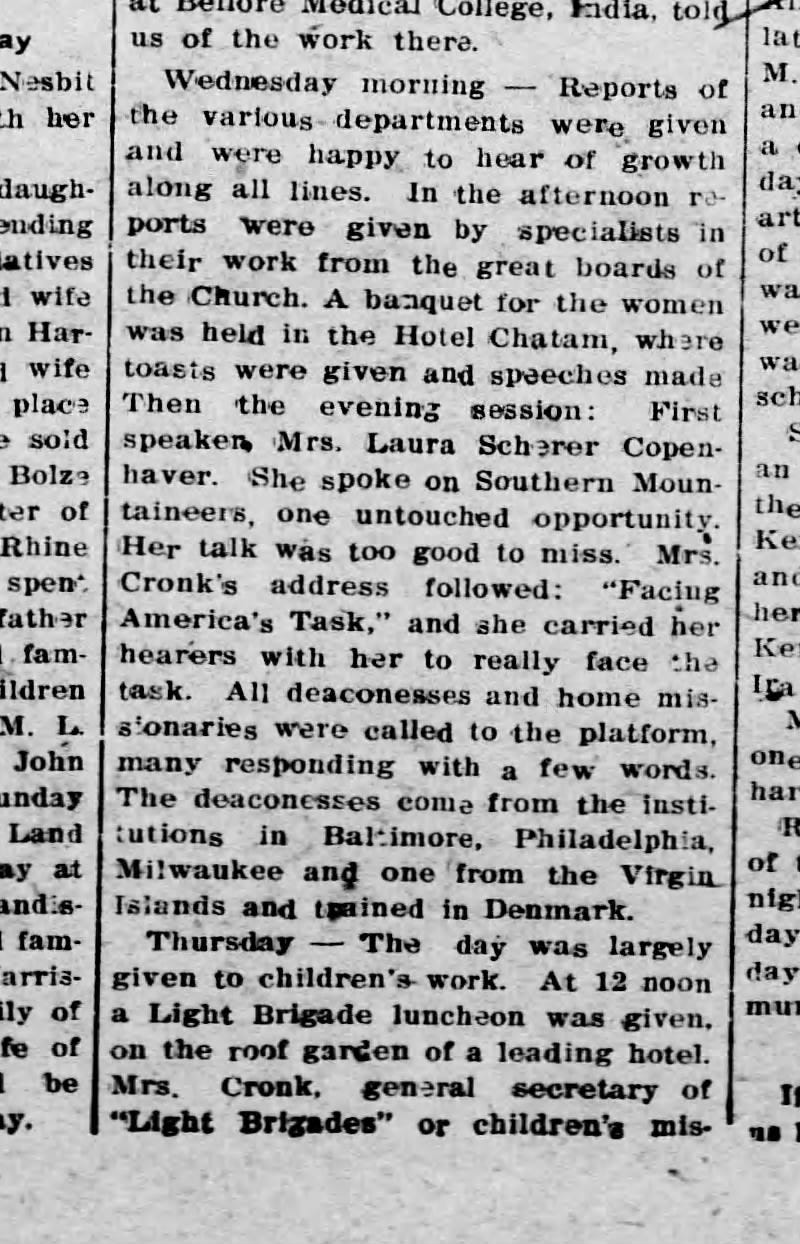
The real architects of stability during these decades were the women. The Southern Mama was the backbone of every coal camp and hillside farm. During the brutal labor disputes against coal companies, it was the Women’s Auxiliaries that kept the families from starving. Whether they were facing down the private armed guards known as Pennsylvania Cossacks in the 1920s (Coal and Iron Police 1865–1931) or running the strike pantry and processing donations during the historic Warrior Met strike in Alabama, these women put their bodies on the line (Wright, cited in In These Times 2021). They forged sisterhoods that transcended simple friendship. While the history of industry is written in coal and timber, the history of the community is written in the records of these women who refused to be shoved down.

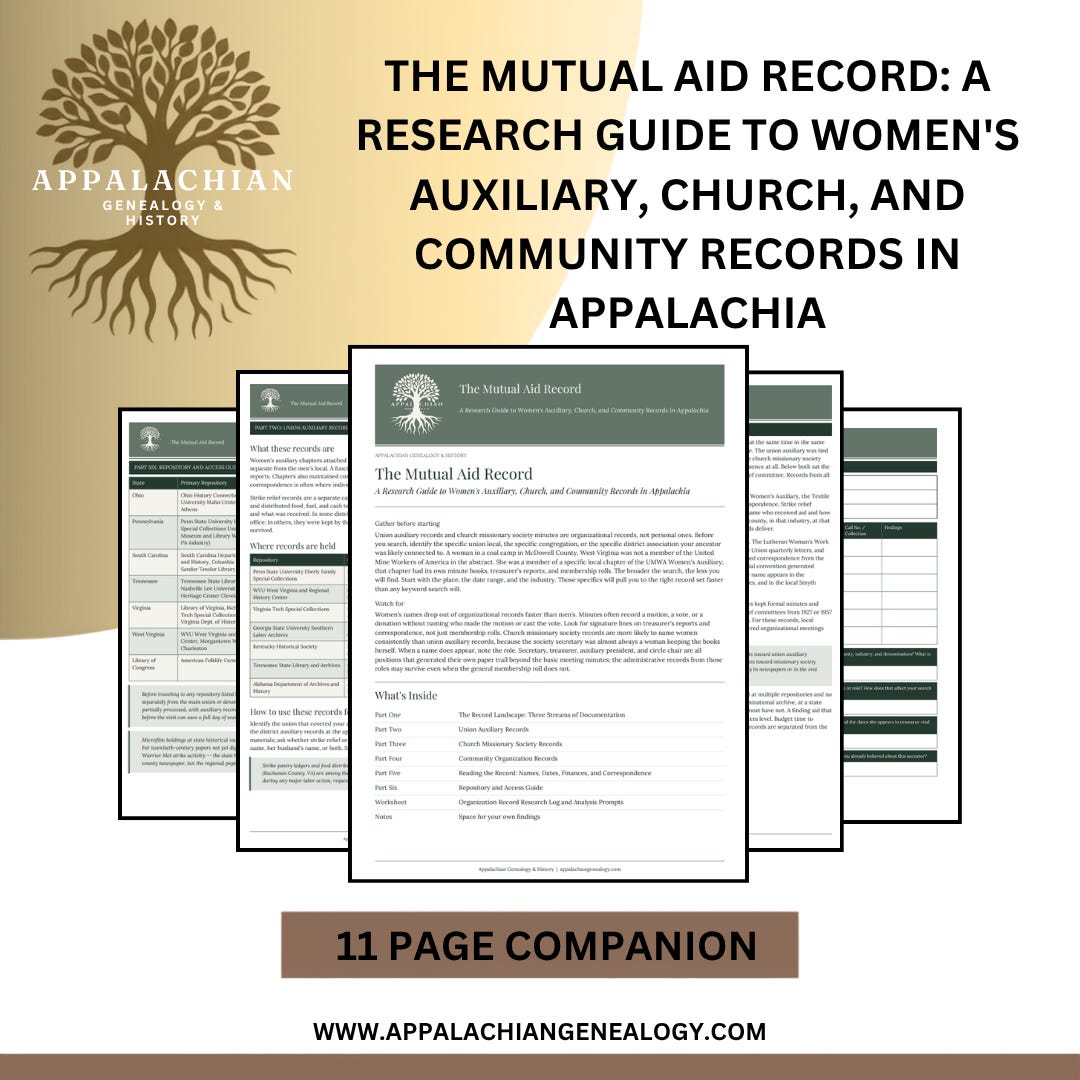
The Mutual Aid Record: A Research Guide to Women's Auxiliary, Church, and Community Records in Appalachia
A strike relief ledger may look like a simple account of money given out during hard times. In practice, it can do much more. If a woman appears as head of household, that clue may point to a husband’s death, absence, disability, or imprisonment before another record ever says so. Likewise, the same auxiliary that kept the relief ledger may have left minutes, membership rolls, treasurer’s reports, correspondence, or newspaper notices that place her inside a working network of women who raised money, visited the sick, taught children, fed families, and held a community together.
This 11-page PDF research guide includes:
Record landscape overview mapping union auxiliaries, church missionary societies, and community organizations, with guidance on county, industry, and denomination clues.
Union auxiliary records guide covering membership rolls, meeting minutes, treasurer’s reports, strike relief ledgers, state repository locations, and separate relief-series requests.
Church missionary society records guide covering local-to-national structures, denomination repositories, and mission school records, including Konnarock Training School.
Community organization records guide covering Ladies Aid Societies, flood relief committees, substitute sources, newspaper society columns, and oral history collections.
Reading-the-record section covering names, membership dates, financial records, correspondence, and a seven-entry name-variant reference table.
Repository and access guide covering Appalachia and the Library of Congress, with primary repositories and collection focus by state.
Organization Record Research Log worksheet with a seven-column log table and four analysis prompts.
Two ruled notes pages
.
Appalachian Genealogy & History is a reader-supported publication. To receive new posts and support my work, consider becoming a free or paid subscriber.

The Vigil of Sarah and the Salt
Consider the life of a woman like Sarah “Ma” Blizzard. She was a woman who could lead a battalion of saboteurs against mine guards by night and then perform a sacred saining ritual for a neighbor by day. When a man died in an isolated hollow, the community did not look for a commercial undertaker. They called for women like Ma Blizzard. This was a world of “Old Time” burials where the passing of a soul was a communal labor of love. First, the female neighbors arrived to wash the body and stitch a shroud. They stopped the household clock to mark the exact moment of departure and turned mirrors to the wall so the spirit would not be trapped in the reflective glass.
The rituals were both practical and profound. Male neighbors would construct a cooling board from old wooden doors or planks to rest the body in the parlor while a carpenter measured the deceased for a coffin (West Virginia Encyclopedia 2025; NCpedia 2025). The oldest woman in the household would approach the body with a lit candle and a bowl of salt. She would wave the candle over the body three times to protect the soul from evil things and place three handfuls of salt in a wooden bowl on the chest of the deceased, since many believed the soul did not leave the body for twenty-four hours (Appalachian History 2023). The final gift was the digging of the grave on a high hilltop to ensure good drainage and a view toward the east. This sacred work is the direct ancestor of the supply caravans crossing state lines today. Both are acts of mountain mercy that refuse to leave a neighbor behind.
This post is free for everyone. If we just helped untangle something in your own research, buying us a coffee is the easiest way to say thanks and keep the lights on.
˗ˏˋ☕ˎˊ˗
The “So What?” of the Mountain Pedigree
For those of us hunting our family history, recognizing these informal networks is essential for a complete pedigree. These are non-traditional records that tell us more about a person’s character than a simple census tally. When you find an ancestor’s name in the minutes of a Women’s Missionary Society or listed in the records of a union auxiliary, you are looking at their commitment to mutual aid. This behavior is an inherited trait that has been handed down through the generations. The human-to-human relationships that once sustained the Konnarock Training School in the 1920s are the same bonds that motivated people in 2025 to hand over their last ten dollars to a flood survivor because they knew exactly what it was like to lose everything.
These networks do not just happen by accident. They are built and strengthened with every catastrophe that hits the mountains. They represent a form of non-commercial resilience that has survived despite a century of corporate neglect and economic hardship. The “So What” of our research is the realization that our ancestors were the architects of their own survival. They created systems of mutual aid that functioned without outside interference. These stories are waiting to be found in the dusty archives of local churches and union halls. Understanding this pedigree of mercy allows us to see our families as part of a long, unbroken thread of mountain resilience.
What stories have been handed down in your family about neighbors helping neighbors during the “hard times” of the mines or the Great Floods, and what records helped you prove it?
If this post gave you something to think about or a new trail to follow, consider restacking it. Every restack puts Appalachian Genealogy in front of someone who might be looking for exactly this. It takes one click and it means more than you know.
❤️ And if you found value here, a like helps too
Genealogical Connection (Dive Deeper into the Records)
Finding the Paper Trail of Mercy
To document the history of mutual aid in your own family tree, you must look beyond the standard birth and death certificates. Seek out the records of the organizations that held the community together.
Union Auxiliary Records: Look for ancestors involved in strikes like Warrior Met, Pittston, or the older West Virginia Mine Wars. These records often name the wives and daughters who organized the food pantries and community support networks.
Church Minutes and Missionary Society Reports: Search the archives of Lutheran Woman’s Work or similar denominational publications. Look for letters from the mission field and reports from parish workers to find names of local women providing healthcare and education.
Funeral and Burial Records: Examine land deeds for mentions of family plots or hilltop burial traditions. These deeds can reveal the community ties between families who shared a graveyard.
Local Oral Histories: Utilize the collections at Appalshop or university archives. These recorded narratives often contain the only surviving mention of who provided the cooling board or who helped dig the hilltop grave during a crisis.
🌲🌲🌲🌲
Resource Box: Archives of Appalachian Resilience
Dils Cemetery Historic Site: Documentation of hilltop burial traditions and the inclusive history of the McCoy family’s final resting place.
UMWA Strike Archives: Records of historical and modern labor actions including the vital role played by the Women’s Auxiliary.
Konnarock Training School Collection: Digital archives detailing mission work, education, and the advocacy of Kenneth Killinger and Laura Scherer Copenhaver in Southwest Virginia.
Grist Extreme Weather Reporting: Contemporary reporting on Appalachian mutual aid networks and the history of regional flood response.
🌲🌲🌲🌲
Sources
Appalachian History. 2023. “An Old Time Appalachian Burial.” appalachianhistory.net.
Coal and Iron Police. Wikipedia. en.wikipedia.org/wiki/Coal_and_Iron_Police.
Library of Virginia. 2007. “Laura Lu Scherer Copenhaver.” Virginia Women in History. lva.virginia.gov.
Myers, Katie. 2025. “We Know What It’s Like: How Appalachian Towns Are Learning to Help Each Other After Floods.” Grist / Blue Ridge Public Radio, February 21, 2025. bpr.org.
NCpedia. 2025. “Burial Customs.” ncpedia.org.
Virginia Department of Historic Resources. 1997. “Konnarock Training School.” dhr.virginia.gov.
West Virginia Encyclopedia. 2025. “Burial Customs.” wvencyclopedia.org.
Wright, Haeden, quoted in “Striking Alabama Miners Are Done Playing Nice.” In These Times, July 28, 2021. inthesetimes.com.
WYMT. 2025. “There Is Nothing That Can Stop Us: Letcher Co. Volunteers Help Flood Victims.” February 21, 2025. wymt.com.
Thank you so much for supporting our publication.
The mountains remember because people like you refuse to let them forget.
🎙️ The Podcast - Deep dive into the sources
📺 The Videos - Join us over on YouTube
📚 The Resource Library - downloadable research guides to take your research further
Appalachian Genealogy & History is a reader-supported publication. To receive new posts and support my work, consider becoming a free or paid subscriber.


Comments
Nothing yet. Say the first thing.
Sign in to join the conversation.