
📚 The Witch Stick and the Well: A Research Companion for Tracing Water Witching in Appalachian Records is waiting in the Resource Library.
🔍 Free Members: Learn more about the benefits of Free vs. Paid. Click here.
🌲Support us by shopping our Amazon recommendations page. As an Amazon Associate, we earn a commission for each purchase, which keeps us going. 💚 Or, you can Buy Us a Coffee.

In Randolph County, West Virginia, Gerald Milnes once blindfolded a water witcher, set a large bucket somewhere inside a 360-degree circle around him, spun the man until he could barely stand, and stepped back to watch. Milnes ran the test half a dozen times with the same result, the witcher's arms shaking violently every time the divining rod passed over the bucket (Milnes 2007). The man, a witcher by the name of Burt, was a neighbor in those hollows, and he had fingernails two inches long on some fingers, curved like talons; Milnes spent a year working up the nerve to ask about them before Burt finally told him he just never got around to cutting them. The fingernails had nothing to do with the gift, which lived somewhere else entirely.
Martin Luther wrote in 1518 that using a divining rod to find water or ore violated the first commandment, which tells you the practice was already common enough to require a papal opinion (Milnes 2007). German miners had been walking ore seams with forked rods for at least a generation before Georgius Agricola described the technique in his 1556 treatise De Re Metallica, and those same miners had passed the method to English tin men working the same seams, who carried it home and eventually across the Atlantic. When German-speaking Protestants and Anabaptists began fleeing religious persecution in the seventeenth century and making their way down the Great Wagon Road into the Appalachian backcountry, the witch stick came with them as naturally as the Bible and the powwow healing traditions and the habit of planting by the signs.
Gerald Milnes spent years in the remote highlands of West Virginia collecting oral histories from the descendants of those settlers, and what he found in Randolph County, Pendleton County, and the hollows between them was a living tradition that nobody had bothered to codify because nobody needed to: you learned it from the person who had it, you found out whether you carried the gift, and the community knew where to come when they needed a well sited (Milnes 2007). The inheritance Milnes documented in West Virginia followed the same pattern across the Tennessee mountains, where families carried water witching alongside powwow healing and Scripture without distinguishing between them; one Washington County family line ran from a great-great-grandfather who witched for water through a Baptist preacher grandfather who stopped blood and doctored warts and saw no line between the church and the witch stick, because in those mountains there never had been one (Richards 2019).
Before mechanical drilling rigs reached the southern Appalachians in the 1920s, siting a well wrong was not an error a family could absorb (Coburn 2025). A man who needed water dug for it by hand, dropping into a hole barely wide enough to swing a pick, hauling bucket after bucket of displaced earth up on a rope, sometimes for weeks, sometimes for months, watching the shoring for signs of shift and the air for signs of going bad. Every holler in the southern Appalachians kept a witcher within reach for one simple reason documented by Kimberly Coburn in her 2024 fieldwork across the region: if you were going to dig by hand a hundred feet down into mountain rock, you did not want to do it twice (Coburn 2025).
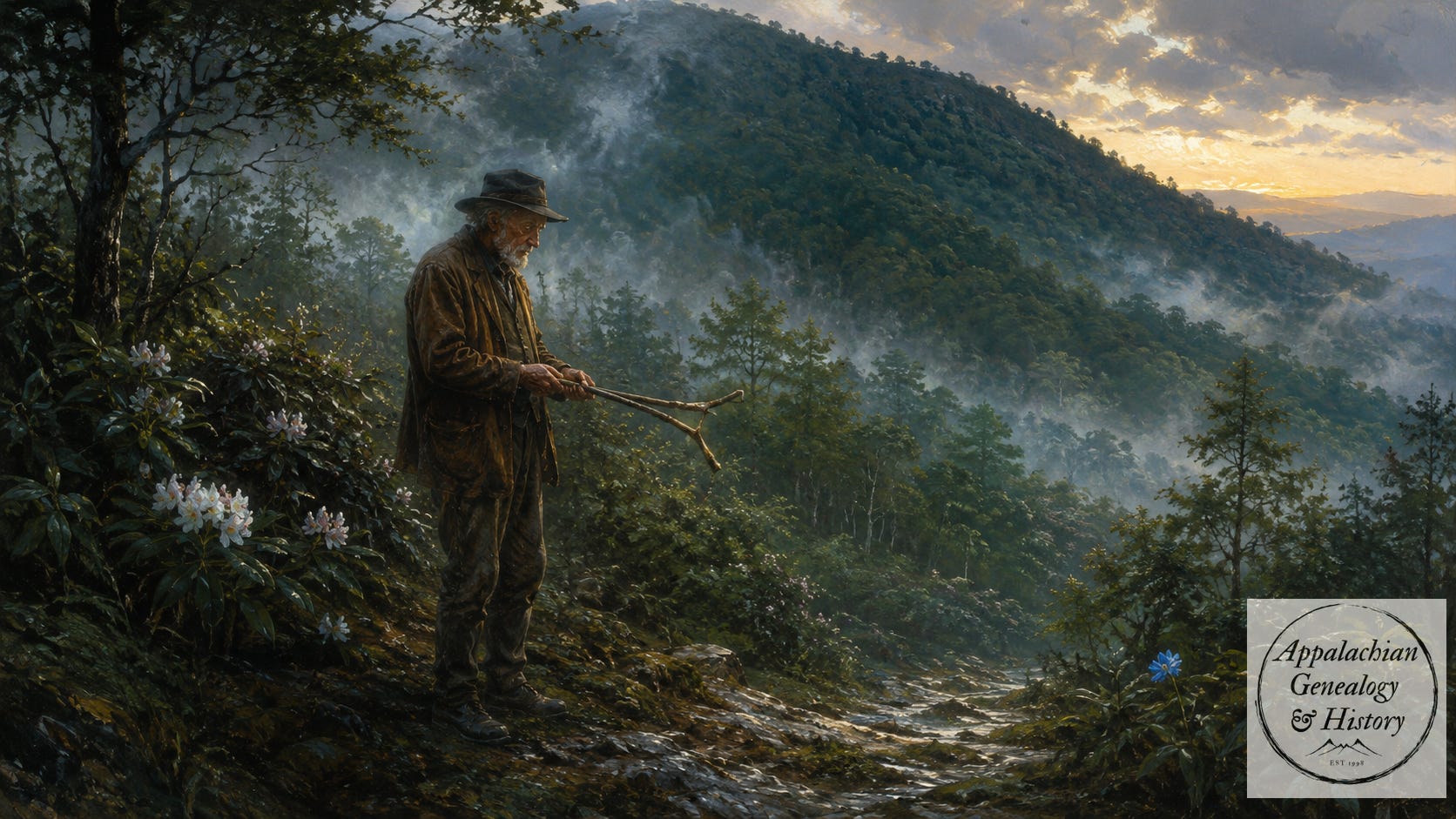
Peach branches were probably the most common choice across the central Appalachians, though a witcher used whatever his family had always preferred: willow, dogwood, witch hazel (Roark 2023). Witch hazel carries the practice in its own name, since the “wiche” comes from an old English word meaning bendable or pliable, and settlers who found the native plant resembling the Old World hazel shrubs they had used for dowsing rods back home simply continued the work through whatever grew on the mountain. Vance Randolph, who spent years in the Ozark backcountry collecting what the old settlers still knew, found water witches and witch wigglers in practically every community he visited, and he was careful about what the name meant and what it did not: the witcher had no dealings with the devil, the community did not consider him dangerous, and the sinister sound of the word attached to the practice of walking with a forked stick, not to the person who walked it (Randolph 1947).
The gift mostly ran through men, though women were not unknown in the role; family lines that carried water witching often carried other folk practices alongside it, the healing arts and the divining gift passing through the same households without anyone treating them as separate things (New World Witchery 2010). Some communities traced the gift through the seventh son of a seventh son; others held that boys born on Christmas Day were likely to carry it. The explanation most people actually gave was the simplest one: a father had put the stick in a son’s hands, told him to walk, and the stick had moved, so the community found out soon enough (Milnes 2007).
📚 Read More About Appalachian Folk Traditions
Signs, Cures, and Witchery: German Appalachian Folklore by Gerald C. Milnes is the foundation for understanding how Old World German folk practices, including water witching, arrived in Appalachia and became mountain custom. Click here to purchase. *As Amazon assoicates we earn a commison on purchases through the links we provide.
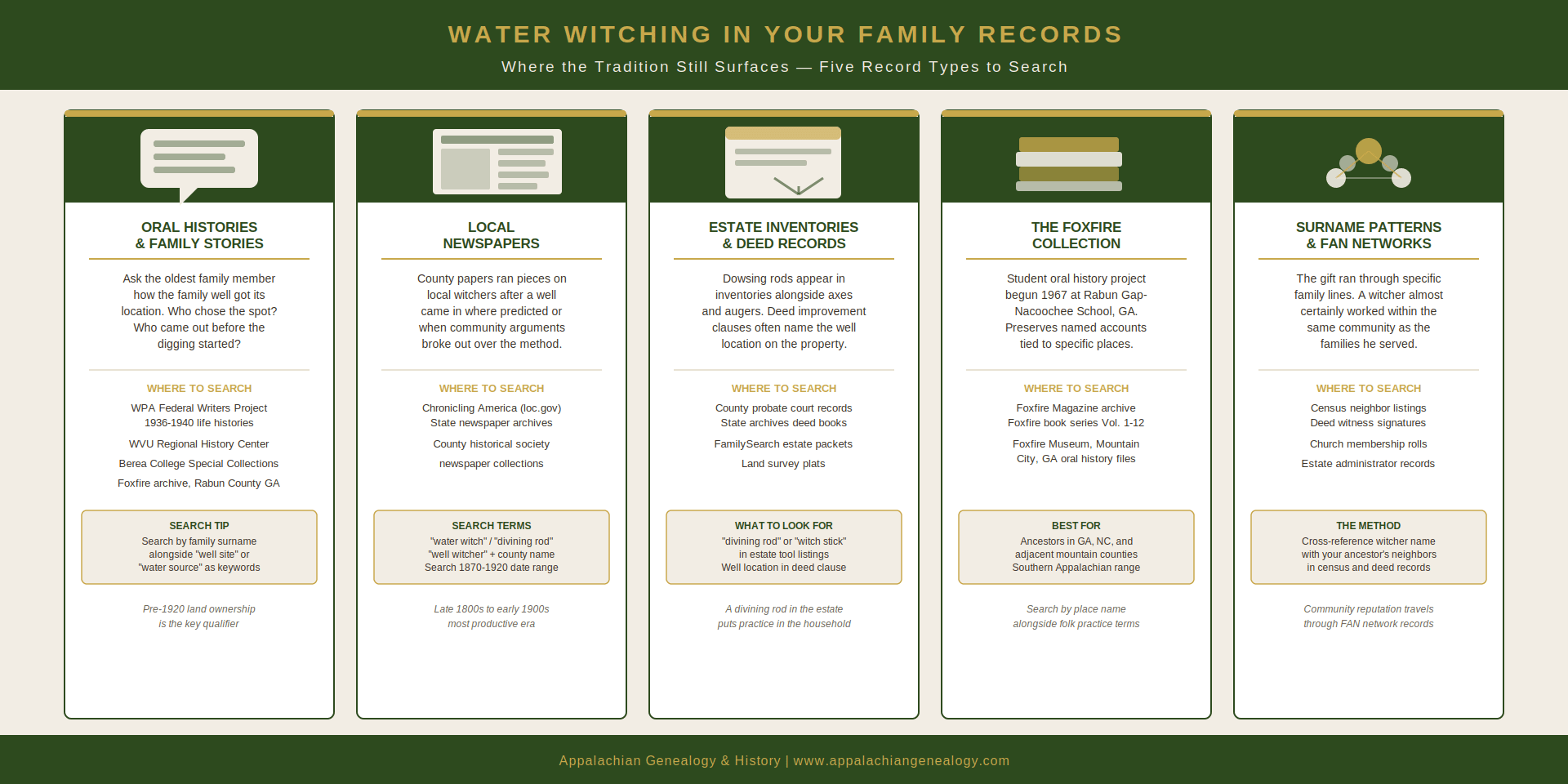
If your people owned mountain land before the 1920s, a water witcher probably had something to do with where the family well went in, and the records that preserve that history are more findable than most researchers expect.
🗣️ Oral histories and family stories. Start with the oldest person in your family who might remember being told about the well: ask how it got there, ask who chose the spot, ask whether anyone in the neighborhood was known for finding water. The WPA Federal Writers’ Project sent interviewers into Appalachian communities between 1936 and 1940, and the life histories they collected, now held in the Library of Congress and in state archives across the region, occasionally name specific witchers or describe the practice as part of ordinary community life (Library of Congress 2024). The West Virginia University Regional History Center and the Berea College Special Collections both hold oral history materials worth searching for family names alongside references to well sites.
📰 Local newspapers. County papers through the late 1800s and early 1900s ran pieces on local witchers, usually when a well came in exactly where someone predicted it would or when a community argument broke out over whether the method could work. Searching Chronicling America with terms like “water witch,” “divining rod,” or “well witcher” alongside your ancestor’s county name turns up mentions that appear nowhere else in the record.
📜 Estate inventories and deed records. Dowsing rods appear in estate inventories often enough to be worth watching for, listed alongside the axes and augers. A divining rod in your ancestor’s estate puts the practice inside the household. Deed descriptions sometimes call out the location of an existing well as part of the property improvements, and when you match that against the land survey, you can place exactly where on the ground the family concentrated their water.
📖 The Foxfire collection. Beginning in 1967, students at Rabun Gap-Nacoochee School in Rabun County, Georgia recorded oral histories from people across the southern Appalachians. The Foxfire magazine and book series preserves interviews on dozens of traditional practices, water witching among them. Researchers with ancestors in Georgia, North Carolina, and the adjacent mountain counties should look through these volumes for accounts tied to specific places and family names.
🧬 Surname patterns and community reputation. In many hollows the gift ran through particular family lines and the community knew which ones. If your oral history preserves the name of a local witcher, cross-referencing it with census neighbors and deed witnesses can place that person inside the same FAN network your ancestors lived in. A witcher who worked for the community almost certainly witched ground for the same people he farmed beside, married into, and buried next to.

The Witch Stick and the Well: A Research Companion for Tracing Water Witching in Appalachian Records
The man who witched your ancestor’s well almost certainly never signed his name to a courthouse record. But the well is still in the ground, and the records that describe it -- the improvement clause in the deed transfer, the divining rod listed between the broadaxe and the adze in the estate inventory, the newspaper column after a disputed well came in -- have been sitting in courthouse basements and archive stacks long enough to be worth going back for. This companion moves through those record types with search strategies built for each one, a volume-by-volume guide to the Foxfire accounts most likely to hold named practitioners by county, and a repository guide to the oral history collections that have indexed this kind of folk knowledge by surname and place.
17 page PDF research guide includes:
Record types overview table covering deed improvement clauses, estate inventories, county newspapers, WPA life histories, Foxfire interviews, university and state oral history collections, and survey plats, with where each is held, what the entry contains, and its genealogical value
Search strategy table with specific access points, search terms, and field strategies for each record type
Foxfire volume guide identifying which volumes carry water witching content with named informants by county
Oral history repository guide covering seven collections across the Appalachian range
Parallel research logging worksheets for deed records, estate inventories, newspaper accounts, and WPA and oral history collections, each with an ancestor ID block, analysis prompts, and a twelve-row entry log
Family interview question set with opening and follow-up questions, each with a researcher note on what to listen for
Notes pages
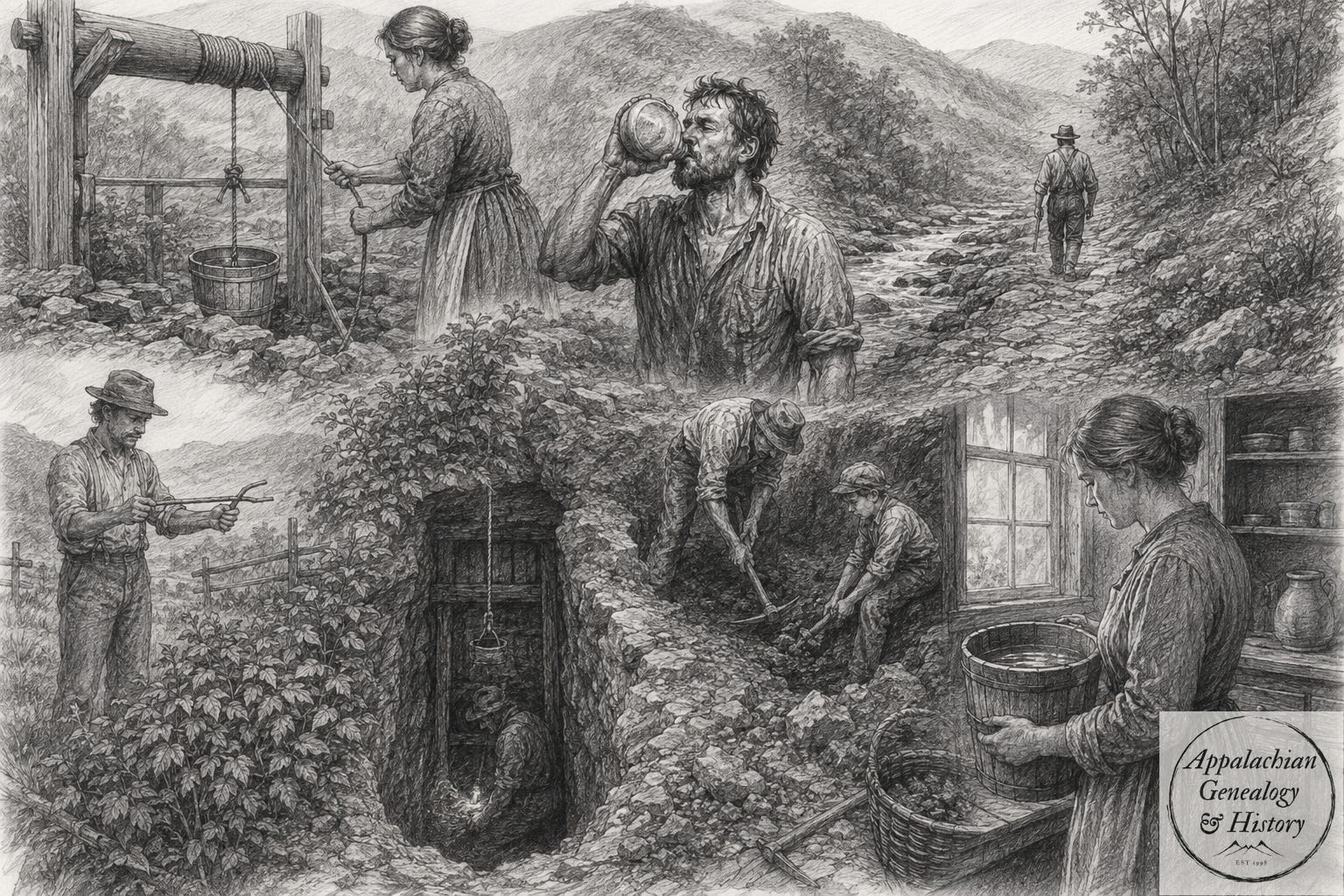
The following is a short work of historical fiction (Copyright 2026 by Misty Hamilton Smith) drawn from documented accounts of Appalachian water witching traditions; the details are real, but Elias Moser and the Henderson family are not.
Ruth fed the rope hand-over-hand while her husband worked at the bottom of the third hole, fifty feet down into red clay that smelled like copper and told them nothing. The bucket came up heavy. She set it aside without looking in it.
When William climbed the notched log to the surface his shirt was soaked through to the skin and his hands were shaking in a way that had nothing to do with the cold. Ruth handed him the water jug. Neither of them said anything. Down the ridge the creek ran loud over the flat rocks where she had been carrying water from since March, and she stood listening to it while William drank, half a mile of mountain between her kitchen and the only water they had found all spring.
Their neighbor Pratt mentioned Elias Moser the next morning over the fence line. Elias lived three hollows east. His grandfather had witched the well that still served that same property sixty years on, and his father before him had put a peach branch in Elias’s hands when he was twelve years old, told him to walk, and the branch had moved. Pratt said it the way he would say the man could mend a harness or read the weather: just something Elias could do.
Ruth sent the youngest up the creek before breakfast.
Elias came down the mountain an hour later with a fresh-cut branch, the knots already off it, his pocketknife put away. He did not ask about the three holes. He walked from the garden fence toward the upper pasture with the branch held at tension in both hands and the long end tilted toward the sky, moving slow while the Henderson children watched from the porch with their chins on the railing. The branch stayed level across the garden plot, level through the kitchen garden, level past the stone wall where William had stacked the waste rock from the second hole. Near the north corner post, where elderberry grew thick along the fence and the ground had never once seemed worth a second look, the branch turned hard toward the earth and Elias’s arms shook with the force of it. He got his boot heel into the soil above the spot. Stood there a moment with his hand over the mark, feeling what was underneath.
William asked him how deep they would need to go.
Elias said he couldn’t tell them that. He could tell them the water was there.
Father and son were in the hole before dawn the next morning, trading the pick back and forth in the dark. At sixty feet the ground changed under the iron and water rose to meet them, cold and clear. Ruth came down the path with the bucket herself, drew the first pull, and carried it back up to the house. She set it on the kitchen shelf and stood looking at it for a moment in the morning light, the water so clear she could see the grain of the wood beneath it.
Outside, William was already measuring timber for the well box. The elderberry along the fence line stood full-leafed in the early sun, exactly as it had stood every morning for eleven years, the whole time the water ran below it without anyone thinking to ask.
Elias took a smoked ham for the work. Ruth pressed it into his arms at the gate and watched him go back up the mountain, the same unhurried pace he had come down with, his pocketknife in his pocket, already gone before she thought to thank him properly.
Vance Randolph noted in the 1940s that nearly every old well he encountered in the Ozark backcountry had been located by a water witch, which means that for the families whose descendants are now searching deed books and census records, the well sitting at the center of every homestead description was almost certainly chosen by someone whose name never made it into the county record (Randolph 1947). Every one of those documents describes a decision that somebody made before the first shovel went in: the improvement clause naming the well, the survey plat marking the water source, the tax record valuing the productive land. The person who made that decision left no signature.
What Gerald Milnes found in Randolph County, West Virginia, was a tradition that had been operating this way for generations, passing through family lines without ceremony or documentation, the community keeping track of who carried the gift while the courthouse kept track of everything else (Milnes 2007). Burt’s name does not appear in any deed, but the wells he sited do. They are in the improvement clauses of every property he ever walked, in the corner of every survey plat that shows where the family built their life around the water he found, and in the ground itself, which has not moved.
Most families carry some version of this knowledge if they know where to look for it. An estate inventory with a divining rod listed between the broadaxe and the crosscut saw, a family story about who came out before the digging started, a neighbor’s name that surfaces in oral history when someone thinks to ask how the well got its location: none of these require a deed to exist. They require a different kind of searching, and the records that reward that search have been sitting in courthouse basements and library archives and family Bibles long enough to be worth going back for.
💬 Did anyone in your family witch water? Do you know the story of how your people found their well? Tell me in the comments.
If this post gave you something to think about or a new trail to follow, consider restacking it. Every restack puts Appalachian Genealogy in front of someone who might be looking for exactly this. It takes one click and it means more than you know.
❤️ And if you found value here, a like helps too.
🌲🌲🌲🌲
📚 Resource Box:
Appalachian History: Divining for Water
Draws directly from Gerald Milnes’s fieldwork in West Virginia, including the documented blindfold tests of a Randolph County water witch.Witching Water: In Search of the Unseen
Kimberly Coburn’s 2024 long-form feature documenting the water witching tradition across the southern Appalachian range, with field observation and interviews with active practitioners.American Society of Dowsers: Find a Chapter
The national organization for dowsing practice; maintains regional chapters across the Appalachian range and archives documentation on the tradition by state and county.American Life Histories: Federal Writers’ Project, 1936–1940 | Library of Congress
Approximately 2,900 life history documents from WPA interviewers across 24 states; searchable by keyword for references to water witching, well sites, and folk practices in specific Appalachian counties.Signs, Cures, and Witchery: German Appalachian Folklore | University of Tennessee Press
Gerald C. Milnes’s foundational fieldwork documenting German folk practices in the West Virginia highlands, including water witching oral histories, field tests, and the family transmission of the gift across generations.
🌲🌲🌲🌲
Coburn, Kimberly. 2025. “Witching Water: In Search of the Unseen.” The Bitter Southerner. January 8, 2025.
Library of Congress. 2024. “American Life Histories: Manuscripts from the Federal Writers’ Project, 1936 to 1940.” loc.gov.
Milnes, Gerald C. 2007. Signs, Cures, and Witchery: German Appalachian Folklore. Knoxville: University of Tennessee Press.
New World Witchery. 2010. “Blog Post 59: Appalachian Mountain Magic, Part II.” May 13, 2010. newworldwitchery.com.
Randolph, Vance. 1947. Ozark Superstitions. New York: Columbia University Press.
Richards, Jake. 2019. Backwoods Witchcraft: Conjure & Folk Magic from Appalachia. Newburyport: Red Wheel/Weiser.
Roark, Steve. 2023. “Water Witching Is a Mountain Tradition.” Historic Union County. September 25, 2023. historicunioncounty.com.
Thank you so much for supporting our publication.
The mountains remember because people like you refuse to let them forget.
🎙️ The Podcast — free for everyone
📺 The Videos — free for everyone
📚 The Resource Library — downloadable research companions included with every paid subscription


Comments
Nothing yet. Say the first thing.
Sign in to join the conversation.