
📚 The Class Book Trail: A Research Guide to Appalachian Methodist Membership Records is waiting in the Resource Library.
🔍 Free Members: Learn more about the benefits of Free vs. Paid. Click here.
🌲This newsletter runs on courthouse records and coffee. If this research saves you a trip to the archive, Buy Us a Coffee.💚 ☕

Edward Keenan kept his mouth shut and his hands on the reins. Ahead of him on the road from Potts Creek, William Phoebus was still talking, the same low, steady talk he had carried through the whole meeting, and around him three or four other men rode along nodding in the dark. At home, Keenan's wife and her mother would be at the wheel and the cards, working wool by firelight the way they always did when the preachers came to pray. Both women were Catholic, and neither one had ever knelt for a Methodist prayer in her life. Keenan had ridden along to these meetings for months now, close enough to hear everything and careful to be counted as nothing more than company. Then somewhere on the dark road behind him, the talk lifted into song, and before Keenan reached his own gate, he was singing too (Morton 1916).
The system that could turn a single ride home into a lifetime of standing meetings did not begin on any Appalachian road. It began on February 15, 1742, in a room in Bristol, England, where a Methodist society had gathered to solve a debt on their meetinghouse, not a spiritual crisis. A sea captain named Foy proposed that every member give a penny a week until the debt was cleared, and when someone pointed out that the poorest members could never manage it, Foy answered by taking on eleven of the poorest himself, promising to call on each one weekly and cover whatever they came up short. Other leaders in the room made the same promise to eleven of their own, and within weeks those weekly visits had turned into something Foy never intended. The leaders came back reporting who was struggling, who had stopped attending, who needed prayer more than pennies, and Wesley recognized what he had stumbled into: a system built to collect money was actually built to track souls (Watson 1985).
Every class soon had a leader keeping a running account, no longer of pennies but of people. New converts were admitted on trial for roughly six months before they could be received into full connection, and every quarter the class leader renewed each member’s standing with a paper ticket. Miss three meetings running, and a name could be quietly struck from the book (Watson 1985).
The same system of leaders and ledgers crossed the Atlantic within a generation and then climbed into the mountains behind circuit riders willing to ride the same loop of settlements twice a year. Francis Asbury alone crossed the Alleghenies more than sixty times over his ministry, planting classes in cabins and schoolhouses from the Blue Ridge to the Cumberlands long before those settlements could support a resident preacher or a church building of their own (Frey 2024). The class book was what held a congregation together in the months between a circuit rider’s visits, recording a membership the settlement itself was too new and too scattered to prove any other way.
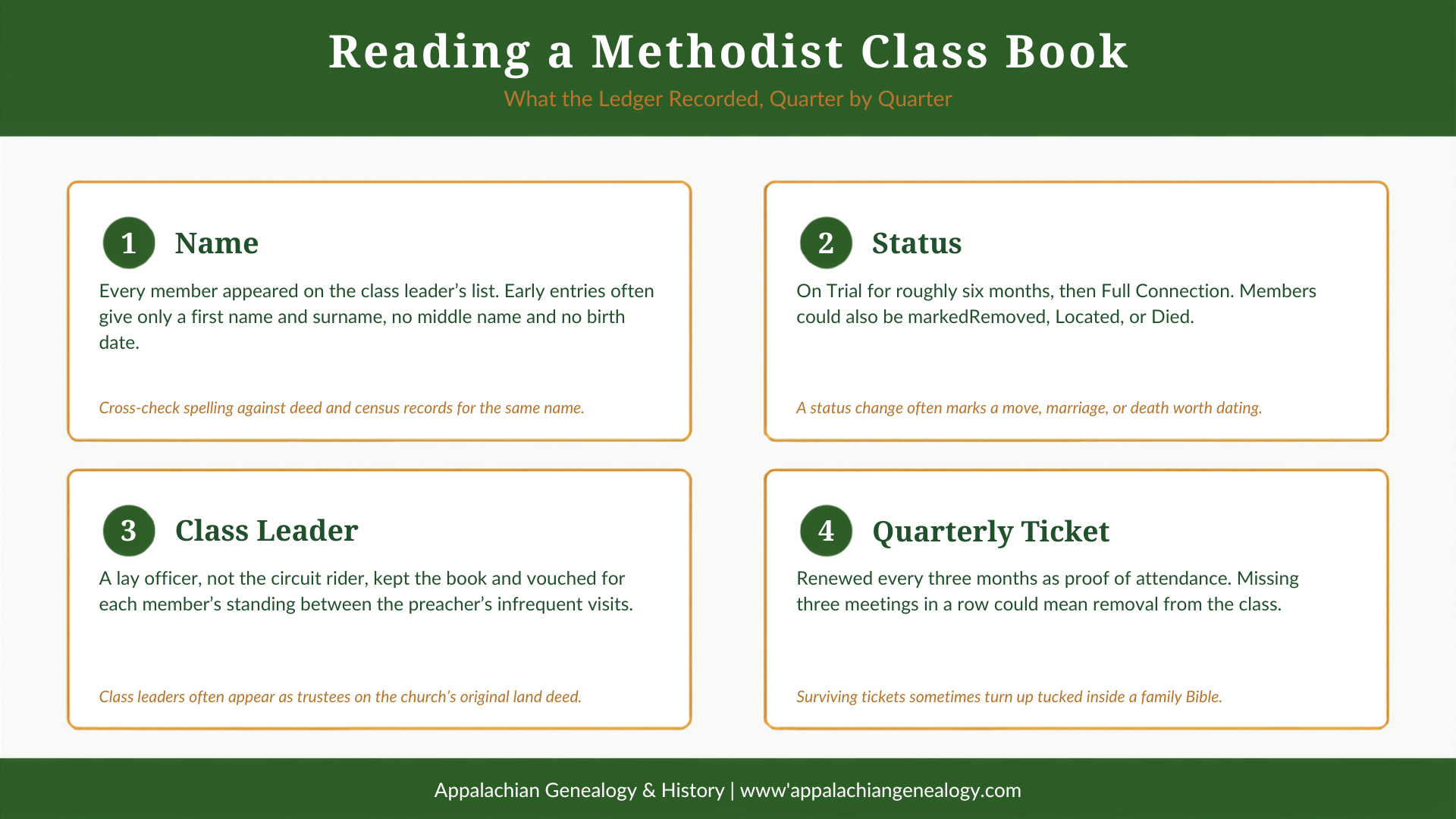
Class books fill exactly that gap, the space between a settlement too new to prove itself and a member too ordinary to reach the deed books. Four record types can put a researcher inside it.
📜 Land bonds and deeds naming trustees. When a congregation built its first church, the bond or deed transferring the land almost always named trustees, and trustees were frequently the same men serving as class leaders and stewards elsewhere in the record. Search county deed books for language binding a grantor to trustees appointed by the preachers of the Methodist church, then check every name against surviving quarterly conference minutes and class tickets for that circuit.
🏛️ Annual conference archives. Surviving class books, where they exist, are usually held at the regional annual conference archive rather than the national church. The West Virginia Annual Conference Archives at West Virginia Wesleyan College and the General Commission on Archives and History at Drew University are two starting points for tracing where a specific circuit’s records ended up (General Commission on Archives and History 2023).
🎫 Class tickets in family papers. The quarterly paper ticket a member carried as proof of standing sometimes survived in family Bibles or estate papers long after the class book itself was lost. A ticket with a name and a date is a small, portable piece of the record the book once held.
🗺️ Circuit and quarterly conference minutes. Circuits covered wide territory, and quarterly conference minutes often named class leaders, local preachers, and stewards by name even when the underlying class book did not survive. These minutes can place an ancestor inside a specific congregation even without the ledger itself.

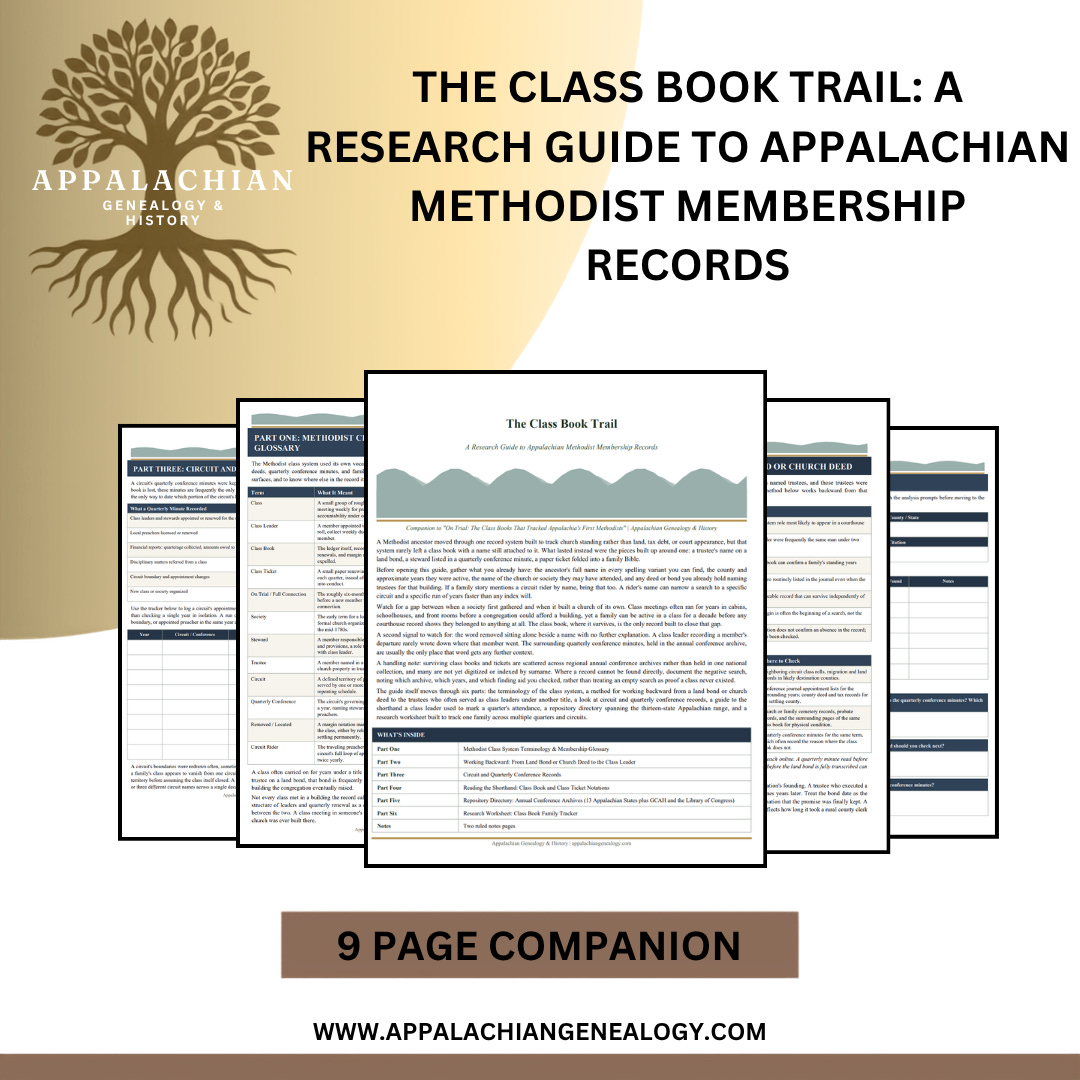
The Class Book Trail: A Research Guide to Appalachian Methodist Membership Records
A class book rarely survives with a name still attached to it, but the trail around one usually does. A trustee’s name lands in a courthouse deed instead of a churchhouse ledger, and a quarterly conference minute lists a steward where the book itself lists nothing at all. A folded paper ticket can outlive the book that issued it by a hundred years, tucked inside a family Bible nobody thought to open until now. This companion moves through the vocabulary of the class system itself, a method for working backward from a land bond or church deed to the trustees who were often class leaders under another title, a look at what a circuit’s quarterly conference minutes recorded when the class book itself did not survive, and a shorthand key for reading the marks a leader left behind.
9 page PDF research guide includes:
Methodist class system glossary covering twelve terms, from class ticket to circuit rider, with where each appears elsewhere in the record and its genealogical value
Seven-step method for working backward from a land bond or church deed to the trustees who often served as class leaders, plus a signal table interpreting four causes behind a bare removed notation
Circuit and quarterly conference records reference table, plus a circuit appointment tracker for logging preachers and class leaders across consecutive years
Shorthand reference table for reading eight common class book and class ticket notations, with cautions on circuit-specific keys
Repository directory covering the national connectional archive (GCAH), the Library of Congress, and the annual conference archive for each of the thirteen Appalachian states
Research worksheet with an ancestor identification block, a class book family tracker, and three analysis prompts
Two ruled notes pages
Keenan’s ride home from Potts Creek marked more than one conversion. He had been sitting in on the Sinks society since the families there first gathered in front rooms the summer before, back when John Wiseman and James Christy were doing what preaching got done and nobody yet owned so much as a schoolhouse to meet in. Keenan finally asked to join, and it did not take long before the same man who had ridden home singing that night was the one calling the roll. Within a few years he had become a steward and then a class leader, the man responsible for the book that tracked who belonged to the society and who had drifted from it. He stayed Methodist for the rest of his life (Morton 1916).
The congregation still needed a building of its own. On February 9, 1787, Keenan executed a bond binding himself to five neighbors named as trustees, William Scarborough, James Scarborough, Daniel McMullen, James Christy, and Alexander House, promising to make good title to the land once the deed was recorded (Morton 1916). The building itself had gone up the year before, in June 1786, when Samuel Clark, a veteran of the Revolution, helped set the wall logs into place. It stood barely twenty-one by twenty-nine feet, so small that Bishop Asbury reportedly preached the dedication sermon from the doorway because the crowd could not fit inside (e-WV 2024). Francis Asbury later held three sessions of the Greenbrier Conference inside those same walls, and on July 5 and 6, 1788, he ordained John Smith there as a deacon, the first Methodist ordination performed west of the Alleghenies (General Commission on Archives and History 2023).
The land Keenan farmed had belonged to the Shawnee, who hunted it for generations before Virginia’s land companies began surveying it out from under them in the 1750s, and Shawnee fighters held onto it hard enough to burn out the Greenbrier settlements more than once before the fighting finally moved west into the Ohio country. Even after the worst of it had passed, families in the Sinks still kept half an ear turned toward the tree line. On at least one occasion the Keenan family ran for the shelter of Byrnside’s Fort in the dark, their infant daughter Margaret wrapped in a white sheet so her mother could keep sight of her on the path (Morton 1916). Keenan lived to see the congregation he had helped build outlast that fear by decades. He died in 1826 and is buried in the churchyard on the land he once bonded himself to provide, not far from the building where he spent years as the man who kept the list.
This post is free for everyone. If we just helped untangle something in your own research, buying us a coffee is the easiest way to say thanks and keep the lights on.
˗ˏˋ☕ˎˊ˗
A class book that survives with a name still attached to it is the exception, not the rule. What usually survives instead is everything built up around one: a bond that puts a name on a courthouse record, a county historian who thought that bond worth transcribing generations later, a church still standing on land once provided for it.
Even a surviving book rarely explains its own gaps. A name struck from the roll might read nothing more than “removed” beside six quarters of faithful attendance, and then nothing else (Watson 1985). The West Virginia Annual Conference Archives and the General Commission on Archives and History both hold quarterly minutes that can sometimes fill in what that single word leaves out, naming the circuit a family moved to or the class a new leader inherited. A word like that in a surviving ledger is rarely the end of a search. It is usually the beginning of one.
💬 Did your family keep a Methodist class ticket, or does a church deed in your research name a trustee you have not yet traced further? Tell me in the comments.
If this post gave you something to think about or a new trail to follow, consider restacking it. Every restack puts Appalachian Genealogy in front of someone who might be looking for exactly this. It takes one click and it means more than you know.
❤️ And if you found value here, a like helps too.
🌲🌲🌲🌲
📚 Resource Box:
Genealogy and Family Research | General Commission on Archives & History
GCAH’s guide to clergy research, church membership records, and the annual conference archive directory researchers need for locating surviving class books.Genealogy Search | UMC.org
The United Methodist Church’s starting guide for family history research, including where baptism and membership records are typically held.WV United Methodist Archives | Annie Merner Pfeiffer Library, West Virginia Wesleyan College
Collection overview and contact information for the West Virginia Annual Conference Archives, the regional depository for surviving Methodist church records in the state.
🌲🌲🌲🌲
Sources
Frey, Robert L. 2024. “Methodists.” e-WV: The West Virginia Encyclopedia. February 8, 2024.
e-WV: The West Virginia Encyclopedia. 2024. “Rehoboth Church.” February 9, 2024.
General Commission on Archives and History. 2023. “Rehoboth Church and Museum.” gcah.org.
Morton, Oren F. 1916. A History of Monroe County, West Virginia. Staunton, VA: McClure.
Watson, David Lowes. 1985. The Early Methodist Class Meeting: Its Origins and Significance. Nashville: Discipleship Resources.
Thank you so much for supporting our publication.
The mountains remember because people like you refuse to let them forget.
🎙️ The Podcast - free for everyone
📺 The Videos - free for everyone
📚 The Resource Library - downloadable research companions included with every paid subscription


Comments
Nothing yet. Say the first thing.
Sign in to join the conversation.