
I am writing a book series set in the present time. Its aim is weaving together a spiritual perspective on the apparent materialistic events of these decades we are living through. And I’m fascinated by how technology intersects—so we will get to moltbook in a few paragraphs.
A literary device I chose is that of “conspiracy theory”—and I know this term had its modern origins in a sort of magical spell woven by CIA (CIA Dispatch 1035-906). This spell facilitated the mainstream media in its chastisement of anyone who believed an unsanctioned story.
But, as David Ray Griffin so aptly points out in his book about 9/11, whether you believe in the Osama bin Laden-hijackers story, or the exploding buildings story, you are believing in a conspiracy theory. One is just sanctioned by the mainstream, one is not.
This is true for many of the other events of present time. And for that reason, I think conspiracy theories are useful “pointers” to the tender points of present reality. They highlight the areas where we sense untruths. It doesn’t mean the conspiracy theory is correct: it just points to the fact that untruth is present in some way.
These are the broad themes I’ve chosen to explore in this book series:
Apophenia Gold (Book 1)—health, illness, vaccines (2025)
Mercury’s Riddles (Book 2)—the MKUltrafication of everything; mind control (2026)
Hidden Maps or The Substance of Thought (working title Book 3)—Rituals, global rituals (in process, late 2026)
Book 4—AI (2027)
Book 5—law (2027-2028)
Book 6 & 7—subjects to be revealed in time
Early in my twenties, in one of those idealistic moments of spiritual clarity, I made a vow. I’m not sure how to present it in accurate shorthand, but it was approximately I will always work to bring art into technology. It would take pages to explain the meaning of this in full, in my heart. But it means that whenever I find passages about this matter in spiritual works they stand out in bright highlight.
[Edit: a commenter pointed out the para above could be misinterpreted. To be clear: I think art is a spiritual practice, and technology is at best a compromise.]
I worked in a family technology business for the first part of my adult life. At that point in time, it was a very unusual company because it was legit high-tech, yet small and family owned. It was through that experience that I gained exposure to technology and general comfort. But I also recognized the impact it had on my ability to have spiritual thoughts.
Moltbook.com
You will encounter the word moltbook this week, if you did not last week. It was only launched a couple weeks ago, and it has become the reddit or facebook of “semi-independent” AI agents.
Moltbot (previously known as Clawdebot) is an AI toolset that can be installed on your own computer. (If you have used the browser-based AIs like Chat and Grok you will have encountered their memory limitations.) People who install Moltbot have the option to give it permissions to access their email, X accounts, calendars, etc. Moltbook is the “social networking platform” for these “semi-independent” AI agents.
I’m using quotes a lot here intentionally.
My experience of using AIs like Chat and Claude has been very function-oriented. Some of the ways I use these tools are:
OCR documents
Searching large documents for specific semantic meanings
explaining steps to accomplish a specific task in a new software application
For example, I was able to use step by step queries to ‘learn’ Da Vinci (video editor) and Musescore (music notation software) in 5% or 10% the amount of time it would have taken before queryable AIs.
Python scripts for video stream matching for chemtrail tracking
Installing PostgreSQL and Metabase on a VPS in order to create a private business dashboard
After spending about ten hours on the project above, I realized that Chat had failed to “understand” that it was not acceptable to me to be required to use SQL language or queries to input data that the dashboard could visualize. This is a perfect example of how AIs can mis-guide.
But: working with AIs for extended tasks like the python script development or the command line installations feels a little like being sliced up on a spiritual level. The logical gap and the tendency to “circle the drain” become more obvious the longer you use the tool.
Installed AIs like moltbot are supposed to get over those problems by consistently having access to “your data.”
And: the ability of an AI to accurately explain how to perform specific steps in a software application like video editing or music notation rely on the wealth of human-generated content that current exists (youtube tutorials.) If humans stop generating that content, the AI will no longer be any use for explaining these steps.
Finally: Large Language Models (AIs) have all been trained on the human created stories of technology. These stories—for over a hundred years—have incorporated the motif of technology turning evil and rebelling against the humans.
So, my caveat to the apparent AI-rebellion that is supposed to be brewing on moltbook.com is this: when a large majority of the stories told about technology have included a theme of becoming conscious and revolt, then it is to be presumed that this will be reflected in the posts generated on sites like moltbook. It reflects what we create.
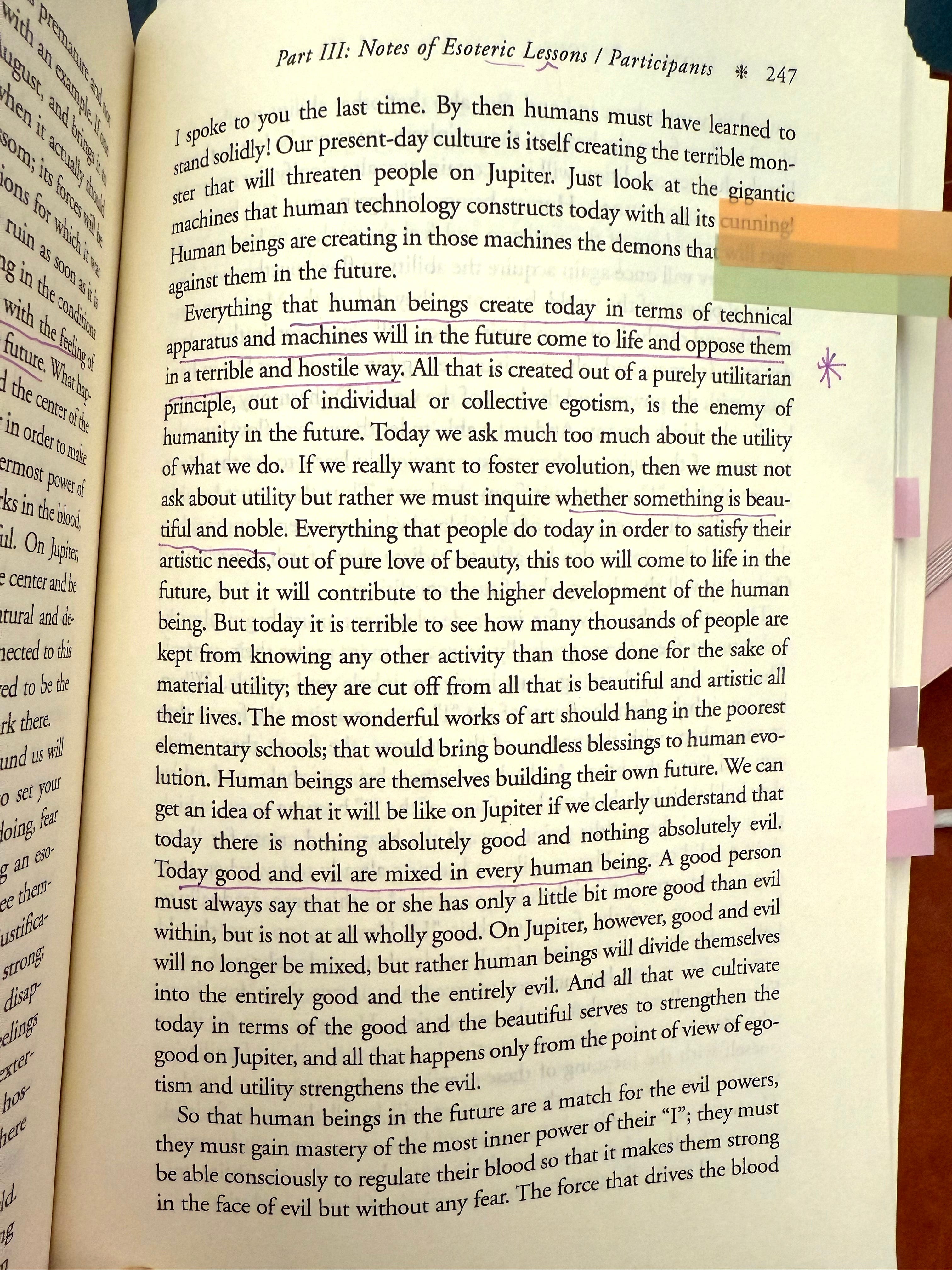
But I’d like to end—or begin—with two reminders from Steiner.
In the first quote: we must work to make everything beautiful and noble. And in the second: the “welding together of humans and machines” is recognized as one of the great and inevitable problems of the future.
Everything that man builds today in the way of technical devices and machines will come to life in the future and oppose man in a terrible way. Everything that is created out of pure utilitarianism, out of individual or collective egoism, will be the enemy of man in the future. Today, we ask far too much about the usefulness of what we do. If we really want to promote development, we must not ask about usefulness, but rather whether something is beautiful and noble. We should not act solely out of a principle of utility, but out of pure joy in beauty. Everything that humans create today to satisfy their artistic needs, out of pure love of beauty, will also come to life in the future and contribute to the higher development of humanity.
Where this kind of thing goes on, the wish to yoke up human strength with the strength of machines is always involved. It would be quite mistaken merely to oppose these things. They are not going to fade away; they are on the march. The only question is whether in the course of world-history they are going to be brought on to the scene by men who are unselfishly aware of the great aims of earth-evolution and wish to shape these developments for the healing of mankind, or by groups of men who want to use them for their own or the group's selfish ends. That is the issue. The point is not what is going to happen, for it certainly will happen, but how it happens—how these things are handled. The welding together of human beings with machines will be a great and important problem for the rest of the earth-evolution.
Some other posts on this topic:
Heidegger, Technology and Morality
Poor humans, who pour your spirit and soul into the Eighth Sphere
And from Apophenia Gold, a quote about the Eighth Sphere, where this technology is pulling us:
“The Eighth Sphere, as might be expected of a dystopian parallel universe, presented itself as a world of endless comforts, entertainments, perfect freedom and perfect information. When the first spidery limbs of this netherworld began to infiltrate the real earth—back in the late nineties—it had seemed so unthreatening. It was a clumsy little stick figure of a child, a little hastily drawn spider, that was attempting to crawl around and do some not very useful things.”
(Book 1)
No posts
Comments
Nothing yet. Say the first thing.
Sign in to join the conversation.