
We are a quarter of the way through this Substack project, so I thought it would be a good time to pause and reflect. We have explored the story of 12 countries through various core demographic indicators and themes:
Urban/Rural continuum - Papua New Guinea and Singapore;
Fertility - South Korea and Somalia
To me, these are some of the foundational concepts to get started thinking about why demography matters. So, I am doing something a little different for the next 3 pieces: I am going to use the UN World Population Prospects’s trifurcation of countries based on the timing of their population peaks to dive into 3 countries (one from each of the groupings) to consider all those indicators above, and what they mean for their futures.
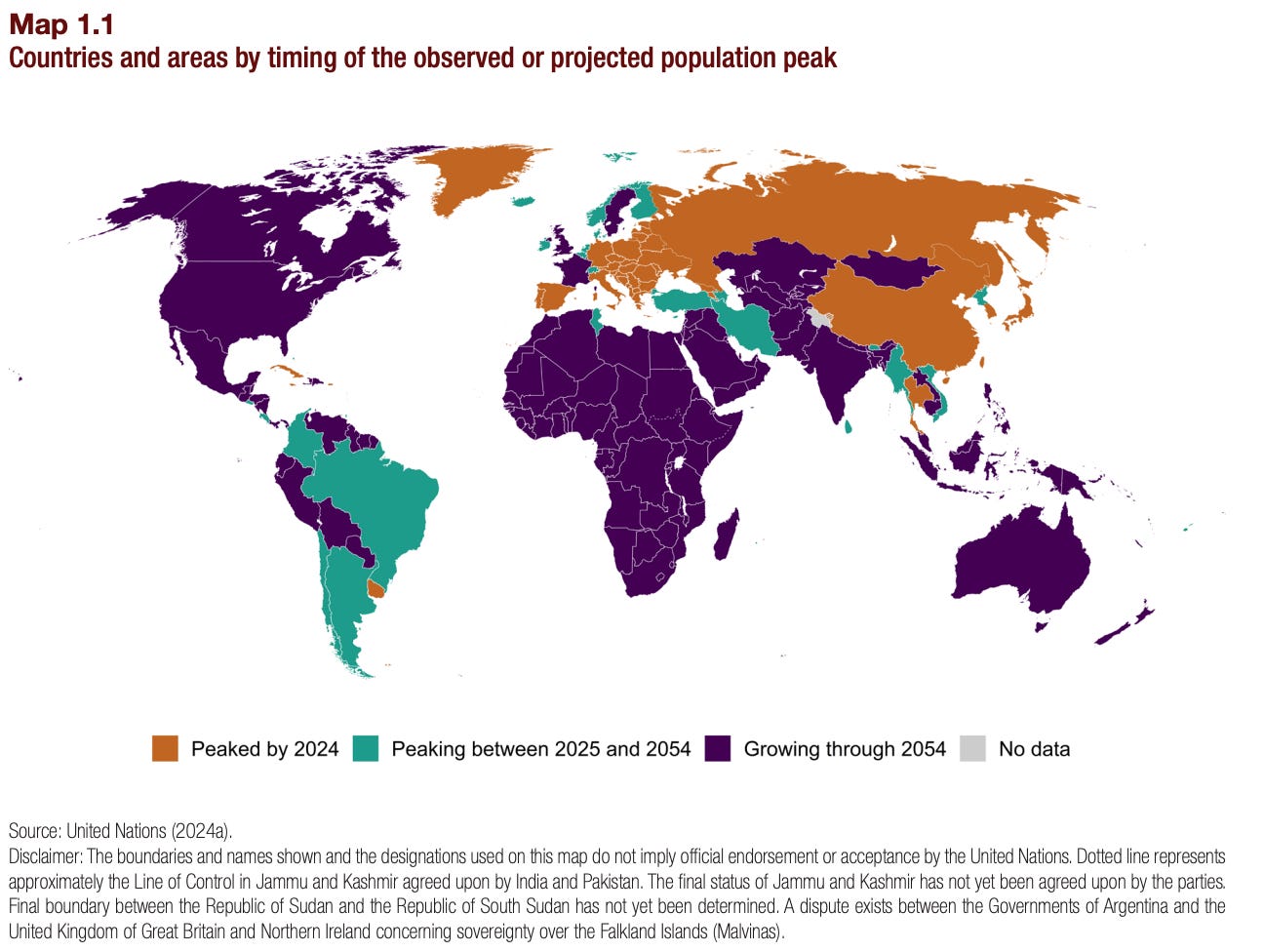
Group 1 (orange in the map) are countries that peaked in population size before or during 2024. These comprise about 28% of the global population and include China, Germany, Japan, and Russia, and are in the post-transition phase of the Demographic Transition (if you recall the figure from last week.)
Group 2 (green) represents 10% of the global population and countries here are expected to peak in population between now and mid-century (2054). This includes Brazil, Iran, Turkey, and Vietnam among others.
Finally, Group 3 (purple) are countries whose population is likely to grow through 2054, potentially reaching a peak later in the century or even beyond 2100.
It might surprise you then to think that the country that was the most populous in the world until 2023 is actually in Group 1, where the population has already peaked and is declining. If you think about population policies, you most likely think of China, specifically the One-Child Policy (OCP). There’s so many layers to the population story in the country, and most thrillingly, its future.
The OCP, launched in 1980 to curb rapid population growth and facilitate economic development, has left a profound and complex legacy that continues to shape the nation’s demographic and social landscape. While the policy is often credited with China’s plummeting fertility, research indicates that the total fertility rate had already dropped from 5.8 in 1970 to 2.7 by 1979 due to the earlier “Long, Late, Few” voluntary campaign (longer birth intervals, later marriage, fewer births). The OCP further reduced fertility rates to 1.5 by 2000. Some of the consequences made sense, and others were likely not foreseen.
Although the enforcement of the one-child policy may have mildly accelerated the fertility transition in China, it also brought substantial costs, including political costs, human rights concerns, a more rapidly aging population, and an imbalanced sex ratio resulting from a preference for sons. In retrospect, one may question the need for introducing the one-child policy in China.
-Zhang (2017)
The policy created a 4-2-1 family structure, placing the immense burden of supporting four grandparents and two parents on a single child. Additionally, millions of “undocumented” children born outside the policy’s limits faced lifelong struggles to access education and healthcare. Despite these hardships, some research suggests the policy boosted other things like female entrepreneurship by nearly 40%, as women with fewer domestic demands redirected their efforts into businesses. However, the human cost remained high, often involving coercive enforcement measures like forced abortions, sterilizations, and sex-selective abortions (read, a preference for sons). It also resulted in tremendous out-migration, acting as a push factor that caused families to seek ways to have more children or escape strict penalties. Even after transitioning to a two-child policy in 2016 and a three-child policy in 2021, China continues to face a demographic crisis as birth rates remain at record lows due to high living costs and changing societal attitudes toward parenthood.
The future bears this out. The peak that places the country in Group 1 is not a temporary fluctuation, but the start of a sustained demographic contraction that is projected to reduce the population by 14% over the next 30 years.
It is anticipated that China, the country currently with the world’s second largest population, will likely experience the largest absolute population loss between 2024 and 2054 (204 million), followed by Japan and the Russian Federation (21 and 10 million, respectively). Long-range population projections are less certain. Nevertheless, due to its large size and sustained low level of fertility, China is also likely to record the largest population decline of any country through the end of the century (786 million people). By 2100, China is projected to have lost more than half of its current population and to have returned to a population size comparable to that recorded in the late 1950s.
-UN World Population Prospects (2024)
By early 2026, official statistics confirmed that births in 2025 had plunged to a historic low of 7.9 million, which is comparable to the year 1738(!!) when the total population was only 150 million compared to 1.4 billion today. The acceleration of China’s population peak, which occurred years earlier than previous UN revisions, is largely because fertility rates fell to really low levels, about 1 birth per woman. You will recall from the South Korea piece that fertility has been falling for many countries. However, in China, this decline has been steeper and more persistent due to the unique intersection of historical state intervention and modern socioeconomic pressures. Think back to the life expectancy pieces and causes of mortality in Japan v Nigeria – in China, official statistics show the death rate reaching its highest level since 1968, driven by the rapid aging of the massive cohorts born right after 1949. While life expectancy has reached 79 years (and expected to improve further to 2050), the worker to elderly ratio is projected to fall from 5:1 today to 2:1 by 2050 which is quite a decrease and poses all kinds of issues thinking about healthcare, pension systems, and family dynamics.
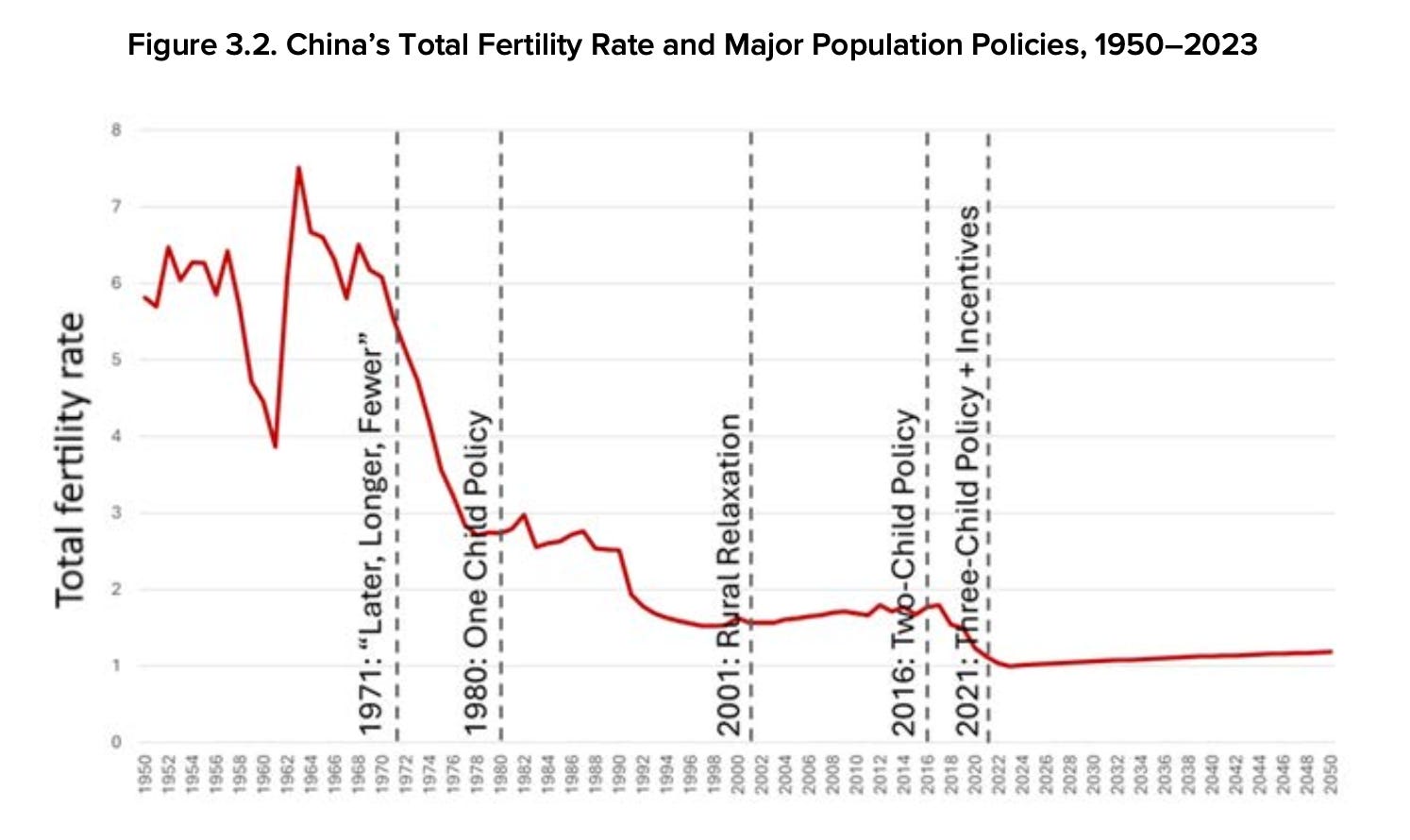
Source: RAND (2025)
The population pyramids - today and 2050 - are striking, and more urn-esque than pyramid-like. There is a missing chunk of young people who would otherwise be stewards of China’s long-term economic growth prospects.
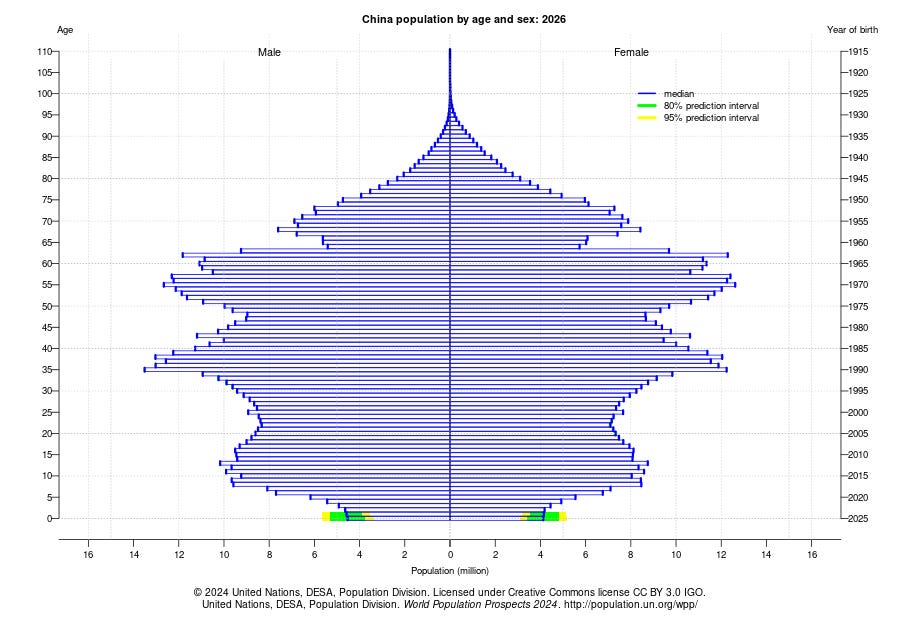
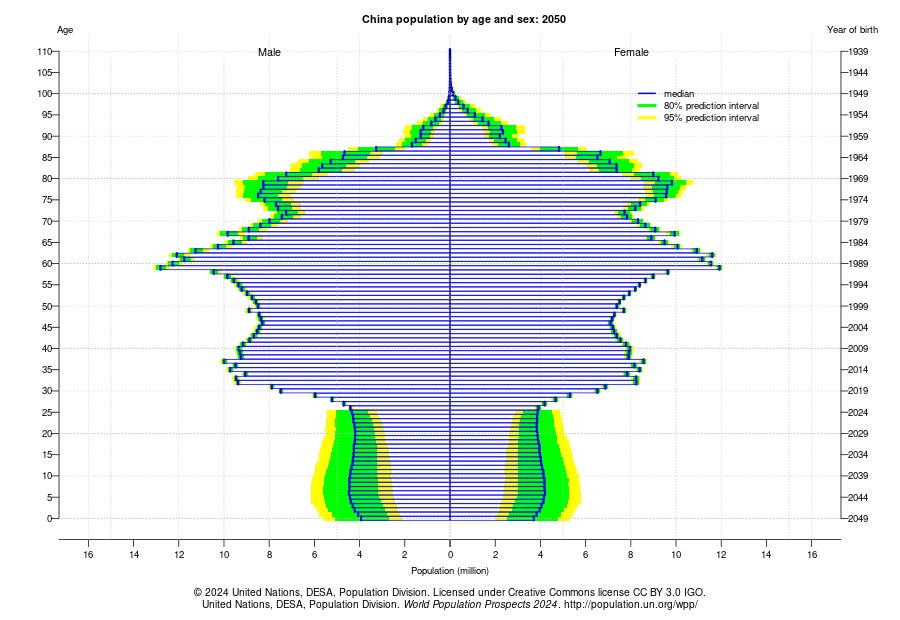
Source: UN World Population Prospects (2024)
Far from mandating a 4-child policy (not a real thing, just my hyperbole); to maintain current GDP per capita (5%) growth, China must either figure out ways to increase productivity or compel citizens to work additional hours. To the latter point, many Chinese employees are already expected to work long hours. The gruelling 996 culture (9am to 9pm, six days a week) seems to have been deemed illegal in the last few years, but some question whether it is being enforced appropriately, particularly in the tech sector.
Importantly, China’s demographic transition will ultimately also reshape regional and global dynamics. As the workforce shrinks and geopolitical tensions accumulate, China’s role famously as the “world’s factory” may change. There’s also the point about rapid investment over recent decades in Africa. Additionally, research shows that aging societies face concerns over military security because with a shrinking younger population, the pool of potential military recruits is shrinking and the military must compete for funding with other priorities (possibly in a contracting economy). States can partially address a smaller recruitment pool through technology (think about what Singapore is planning), strong alliances, and improved military efficiency. China likely has time before military security becomes a major problem. Indeed, military security implications stemming from demographic trends include minimal immediate concerns for the People’s Liberation Army’s force size but more significant potential concerns in the decades ahead. Perhaps advanced technology and robotics could partially make up for China having a smaller military force. Another important piece noted by experts is that strengthening alliances with Russia and Iran could also offset force size concerns by enhancing deterrent signaling.
China’s long-term strategy has shifted toward what the government is calling new quality productive forces to sustain its economy. Rather than relying on hyper-extended work weeks or population mandates, the state is prioritizing disruptive technological innovation, such as quantum computing and humanoid robots, to trigger a substantial increase in total factor productivity. By transitioning from a growth-maximizing model to a technology-led new national system, the government aims to automate and modernize the industrial base, effectively betting that high-tech breakthroughs will provide the economic momentum that human labor alone can no longer sustain.

Source: Brookings (2024)
Funny enough, these new measures may require more years of sophisticated training and education, which have already been known to delay marriage and further lower fertility.
So China, having failed to raise fertility, now needs lots of robots. China’s manufacturing sector has been “quite labor-intensive,” Rian Whitton of Bismarck Analysis told the Telegraph. “So in a preemptive fashion, they want to automate it as much as possible, not because they expect they’ll be able to get higher margins — that is usually the idea in the West — but to compensate for this population decline and to get a competitive advantage.” In the meantime, China’s robots pose another problem. Each robot installed means at least one job fewer for humans, and the country already has an unemployment problem. Beijing reports that the overall urban unemployment rate in August was 5.3 percent. The rate for the 16-to-24 age group that month was 18.9 percent.
Source: The Hill (2025)
Much like Japan, China is attempting to turn the challenge of an aging population from a burden to a boon. There are massive investments being planned to cultivate the Silver Economy, which targets citizens aged 60 and above (a massive chunk of the population already, and in the future.) It has been estimated that China’s silver economy is currently worth about 7 trillion yuan ($989 billion). By 2035, it could reach 30 trillion yuan and account for 10 percent of the country’s GDP. There are things being proposed to integrate advanced tech into eldercare that sound like sci-fi: prioritizing technology-empowered care (focusing on humanoid robots, health monitors, and rehabilitation aids) to assist those with declining physical functions. The government is also integrating elderly care into a 15-minute convenient life circle (bringing retail, dining, and medical services within a short walk of senior homes) and incentivizing e-commerce platforms to adopt simplified senior modes. With over half of China’s seniors now online, the digital divide is being bridged through community-led training and AI-driven accessibility tools (such as voice-activated interfaces and smart-home sensors that detect falls).
China’s average per capita income is still far below that of the developed world, at around $8,000 a year. Per capita income in the United States is $56,000. There is the question then of equity; these initiatives will likely cater to increasingly affluent and tech-savvy retirees. What about the rest?
While migration has been posed as a salve for some of the challenges elsewhere, some experts claim that it might not work in China.
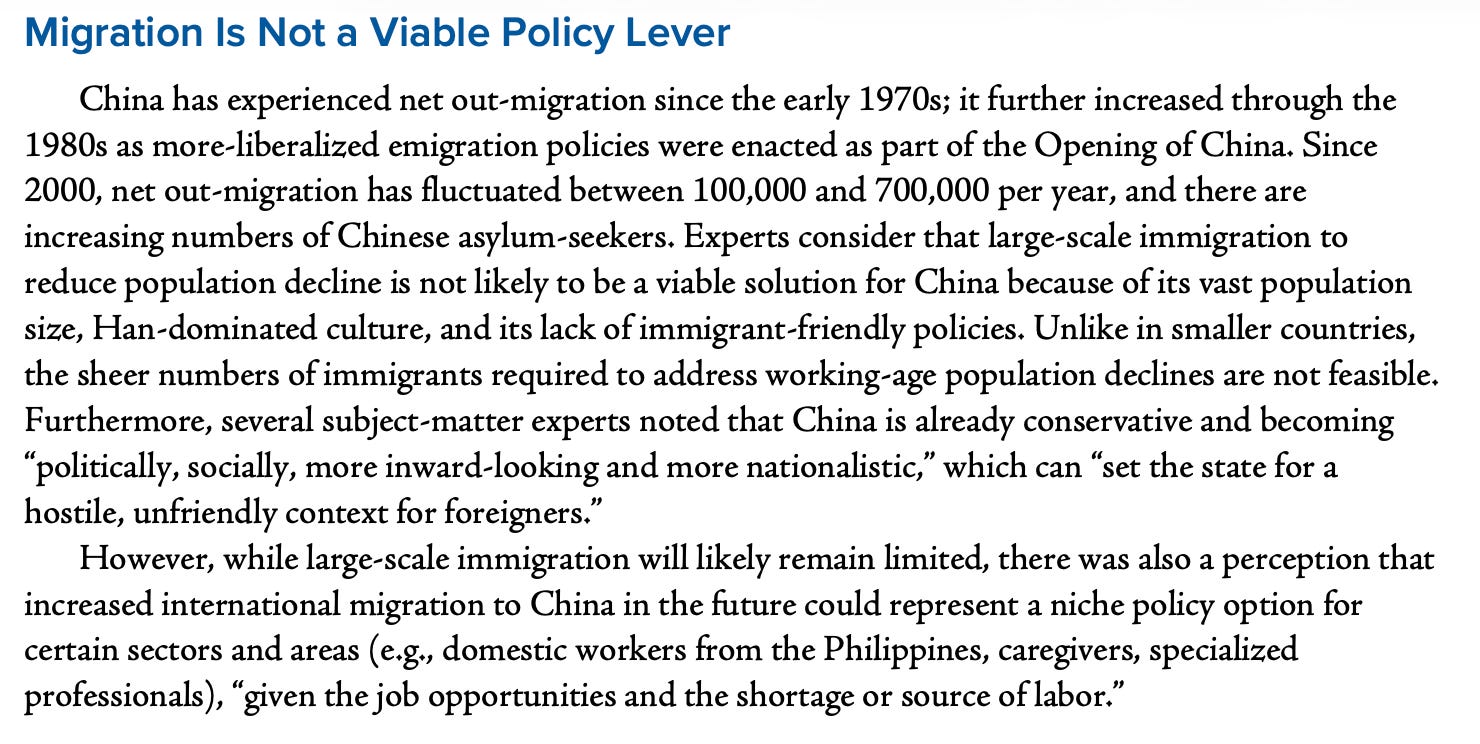
Source: RAND (2025)
But, possibly internal migration?
China’s rate of urbanization, about 65 percent, lags that of most other industrialized countries, leaving substantial room yet to grow. However, nighttime light satellite imagery suggests that urbanization in China is already largely complete or at least well above the United Nations Population Division’s 2025 estimate, and China’s census data show that rural residents are much older than those living in cities, making it harder to achieve gains (see Figure 7).
Furthermore, China’s hukou (household registration system) restricts the freedom to migrate within the country. In place since 1958, hukou ties people’s access to jobs, health care, housing, and schools to their assigned district. This assignment is inherited and locks migrants out of public services and property ownership, even if they move, which reinforces social divides. Relaxing this system, which was hinted at in Beijing’s 2025 policy shift, could unlock economic and other benefits, regardless of urbanization trends.
Source: RAND (2026)
I have had a semi-obsession with the implications of skewed sex ratios for years (and will be a topic for another Substack pairing down the road). While this happens in other settings too (India most notably), in China, research shows this:
Underreporting of female births, infanticide, and sex-selective abortion (post-pre-natal gender testing) all contribute to this imbalance in sex ratios at birth (with more boys being born and surviving than girls.) Furthermore, poor nutritional and medical care for girls in their younger years can further skew the gender balance by exacerbating excess female child mortality. At the basic source of this issue, however, remains a fundamental gender bias that dates back historically and philosophically through Confucian culture and traditional patriarchal structures.
Source: Stanford (2008)
There is much to dig into here, and for this piece, it’s important to note that this imbalance translates into various social and cultural tensions down the road. The implications for marriage/family formation is one.
In some ways, the root of the fertility collapse may lie in this marriage squeeze for men. This headline from a recent (excellent) NYT op-doc haunts me, “How to Find a Date in a Country With Over 30 Million Extra Men.” Do give it a watch if you can, it’s only about 15 mins and explores themes of loneliness, helplessness and so much more. This surplus of men is felt most acutely in remote rural areas. While the country is rapidly urbanizing, about 34% of the population does still live in rural areas. Unlike voluntary singleness in Western societies, rural Chinese men often feel a profound sense of failure, exacerbated by the universal social norm of marriage and the practice of social status hypergamy, where women prefer to “marry up” into urban or wealthier cohorts.
While much of the focus is on the male experience, I do wonder about what it means to be a woman in China faced with these surplus men and what it means for gender dynamics, marriage, labor market, and nearly everything else. I had heard the term “leftover women,” referring to educated, driven women over the age of 27 who were not married. These women are not necessarily a match for the surplus men (or “leftover men”):
At present, there are nearly 200 million single people in China, and men outnumber women by 33.66 million. Therefore, more men than women are being forced to remain single due to circumstance. A detailed geographic analysis has revealed that there are more “Leftover Men” in rural areas than “Leftover Women” in urban areas. However, when it comes to cities alone (especially big cities), there are more unmarried women than single men. The more developed a city is, the more unmarried women it has, as the urban development level is inversely proportional to the ratio between unmarried men and women. In Shanghai, for example, the number of unmarried men is only a quarter of the number of unmarried women, most of whom are between 30 and 35 years old.
The “Leftover Women” in cities are usually highly educated and high earners. This is typical of China, where women are equal to men in terms of educational rights thanks to the women’s liberation movement. Since 2006, female university registrations have surpassed male, despite the larger population base of men than that of women. Meanwhile, the employment-to-population ratio of women in China stands at 73%. That means, in economic terms, that the gap between men and women in China is among the narrowest in the world.
Source: World Economic Forum (2017)
Indeed, in urban centers, marriage rates have hit historic lows, with marriage registrations totaling only 6.1 million in 2024. Urban women are increasingly pushing back against traditional gender roles that demand they prioritize domesticity over career aspirations. Rather than being “left over,” it would appear that many highly educated urban women are choosing to remain single to protect their autonomy and financial security. Much like South Korea, the astronomical cost of child-rearing further deters family formation, turning parenthood from a social norm into a risky economic gamble.
Like in Japan, this impacts the care economy (remember the “panini generation?”) and family dynamics. The inversion of the population pyramid has forced a total rethink of intergenerational wealth flow and care practices. The 4-2-1 problem, where one child must support two parents and four grandparents is no longer a theoretical risk but a daily reality.
While Confucian values traditionally emphasized multi-generational co-residence, internal migration and urban housing constraints have made this unsustainable. Instead, a model of remote care has emerged, mediated by technology (no surprises there.)
Wearables from Huawei and Xiaomi integrate fall detection, blood pressure tracking and emergency alerts, to allow adult children to track the well-being of their elderly parents from afar. Meanwhile, AI-powered caregiving robots—once novelties—are gaining adoption in eldercare facilities.
“The traditional model is evolving from co-residence to ‘remote filial piety,’ enabled by technology,” says Lai. “Adult children use tech to provide care remotely, ordering groceries via Meituan’s ‘Deliver to Parents’ feature or monitoring parents via smart displays like Xiaodu. This fuels demand for professional services that supplement family care, including home-care beds, meal delivery and part-time nursing homes for post-surgery or respite care.”
Source: CKGSB (2025)
There’s this thing I read about that made me laugh and envious in my busiest days. Some Chinese youth are rejecting the grueling work culture in favor of a slow life. This results in something called the “lying flat” (tang ping) phenomenon and its more extreme successor, “letting it rot” (bai lan). Originally it was a silent protest against the relentless pressure of social competition and high living costs, and now this movement has evolved into a proactive recalibration, where highly educated urbanites are migrating from Tier-1 megacities like Beijing to smaller, culturally vibrant hubs like Dali or Chengdu to prioritize well-being over material gain.
This cultural disillusionment is inextricably linked to China’s deepening demographic crisis, which as we have seen, transitioned from a theoretical projection to reality in early 2026. China’s inclusion in Group 1 (countries who have already peaked in their population size) marks the end of an era defined by sheer scale. The story is no longer about curbing growth, but about managing a 14% population contraction over the next 30 years.
China watchers suggest that the analytical signal to watch is not whether births rise next year, but whether China reframes demographic policy from birth promotion to system adaptation. Are humanoid robots going to become labor surrogates? Time will tell. Ultimately, China’s future depends on a delicate social contract. Can it balance the autonomy of urban “leftover women” and the disillusionment of the lying flat youth with the needs of a shrinking workforce? If the world’s factory successfully automates its way out of a demographic crisis, its path may provide a definitive blueprint or the ultimate cautionary tale for other Group 1 countries currently staring down their own population peaks.
When I tell you that all my children want to eat on the weekends is Din Tai Fung, it is no exaggeration. SO, we recreated our favorite things there. Ekim made the sichuan beef noodle soup, I made dumplings in chilli sauce (dumplings from scratch, might I add), and cucumber salad. It was beyond 10/10 for all, and now we don’t know what to eat outside this weekend. (it’s probably still going to be something Chinese.)

Comments
Nothing yet. Say the first thing.
Sign in to join the conversation.