
A PolyPath is a new term for someone who has multiple meaningful pursuits in life.
Let me start with why I felt the need to coin a new term in the first place.
In all my adult life, I never had the right term to describe what music meant to me. I was quite fed up of calling it my “hobby”. It has always been an integral part of my identity and poetically, a life companion who has witnessed my growth as that kid singing welcome songs on the school stage, to someone performing her own compositions for huge audiences.
And while I always thought I did music seriously and approached my performances and productions as a true professional, I used to get “Oh, but isn’t computer science your “main thing”?”
Yes, math → computer science → tech has been a foundational journey in my life.
In fact, I never fantasize leaving tech, and doing music “full-time”. I don’t work in tech just to pay the bills. I was (still am) fascinated by cryptography and truly derive joy from the problems I can solve with it.
I have always felt excited and energized by both, have felt the drive to grow and excel in both and most importantly, absolutely love both! Just like a mom, I could never “pick one”.
And speaking of, motherhood actually further accelerated the need for this term.
As a new mom, I struggled with a huge identity crisis. Being a mom was important to me, but I didn’t want it to define me completely. I still felt the need to express myself musically, to challenge myself with technical problems and most importantly, to stay connected with myself.
And that’s when I realized I need to create a new vocabulary, at least for my sanity.
Career, profession, hobby, side-hustle, passion project seemed just unhelpful terms, none of them capturing the essence. None of them capture the underlying similarity of approach and unified self that you are bringing to all those things in life that are important to you. So, I landed on the following –
Everything meaningful in life is a PATH you walk on.
Path in itself is a beautiful word that captures the journey on any pursuit. You can walk at your own pace — pause when tired, sprint when you feel like; you can savor the learnings, and most importantly, there isn’t necessarily a destination to reach, you can keep taking the next step.
But PATH also stands for an acronym which decomposes into the essential ingredients of what makes something a meaningful pursuit.
Passion x Play: You are attracted to the activity, you enjoy it and it feels like play to you. There’s probably an initial spark. You watch someone tap dance, and you want to learn it. You hear someone make a spectacular argument in a court drama, and you just have to study law. For that matter, even attraction to another human counts. That’s where every PATH begins.
Aliveness: You feel alive when engaged in the activity, you lose track of time, you feel like you are in the zone! You keep playing the piano and experimenting with new chords, no one is telling you to. You keep reading about the latest research on gene editing like there is no end.
Trajectory: As you keep coming back to the activity, you want to get better. You don’t want to just dabble but really pursue growth and excellence. You want to write more impactful scripts, you want to architect better transformers or you want to improve your backhand in tennis.
Heart: Finally, you cannot imagine being away from the activity for long. It becomes a part of your identity and you stay deeply connected to it. And most importantly, you feel the need to contribute to the world through the path. Maybe you want to publish your book or make progress solving the Goldbach’s conjecture or mentor the younger generation of designers.
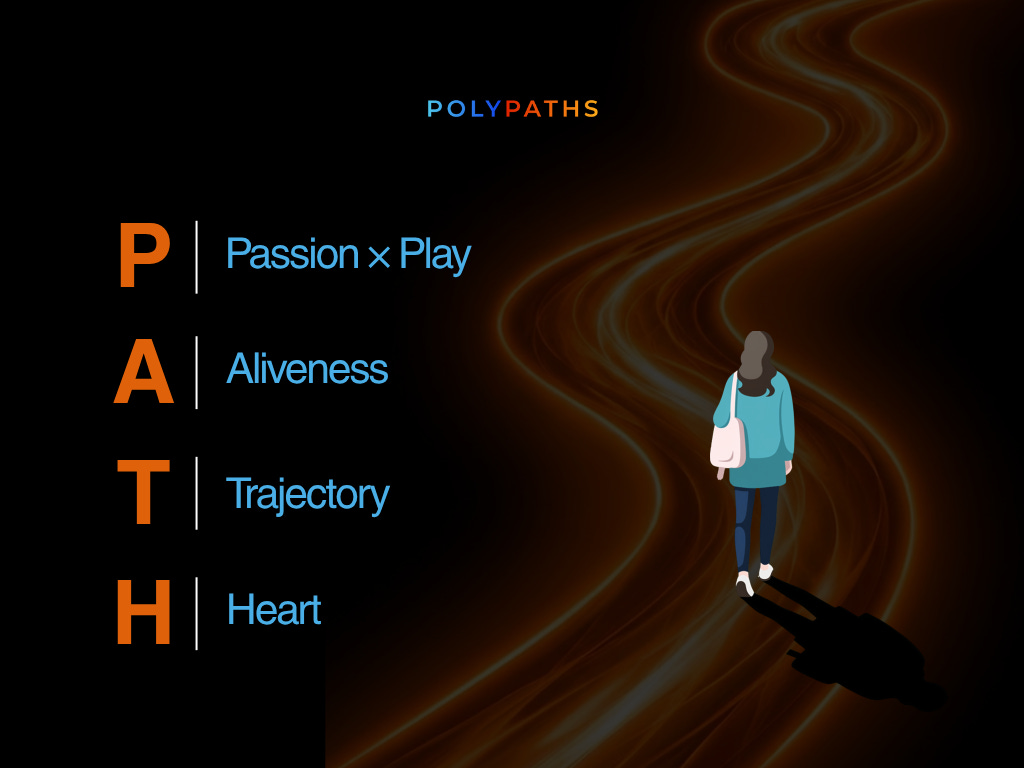
These four components are rooted in the fundamentals of human psychology. Let’s start with self determination theory (SDT), which has been the gold standard for understanding human motivation. SDT identifies three innate needs that all humans have – autonomy, competence and connectedness.
Autonomy is the desire to be a causal agent in one’s own life. I understand it as our perceived ability to have power over the happenings in our life and be in control of our own destiny. Tactically, it translates to having autonomy over how we are spending our time. And hence it directly relates to being able to do things that you like (passion x play).
Turns out “Follow your passion” is good advice after all. And most importantly, it need not be a singular passion to follow!
In Vallerand’s seminal research, he articulates the concept of harmonious passion which is an intrinsic drive to engage in something you love as opposed to obsessive passion governed by external factors.
This is exactly why P is at the intersection of passion and play, a passion that is intrinsic and natural to you. Over many longitudinal studies, harmonious passion has shown more vitality, better health and stronger relationships.
Feeling “alive” is rooted in the concept of subjective vitality, a construct developed by Ryan and Deci. Vitality is the experience of feeling energized using our internal reserves, as opposed to a fleeting pleasure derived by external stimuli. Research suggests that this feeling is a direct byproduct of autonomy which is why a PATH acts as a psychological battery charger.
How we perceive this energy over time is governed by Event Segmentation Theory (Zacks et al., 2007). Our brains do not process time as a continuous, flowing stream; but as discrete events. When we live on autopilot, repeating identical routines, we create few event boundaries. We end up feeling ‘time flies’ without a meaningful footprint. Conversely, when we are in a state of aliveness, the brain to creates more frequent, distinct event markers. It makes life feel more expansive and memorable.
So how do we get to this feeling? It is activated through the flow state (coined by Mihaly Csikszentmihalyi).
Flow occurs when a person is fully absorbed in a task where the challenge perfectly matches their skill, resulting in a state where the brain’s analytical prefrontal cortex temporarily decreases activity. By silencing the internal critic, flow allows for seamless cognitive performance and deep creativity.
The next need in SDT is that of competency which is the intrinsic human desire to mastery, and the inherent inclination to growth. And this directly translates into the T for trajectory on any path. Per Carl Rogers, all living organisms possess an innate actualizing tendency, which is a built-in drive to develop all their capacities in ways that enhance the self.
This built-in drive makes walking on the path intrinsically rewarding. Trajectory then, goes hand in hand with the flow state. Flow state is unlocked when your challenge level matches your current skill on any path. As you continue walking on that path, you naturally seek out bigger challenges thus increasing your skill level in the process.
Seeking the right challenges is what Erikson extensively wrote about in his book Peak where he studied the top artists, scientists and athletes. He writes that these high performers engage in what he calls deliberate practice. It is the process of seeking out and concentratedly working at the edge of our abilities and thus, the need to advance our trajectory.
And finally, third component of SDT (after autonomy and competence) is connectedness which is the ability to care for others. Studies on generativity also consistently show that individuals who contribute to others through work, mentoring, parenting, or creative output report higher levels of life satisfaction.
Victor Frankl in his seminal book Man’s search for meaning, posited that meaning is not found in the self, but in the service of something or someone other than oneself. Even Maslow, towards the end of his life, added a level above self-actualization to his hierarchy of needs which is self-transcendence i.e. creating impact that lives beyond us.
We all feel a strong need to contribute to society and add value to others through the paths we walk on. It is inevitable that we start with a pursuit that gives us passion/play, then experience aliveness in a recurring fashion, achieve a level of expertise and a trajectory of growth with time, and thus create something on our paths that truly helps others and touches their heart.
Not everything you pursue can be a PATH. I have often heard my friends tell me ‘I just love baking, I don’t want to be a Michelin star chef’ or ‘I love playing tennis, but I don’t to be a Roger Federer’, or music is just a stress-buster for me!
And fair, I totally get it! And that’s where the concept of a PARK kicks in which we will deep dive into next week on PolyPaths 🙂
In the meantime, what are the PATHs that are meaningful in your life? Let me know in the comments below.
Comments
Nothing yet. Say the first thing.
Sign in to join the conversation.