
These days, I consume a lot of business and entrepreneurial wisdom.
As a new founder, I truly enjoy learning more about building a business.
One piece of advice I have heard again and again is:
“Work on your business, not in it”
Michael Gerber introduced this phrase several years ago in his popular book. He tells the story of Sarah; a young creative who loves baking pies and decides to open a bakery. She then gets overwhelmed by the thousand things she needs to do, and is unable to find time for the very thing she loves.
In a way, it’s a cautionary tale on building a business that works for your life, and making sure it’s not the other way around.
Every founder who productizes something they like, ends up being Sarah in some shape or form. Basically, when you have a business, the buck stops at you. You are ultimately responsible for anything that needs tending; whether it’s handling paperwork for your LLC or filing business receipts or figuring out a new storage plan or finding a new vendor.
It’s not just about admin tasks though, which can be painful but in some ways are deterministic. The bigger challenge is when things are kind of working, but something is amiss.
For example, you might have a lot of orders for your product, but you are working 80 hour weeks to meet them. Or you might be getting a lot of interest on social media but not enough people are actually buying your services. Or you have a vendor that’s costing you more than you would like.
In such cases, it is important to take a break from working in the business to work on the business.
You need to step aside from the daily operations and execution of the business to figure out what needs to happen to level up. Ray Dalio, in his book Principles, refers to this approach as creating the machine and simultaneously working on the machine.
As I was thinking more about this business wisdom, I realized that we can adopt some of this for life as well. Let’s see how.

What even is the distinction?
Let’s go back to working on vs in your business.
I posit that not working in your business is not realistic unless you exited it. But the work you do in your business needs to keep changing if the business has to grow.
That’s where you switch to working on the business i.e. figuring out the bottlenecks, hiring, delegating, making new strategies. Basically, your job as the founder is to:
Replace yourself by eliminating or delegating the work you are doing currently, but don’t want to do. Create systems that work without you.
Figure out a new scope for yourself by understanding what are the things only you can do at this stage of the business.
Finally, step into that new role and go back to working in the business.
The goal is to uplevel yourself within your business and correspondingly, scale the business.
Now let’s come to life.
You obviously have to live your life. So by default, you are working in your life.
But sometimes you get into a rut, you get burnt out, you might even feel you are losing touch with yourself. Or you feel you are suppressing parts of yourself and that’s costing you more than you want it to.
Basically, you feel the need to revamp your life, and that’s when you need to work on your life. You need to take a step back from the day to day busyness and actually ask the deeper questions.
The goal of life is essentially to uplevel yourself, to constantly work towards a newer, better version of yourself.
Tactically, how to do it?
There are six steps in the PolyPath Reset framework to uplevel yourself, and these apply to business as well as life:
1. Rethink
What are the limiting beliefs, conditioning or faulty assumptions that you are carrying? Harvard faculty Christensen, wrote a mighty book on innovation in 1997, proving that great companies don’t fail because of bad management; they fail because they follow traditional “good management” dogmas too rigidly.
For example, we believe that working more is always better somehow, in business and in life. But is it really true?
“Workaholics don’t accomplish more than non-workaholics. They may feel like heroes, but the real hero is already home because she figured out a faster way to do it.”
– Jason Fried, founder of unicorn AI startup Basecamp
“We don’t care how many hours you work; we care about the quality of your impact.”
– Reed Hastings, CEO, Netflix
Similarly in life, we carry our conditioning and limiting beliefs whether it’s about working more, or trying to achieve success by someone else’s definition or believing that we need to pick one thing to specialize!
2. Reframe
I have been writing OKRs for the past seven years in my tech jobs. Doerr talks about Objectives and Key Results (OKR) as an effective mechanism for goal setting. It is really an exercise in prioritization. You identify 3 to 5 critical goals and align resources behind them. This has helped Google, Intel, Snap, and many other companies become the tech giants that they are today.
We need to bring that same intentionality to life as well.
We need to think through what are the PATHs that you want to walk in life aka your priorities in life. What are the pursuits you see yourself growing on vs those that are meant to be more leisurely? Identifying your PATHs and PARKs for life gives you a strong foundation to actually start building your life.
And of course there is seasonality, some PATHs are more important in certain seasons of life.
3. Re-envision
Amazon has a fascinating way of designing new products. They invite the proposing team to write an internal press release and FAQ document before a single line of code is written. They define the perfect future state for the customer and then engineer backward to the present day.
What if we took the time to actually imagine what we want our ideal life to look like? What if we really asked ourselves how we want to spend our week if there were no constraints? What is the proportion you would ideally allocate to all your PATHs and PARKs?
The problem is that we never give ourselves the permission to visualize. This is not day-dreaming but a realistic run into the future-you.
In all the cohorts that I have run, the re-envision path pie exercise has been a game changer for all the participants. People actually think carefully through what they want their path pie (proportions of different PATHs) to be in 3 years and in 1 year and now.
Once we know where we are going we can reverse engineer how to get there. We are all natural problem solvers.
4. Rebuild
Deming, the father of modern manufacturing systems, famously said: “A bad system will defeat a good person every time.” And you have probably heard James Clear on how we don’t rise to the level of our goals but fall to the level of our systems.
Also you probably don’t need to do everything on your own. Strategic coach Dan Sullivan argues that when entrepreneurs want to scale, they ask the wrong question: “How do I do this?” This keeps them trapped in execution. Instead, they should ask: “Who can do this for me?”
Once we set our goals in life, we need to make sure we have the right systems to meet our goals whether that’s for our home management or for music projects. And as we create this system, we also realize the things that could be outsourced to buy us back more time.
5. Reconnect
In his book Zero to one, Peter Thiel talks about how founders copy existing models because it feels safe, but it traps them in a brutal war for tiny margins. He mentions that the goal is to build a creative monopoly by doing something fundamentally unique.
I see polypaths downplay their music or shrug their literary prowess or never mention how important tennis is to them. They want to be like every other dedicated tech worker. But the actual leverage is being that unique data scientist who is a chef and can use her reverse decoding culinary skills to better understand data, or an animation artist who can code and create AI tools for film makers.
Reid Hoffman, the founder of LinkedIn, argues that a company’s greatest asset is its network’s collective intelligence. Similarly your greatest strength is the unique combination and intersections of your PATHs. Your callings don’t compete, they actually complete you and help you build something only you can!
6. Reclaim
Seth Godin, in his book Linchpin, argues that a business must dare to be a “Purple Cow”, which is something inherently remarkable that people actually want to talk about and celebrate. It requires shedding corporate timidity and proudly broadcasting your distinct difference. This is what gives the business its competitive advantage.
Similarly, the individuals that will thrive are those who not just embrace but celebrate their weirdness and uniqueness. They know their strengths and they know their weaknesses. They know what’s non-negotiable in their lives and how their multiple pursuits are a precious asset. They know exactly what value they add, and they dare to be unapologetically themselves!
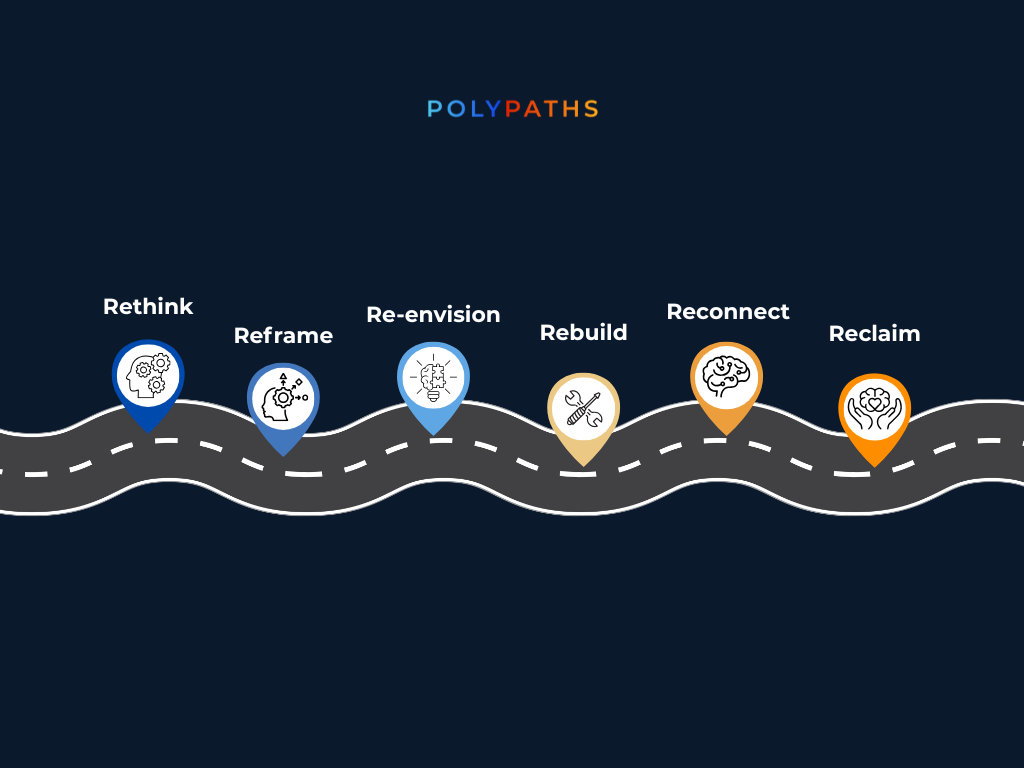
I have seen time and again that when people pause and work through these six steps, they uplevel themselves. They transform themselves into a better version of themselves!
A16Z founding partner Ben Horowitz talks often about how a founder must consciously transform their identity as the company grows, and so is true as you grow in age and evolve in life as a person.
And that transformation doesn’t happen by accident. It requires intentionality.
As Wickman defines in his book Entrepreneur OS, a clarity break is a scheduled time on your calendar to step away from the business to think, clear your mind, and work on the business. It is not an option; it is a discipline.
So I urge you to take that clarity break to reset your life as well. If you are ready, you can apply for the PolyPath Reset cohort where you will get to go on this journey of transformation with multifaceted achievers just like you.
At the very least, I urge you to block an hour or more this weekend, go into nature with a paper and pen, and reflect on the reset exercises in the above order.
I assure you that you will learn a ton about yourself.
I assure you that when you invest in working on your life, you will come back infinitely more energized to work in your life aka to live your best life! Let me know how it goes ;)
Comments
Nothing yet. Say the first thing.
Sign in to join the conversation.