
You can get rich with APIs and AI! No, really. But only if you design your API so that AI agents have the best experience possible. AX, or agentic experience, is the measure of how easily an AI agent can understand and use an API. If your API offers a good AX, AI agents will be able to find it and use it easily. You'll get more users and, even better, more repeated usage. On the other hand, if your API has bad AX, agents won't use it as much, and you won't take advantage of exposing it to AI. Yes, AX is quite important. So, how can you improve it? Keep reading.
This article is brought to you with the help of our supporter, Scalar.
Scalar is the modern OpenAPI platform for the entire API lifecycle. Govern APIs with Scalar Registry, test offline with their built-in Client, generate beautiful documentation, and ship SDKs instantly - all from your single source of truth.
Agentic experience is the new developer experience. It’s not enough that your API is well-documented and easy to integrate with. And it’s also not enough that it’s well-designed so that its capabilities benefit end users. Now what’s most important is that AI agents can easily discover, onboard, and repeatedly interact with your API. End users won’t even notice what’s going on behind the scenes. It’s the agent’s job to abstract away all the technical details. But, to do that, agents themselves need to be able to use APIs in the easiest way. And the benefit of that isn’t just having an API that’s easier to consume by AI. It’s also having one that’s easier to monetize. Why? To understand that, let’s first look at something called the AARRR funnel.
“Pirate metrics” is where our journey begins. It was first popularized by entrepreneur and investor Dave McClure back in 2007. The name comes from the sound of the AARRR acronym when you read it out loud. Its five letters are the initials of the five stages of a product funnel: acquisition, activation, retention, referral, and revenue. Your goal is to make users move from one stage to the next flawlessly. The reality, however, is that the further you go down the funnel, the thinner it becomes. Unfortunately, only a percentage of the users who enter the funnel ever get to the bottom stage. What does this have to do with AX and the ability to monetize an API? Good question. To answer it, let’s begin by understanding how DX contributes to the AARRR funnel.
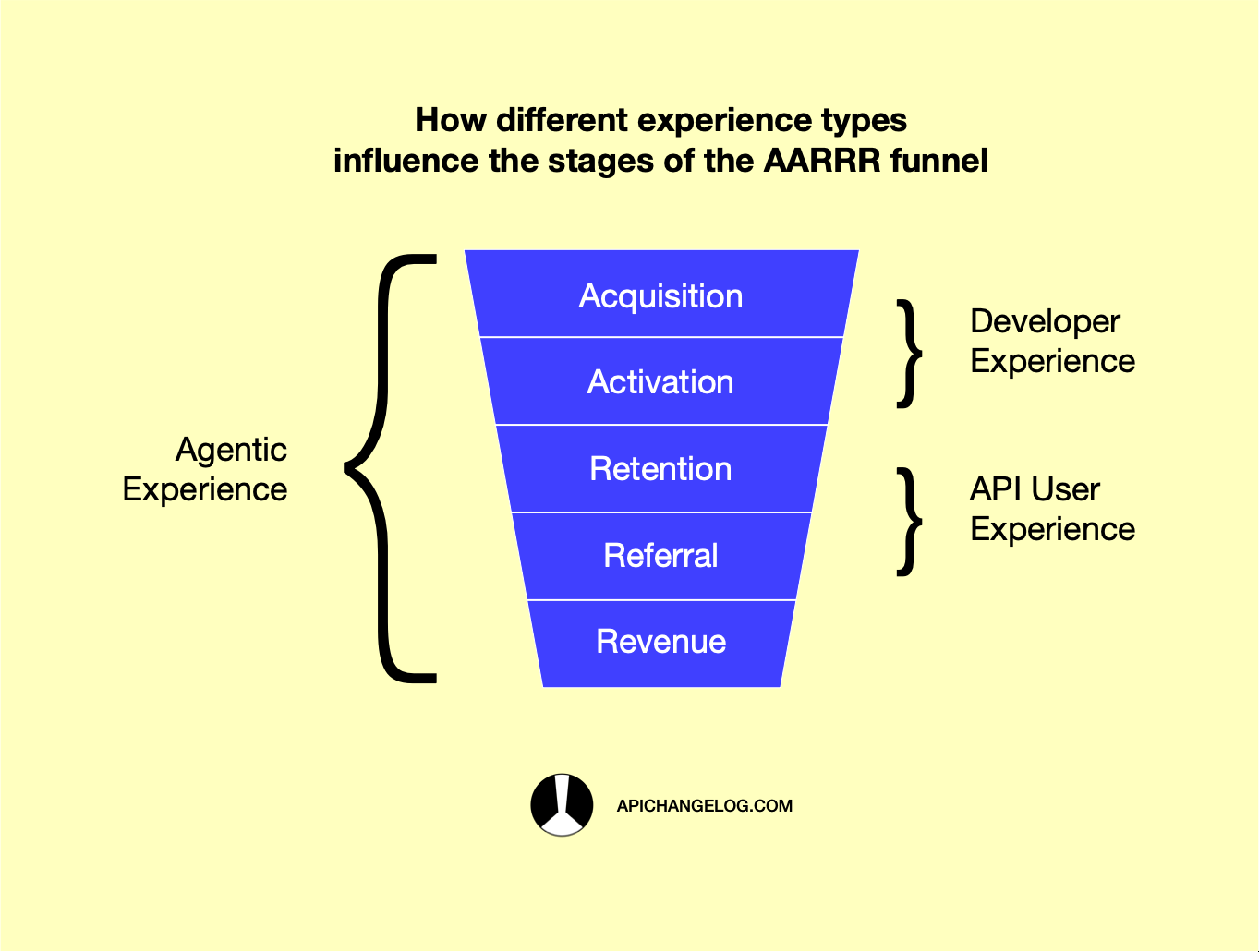
Developer Experience, or DX, is the sum of all interactions a developer has with an API, from initial discovery to long-term maintenance. DX is critical to the success of an API because it dictates the speed of adoption and the ease of integration, serving as the primary driver for the acquisition and activation stages of the AARRR funnel. Time-to-first-call, or TTFC, is one of the most important API metrics to track for a reason. It’s the best way to understand how good your DX is. If TTFC is too high, it means that you have a lot of API friction and developers find it really hard to start using your API. In other words, DX is bad. If TTFC is low, it means that your API is easy to onboard, and developers can make a request in a short amount of time. After that, developers build their integrations with your API, and their work is done. In many cases, developers won’t ever again interact with your API. That’s why you need more than just good DX to move from activation to retention (the first R in AARRR). You have to make sure the applications developers are building with your API also have a good UX. In other words, retention depends on how easily users can achieve their goals. Otherwise, they can quickly switch to a competitor.
That is what I call API UX, or the second-degree user experience. “Elements such as the choice of API architecture, the authentication scheme, and the way the API returns information to the consumer can directly impact the experience of the users of applications that interact with your API,” I wrote in Building an API Product. Next time you’re designing an API pay close attention to the kind of experience you’re baking into your choices because “users interact with the API through the application that they’re using. That’s why we call it second-degree use experience,” I added. If everything goes well, users won’t churn, and your retention rate will grow. What about referring your API to other users? That usually happens indirectly. Users won’t refer your API to other users. Instead, they’ll refer the application that integrates with your API. For that to happen, users need to feel that the application they’re using is the best of its kind. That means that your API UX must be excellent, and the integration with the application must be flawless. It’s only at that point that you start seeing some signs of revenue. How, then, can you boost your returns without all this effort?
AX is the answer. It’s the new DX and API UX all in one. On steroids! In short, making AI agents your primary API consumers is now your goal. Let me repeat. AI agents are now your main API consumers. Everything else is just noise. And, to get there, you need to provide an excellent AX. The amount of API requests AI agents make is directly related to the number of prompts their users submit. On top of that, onboarding is practically taken care of with solutions like the OAuth 2.0 Dynamic Client Registration, or the more granular x402 Agentic Authorization Flow. Billing moves from a SaaS-oriented subscription model to a metered reality, where agents are the ones making the purchase decisions. In this new state of play, if agents have success completing tasks using your API, they’ll likely return. If your AX is poor, agents will churn and find a more efficient API to save tokens.
Offering a good AX starts with having all your documentation in a way a machine would understand. “Focus on using well-known API definition standards based on machine-readable formats. Use OpenAPI for documenting REST APIs, AsyncAPI for asynchronous APIs, Protocol Buffers for gRPC, and the GraphQL Schema Definition Language,” I wrote in API Documentation for Machines. Then you have things like making sure that all API operations, inputs, and outputs are well documented. Or providing meaningful error responses by following standards like the RFC 9457. Or even anticipating what agents will do by creating Arazzo definitions of possible workflows. There’s much more to it, as you can imagine. However, exploring all the options you have is not the goal of this article. Instead, the point I’m making is that AX is now non-negotiable if you want to have a successful API.
If you ignore this reality now, your API will simply be invisible to AI agents. Yes, you might still be able to convince developers to build a new integration now and then, but you won’t be able to tap into the growing AI agents market. But your competitors will. So if you’re serious about your API’s success and revenue potential, you know what to do. You know that it will take some learning and potentially some upfront investment. But what doesn’t?
Comments
Nothing yet. Say the first thing.
Sign in to join the conversation.