Snowflake Koch Fractal
With a serious lack of holiday themed cosy maths in the advent calendar, I present some titbits about this snowflake looking thing called the von Koch fractal. It's fascinating enough to be useful for time travel. Okay, that's obviously a lie, but not entirely - the characters in the novel The Curve of the Snowflake by W. G. Walter use this fractal for time travel for its peculiar property.

But before we go into the peculiarity, here's how you could make your own Koch fractal. At least, after you've giggled about the name for a couple minutes. If it helps, it's pronounced the same way as coke.
Take a line. Divide it into 3 parts, take the middle part and make a hat.

From then on, every time you see a straight line, we divide and make a hat. Hats on hats on hats.
Hat all the lines as many times as you can, and you reach a Koch curve.
Making a hat for every possible hat-less line till the end of time, gives you the actual fractal curve.
You can try going through the many iterations of making hats here: Complexity Explorables. Select the koch fractal, and play away! The website also has some popular science models that you can play with
You put these lines as part of a triangle, and you get a snowflake fractal. The area of this shape, despite going through infinite iteration of hat making, is indeed finite - in between a triangle and a hexagon. The precise number would be 8/5 of the triangle's area it started its life on. But with infinite divisions, comes the infinite perimeter, the property that got Walter to solve time travel in his story.
This infinite perimeter was peculiar enough, that mathematicians in the 20th century called it a monster. Mandelbrot mentions these fears and tames this monster and many other fractal monsters in his book from 1982 "The Fractal Geometry of Nature". I won't go into the details of how he tamed them, but there are some interesting mathematics behind how fractals break geometric intuition, and how it was solved with the notion of fractal dimensions.
Using the fractal to do some science
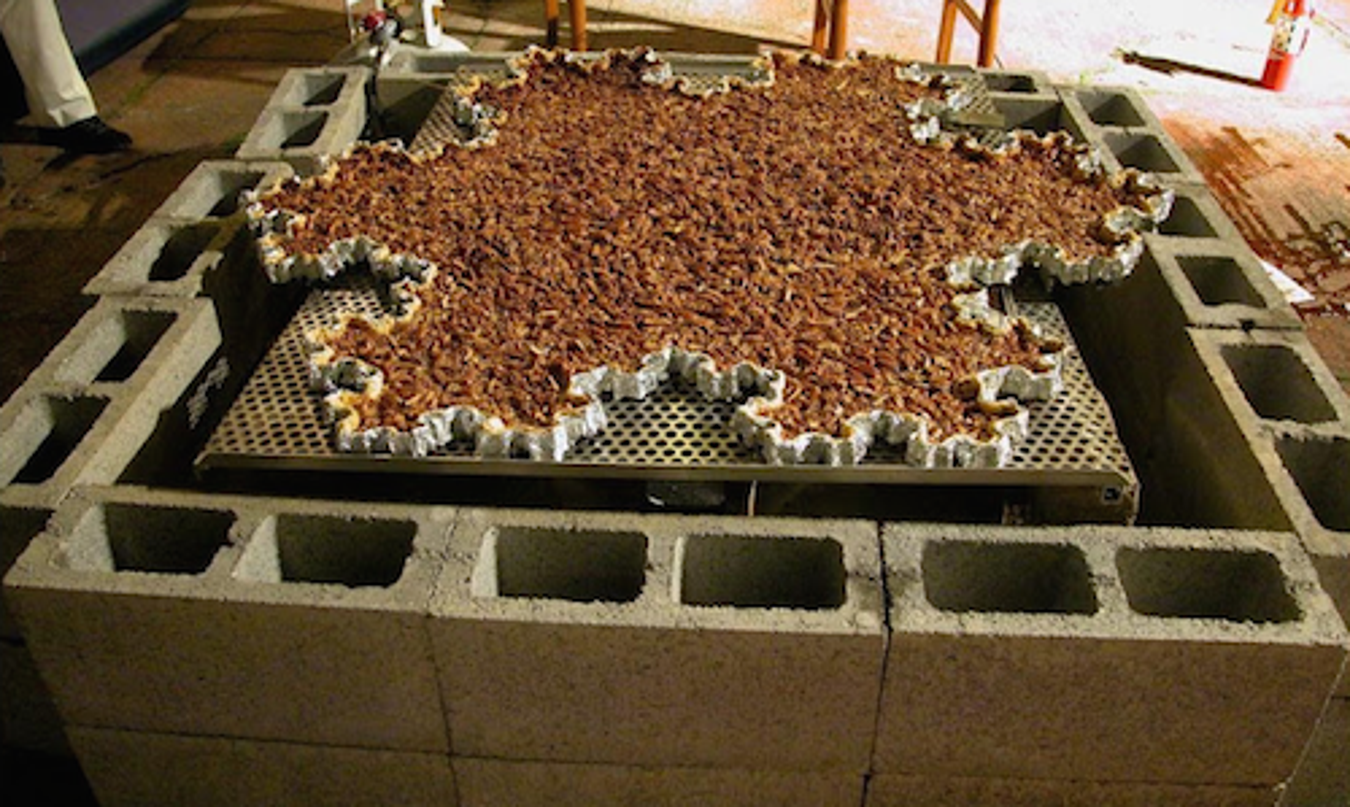
I came across someone making a pie pictured above in the shape of a Koch fractal to have more crust surface area to compensate with all the filling in the middle compared to a circular pie. Besides these, a quick stroll through the Wikipedia article for the Koch fractal shows an application with Radio Antennae in medical imaging. These antennae aren't better than circular antennae in accuracy for the designed set of frequencies, but maybe versatile for a broad range of frequencies without adjusting the circular antennae. There is apparently still more investigation to be done with fractal structured antennae.
The most interesting use case that I found was studying the settlements of cities with networks based off of the Koch fractal. The image below, taken from this paper, shows an intuitive way of how a fractal can map onto a graph without going into too many details.
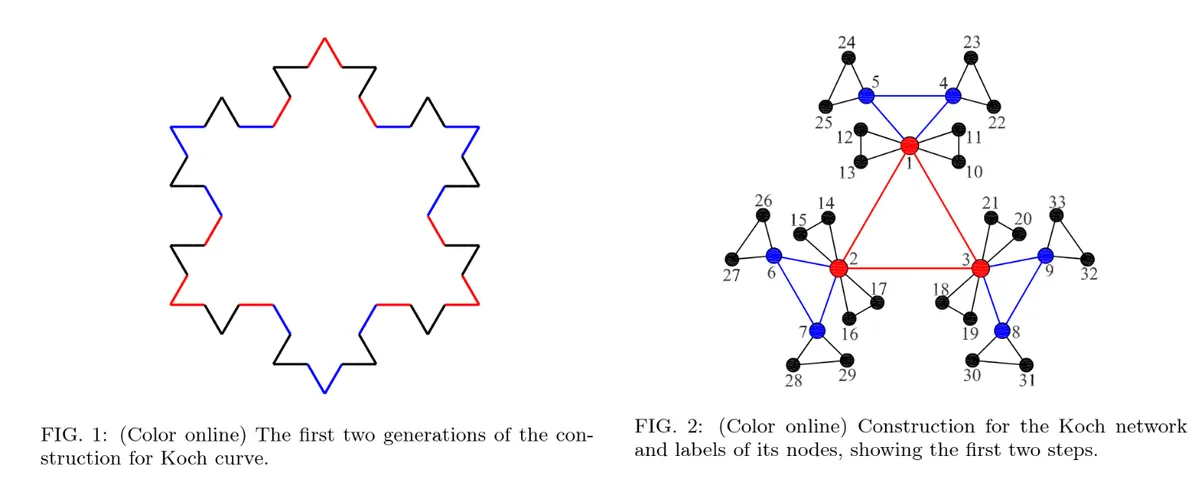
How can a graph be used to study cities, you may ask. Central Place theory in geography can help to study how settlements in cities and towns are connected to surrounding markets. This helps in understanding how cities scale in size. These connections between hubs and markets can be modelled after simplified graphs. And the fractal helps us model the growing structures of the cities through division of graph nodes. This theory has its criticism of too much simplification, starting with cities not being symmetrical like these fractals, I have yet to go through this theory deeper to see if there is indeed any real use in understanding city scaling with fractal networks. I will try to post something about this, hopefully with some actual maths.
If you're curious, here's the main paper (open link) I've been reading.
Side Tangent: Real Snowflakes
Credit for images and content: read more on The Science of Snowflakes - The Oxford Scientist
The Koch snowflake has a very loose hexagonal connection to the real snowflake. Water molecules on the atomic scale form hexagonal bonds with each other.

These microscopic arrangements induce the hexagonal core of the snowflake crystal. The branches of the snowflake on the other hand are also a bit strange compared to other crystal formations. The article seems to explain it away by saying it's less likely that as the snowflake grows that the molecules are able fill up the structure, but the original paper (Nelson 2005 "Branch Growth and Sidebranching in Snow Crystals") goes into a bit more detail as to how environmental factors and the process of crystallization affects the symmetries and the unique shapes of the snowflake branches.
I will probably go into the maths of snowflake branching and make things a bit more accessible on yet another future post. If you can't wait, here's an open link to the paper.
I got these detailed aspects of the real snowflake from this blog called Story of Snow. This post also goes through why the hexagon structure is induced in more detail.
Expect the future posts after Christmas, so I have enough time outside of making little pixel doodles for the Grizzly Gazette Advent Calendar (which you should check out, if you came to the post from my blog instead of the calendar). Until then, I hope you enjoy this season with a couple more vague maths facts in your step.
Reply via email
Licensed under CC BY NC ND 4.0