- Home
- Activities
- Tracking SARS-CoV-2 variants

All viruses, including SARS-CoV-2, the virus that causes COVID-19, change over time. Most changes have little to no impact on the virus’s properties. However, some changes may affect the virus’s properties, such as how easily it spreads, the associated disease severity, or the performance of vaccines, therapeutic medicines, diagnostic tools, or other public health and social measures.
In June 2020, the WHO Virus Evolution Working Group was established with a specific focus on SARS-CoV-2 variants, their phenotype and their impact on countermeasures. This later became the Technical Advisory Group on SARS-CoV-2 Virus Evolution. In late 2020, the emergence of variants that posed an increased risk to global public health prompted WHO to characterize some as variants of interest (VOIs) and variants of concern (VOCs) in order to prioritize global monitoring and research, and to inform and adjust the COVID-19 response. From May 2021 onwards, WHO began assigning simple, easy-to-say labels for key variants.
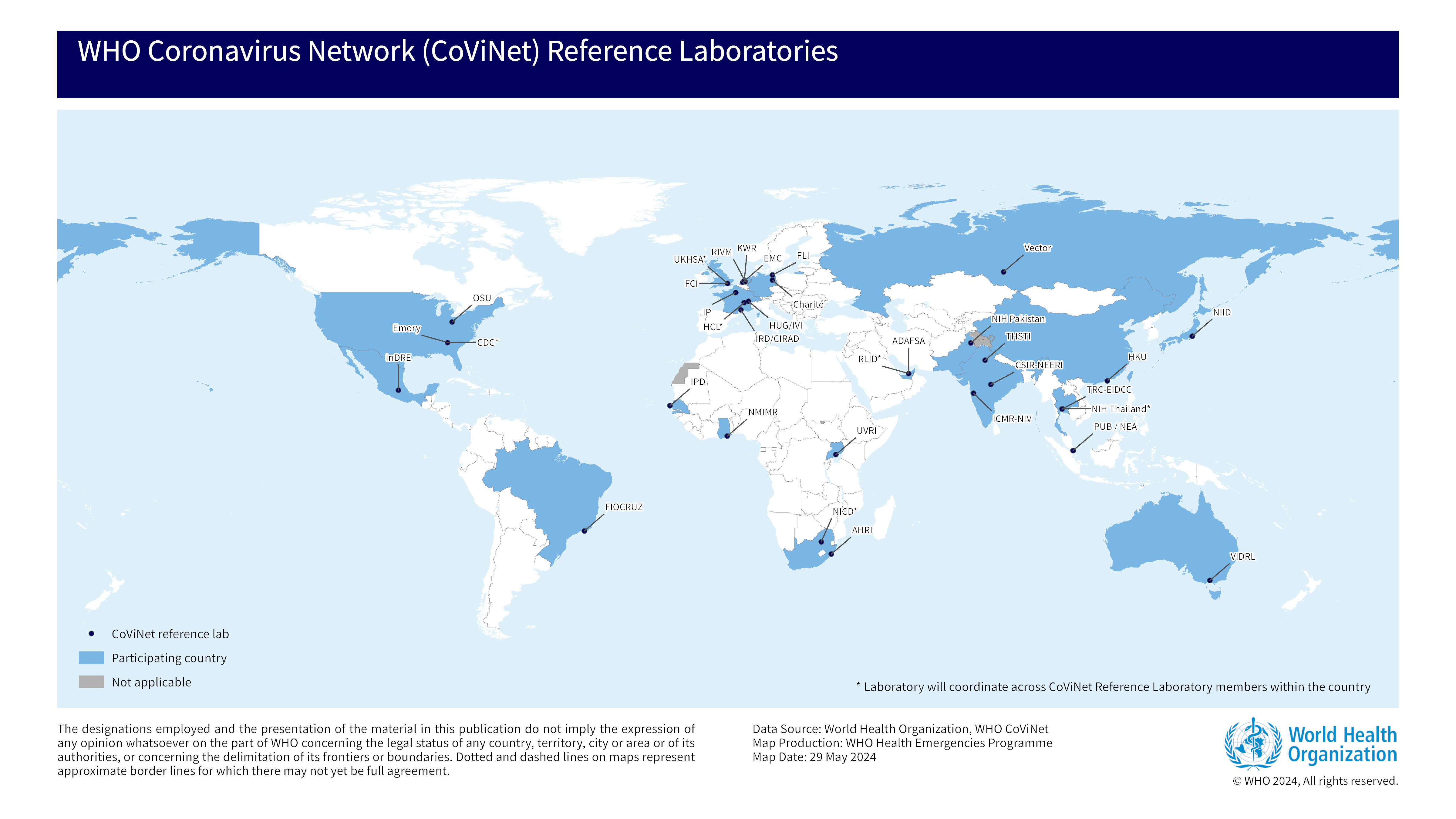
Considerable progress has been made in establishing and strengthening a global system to detect signals of potential VOIs or VOCs and rapidly assess the risk posed by SARS-CoV-2 variants to public health. More specifically, in 2024 WHO launched a WHO Coronavirus Network (CoViNet) to facilitate early and accurate detection of coronaviruses and variant tracking including coordinating risk evaluations. It remains critical that these systems are maintained, and data are shared, according to good principles and in a timely fashion, as SARS-CoV-2 continues to circulate at high levels around the world. While monitoring the circulation of SARS-CoV-2 globally, it also remains essential to monitor their spread in animal populations and chronically infected individuals, which are crucial aspects of the global strategy to reduce the occurrence of mutations that have negative public health implications. In March 2023, WHO updated its tracking system and working definitions for variants of concern, variants of interest and variants under monitoring. They can be found here. The previous working definitions can be found here.
This content was last updated on 28 July 2026.
News
Currently circulating variants of concern (VOCs) as of 15 March 2023
Currently circulating variants of interest (VOIs) (as of 2 December 2024)
| Pango lineage | Next strain clade | Genetic features | Earliest documented samples | Date of designation and risk assessments |
JN.1# | 24A | BA.2.86 + S:L455S | 25-08-2023 | 18-12-2023 JN.1 Initial Risk Evaluation 18 December 2023 |
#Excludes JN.1 sublineages listed as VUMs below.
Currently circulating variants under monitoring (VUMs) (as of 27 July 2026)
| Pango lineage | Next strain clade | Genetic features | Earliest documented samples | Date of designation and risk assessments |
| PQ.16.1.1 | 25B | NB.1.8.1 + S:D253G, S:N417T, S:D420N, S:I478T | 25-03-2024 | 27-07-2026 PQ.16.1.1 Initial Risk Evaluation 27 July 2026 |
| NB.1.8.1 | 25B | JN1 + S:T22N, S:F59S, S:G184S,S:A435S, S:F456L, S:T478I, S:Q493E | 22-01-2025 | 23-05-2025 |
| XFG | 25C | JN1 + S:T22N, S:S31P, S:K182R, S:R190S, S:R346T, S:K444R, S:V445R, S:F456L, S:N487D, S:Q493E, S:T572I | 27-01-2025 | 25-06-2025 |
| BA.3.2 | Relative to Index: P9L, R21T, P26L, A67V, H69-, V70-, T95I, I101T, C136-, N137-, D138-, P139-, F140-, L141-, G142-, V143-, Y144-, Y145-, H146-, K147-, F157S, N164K, S172F, K187T, N211-, L212I, A243-, L244-, P251S, I326V, G339Y, A348P, S371F, S373P, S375F, R403K, D405N, R408S, K417N, A435S, N440R, V445A, G446D, L452W, N460K, S477N, T478N, E484K, G496S, Q498R, N501Y , K529N, E554D, E583D, D614G, H625R, N641K, V642G, E654K, H655Y , N679R, P681R, A688D, S704L, N764K, K795T, D796Y , A852K, S939F, Q954H, N969K, P1162R, D1184E | 22-11-2024 | 05-12-2025 |
Technical Advisory Groups
.jpg?sfvrsn=3976b431_6 "WHOCOVID19_20200812_MEX_0473 (002)")

Networks
WHO encourages the sharing of pathogen genome data to protect global public health. Sharing of pathogen genome data is critical for preventing, detecting,...
This document aims to describe a minimum set of surveillance activities recommended at the national level to detect and monitor the relative prevalence...
The growing understanding of how sequence information can contribute to improved public health is driving global investments in sequencing facilities and...
Sequencing enabled the world to rapidly identify SARS-CoV-2 and develop diagnostic tests and other tools for outbreak management. Continued genome sequencing...
