Weather creates hazards for ships and aircraft. At sea, wind waves and swell produced by storms are the major hazards. In the air, the main hazards are hailstones and microbursts, both of which are produced by intense thunderstorms. Thick fog is a hazard to sea and air operations as it can significantly reduce visibility, obscuring coastlines and airport runways.
Waves and Swell
The sea state at any location is usually a combination of wind wave and swell. Huge sea waves, usually associated with tropical cyclones and monsoon surges, pose a threat to the safety of mariners.
Wind waves are short waves generated by local winds. Just how big the waves are depends on the strength of the winds, how long they blow, and how far they blow over the sea (the “fetch”). The waves can rise to heights of over 15 metres in the vicinity of tropical cyclones in the open sea.
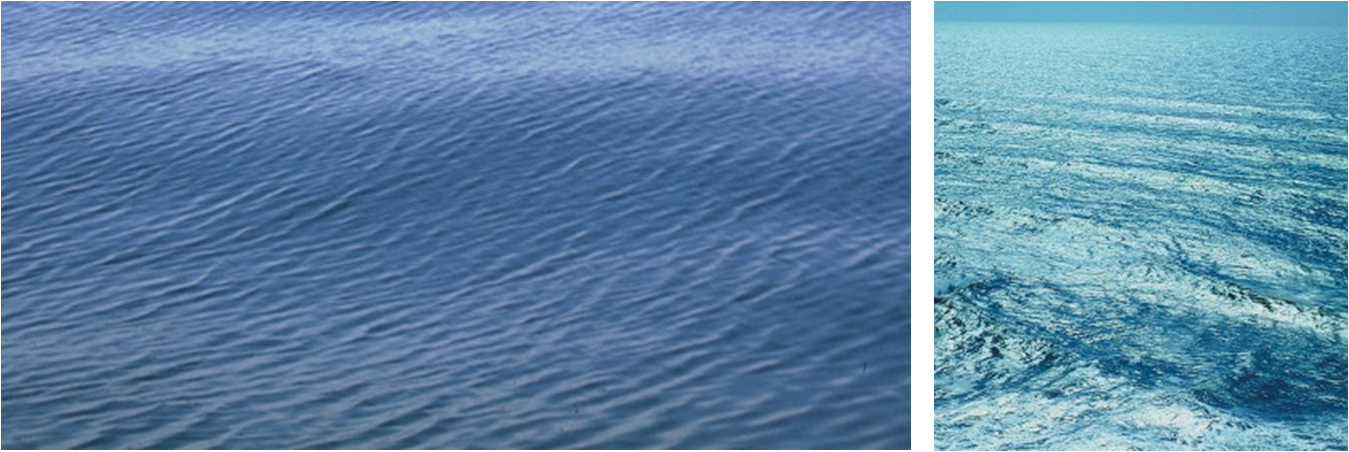 Wind wave (left) and Swell wave (right). Wind waves are surface winds resulting from winds blowing over the ocean’s surface. Swell waves are a series of wind–generated waves not by local winds at that time but by winds from distant weather systems blown for a duration of time and distance over the ocean (Image credit:
www.earthsci.org/index.html)
Swells are longer waves that propagate away from the point where they originated. Swells, when generated by tropical cyclones, can propagate out of their generation zones and travel very long distances across the ocean. They have very low correlation to the local winds. Swells propagate much faster than the tropical cyclone itself, reaching the coastal areas way ahead of the tropical cyclone making landfall. When swells enter shallow waters, their heights increase and pose a hazard to people staying along coastal areas.
Fog
Fog consists of numerous tiny water droplets suspended in the air — this is what obscures our vision. In the presence of fog, the visibility is below 1 km. It is known as mist when visibility is between 1 and 5 km. Under light wind, humid and clear sky conditions, moisture near the ground can often condense near the ground to form fog or mist, especially at dawn or dusk. Fog and mist are actually ground-level stratus clouds.
Fog rarely occurs in Singapore. However mist is not uncommon, especially during inter-monsoon periods when winds are generally light, and is commonly found in forested areas on cool nights and in the early morning.