1 Introduction
The purpose of this document is to catalog the functions and operators required for XPath 3.1, XQuery 3.1, and XSLT 3.0 (at the time of writing, XSLT 3.0 requires support for version 3.0 of this specification, and makes support for version 3.1 optional). The exact syntax used to call these functions and operators is specified in [XML Path Language (XPath) 3.1], [XQuery 3.1: An XML Query Language] and [XSL Transformations (XSLT) Version 3.0].
This document defines three classes of functions:
-
General purpose functions, available for direct use in user-written queries, stylesheets, and XPath expressions, whose arguments and results are values defined by the [XQuery and XPath Data Model (XDM) 3.1].
-
Constructor functions, used for creating instances of a datatype from values of (in general) a different datatype. These functions are also available for general use; they are named after the datatype that they return, and they always take a single argument.
-
Functions that specify the semantics of operators defined in [XML Path Language (XPath) 3.1] and [XQuery 3.1: An XML Query Language]. These exist for specification purposes only, and are not intended for direct calling from user-written code.
[XML Schema Part 2: Datatypes Second Edition] defines a number of primitive and derived datatypes, collectively known as built-in datatypes. This document defines functions and operations on these datatypes as well as the other types (for example, nodes and sequences of nodes) defined in Section 2.7 Schema Information DM31 of the [XQuery and XPath Data Model (XDM) 3.1]. These functions and operations are available for use in [XML Path Language (XPath) 3.1], [XQuery 3.1: An XML Query Language] and any other host language that chooses to reference them. In particular, they may be referenced in future versions of XSLT and related XML standards.
[Schema 1.1 Part 2] adds to the datatypes defined
in [XML Schema Part 2: Datatypes Second Edition]. It introduces a new derived type xs:dateTimeStamp, and it
incorporates as built-in types the two types xs:yearMonthDuration and xs:dayTimeDuration
which were previously XDM additions to the type system. In addition, XSD 1.1 clarifies
and updates many
aspects of the definitions of the existing datatypes: for example, it extends the
value space of
xs:double to allow both positive and negative zero, and extends the lexical space to allow
+INF;
it modifies the value space of xs:Name
to permit additional Unicode characters; it allows year zero and disallows leap seconds
in xs:dateTime
values; and it allows any character string to appear as the value of an xs:anyURI item.
Implementations of this specification may support either XSD 1.0 or XSD 1.1 or both.
References to specific sections of some of the above documents are indicated by cross-document links in this document. Each such link consists of a pointer to a specific section followed a superscript specifying the linked document. The superscripts have the following meanings: 'XQ' [XQuery 3.1: An XML Query Language], 'XT' [XSL Transformations (XSLT) Version 3.0], 'XP' [XML Path Language (XPath) 3.1], and 'DM' [XQuery and XPath Data Model (XDM) 3.1].
1.1 Conformance
This recommendation contains a set of function specifications. It defines conformance at the level of individual functions. An implementation of a function conforms to a function specification in this recommendation if all the following conditions are satisfied:
-
For all combinations of valid inputs to the function (both explicit arguments and implicit context dependencies), the result of the function meets the mandatory requirements of this specification.
-
For all invalid inputs to the function, the implementation signals (in some way appropriate to the calling environment) that a dynamic error has occurred.
-
For a sequence of calls within the same ·execution scope·, the requirements of this recommendation regarding the ·determinism· of results are satisfied (see 1.7.4 Properties of functions).
Other recommendations ("host languages") that reference this document may dictate:
-
Subsets or supersets of this set of functions to be available in particular environments;
-
Mechanisms for invoking functions, supplying arguments, initializing the static and dynamic context, receiving results, and handling errors;
-
A concrete realization of concepts such as ·execution scope·;
-
Which versions of other specifications referenced herein (for example, XML, XSD, or Unicode) are to be used.
Any behavior that is discretionary (implementation-defined or implementation-dependent) in this specification may be constrained by a host language.
Note:
Adding such constraints in a host language, however, is discouraged because it makes it difficult to re-use implementations of the function library across host languages.
This specification allows flexibility in the choice of versions of specifications on which it depends:
-
It is ·implementation-defined· which version of Unicode is supported, but it is recommended that the most recent version of Unicode be used.
-
It is ·implementation-defined· whether the type system is based on XML Schema 1.0 or XML Schema 1.1.
-
It is ·implementation-defined· whether definitions that rely on XML (for example, the set of valid XML characters) should use the definitions in XML 1.0 or XML 1.1.
Note:
The XML Schema 1.1 recommendation
introduces one new concrete datatype: xs:dateTimeStamp; it also incorporates
the types xs:dayTimeDuration, xs:yearMonthDuration,
and xs:anyAtomicType which were previously defined in earlier versions of [XQuery and XPath Data Model (XDM) 3.1].
Furthermore, XSD 1.1
includes the option of supporting revised definitions of types such as xs:NCName
based on the rules in XML 1.1 rather than 1.0.
In this document, text labeled as an example or as a Note is provided for explanatory purposes and is not normative.
1.2 Namespaces and prefixes
The functions and operators defined in this document are contained in one of
several namespaces (see [Namespaces in XML]) and referenced using an
xs:QName.
This document uses conventional prefixes to refer to these namespaces. User-written
applications can choose a different prefix to refer to the namespace, so long as it
is
bound to the correct URI. The host language may also define a default namespace for
function calls, in which case function names in that namespace need not be prefixed
at all. In many cases the default namespace will be
http://www.w3.org/2005/xpath-functions, allowing a call on the fn:name
function (for example) to be written as name() rather than fn:name();
in this document, however, all example function calls are explicitly prefixed.
The URIs of the namespaces and the conventional prefixes associated with them are:
-
http://www.w3.org/2001/XMLSchemafor constructors — associated withxs.The section 18 Constructor functions defines constructor functions for the built-in datatypes defined in [XML Schema Part 2: Datatypes Second Edition] and in Section 2.7 Schema Information DM31 of [XQuery and XPath Data Model (XDM) 3.1]. These datatypes and the corresponding constructor functions are in the XML Schema namespace,
http://www.w3.org/2001/XMLSchema, and are named in this document using thexsprefix. -
http://www.w3.org/2005/xpath-functionsfor functions — associated withfn.The namespace prefix used in this document for most functions that are available to users is
fn. -
http://www.w3.org/2005/xpath-functions/mathfor functions — associated withmath.This namespace is used for some mathematical functions. The namespace prefix used in this document for these functions is
math. These functions are available to users in exactly the same way as those in thefnnamespace. -
http://www.w3.org/2005/xpath-functions/mapfor functions — associated withmap.This namespace is used for some functions that manipulate maps (see 17.1 Functions that Operate on Maps). The namespace prefix used in this document for these functions is
map. These functions are available to users in exactly the same way as those in thefnnamespace. -
http://www.w3.org/2005/xpath-functions/arrayfor functions — associated witharray.This namespace is used for some functions that manipulate maps (see 17.3 Functions that Operate on Arrays). The namespace prefix used in this document for these functions is
array. These functions are available to users in exactly the same way as those in thefnnamespace. -
http://www.w3.org/2005/xqt-errors— associated witherr.There are no functions in this namespace; it is used for error codes.
This document uses the prefix
errto represent the namespace URIhttp://www.w3.org/2005/xqt-errors, which is the namespace for all XPath and XQuery error codes and messages. This namespace prefix is not predeclared and its use in this document is not normative. -
http://www.w3.org/2010/xslt-xquery-serialization— associated withoutput.There are no functions in this namespace: it is used for serialization parameters, as described in [XSLT and XQuery Serialization 3.1]
-
Functions defined with the
opprefix are described here to underpin the definitions of the operators in [XML Path Language (XPath) 3.1], [XQuery 3.1: An XML Query Language] and [XSL Transformations (XSLT) Version 3.0]. These functions are not available directly to users, and there is no requirement that implementations should actually provide these functions. For this reason, no namespace is associated with theopprefix. For example, multiplication is generally associated with the*operator, but it is described as a function in this document:op:numeric-multiply($arg1asxs:numeric,$arg2asxs:numeric)asxs:numeric
Note:
The above namespace URIs are not expected to change from one version of this document to another. The contents of these namespaces may be extended to allow additional functions (and errors, and serialization parameters) to be defined.
1.3 Function overloading
A function is uniquely defined by its name and arity (number of arguments); it is
therefore
not possible to have two different functions that have the same name and arity, but
different
types in their signature. That is, function overloading in this sense of the term
is not permitted.
Consequently, functions such as fn:string which accept arguments of many different
types have a signature that defines a very general argument type, in this case item()?
which accepts any single item; supplying an inappropriate item (such as a function
item) causes
a dynamic error.
Some functions on numeric types include the type xs:numeric in their signature
as an argument or result type. In this version of the specification, xs:numeric
has been redefined as a built-in union type representing the union of
xs:decimal, xs:float, xs:double (and thus automatically
accepting types derived from these, including xs:integer).
Operators such as "+" may be overloaded: they map to different underlying functions depending on the dynamic types of the supplied operands.
It is possible for two functions to have the same name provided they have different arity (number of arguments). For the functions defined in this specification, where two functions have the same name and different arity, they also have closely related behavior, so they are defined in the same section of this document.
1.4 Function signatures and descriptions
Each function (or group of functions having the same name) is defined in this specification using a standard proforma.
The function name is a QName as defined in [XML Schema Part 2: Datatypes Second Edition]
and must adhere to its syntactic conventions. Following the precedent set by [XML Path Language (XPath) Version 1.0],
function names are generally composed of English words separated by hyphens ("-").
Abbreviations are
used only where there is a strong precedent in other programming languages (as with
math:sin and
math:cos for sine and cosine). If a
function name contains a [XML Schema Part 2: Datatypes Second Edition] datatype name, it may have
intercapitalized spelling and is used in the function name as such. An example is
fn:timezone-from-dateTime.
The first section in the proforma is a short summary of what the function does. This is intended to be informative rather than normative.
Each function is then defined by specifying its signature, which defines the types of the parameters and of the result value.
Each function's signature is presented in a form like this:
fn:function-name($parameter-name as parameter-type, ...) as return-type
In this notation, function-name, in bold-face, is the name of the
function whose signature is being specified. If the function takes no
parameters, then the name is followed by an empty parameter list:
"()"; otherwise, the name is followed by a parenthesized list of
parameter declarations, in which each declaration specifies the static type of the
parameter, in italics, and a descriptive, but non-normative, name. If there are
two or more parameter declarations, they are separated by a comma. The
return-type, also in italics, specifies the static type of the value returned by the
function. The dynamic type of the value returned by the function is the same as its
static
type or derived from the static type. All parameter types and return types are
specified using the SequenceType notation defined in Section
2.5.4 SequenceType Syntax
XP31.
One function, fn:concat, has a variable number of arguments (two or more).
More strictly, there is an infinite set of functions having the name fn:concat, with arity
ranging from 2 to infinity. For this special case, a single function signature is
given, with an ellipsis
indicating an indefinite number of arguments.
The next section in the proforma defines the semantics of the function as a set of rules. The order in which the rules appear is significant; they are to be applied in the order in which they are written. Error conditions, however, are generally listed in a separate section that follows the main rules, and take precedence over non-error rules except where otherwise stated. The principles outlined in Section 2.3.4 Errors and Optimization XP31 apply by default: to paraphrase, if the result of the function can be determined without evaluating all its arguments, then it is not necessary to evaluate the remaining arguments merely in order to determine whether any error conditions apply.
Where the proforma includes sections headed Notes or Examples, these are non-normative.
Rules for passing parameters to operators are described in the relevant sections
of [XQuery 3.1: An XML Query Language] and [XML Path Language (XPath) 3.1]. For example, the rules for
passing parameters to arithmetic operators are described in Section
3.5 Arithmetic Expressions
XP31. Specifically, rules for parameters of
type xs:untypedAtomic and the empty sequence are specified in this section.
As is customary, the parameter type name indicates that the function or operator
accepts arguments of that type, or types derived from it, in that position. This
is called subtype substitution (See Section
2.5.5 SequenceType Matching
XP31). In addition, numeric type instances and
instances of type xs:anyURI can be promoted to produce an argument
of the required type. (See Section
B.1 Type Promotion
XP31).
-
Subtype Substitution: A derived type may substitute for its base type. In particular,
xs:integermay be used wherexs:decimalis expected. -
Numeric Type Promotion:
xs:decimalmay be promoted toxs:floatorxs:double. Promotion toxs:doubleshould be done directly, not viaxs:float, to avoid loss of precision. -
anyURI Type Promotion: A value of type
xs:anyURIcan be promoted to the typexs:string.
Some functions accept a single value or the empty sequence as an argument and
some may return a single value or the empty sequence. This is indicated in the
function signature by following the parameter or return type name with a
question mark: "?", indicating that either a single value or the
empty sequence must appear. See below.
fn:function-name($parameter-name as parameter-type?) as return-type?
Note that this function signature is different from a signature in which the
parameter is omitted. See, for example, the two signatures
for fn:string. In the first signature, the parameter is omitted
and the argument defaults to the context item, referred to as ..
In the second signature, the argument must be present but may be the empty
sequence, written as ().
Some functions accept a sequence of zero or more values as an argument. This is
indicated by following the name of the type of the items in the sequence with
*. The sequence may contain zero or more items of the named type.
For example, the function below accepts a sequence of xs:double and
returns a xs:double or the empty sequence.
fn:median($arg as xs:double*) as xs:double?
1.5 Options
As a matter of convention, a number of functions defined in this document take a parameter whose value is a map, defining options controlling the detail of how the function is evaluated. Maps are a new datatype introduced in XPath 3.1.
For example, the function fn:xml-to-json has an options parameter
allowing specification of whether the output is to be indented. A call might be written:
fn:xml-to-json($input, map{'indent':true()})[Definition] Functions that take an options parameter adopt common conventions on how the options are used. These are referred to as the option parameter conventions. These rules apply only to functions that explicitly refer to them.
Where a function adopts the ·option parameter conventions·, the following rules apply:
-
The value of the relevant argument must be a map. The entries in the map are referred to as options: the key of the entry is called the option name, and the associated value is the option value. Option names defined in this specification are always strings (single
xs:stringvalues). Option values may be of any type. -
The type of the options parameter in the function signature is always given as
map(*). -
Although option names are described above as strings, the actual key may be any value that compares equal to the required string (using the
eqoperator with Unicode codepoint collation; or equivalently, theop:same-keyrelation). For example, instances ofxs:untypedAtomicorxs:anyURIare equally acceptable.Note:
This means that the implementation of the function can check for the presence and value of particular options using the functions
map:containsand/ormap:get. -
It is not an error if the options map contains options with names other than those described in this specification. Implementations may attach an ·implementation-defined· meaning to such entries, and may define errors that arise if such entries are present with invalid values. Implementations must ignore such entries unless they have a specific ·implementation-defined· meaning. Implementations that define additional options in this way should use values of type
xs:QNameas the option names, using an appropriate namespace. -
All entries in the options map are optional, and supplying an empty map has the same effect as omitting the relevant argument in the function call, assuming this is permitted.
-
For each named option, the function specification defines a required type for the option value. The value that is actually supplied in the map is converted to this required type using the function conversion rulesXP31. This will result in an error (typically [err:XPTY0004]XP31 or [err:FORG0001]FO31) if conversion of the supplied value to the required type is not possible. A type error also occurs if this conversion delivers a coerced function whose invocation fails with a type error. A dynamic error occurs if the supplied value after conversion is not one of the permitted values for the option in question: the error codes for this error are defined in the specification of each function.
Note:
It is the responsibility of each function implementation to invoke this conversion; it does not happen automatically as a consequence of the function calling rules.
-
In cases where an option is list-valued, by convention the value may be supplied either as a sequence or as an array. Accepting a sequence is convenient if the value is generated programmatically using an XPath expression; while accepting an array allows the options to be held in an external file in JSON format, to be read using a call on the
fn:json-docfunction. -
In cases where the value of an option is itself a map, the specification of the particular function must indicate whether or not these rules apply recursively to the contents of that map.
1.6 Type System
The diagrams in this section show how nodes, functions, primitive simple types, and user defined types fit together into a type system. This type system comprises two distinct subsystems that both include the primitive atomic types. In the diagrams, connecting lines represent relationships between derived types and the types from which they are derived; the arrowheads point toward the type from which they are derived. The dashed line represents relationships not present in this diagram, but that appear in one of the other diagrams. Dotted lines represent additional relationships that follow an evident pattern. The information that appears in each diagram is recapitulated in tabular form.
The xs:IDREFS, xs:NMTOKENS,
xs:ENTITIES types, and xs:numeric and both the
user-defined list types and
user-defined union types
are special types in that these types are lists or unions
rather than types derived by extension or restriction.
1.6.1 Item Types
The first diagram and its corresponding table illustrate the relationship of various item types.
Item types are used to characterize the various types of item that can appear in a sequence (nodes, atomic values, and functions), and they are therefore used in declaring the types of variables or the argument types and result types of functions.
Item types in the data model
form a directed graph, rather than a hierarchy or lattice: in the relationship defined
by the derived-from(A, B) function, some types are derived
from more than one other type. Examples include functions (function(xs:string) as xs:int
is substitutable for function(xs:NCName) as xs:int and also for
function(xs:string) as xs:decimal), and union types (A
is substitutable for union(A, B) and also for union(A, C).
In XDM, item types include node types, function types, and built-in atomic types.
The diagram, which shows only hierarchic relationships, is therefore a simplification
of
the full model.
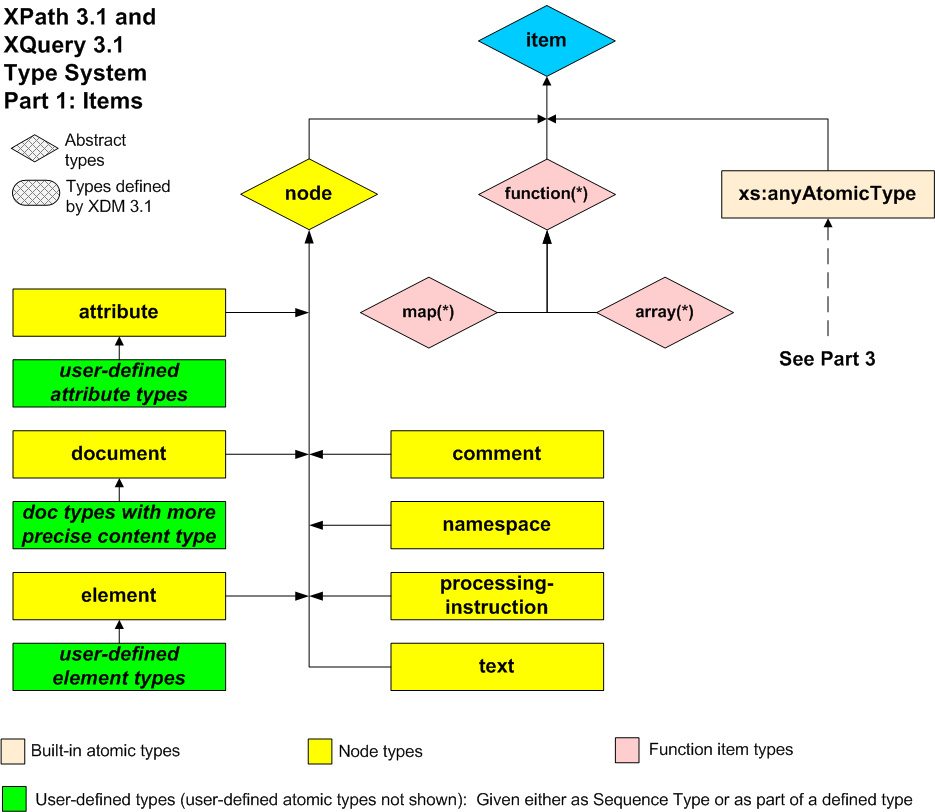
In the table, each type whose name is indented is derived from the type whose name appears nearest above it with one less level of indentation.
| item | |||
| xs:anyAtomicType | |||
| node | |||
| attribute | |||
| user-defined attribute types | |||
| comment | |||
| document | |||
| user-defined document types | |||
| element | |||
| user-defined element types | |||
| namespace | |||
| processing-instruction | |||
| text | |||
| function(*) | |||
| array(*) | |||
| map(*) |
1.6.2 Schema Type Hierarchy
The next diagram and table illustrate the schema type subsystem, in which
all types are derived from the distinguished type xs:anyType.
Schema types include built-in types defined in the XML Schema specification, and user-defined types defined using mechanisms described in the XML Schema specification. Schema types define the permitted contents of nodes. The main categories are complex types, which define the permitted content of elements, and simple types, which can be used to constrain the values of both elements and attributes.
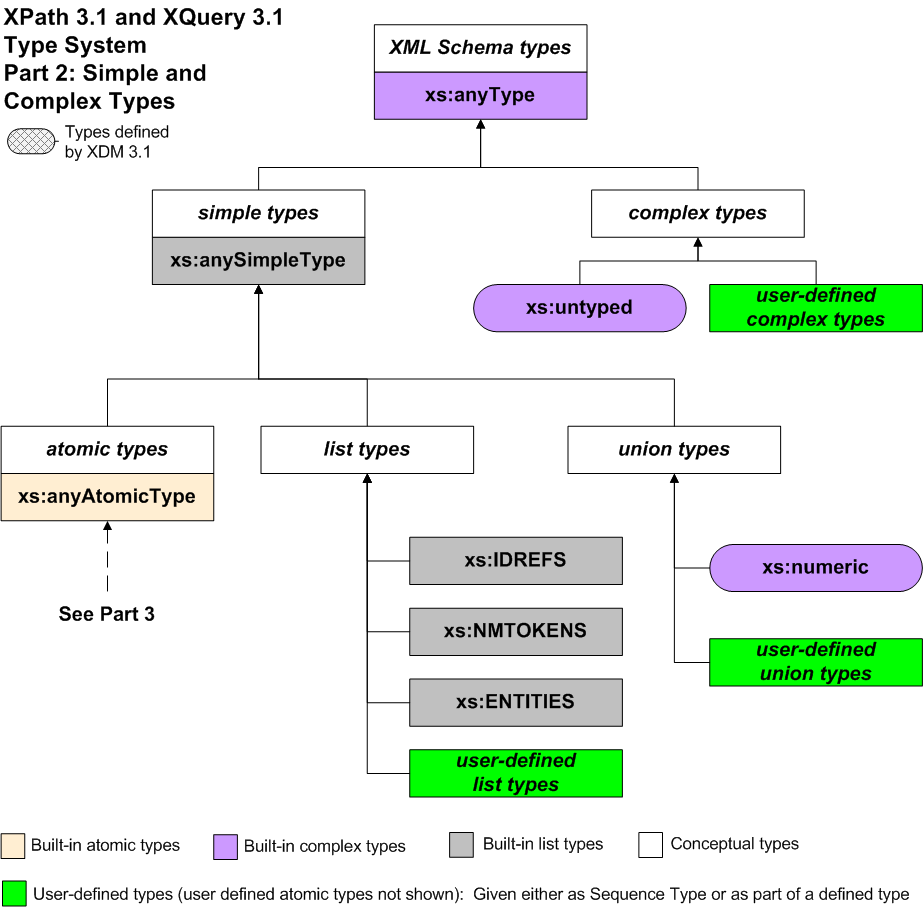
In the table, each type whose name is indented is derived from the type whose name appears nearest above it with one less level of indentation.
| xs:anyType | |||
| xs:anySimpleType | |||
| xs:anyAtomicType | |||
| list types | |||
| xs:IDREFS | |||
| xs:NMTOKENS | |||
| xs:ENTITIES | |||
| user-defined list types | |||
| union types | |||
| xs:numeric | |||
| user-defined union types | |||
| complex types | |||
| xs:untyped | |||
| user-defined complex types |
1.6.3 Atomic Type Hierarchy
The final diagram and table show all of the atomic types, including the primitive simple types and the built-in types derived from the primitive simple types. This includes all the built-in datatypes defined in [XML Schema Part 2: Datatypes Second Edition].
Atomic types are both item types and schema types, so the root type xs:anyAtomicType may be found
in both the previous diagrams.
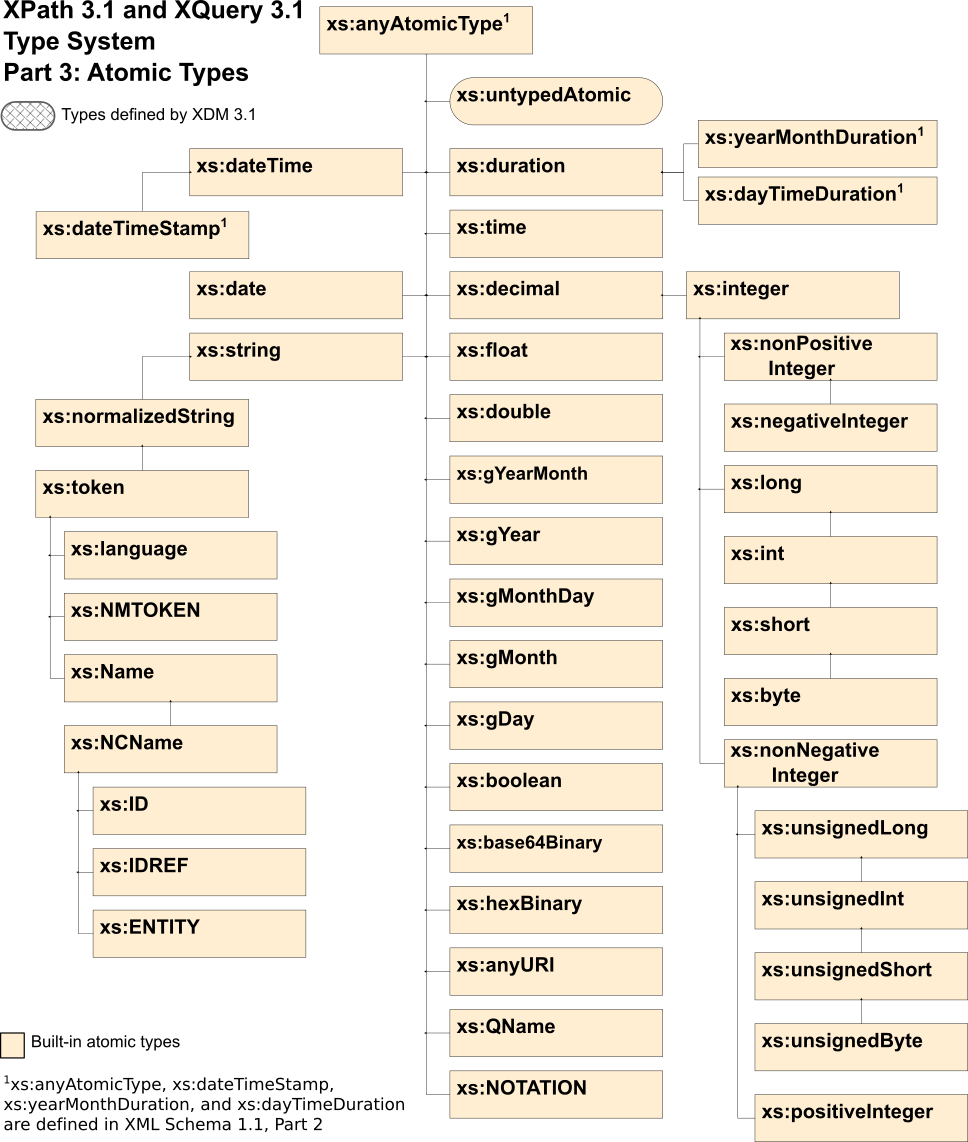
In the table, each type whose name is indented is derived from the type whose name appears nearest above it with one less level of indentation.
| xs:untypedAtomic | ||||||
| xs:dateTime | ||||||
| xs:dateTimeStamp | ||||||
| xs:date | ||||||
| xs:time | ||||||
| xs:duration | ||||||
| xs:yearMonthDuration | ||||||
| xs:dayTimeDuration | ||||||
| xs:float | ||||||
| xs:double | ||||||
| xs:decimal | ||||||
| xs:integer | ||||||
| xs:nonPositiveInteger | ||||||
| xs:negativeInteger | ||||||
| xs:long | ||||||
| xs:int | ||||||
| xs:short | ||||||
| xs:byte | ||||||
| xs:nonNegativeInteger | ||||||
| xs:unsignedLong | ||||||
| xs:unsignedInt | ||||||
| xs:unsignedShort | ||||||
| xs:unsignedByte | ||||||
| xs:positiveInteger | ||||||
| xs:gYearMonth | ||||||
| xs:gYear | ||||||
| xs:gMonthDay | ||||||
| xs:gDay | ||||||
| xs:gMonth | ||||||
| xs:string | ||||||
| xs:normalizedString | ||||||
| xs:token | ||||||
| xs:language | ||||||
| xs:NMTOKEN | ||||||
| xs:Name | ||||||
| xs:NCName | ||||||
| xs:ID | ||||||
| xs:IDREF | ||||||
| xs:ENTITY | ||||||
| xs:boolean | ||||||
| xs:base64Binary | ||||||
| xs:hexBinary | ||||||
| xs:anyURI | ||||||
| xs:QName | ||||||
| xs:NOTATION |
1.7 Terminology
The terminology used to describe the functions and operators on types defined in [XML Schema Part 2: Datatypes Second Edition] is defined in the body of this specification. The terms defined in this section are used in building those definitions.
Note:
Following in the tradition of [XML Schema Part 2: Datatypes Second Edition], the terms type and datatype are used interchangeably.
1.7.1 Strings, characters, and codepoints
This document uses the terms string, character, and codepoint
with meanings that are normatively defined in [XQuery and XPath Data Model (XDM) 3.1], and which are paraphrased here
for ease of reference:
[Definition] A character is an instance of the CharXML production of [Extensible Markup Language (XML) 1.0 (Fifth Edition)].
Note:
This definition excludes Unicode characters in the surrogate blocks as well as xFFFE and xFFFF, while including characters with codepoints greater than xFFFF which some programming languages treat as two characters. The valid characters are defined by their codepoints, and include some whose codepoints have not been assigned by the Unicode consortium to any character.
[Definition] A string is a sequence of zero or more
·characters·, or equivalently,
a value in the value space of the xs:string datatype.
[Definition] A codepoint is an integer assigned to a ·character· by the Unicode consortium, or reserved for future assignment to a character.
Note:
The set of codepoints is thus wider than the set of characters.
This specification spells "codepoint" as one word; the Unicode specification spells it as "code point". Equivalent terms found in other specifications are "character number" or "code position". See [Character Model for the World Wide Web 1.0: Fundamentals]
Because these terms appear so frequently, they are hyperlinked to the definition only when there is a particular desire to draw the reader's attention to the definition; the absence of a hyperlink does not mean that the term is being used in some other sense.
It is ·implementation-defined· which version of [The Unicode Standard] is supported, but it is recommended that the most recent version of Unicode be used.
Unless explicitly stated, the xs:string values returned by the
functions in this document are not normalized in the sense of [Character Model for the World Wide Web 1.0: Fundamentals].
Notes:
In functions that involve character counting such
as fn:substring, fn:string-length and
fn:translate, what is counted is the number of XML ·characters·
in the string (or equivalently, the number of Unicode codepoints). Some
implementations may represent a codepoint above xFFFF using two 16-bit
values known as a surrogate pair. A surrogate pair counts as one character, not two.
1.7.2 Namespaces and URIs
This document uses the phrase "namespace URI" to identify the concept identified in [Namespaces in XML] as "namespace name", and the phrase "local name" to identify the concept identified in [Namespaces in XML] as "local part".
It also uses the term "expanded-QName" defined below.
[Definition] An expanded-QName
is a value in the value space of the xs:QName datatype as defined in the XDM data model
(see [XQuery and XPath Data Model (XDM) 3.1]): that is, a triple containing namespace prefix (optional), namespace URI (optional),
and local name. Two expanded QNames are equal if the namespace URIs are the same (or
both absent)
and the local names are the same. The prefix plays no part in the comparison, but
is used only
if the expanded QName needs to be converted back to a string.
The term URI is used as follows:
[Definition] Within this specification, the term URI refers to Universal Resource Identifiers as
defined in [RFC 3986] and extended in [RFC 3987] with a new name IRI. The term URI
Reference, unless otherwise stated, refers to a string in the lexical space of the xs:anyURI datatype
as defined in [XML Schema Part 2: Datatypes Second Edition].
Note:
Note that this means, in practice, that where this
specification requires a "URI Reference", an IRI as defined in [RFC 3987] will be
accepted, provided that other relevant specifications also permit an IRI. The term
URI has been
retained in preference to IRI to avoid introducing new names for concepts such as
"Base URI" that
are defined or referenced across the whole family of XML specifications. Note also
that the
definition of xs:anyURI is a wider definition than the definition in [RFC 3987];
for example it does not require non-ASCII characters to be escaped.
1.7.3 Conformance terminology
In this specification:
-
The auxiliary verb must, when rendered in small capitals, indicates a precondition for conformance.
-
When the sentence relates to an implementation of a function (for example "All implementations must recognize URIs of the form ...") then an implementation is not conformant unless it behaves as stated.
-
When the sentence relates to the result of a function (for example "The result must have the same type as
$arg") then the implementation is not conformant unless it delivers a result as stated. -
When the sentence relates to the arguments to a function (for example "The value of
$argmust be a valid regular expression") then the implementation is not conformant unless it enforces the condition by raising a dynamic error whenever the condition is not satisfied.
-
-
The auxiliary verb may, when rendered in small capitals, indicates optional or discretionary behavior. The statement "An implementation may do X" implies that it is implementation-dependent whether or not it does X.
-
The auxiliary verb should, when rendered in small capitals, indicates desirable or recommended behavior. The statement "An implementation should do X" implies that it is desirable to do X, but implementations may choose to do otherwise if this is judged appropriate.
[Definition] Where behavior is described as implementation-defined, variations between processors are permitted, but a conformant implementation must document the choices it has made.
[Definition] Where behavior is described as implementation-dependent, variations between processors are permitted, and conformant implementations are not required to document the choices they have made.
Note:
Where this specification states that something is implementation-defined or implementation-dependent, it is open to host languages to place further constraints on the behavior.
1.7.4 Properties of functions
This section is concerned with the question of whether two calls on a function, with the same arguments, may produce different results.
[Definition] An execution scope is a sequence of
calls to the function library during which certain aspects of the state are required
to remain invariant.
For example, two calls to fn:current-dateTime within the same execution scope will return the same result.
The execution scope is defined by the host language that invokes the function library.
In XSLT, for example, any two function calls executed during
the same transformation are in the same execution scope (except that static expressions,
such as those used in
use-when attributes, are in a separate execution scope).
The following definition explains more precisely what it means for two function calls to return the same result:
[Definition] Two values are defined to be identical if they contain the same number of items and the items are pairwise identical. Two items are identical if and only if one of the following conditions applies:
-
Both items are atomic values, of precisely the same type, and the values are equal as defined using the
eqoperator, using the Unicode codepoint collation when comparing strings. -
Both items are nodes, and represent the same node.
-
Both items are maps, both maps have the same number of entries, and for every entry E1 in the first map there is an entry E2 in the second map such that the keys of E1 and E2 are ·the same key·, and the corresponding values V1 and V2 are ·identical·.
-
Both items are arrays, both arrays have the same number of members, and the members are pairwise ·identical·.
-
Both items are function items, neither item is a map or array, and all the following conditions apply:
-
Either both functions have the same name, or both names are absentDM31.
-
Both functions have the same arity.
-
Both functions have the same function signature. Two function signatures are defined to be the same if the declared result types are identical and the declared argument types are pairwise identical. Two types S and T are defined to be identical if and only if
subtype(S, T)andsubtype(T, S)both hold, where the subtype relation is defined in Section 2.5.6.1 The judgement subtype(A, B) XP31.Note:
Under this definition, a union type with
memberTypes="xs:double xs:decimal"is identical to a union type withmemberTypes="xs:decimal xs:double". However, two functions whose signatures differ in this way will probably be deemed non-identical under rule (e) below, because they are likely to have different effect when invoked with an argument of typexs:untypedAtomic. -
Both functions have the same nonlocal variable bindings (sometimes called the function's closure).
-
The processor is able to determine that the implementations of the two functions are equivalent, in the sense that for all possible combinations of arguments, the two functions have the same effect.
Note:
There is no function or operator defined in the specification that tests whether two function items are identical. Where the specification requires two function items to be identical, for example in the results of repeated calls of a function whose result is a function, then the processor must ensure that it returns functions that are indistinguishable in their observable effect. Where the specification defines behavior conditional on two function items being identical, the determination of identity is to some degree implementation-dependent. There are cases where function items are definitely not identical (for example if they have different name or arity), but positive determination of identity is possible only using implementation-dependent techniques, for example when both items contain references to the same piece of code representing the function's implementation.
-
Some functions produce results that depend not only on their explicit arguments, but also on the static and dynamic context.
[Definition] A function may have the property of being context-dependent: the result of such a function depends on the values of properties in the static and dynamic evaluation context as well as on the actual supplied arguments (if any).
[Definition] A function that is not ·context-dependent· is called context-independent.
A function that is context-dependent can be used as a named
function reference, can be partially applied, and can be found using fn:function-lookup.
The principle in such cases is that the static context used for the function evaluation
is taken from the static context of the named function reference, partial function
application, or the call
on fn:function-lookup; and the dynamic context for the function evaluation is taken from the dynamic
context of the evaluation of the named function reference, partial function application,
or the call
of fn:function-lookup. In effect, the static and dynamic part of the context thus act
as part of the closure of the function item.
Context-dependent functions fall into a number of categories:
-
The functions
fn:current-date,fn:current-dateTime,fn:current-time,fn:default-language,fn:implicit-timezone,fn:adjust-date-to-timezone,fn:adjust-dateTime-to-timezone, andfn:adjust-time-to-timezonedepend on properties of the dynamic context that are fixed within the ·execution scope·. The same applies to a number of functions in theop:namespace that manipulate dates and times and that make use of the implicit timezone. These functions will return the same result if called repeatedly during a single ·execution scope·. -
A number of functions including
fn:base-uri#0,fn:data#0,fn:document-uri#0,fn:element-with-id#1,fn:id#1,fn:idref#1,fn:lang#1,fn:last#0,fn:local-name#0,fn:name#0,fn:namespace-uri#0,fn:normalize-space#0,fn:number#0,fn:path#0,fn:position#0,fn:root#0,fn:string#0, andfn:string-length#0depend on the focusXP31. These functions will in general return different results on different calls if the focus is different.[Definition] A function is focus-dependent if its result depends on the focusXP31 (that is, the context item, position, or size).
[Definition] A function that is not ·focus-dependent· is called focus-independent
-
The function
fn:default-collationand many string-handling operators and functions depend on the default collation and the in-scope collations, which are both properties of the static context. If a particular call of one of these functions is evaluated twice with the same arguments then it will return the same result each time (because the static context, by definition, does not change at run time). However, two distinct calls (that is, two calls on the function appearing in different places in the source code) may produce different results even if the explicit arguments are the same. -
Functions such as
fn:static-base-uri,fn:doc, andfn:collectiondepend on other aspects of the static context. As with functions that depend on collations, a single call will produce the same results on each call if the explicit arguments are the same, but two calls appearing in different places in the source code may produce different results.
The fn:function-lookup function is a special case because it is
potentially dependent on everything in the static and dynamic context. This is because
the static and dynamic
context of the call to fn:function-lookup are used as the static and dynamic context of the
function that fn:function-lookup returns.
[Definition] For a ·context-dependent· function, the parts of the context on which it depends are referred to as implicit arguments.
[Definition] A function that is guaranteed to produce ·identical· results from repeated calls within a single ·execution scope· if the explicit and implicit arguments are identical is referred to as deterministic.
[Definition] A function that is not ·deterministic· is referred to as nondeterministic.
All functions defined in this specification are ·deterministic· unless otherwise stated. Exceptions include the following:
-
[Definition] Some functions (such as
fn:distinct-values,fn:unordered,map:keys, andmap:for-each) produce results in an ·implementation-defined· or ·implementation-dependent· order. In such cases two calls with the same arguments are not guaranteed to produce the results in the same order. These functions are said to be nondeterministic with respect to ordering. -
Some functions (such as
fn:analyze-string,fn:parse-xml,fn:parse-xml-fragment, andfn:json-to-xml) construct a tree of nodes to represent their results. There is no guarantee that repeated calls with the same arguments will return the same identical node (in the sense of theisoperator). However, if non-identical nodes are returned, their content will be the same in the sense of thefn:deep-equalfunction. Such a function is said to be non-deterministic with respect to node identity. -
Some functions (such as
fn:docandfn:collection) create new nodes by reading external documents. Such functions are guaranteed to be ·deterministic· with the exception that an implementation is allowed to make them non-deterministic as a user option.
Where the results of a function are described as being (to a greater or lesser extent) ·implementation-defined· or ·implementation-dependent·, this does not by itself remove the requirement that the results should be deterministic: that is, that repeated calls with the same explicit and implicit arguments must return identical results.
2 Accessors
Accessors and their semantics are described in [XQuery and XPath Data Model (XDM) 3.1]. Some of these accessors are exposed to the user through the functions described below.
Each of these functions has an arity-zero signature which is equivalent to the arity-one
form, with the context item supplied as the implicit first argument. In addition,
each of the
arity-one functions accepts an empty sequence as the argument, in which case it generally
delivers
an empty sequence as the result: the exception is fn:string, which delivers
a zero-length string.
| Function | Accessor | Accepts | Returns |
|---|---|---|---|
fn:node-name
|
node-name
|
node (optional) | xs:QName (optional)
|
fn:nilled
|
nilled
|
node (optional) | xs:boolean (optional)
|
fn:string
|
string-value
|
item (optional) |
xs:string
|
fn:data
|
typed-value
|
zero or more items | a sequence of atomic values |
fn:base-uri
|
base-uri
|
node (optional) | xs:anyURI (optional)
|
fn:document-uri
|
document-uri
|
node (optional) | xs:anyURI (optional)
|
2.1 fn:node-name
- Summary
-
Returns the name of a node, as an
xs:QName. - Signatures
-
fn:node-name()asxs:QName?fn:node-name($argasnode()?)asxs:QName? - Properties
-
The zero-argument form of this function is ·deterministic·, ·context-dependent·, and ·focus-dependent·.
The one-argument form of this function is ·deterministic·, ·context-independent·, and ·focus-independent·.
- Rules
-
If the argument is omitted, it defaults to the context item (
.). The behavior of the function if the argument is omitted is exactly the same as if the context item had been passed as the argument.If
$argis the empty sequence, the empty sequence is returned.Otherwise, the function returns the result of the
dm:node-nameaccessor as defined in [XQuery and XPath Data Model (XDM) 3.1] (see Section 5.10 node-name Accessor DM31). - Error Conditions
-
The following errors may be raised when
$argis omitted:-
If the context item is absentDM31, dynamic error [err:XPDY0002]XP31
-
If the context item is not a node, type error [err:XPTY0004]XP31.
-
- Notes
-
For element and attribute nodes, the name of the node is returned as an
xs:QName, retaining the prefix, namespace URI, and local part.For processing instructions, the name of the node is returned as an
xs:QNamein which the prefix and namespace URI are absentDM31.For a namespace node, the function returns an empty sequence if the node represents the default namespace; otherwise it returns an
xs:QNamein which prefix and namespace URI are absentDM31 and the local part is the namespace prefix being bound.For all other kinds of node, the function returns the empty sequence.
2.2 fn:nilled
- Summary
-
Returns true for an element that is nilled.
- Signatures
-
fn:nilled()asxs:boolean?fn:nilled($argasnode()?)asxs:boolean? - Properties
-
The zero-argument form of this function is ·deterministic·, ·context-dependent·, and ·focus-dependent·.
The one-argument form of this function is ·deterministic·, ·context-independent·, and ·focus-independent·.
- Rules
-
If the argument is omitted, it defaults to the context item (
.). The behavior of the function if the argument is omitted is exactly the same as if the context item had been passed as the argument.If
$argis the empty sequence, the function returns the empty sequence.Otherwise the function returns the result of the
dm:nilledaccessor as defined in [XQuery and XPath Data Model (XDM) 3.1] (see Section 5.8 nilled Accessor DM31). - Error Conditions
-
The following errors may be raised when
$argis omitted:-
If the context item is absentDM31, dynamic error [err:XPDY0002]XP31
-
If the context item is not a node, type error [err:XPTY0004]XP31.
-
- Notes
-
If
$argis not an element node, the function returns the empty sequence.If
$argis an untyped element node, the function returns false.In practice, the function returns
trueonly for an element node that has the attributexsi:nil="true"and that is successfully validated against a schema that defines the element to be nillable; the detailed rules, however, are defined in [XQuery and XPath Data Model (XDM) 3.1].
2.3 fn:string
- Summary
-
Returns the value of
$argrepresented as anxs:string. - Signatures
-
fn:string()asxs:stringfn:string($argasitem()?)asxs:string - Properties
-
The zero-argument form of this function is ·deterministic·, ·context-dependent·, and ·focus-dependent·.
The one-argument form of this function is ·deterministic·, ·context-independent·, and ·focus-independent·.
- Rules
-
In the zero-argument version of the function,
$argdefaults to the context item. That is, callingfn:string()is equivalent to callingfn:string(.).If
$argis the empty sequence, the function returns the zero-length string.If $arg is a node, the function returns the string value of the node, as obtained using the
dm:string-valueaccessor defined in [XQuery and XPath Data Model (XDM) 3.1] (see Section 5.12 string-value Accessor DM31).If $arg is an atomic value, the function returns the result of the expression
$arg cast
                           as xs:string
(see 19 Casting).In all other cases, a dynamic error occurs (see below).
- Error Conditions
-
A dynamic error is raised [err:XPDY0002]XP31 by the zero-argument version of the function if the context item is absentDM31.
A type error is raised [err:FOTY0014] if
$argis a function item (this includes maps and arrays). - Notes
-
Every node has a string value, even an element with element-only content (which has no typed value). Moreover, casting an atomic value to a string always succeeds. Functions, maps, and arrays have no string value, so these are the only arguments that satisfy the type signature but cause failure.
- Examples
-
The expression
string(23)returns"23".The expression
string(false())returns"false".The expression
string("Paris")returns"Paris".The expression
string((1, 2, 3))raises errorXPTY0004.The expression
string([[1, 2], [3, 4]])raises errorFOTY0014.The expression
string(abs#1)raises errorFOTY0014.let $para := <para>In a hole in the ground there lived a <term author="Tolkien">hobbit</term>.</para>The expression
string($para)returns"In a hole in the ground there lived a hobbit.".
2.4 fn:data
- Summary
-
Returns the result of atomizing a sequence. This process flattens arrays, and replaces nodes by their typed values.
- Signatures
-
fn:data()asxs:anyAtomicType*fn:data($argasitem()*)asxs:anyAtomicType* - Properties
-
The zero-argument form of this function is ·deterministic·, ·context-dependent·, and ·focus-dependent·.
The one-argument form of this function is ·deterministic·, ·context-independent·, and ·focus-independent·.
- Rules
-
If the argument is omitted, it defaults to the context item (
.). The behavior of the function if the argument is omitted is exactly the same as if the context item had been passed as the argument.The result of
fn:datais the sequence of atomic values produced by applying the following rules to each item in$arg:-
If the item is an atomic value, it is appended to the result sequence.
-
If the item is a node, the typed value of the node is appended to the result sequence. The typed value is a sequence of zero or more atomic values: specifically, the result of the
dm:typed-valueaccessor as defined in [XQuery and XPath Data Model (XDM) 3.1] (See Section 5.14 typed-value Accessor DM31). -
If the item is an array, the result of applying
fn:datato each member of the array, in order, is appended to the result sequence.
-
- Error Conditions
-
A type error is raised [err:FOTY0012] if an item in the sequence
$argis a node that does not have a typed value.A type error is raised [err:FOTY0013] if an item in the sequence
$argis a function item other than an array.A dynamic error is raised if
$argis omitted and the context item is absentDM31. - Notes
-
The process of applying the
fn:datafunction to a sequence is referred to asatomization. In many cases an explicit call onfn:datais not required, because atomization is invoked implicitly when a node or sequence of nodes is supplied in a context where an atomic value or sequence of atomic values is required.The result of atomizing an empty sequence is an empty sequence.
The result of atomizing an empty array is an empty sequence.
- Examples
-
The expression
data(123)returns123.The expression
data((123, 456))returns123, 456.The expression
data([[1,2],[3,4]])returns1, 2, 3, 4.let $para := <para>In a hole in the ground there lived a <term author="Tolkien">hobbit</term>.</para>The expression
data($para)returnsxs:untypedAtomic("In a hole in the ground there lived a hobbit.").The expression
data($para/term/@author)returnsxs:untypedAtomic("Tolkien").The expression
data(abs#1)raises errorFOTY0013.
2.5 fn:base-uri
- Summary
-
Returns the base URI of a node.
- Signatures
-
fn:base-uri()asxs:anyURI?fn:base-uri($argasnode()?)asxs:anyURI? - Properties
-
The zero-argument form of this function is ·deterministic·, ·context-dependent·, and ·focus-dependent·.
The one-argument form of this function is ·deterministic·, ·context-independent·, and ·focus-independent·.
- Rules
-
The zero-argument version of the function returns the base URI of the context node: it is equivalent to calling
fn:base-uri(.).The single-argument version of the function behaves as follows:
- If
$argis the empty sequence, the function returns the empty sequence. - Otherwise, the function returns the value of the
dm:base-uriaccessor applied to the node$arg. This accessor is defined, for each kind of node, in the XDM specification (See Section 5.2 base-uri Accessor DM31).
Note:
As explained in XDM, document, element and processing-instruction nodes have a base-uri property which may be empty. The base-uri property for all other node kinds is the empty sequence. The dm:base-uri accessor returns the base-uri property of a node if it exists and is non-empty; otherwise it returns the result of applying the dm:base-uri accessor to its parent, recursively. If the node does not have a parent, or if the recursive ascent up the ancestor chain encounters a parentless node whose base-uri property is empty, the empty sequence is returned. In the case of namespace nodes, however, the result is always an empty sequence — it does not depend on the base URI of the parent element.
See also
fn:static-base-uri. - If
- Error Conditions
-
The following errors may be raised when
$argis omitted:-
If the context item is absentDM31, dynamic error [err:XPDY0002]XP31
-
If the context item is not a node, type error [err:XPTY0004]XP31.
-
2.6 fn:document-uri
- Summary
-
Returns the URI of a resource where a document can be found, if available.
- Signatures
-
fn:document-uri()asxs:anyURI?fn:document-uri($argasnode()?)asxs:anyURI? - Properties
-
The zero-argument form of this function is ·deterministic·, ·context-dependent·, and ·focus-dependent·.
The one-argument form of this function is ·deterministic·, ·context-independent·, and ·focus-independent·.
- Rules
-
If the argument is omitted, it defaults to the context item (
.). The behavior of the function if the argument is omitted is exactly the same as if the context item had been passed as the argument.If
$argis the empty sequence, the function returns the empty sequence.If
$argis not a document node, the function returns the empty sequence.Otherwise, the function returns the value of the
document-uriaccessor applied to$arg, as defined in [XQuery and XPath Data Model (XDM) 3.1] (See Section 6.1.2 Accessors DM31). - Error Conditions
-
The following errors may be raised when
$argis omitted:-
If the context item is absentDM31, dynamic error [err:XPDY0002]XP31
-
If the context item is not a node, type error [err:XPTY0004]XP31.
-
- Notes
-
In the case of a document node
$Dreturned by thefn:docfunction, or a document node at the root of a tree containing a node returned by thefn:collectionfunction, it will always be true that eitherfn:document-uri($D)returns the empty sequence, or that the following expression is true:fn:doc(fn:document-uri($D))is$D. It is ·implementation-defined· whether this guarantee also holds for document nodes obtained by other means, for example a document node passed as the initial context node of a query or transformation.
3 Errors and diagnostics
3.1 Raising errors
In this document, as well as in [XQuery 3.1: An XML Query Language] and [XML Path Language (XPath) 3.1],
the phrase "an error is raised"
is used. Raising an error is equivalent to calling the fn:error
function defined in this section with the provided error code. Except
where otherwise
specified, errors defined in this specification are dynamic errors.
Some errors,
however, are classified as type errors. Type errors are typically
used where the presence
of the error can be inferred from knowledge of the type of the actual arguments
to a function, for
example with a call such as fn:string(fn:abs#1). Host languages may allow type errors
to be reported statically if they are discovered during static analysis.
When function specifications indicate that an error is to be raised, the notation
"[error code]". os used to specify an error code. Each error defined
in this document is identified by an xs:QName that is in the
http://www.w3.org/2005/xqt-errors namespace, represented in this document by the err prefix. It is this
xs:QName that is actually passed as an argument to the
fn:error function. Calling this function raises an error. For a
more detailed treatment of error handing, see Section
2.3.3 Handling Dynamic Errors
XP31.
The fn:error function is a general function that may be called as above
but may also be called from [XQuery 3.1: An XML Query Language] or [XML Path Language (XPath) 3.1]
applications with, for example, an xs:QName argument.
3.1.1 fn:error
- Summary
-
Calling the
fn:errorfunction raises an application-defined error. - Signatures
-
fn:error()asnonefn:error($codeasxs:QName?)asnonefn:error($codeasxs:QName?,$descriptionasxs:string)asnonefn:error($codeasxs:QName?,$descriptionasxs:string,$error-objectasitem()*)asnone - Properties
-
This function is ·nondeterministic·, ·context-independent·, and ·focus-independent·.
- Rules
-
This function never returns a value. Instead it always raises an error. The effect of the error is identical to the effect of dynamic errors raised implicitly, for example when an incorrect argument is supplied to a function.
The parameters to the
fn:errorfunction supply information that is associated with the error condition and that is made available to a caller that asks for information about the error. The error may be caught either by the host language (using a try/catch construct in XSLT or XQuery, for example), or by the calling application or external processing environment. The way in which error information is returned to the external processing environment is ·implementation-dependent·.There are three pieces of information that may be associated with an error:
-
The
$codeis an error code that distinguishes this error from others. It is anxs:QName; the namespace URI conventionally identifies the component, subsystem, or authority responsible for defining the meaning of the error code, while the local part identifies the specific error condition. The namespace URIhttp://www.w3.org/2005/xqt-errorsis used for errors defined in this specification; other namespace URIs may be used for errors defined by the application.If the external processing environment expects the error code to be returned as a URI or a string rather than as an
xs:QName, then an error code with namespace URINSand local partLPwill be returned in the formNS#LP. The namespace URI part of the error code should therefore not include a fragment identifier.If no value is supplied for the
$codeargument (that is, if the function is called with no arguments or if the first argument is an empty sequence), the effective value of the error code isfn:QName('http://www.w3.org/2005/xqt-errors', 'err:FOER0000'). -
The
$descriptionis a natural-language description of the error condition.If no value is supplied for the
$descriptionargument (that is, if the function is called with less than two arguments), then the effective value of the description is ·implementation-dependent·. -
The
$error-objectis an arbitrary value used to convey additional information about the error, and may be used in any way the application chooses.If no value is supplied for the
$error-objectargument (that is, if the function is called with less than three arguments), then the effective value of the error object is ·implementation-dependent·.
-
- Error Conditions
-
This function always raises a dynamic error. By default, it raises [err:FOER0000]
- Notes
-
The value of the
$descriptionparameter may need to be localized.The type "none" is a special type defined in [XQuery 1.0 and XPath 2.0 Formal Semantics] and is not available to the user. It indicates that the function never returns and ensures that it has the correct static type.
Any QName may be used as an error code; there are no reserved names or namespaces. The error is always classified as a dynamic error, even if the error code used is one that is normally used for static errors or type errors.
- Examples
-
The expression
fn:error()raises errorFOER0000. (This returns the URIhttp://www.w3.org/2005/xqt-errors#FOER0000(or the correspondingxs:QName) to the external processing environment, unless the error is caught using a try/catch construct in the host language.)The expression
fn:error(fn:QName('http://www.example.com/HR', 'myerr:toohighsal'),
                                 'Does not apply because salary is too high')
raises errormyerr:toohighsal. (This returnshttp://www.example.com/HR#toohighsaland thexs:string"Does not apply because salary is too high"(or the correspondingxs:QName) to the external processing environment, unless the error is caught using a try/catch construct in the host language.)
3.2 Diagnostic tracing
3.2.1 fn:trace
- Summary
-
Provides an execution trace intended to be used in debugging queries.
- Signatures
-
fn:trace($valueasitem()*)asitem()*fn:trace($valueasitem()*,$labelasxs:string)asitem()* - Properties
-
This function is ·deterministic·, ·context-independent·, and ·focus-independent·.
- Rules
-
The function returns the value of
$value, unchanged.In addition, the values of
$value, converted to anxs:string, and$label(if supplied) may be directed to a trace data set. The destination of the trace output is ·implementation-defined·. The format of the trace output is ·implementation-dependent·. The ordering of output from calls of thefn:tracefunction is ·implementation-dependent·. - Notes
-
Sometimes there is a need to output trace information unrelated to a specific value. In such cases it can be useful to set
$valueto an empty string or an empty sequence, and to compute the value of the$labelargument:fn:trace((), "Processing item " || $i). - Examples
-
Consider a situation in which a user wants to investigate the actual value passed to a function. Assume that in a particular execution,
$vis anxs:decimalwith value124.84. Writingfn:trace($v, 'the value of $v is:')will put the strings"124.84"and"the value of $v is:"in the trace data set in implementation dependent order.
4 Functions and operators on numerics
This section specifies arithmetic operators on the numeric datatypes defined in [XML Schema Part 2: Datatypes Second Edition].
4.1 Numeric types
The operators described in this section are defined on the following atomic types. Each type whose name is indented is derived from the type whose name appears nearest above with one less level of indentation.
| xs:decimal | |
| xs:integer | |
| xs:float | |
| xs:double |
They also apply to types derived by restriction from the above types.
The type xs:numeric is defined as a union type whose member types are
(in order) xs:double, xs:float, and xs:decimal. This type is implicitly imported
into the static context, so it can also be used in defining the signature of user-written
functions. Apart from the fact that
it is implicitly imported, it behaves exactly like a user-defined type with the same
definition. This means, for example:
-
If the expected type of a function parameter is given as
xs:numeric, the actual value supplied can be an instance of any of these three types, or any type derived from these three by restriction (this includes the built-in typexs:integer, which is derived fromxs:decimal). -
If the expected type of a function parameter is given as
xs:numeric, and the actual value supplied isxs:untypedAtomic(or a node whose atomized value isxs:untypedAtomic), then it will be cast to the union typexs:numericusing the rules in 19.3.5 Casting to union types. Because the lexical space ofxs:doublesubsumes the lexical space of the other member types, andxs:doubleis listed first, the effect is that if the untyped atomic value is in the lexical space ofxs:double, it will be converted to anxs:double, and if not, a dynamic error occurs. -
When the return type of a function is given as
xs:numeric, the actual value returned will be an instance of one of the three member types (and perhaps also of types derived from these by restriction). The rules for the particular function will specify how the type of the result depends on the values supplied as arguments. In many cases, for the functions in this specification, the result is defined to be the same type as the first argument.
Note:
This specification uses [IEEE 754-2008] arithmetic for xs:float and xs:double values.
One consequence of this is that some operations result in the value NaN (not-a number), which
has the unusual property that it is not equal to itself. Another consequence is that
some operations return the value negative zero.
This differs from [XML Schema Part 2: Datatypes Second Edition] which defines
NaN as being equal to itself and defines only a single zero in the value space.
The text accompanying several functions defines behavior for both positive and negative
zero inputs and outputs
in the interest of alignment with [IEEE 754-2008]. A conformant implementation must
respect these semantics. In consequence, the expression -0.0e0 (which is actually a unary minus operator
applied to an xs:double value) will always return negative zero: see 4.2.8 op:numeric-unary-minus.
As a concession to implementations that rely on implementations of XSD 1.0, however,
when casting from string to double
the lexical form -0 may be converted to positive zero, though negative zero
is recommended.
XML Schema 1.1 introduces support for positive and negative zero as distinct values,
and also uses the [IEEE 754-2008]
semantics for comparisons involving NaN.
4.2 Arithmetic operators on numeric values
The following functions define the semantics of arithmetic operators defined in [XQuery 3.1: An XML Query Language] and [XML Path Language (XPath) 3.1] on these numeric types.
| Operator | Meaning |
|---|---|
op:numeric-add
|
Addition |
op:numeric-subtract
|
Subtraction |
op:numeric-multiply
|
Multiplication |
op:numeric-divide
|
Division |
op:numeric-integer-divide
|
Integer division |
op:numeric-mod
|
Modulus |
op:numeric-unary-plus
|
Unary plus |
op:numeric-unary-minus
|
Unary minus (negation) |
The parameters and return types for the above operators are in most cases declared
to be of type
xs:numeric, which permits the basic numeric
types: xs:integer, xs:decimal, xs:float
and xs:double, and types derived from them.
In general the two-argument functions require that both arguments are of the same
primitive type,
and they return a value of this same type.
The exceptions are op:numeric-divide, which returns
an xs:decimal if called with two xs:integer operands,
and op:numeric-integer-divide which always returns an xs:integer.
If the two operands of an arithmetic expression are not of the same type, subtype substitution and numeric type promotion are used to obtain two operands of the same type. Section B.1 Type Promotion XP31 and Section B.2 Operator Mapping XP31 describe the semantics of these operations in detail.
The result type of operations depends on their argument datatypes and is defined in the following table:
| Operator | Returns |
|---|---|
op:operation(xs:integer, xs:integer)
|
xs:integer (except for op:numeric-divide(integer,
integer), which returns xs:decimal)
|
op:operation(xs:decimal, xs:decimal)
|
xs:decimal
|
op:operation(xs:float, xs:float)
|
xs:float
|
op:operation(xs:double, xs:double)
|
xs:double
|
op:operation(xs:integer)
|
xs:integer
|
op:operation(xs:decimal)
|
xs:decimal
|
op:operation(xs:float)
|
xs:float
|
op:operation(xs:double)
|
xs:double
|
These rules define any operation on any pair of arithmetic types. Consider the following example:
op:operation(xs:int, xs:double) => op:operation(xs:double, xs:double)
For this operation, xs:int must be converted to
xs:double. This can be done, since by the rules above:
xs:int can be substituted for xs:integer,
xs:integer can be substituted for xs:decimal,
xs:decimal can be promoted to xs:double. As far as possible, the promotions should be done in a
single step. Specifically, when an xs:decimal is promoted to an
xs:double, it should not be converted to an xs:float
and then to xs:double, as this risks loss of precision.
As another example, a user may define height as a derived type of
xs:integer with a minimum value of 20 and a maximum value of 100.
They may then derive fenceHeight using an enumeration to restrict the
permitted set of values to, say, 36, 48 and 60.
op:operation(fenceHeight, xs:integer) => op:operation(xs:integer, xs:integer)
fenceHeight can be substituted for its base type
height and height can be substituted for its base type
xs:integer.
The basic rules for addition, subtraction, and multiplication
of ordinary numbers are not set out in this specification; they are taken as given.
In the case of xs:double
and xs:float the rules are as defined in [IEEE 754-2008]. The rules for handling
division and modulus operations, as well as the rules for handling special values
such as infinity and NaN,
and exception conditions such as overflow and underflow, are described more explicitly
since they are not necessarily obvious.
On overflow and underflow situations during arithmetic operations conforming implementations must behave as follows:
-
For
xs:floatandxs:doubleoperations, overflow behavior must be conformant with [IEEE 754-2008]. This specification allows the following options:-
Raising a dynamic error [err:FOAR0002] via an overflow trap.
-
Returning
INFor-INF. -
Returning the largest (positive or negative) non-infinite number.
-
-
For
xs:floatandxs:doubleoperations, underflow behavior must be conformant with [IEEE 754-2008]. This specification allows the following options:-
Raising a dynamic error [err:FOAR0002] via an underflow trap.
-
Returning
0.0E0or+/- 2**Eminor a denormalized value; whereEminis the smallest possiblexs:floatorxs:doubleexponent.
-
-
For
xs:decimaloperations, overflow behavior must raise a dynamic error [err:FOAR0002]. On underflow,0.0must be returned. -
For
xs:integeroperations, implementations that support limited-precision integer operations must select from the following options:-
They may choose to always raise a dynamic error [err:FOAR0002].
-
They may provide an ·implementation-defined· mechanism that allows users to choose between raising an error and returning a result that is modulo the largest representable integer value. See [ISO 10967].
-
The functions op:numeric-add, op:numeric-subtract,
op:numeric-multiply, op:numeric-divide,
op:numeric-integer-divide and op:numeric-mod are each
defined for pairs of numeric operands, each of which has the same
type:xs:integer, xs:decimal, xs:float, or
xs:double. The functions op:numeric-unary-plus and
op:numeric-unary-minus are defined for a single operand whose type
is one of those same numeric types.
For xs:float and xs:double arguments, if either
argument is NaN, the result is NaN.
For xs:decimal values, let N be the number of digits
of precision supported by the implementation, and let M (M <= N) be the minimum limit on the number of digits
required for conformance (18 digits for XSD 1.0, 16 digits for XSD 1.1). Then for
addition, subtraction, and multiplication
operations, the returned result should be accurate to N digits of precision, and for division and modulus operations,
the returned result should be accurate to at least M digits of precision.
The actual precision is ·implementation-defined·. If the number
of digits in the mathematical result exceeds the number of digits that the implementation
retains for that operation, the result is truncated or rounded in an ·implementation-defined· manner.
Note:
This Recommendation does not specify whether xs:decimal operations are fixed point or floating point.
In an implementation using floating point it is possible for very simple operations
to require more digits of precision than
are available; for example adding 1e100 to 1e-100 requires 200 digits of precision for an
accurate representation of the result.
The [IEEE 754-2008] specification also describes handling of
two exception conditions called divideByZero and invalidOperation. The
IEEE divideByZero exception is raised not only by a direct attempt to divide by zero, but also by
operations such as log(0). The IEEE invalidOperation exception is raised by
attempts to call a function with an argument that is outside the function's domain
(for example,
sqrt(-1) or log(-1)).
Although IEEE defines these as exceptions, it also defines "default non-stop exception
handling" in
which the operation returns a defined result, typically positive or negative infinity,
or NaN. With this
function library,
these IEEE exceptions do not cause a dynamic error
at the application level; rather they result in the relevant function or operator
returning
the defined non-error result.
The underlying IEEE exception may be notified to the application
or to the user by some ·implementation-defined·
warning condition, but the observable effect on an application
using the functions and operators defined in this specification is simply to return
the defined
result (typically -INF, +INF, or NaN) with no error.
The [IEEE 754-2008] specification distinguishes two NaN values,
a quiet NaN and a signaling NaN. These two values are not distinguishable in the XDM
model:
the value spaces of xs:float and xs:double each include only a single
NaN value. This does not prevent the implementation distinguishing them internally,
and triggering different ·implementation-defined·
warning conditions, but such distinctions do not affect the observable behavior of
an application
using the functions and operators defined in this specification.
4.2.1 op:numeric-add
- Summary
-
Returns the arithmetic sum of its operands: (
$arg1 + $arg2). - Operator Mapping
-
Defines the semantics of the "+" operator when applied to two numeric values
- Signature
-
op:numeric-add($arg1asxs:numeric,$arg2asxs:numeric)asxs:numeric - Rules
-
General rules: see 4.2 Arithmetic operators on numeric values.
- Notes
-
For
xs:floatorxs:doublevalues, if one of the operands is a zero or a finite number and the other isINFor-INF,INFor-INFis returned. If both operands areINF,INFis returned. If both operands are-INF,-INFis returned. If one of the operands isINFand the other is-INF,NaNis returned.
4.2.2 op:numeric-subtract
- Summary
-
Returns the arithmetic difference of its operands: (
$arg1 - $arg2). - Operator Mapping
-
Defines the semantics of the "-" operator when applied to two numeric values.
- Signature
-
op:numeric-subtract($arg1asxs:numeric,$arg2asxs:numeric)asxs:numeric - Rules
-
General rules: see 4.2 Arithmetic operators on numeric values.
- Notes
-
For
xs:floatorxs:doublevalues, if one of the operands is a zero or a finite number and the other isINFor-INF, an infinity of the appropriate sign is returned. If both operands areINFor-INF,NaNis returned. If one of the operands isINFand the other is-INF, an infinity of the appropriate sign is returned.
4.2.3 op:numeric-multiply
- Summary
-
Returns the arithmetic product of its operands: (
$arg1 * $arg2). - Operator Mapping
-
Defines the semantics of the "*" operator when applied to two numeric values.
- Signature
-
op:numeric-multiply($arg1asxs:numeric,$arg2asxs:numeric)asxs:numeric - Rules
-
General rules: see 4.2 Arithmetic operators on numeric values.
- Notes
-
For
xs:floatorxs:doublevalues, if one of the operands is a zero and the other is an infinity,NaNis returned. If one of the operands is a non-zero number and the other is an infinity, an infinity with the appropriate sign is returned.
4.2.4 op:numeric-divide
- Summary
-
Returns the arithmetic quotient of its operands: (
$arg1 div $arg2). - Operator Mapping
-
Defines the semantics of the "div" operator when applied to two numeric values.
- Signature
-
op:numeric-divide($arg1asxs:numeric,$arg2asxs:numeric)asxs:numeric - Rules
-
General rules: see 4.2 Arithmetic operators on numeric values.
As a special case, if the types of both
$arg1and$arg2arexs:integer, then the return type isxs:decimal. - Error Conditions
-
A dynamic error is raised [err:FOAR0001] for
xs:decimalandxs:integeroperands, if the divisor is (positive or negative) zero. - Notes
-
For
xs:floatandxs:doubleoperands, floating point division is performed as specified in [IEEE 754-2008]. A positive number divided by positive zero returnsINF. A negative number divided by positive zero returns-INF. Division by negative zero returns-INFandINF, respectively. Positive or negative zero divided by positive or negative zero returnsNaN. Also,INFor-INFdivided byINFor-INFreturnsNaN.
4.2.5 op:numeric-integer-divide
- Summary
-
Performs an integer division.
- Operator Mapping
-
Defines the semantics of the "idiv" operator when applied to two numeric values.
- Signature
-
op:numeric-integer-divide($arg1asxs:numeric,$arg2asxs:numeric)asxs:integer - Rules
-
General rules: see 4.2 Arithmetic operators on numeric values.
If
$arg2isINFor-INF, and$arg1is notINFor-INF, then the result is zero.Otherwise, subject to limits of precision and overflow/underflow conditions, the result is the largest (furthest from zero)
xs:integervalue$Nsuch that the following expression is true:fn:abs($N * $arg2) le fn:abs($arg1) and fn:compare($N * $arg2, 0) eq fn:compare($arg1, 0).Note:
The second term in this condition ensures that the result has the correct sign.
The implementation may adopt a different algorithm provided that it is equivalent to this formulation in all cases where ·implementation-dependent· or ·implementation-defined· behavior does not affect the outcome, for example, the implementation-defined precision of the result of
xs:decimaldivision. - Error Conditions
-
A dynamic error is raised [err:FOAR0001] if the divisor is (positive or negative) zero.
A dynamic error is raised [err:FOAR0002] if either operand is
NaNor if$arg1isINFor-INF. - Notes
-
Except in situations involving errors, loss of precision, or overflow/underflow, the result of
$a idiv $bis the same as($a div $b) cast as xs:integer.The semantics of this function are different from integer division as defined in programming languages such as Java and C++.
- Examples
-
The expression
op:numeric-integer-divide(10,3)returns3.The expression
op:numeric-integer-divide(3,-2)returns-1.The expression
op:numeric-integer-divide(-3,2)returns-1.The expression
op:numeric-integer-divide(-3,-2)returns1.The expression
op:numeric-integer-divide(9.0,3)returns3.The expression
op:numeric-integer-divide(-3.5,3)returns-1.The expression
op:numeric-integer-divide(3.0,4)returns0.The expression
op:numeric-integer-divide(3.1E1,6)returns5.The expression
op:numeric-integer-divide(3.1E1,7)returns4.
4.2.6 op:numeric-mod
- Summary
-
Returns the remainder resulting from dividing
$arg1, the dividend, by$arg2, the divisor. - Operator Mapping
-
Defines the semantics of the "mod" operator when applied to two numeric values.
- Signature
-
op:numeric-mod($arg1asxs:numeric,$arg2asxs:numeric)asxs:numeric - Rules
-
General rules: see 4.2 Arithmetic operators on numeric values.
The operation
a mod bfor operands that arexs:integerorxs:decimal, or types derived from them, produces a result such that(a idiv b)*b+(a mod b)is equal toaand the magnitude of the result is always less than the magnitude ofb. This identity holds even in the special case that the dividend is the negative integer of largest possible magnitude for its type and the divisor is -1 (the remainder is 0). It follows from this rule that the sign of the result is the sign of the dividend.For
xs:floatandxs:doubleoperands the following rules apply:-
If either operand is
NaN, the result isNaN. -
If the dividend is positive or negative infinity, or the divisor is positive or negative zero (0), or both, the result is
NaN. -
If the dividend is finite and the divisor is an infinity, the result equals the dividend.
-
If the dividend is positive or negative zero and the divisor is finite, the result is the same as the dividend.
-
In the remaining cases, where neither positive or negative infinity, nor positive or negative zero, nor
NaNis involved, the result obeys(a idiv b)*b+(a mod b)=a. Division is truncating division, analogous to integer division, not [IEEE 754-2008] rounding division i.e. additional digits are truncated, not rounded to the required precision.
-
- Error Conditions
-
A dynamic error is raised [err:FOAR0001] for
xs:integerandxs:decimaloperands, if$arg2is zero. - Examples
-
The expression
op:numeric-mod(10,3)returns1.The expression
op:numeric-mod(6,-2)returns0.The expression
op:numeric-mod(4.5,1.2)returns0.9.The expression
op:numeric-mod(1.23E2, 0.6E1)returns3.0E0.
4.2.7 op:numeric-unary-plus
- Summary
-
Returns its operand with the sign unchanged: (
+ $arg). - Operator Mapping
-
Defines the semantics of the unary "+" operator applied to a numeric value.
- Signature
-
op:numeric-unary-plus($argasxs:numeric)asxs:numeric - Rules
-
General rules: see 4.2 Arithmetic operators on numeric values.
The returned value is equal to
$arg, and is an instance ofxs:integer,xs:decimal,xs:double, orxs:floatdepending on the type of$arg. - Notes
-
Because function conversion rules are applied in the normal way, the unary
+operator can be used to force conversion of an untyped node to a number: the result of+@priceis the same asxs:double(@price)if the type of@priceisxs:untypedAtomic.
4.2.8 op:numeric-unary-minus
- Summary
-
Returns its operand with the sign reversed: (
- $arg). - Operator Mapping
-
Defines the semantics of the unary "-" operator when applied to a numeric value.
- Signature
-
op:numeric-unary-minus($argasxs:numeric)asxs:numeric - Rules
-
General rules: see 4.2 Arithmetic operators on numeric values.
The returned value is an instance of
xs:integer,xs:decimal,xs:double, orxs:floatdepending on the type of$arg.For
xs:integerandxs:decimalarguments,0and0.0return0and0.0, respectively. Forxs:floatandxs:doublearguments,NaNreturnsNaN,0.0E0returns-0.0E0and vice versa.INFreturns-INF.-INFreturnsINF.
4.3 Comparison operators on numeric values
This specification defines the following comparison operators on numeric values.
Comparisons take two arguments of the same type. If the arguments are of
different types, one argument is promoted to the type of the other as described
above in 4.2 Arithmetic operators on numeric values. Each comparison operator returns a boolean
value. If either, or both, operands are NaN, false is
returned.
| Function | Meaning |
|---|---|
op:numeric-equal |
Returns true if and only if the value of $arg1 is equal to the value of
$arg2.
|
op:numeric-less-than |
Returns true if and only if $arg1 is numerically less than
$arg2.
|
op:numeric-greater-than |
Returns true if and only if $arg1 is numerically greater than
$arg2.
|
4.3.1 op:numeric-equal
- Summary
-
Returns true if and only if the value of
$arg1is equal to the value of$arg2. - Operator Mapping
-
Defines the semantics of the "eq" operator when applied to two numeric values, and is also used in defining the semantics of "ne", "le" and "ge".
- Signature
-
op:numeric-equal($arg1asxs:numeric,$arg2asxs:numeric)asxs:boolean - Rules
-
General rules: see 4.2 Arithmetic operators on numeric values and 4.3 Comparison operators on numeric values.
For
xs:floatandxs:doublevalues, positive zero and negative zero compare equal.INFequalsINF, and-INFequals-INF.NaNdoes not equal itself.
4.3.2 op:numeric-less-than
- Summary
-
Returns
trueif and only if$arg1is numerically less than$arg2. - Operator Mapping
-
Defines the semantics of the "lt" operator when applied to two numeric values, and is also used in defining the semantics of "le".
- Signature
-
op:numeric-less-than($arg1asxs:numeric,$arg2asxs:numeric)asxs:boolean - Rules
-
General rules: see 4.2 Arithmetic operators on numeric values and 4.3 Comparison operators on numeric values.
For
xs:floatandxs:doublevalues, positive infinity is greater than all other non-NaNvalues; negative infinity is less than all other non-NaNvalues. If$arg1or$arg2isNaN, the function returnsfalse.
4.3.3 op:numeric-greater-than
- Summary
-
Returns
trueif and only if$arg1is numerically greater than$arg2. - Operator Mapping
-
Defines the semantics of the "gt" operator when applied to two numeric values, and is also used in defining the semantics of "ge".
- Signature
-
op:numeric-greater-than($arg1asxs:numeric,$arg2asxs:numeric)asxs:boolean - Rules
-
The function call
op:numeric-greater-than($A, $B)is defined to return the same result asop:numeric-less-than($B, $A)
4.4 Functions on numeric values
The following functions are defined on numeric types. Each function returns a value of the same type as the type of its argument.
-
If the argument is the empty sequence, the empty sequence is returned.
-
For
xs:floatandxs:doublearguments, if the argument is "NaN", "NaN" is returned. -
Except for
fn:abs, forxs:floatandxs:doublearguments, if the argument is positive or negative infinity, positive or negative infinity is returned.
| Function | Meaning |
|---|---|
fn:abs |
Returns the absolute value of $arg.
|
fn:ceiling |
Rounds $arg upwards to a whole number.
|
fn:floor |
Rounds $arg downwards to a whole number.
|
fn:round |
Rounds a value to a specified number of decimal places, rounding upwards if two such values are equally near. |
fn:round-half-to-even |
Rounds a value to a specified number of decimal places, rounding to make the last digit even if two such values are equally near. |
Note:
fn:round and fn:round-half-to-even produce the same result in all cases
except when the argument is exactly midway between two values with the required precision.
Other ways of rounding midway values can be achieved as follows:
-
Towards negative infinity:
-fn:round(-$x) -
Away from zero:
fn:round(fn:abs($x))*fn:compare($x,0) -
Towards zero:
fn:abs(fn:round(-$x))*-fn:compare($x,0)
4.4.1 fn:abs
- Summary
-
Returns the absolute value of
$arg. - Signature
-
fn:abs($argasxs:numeric?)asxs:numeric? - Properties
-
This function is ·deterministic·, ·context-independent·, and ·focus-independent·.
- Rules
-
General rules: see 4.4 Functions on numeric values.
If
$argis negative the function returns-$arg, otherwise it returns$arg.For the four types
xs:float,xs:double,xs:decimalandxs:integer, it is guaranteed that if the type of$argis an instance of type T then the result will also be an instance of T. The result may also be an instance of a type derived from one of these four by restriction. For example, if$argis an instance ofxs:positiveIntegerthen the value of$argmay be returned unchanged.For
xs:floatandxs:doublearguments, if the argument is positive zero or negative zero, then positive zero is returned. If the argument is positive or negative infinity, positive infinity is returned. - Examples
-
The expression
fn:abs(10.5)returns10.5.The expression
fn:abs(-10.5)returns10.5.
4.4.2 fn:ceiling
- Summary
-
Rounds
$argupwards to a whole number. - Signature
-
fn:ceiling($argasxs:numeric?)asxs:numeric? - Properties
-
This function is ·deterministic·, ·context-independent·, and ·focus-independent·.
- Rules
-
General rules: see 4.4 Functions on numeric values.
The function returns the smallest (closest to negative infinity) number with no fractional part that is not less than the value of
$arg.For the four types
xs:float,xs:double,xs:decimalandxs:integer, it is guaranteed that if the type of$argis an instance of type T then the result will also be an instance of T. The result may also be an instance of a type derived from one of these four by restriction. For example, if$argis an instance ofxs:decimalthen the result may be an instance ofxs:integer.For
xs:floatandxs:doublearguments, if the argument is positive zero, then positive zero is returned. If the argument is negative zero, then negative zero is returned. If the argument is less than zero and greater than -1, negative zero is returned. - Examples
-
The expression
fn:ceiling(10.5)returns11.The expression
fn:ceiling(-10.5)returns-10.
4.4.3 fn:floor
- Summary
-
Rounds
$argdownwards to a whole number. - Signature
-
fn:floor($argasxs:numeric?)asxs:numeric? - Properties
-
This function is ·deterministic·, ·context-independent·, and ·focus-independent·.
- Rules
-
General rules: see 4.4 Functions on numeric values.
The function returns the largest (closest to positive infinity) number with no fractional part that is not greater than the value of
$arg.For the four types
xs:float,xs:double,xs:decimalandxs:integer, it is guaranteed that if the type of$argis an instance of type T then the result will also be an instance of T. The result may also be an instance of a type derived from one of these four by restriction. For example, if$argis an instance ofxs:decimalthen the result may be an instance ofxs:integer.For
xs:floatandxs:doublearguments, if the argument is positive zero, then positive zero is returned. If the argument is negative zero, then negative zero is returned. - Examples
-
The expression
fn:floor(10.5)returns10.The expression
fn:floor(-10.5)returns-11.
4.4.4 fn:round
- Summary
-
Rounds a value to a specified number of decimal places, rounding upwards if two such values are equally near.
- Signatures
-
fn:round($argasxs:numeric?)asxs:numeric?fn:round($argasxs:numeric?,$precisionasxs:integer)asxs:numeric? - Properties
-
This function is ·deterministic·, ·context-independent·, and ·focus-independent·.
- Rules
-
General rules: see 4.4 Functions on numeric values.
The function returns the nearest (that is, numerically closest) value to
$argthat is a multiple of ten to the power of minus$precision. If two such values are equally near (for example, if the fractional part in$argis exactly .5), the function returns the one that is closest to positive infinity.For the four types
xs:float,xs:double,xs:decimalandxs:integer, it is guaranteed that if the type of$argis an instance of type T then the result will also be an instance of T. The result may also be an instance of a type derived from one of these four by restriction. For example, if$argis an instance ofxs:decimaland$precisionis less than one, then the result may be an instance ofxs:integer.The single-argument version of this function produces the same result as the two-argument version with
$precision=0(that is, it rounds to a whole number).When
$argis of typexs:floatandxs:double:-
If
$argis NaN, positive or negative zero, or positive or negative infinity, then the result is the same as the argument. -
For other values, the argument is cast to
xs:decimalusing an implementation ofxs:decimalthat imposes no limits on the number of digits that can be represented. The function is applied to thisxs:decimalvalue, and the resultingxs:decimalis cast back toxs:floatorxs:doubleas appropriate to form the function result. If the resultingxs:decimalvalue is zero, then positive or negative zero is returned according to the sign of$arg.
-
- Notes
-
This function is typically used with a non-zero
$precisionin financial applications where the argument is of typexs:decimal. For arguments of typexs:floatandxs:doublethe results may be counter-intuitive. For example, considerround(35.425e0, 2). The result is not 35.43, as might be expected, but 35.42. This is because thexs:doublewritten as 35.425e0 has an exact value equal to 35.42499999999..., which is closer to 35.42 than to 35.43. - Examples
-
The expression
fn:round(2.5)returns3.0.The expression
fn:round(2.4999)returns2.0.The expression
fn:round(-2.5)returns-2.0. (Not the possible alternative,-3).The expression
fn:round(1.125, 2)returns1.13.The expression
fn:round(8452, -2)returns8500.The expression
fn:round(3.1415e0, 2)returns3.14e0.
4.4.5 fn:round-half-to-even
- Summary
-
Rounds a value to a specified number of decimal places, rounding to make the last digit even if two such values are equally near.
- Signatures
-
fn:round-half-to-even($argasxs:numeric?)asxs:numeric?fn:round-half-to-even($argasxs:numeric?,$precisionasxs:integer)asxs:numeric? - Properties
-
This function is ·deterministic·, ·context-independent·, and ·focus-independent·.
- Rules
-
General rules: see 4.4 Functions on numeric values.
The function returns the nearest (that is, numerically closest) value to
$argthat is a multiple of ten to the power of minus$precision. If two such values are equally near (e.g. if the fractional part in$argis exactly .500...), the function returns the one whose least significant digit is even.For the four types
xs:float,xs:double,xs:decimalandxs:integer, it is guaranteed that if the type of$argis an instance of type T then the result will also be an instance of T. The result may also be an instance of a type derived from one of these four by restriction. For example, if$argis an instance ofxs:decimaland$precisionis less than one, then the result may be an instance ofxs:integer.The first signature of this function produces the same result as the second signature with
$precision=0.For arguments of type
xs:floatandxs:double:-
If the argument is
NaN, positive or negative zero, or positive or negative infinity, then the result is the same as the argument. -
In all other cases, the argument is cast to
xs:decimalusing an implementation of xs:decimal that imposes no limits on the number of digits that can be represented. The function is applied to thisxs:decimalvalue, and the resultingxs:decimalis cast back toxs:floatorxs:doubleas appropriate to form the function result. If the resultingxs:decimalvalue is zero, then positive or negative zero is returned according to the sign of the original argument.
-
- Notes
-
This function is typically used in financial applications where the argument is of type
xs:decimal. For arguments of typexs:floatandxs:doublethe results may be counter-intuitive. For example, considerround-half-to-even(xs:float(150.015), 2). The result is not 150.02 as might be expected, but 150.01. This is because the conversion of thexs:floatvalue represented by the literal 150.015 to anxs:decimalproduces thexs:decimalvalue 150.014999389..., which is closer to 150.01 than to 150.02. - Examples
-
The expression
fn:round-half-to-even(0.5)returns0.0.The expression
fn:round-half-to-even(1.5)returns2.0.The expression
fn:round-half-to-even(2.5)returns2.0.The expression
fn:round-half-to-even(3.567812e+3, 2)returns3567.81e0.The expression
fn:round-half-to-even(4.7564e-3, 2)returns0.0e0.The expression
fn:round-half-to-even(35612.25, -2)returns35600.
4.5 Parsing numbers
It is possible to convert strings to values of type xs:integer,
xs:float, xs:decimal, or xs:double
using the constructor functions described in 18 Constructor functions
or using cast expressions as described in 19 Casting.
In addition the fn:number function is available to convert strings
to values of type xs:double. It differs from the xs:double
constructor function in that any value outside the lexical space of the xs:double
datatype is converted to the xs:double value NaN.
| Function | Meaning |
|---|---|
fn:number |
Returns the value indicated by $arg or, if $arg is not
specified, the context item after atomization, converted to an xs:double.
|
4.5.1 fn:number
- Summary
-
Returns the value indicated by
$argor, if$argis not specified, the context item after atomization, converted to anxs:double. - Signatures
-
fn:number()asxs:doublefn:number($argasxs:anyAtomicType?)asxs:double - Properties
-
The zero-argument form of this function is ·deterministic·, ·context-dependent·, and ·focus-dependent·.
The one-argument form of this function is ·deterministic·, ·context-independent·, and ·focus-independent·.
- Rules
-
Calling the zero-argument version of the function is defined to give the same result as calling the single-argument version with the context item (
.). That is,fn:number()is equivalent tofn:number(.), as defined by the rules that follow.If
$argis the empty sequence or if$argcannot be converted to anxs:double, thexs:doublevalueNaNis returned.Otherwise,
$argis converted to anxs:doublefollowing the rules of 19.1.2.2 Casting to xs:double. If the conversion toxs:doublefails, thexs:doublevalueNaNis returned. - Error Conditions
-
A dynamic error is raised [err:XPDY0002]XP31 if
$argis omitted and the context item is absentDM31.As a consequence of the rules given above, a type error occurs if the context item cannot be atomized, or if the result of atomizing the context item is a sequence containing more than one atomic value.
- Notes
-
XSD 1.1 allows the string
+INFas a representation of positive infinity; XSD 1.0 does not. It is ·implementation-defined· whether XSD 1.1 is supported.Generally
fn:numberreturnsNaNrather than raising a dynamic error if the argument cannot be converted toxs:double. However, a type error is raised in the usual way if the supplied argument cannot be atomized or if the result of atomization does not match the required argument type. - Examples
-
The expression
fn:number($item1/quantity)returns5.0e0.The expression
fn:number($item2/description)returnsxs:double('NaN').Assume that the context item is the
xs:stringvalue "15". Thenfn:number()returns1.5e1.
4.6 Formatting integers
| Function | Meaning |
|---|---|
fn:format-integer |
Formats an integer according to a given picture string, using the conventions of a given natural language if specified. |
4.6.1 fn:format-integer
- Summary
-
Formats an integer according to a given picture string, using the conventions of a given natural language if specified.
- Signatures
-
fn:format-integer($valueasxs:integer?,$pictureasxs:string)asxs:stringfn:format-integer($valueasxs:integer?,$pictureasxs:string,$langasxs:string?)asxs:string - Properties
-
The two-argument form of this function is ·deterministic·, ·context-dependent·, and ·focus-independent·. It depends on default language.
The three-argument form of this function is ·deterministic·, ·context-independent·, and ·focus-independent·.
- Rules
-
If
$valueis an empty sequence, the function returns a zero-length string.In all other cases, the
$pictureargument describes the format in which$valueis output.The rules that follow describe how non-negative numbers are output. If the value of
$valueis negative, the rules below are applied to the absolute value of$value, and a minus sign is prepended to the result.The value of
$pictureconsists of a primary format token, optionally followed by a format modifier. The primary format token is always present and must not be zero-length. If the string contains one or more semicolons then everything that precedes the last semicolon is taken as the primary format token and everything that follows is taken as the format modifier; if the string contains no semicolon then the entire picture is taken as the primary format token, and the format modifier is taken to be absent (which is equivalent to supplying a zero-length string).The primary format token is classified as one of the following:
-
A decimal-digit-pattern made up of optional-digit-signs, mandatory-digit-signs, and grouping-separator-signs.
-
The optional-digit-sign is the character "#".
-
A mandatory-digit-sign is a ·character· in Unicode category Nd. All mandatory-digit-signs within the format token must be from the same digit family, where a digit family is a sequence of ten consecutive characters in Unicode category Nd, having digit values 0 through 9. Within the format token, these digits are interchangeable: a three-digit number may thus be indicated equivalently by
000,001, or999. -
a grouping-separator-sign is a non-alphanumeric character, that is a ·character· whose Unicode category is other than Nd, Nl, No, Lu, Ll, Lt, Lm or Lo.
If the primary format token contains at least one Unicode digit then it is taken as a decimal digit pattern, and in this case it must match the regular expression
^((\p{Nd}|#|[^\p{N}\p{L}])+?)$. If it contains a digit but does not match this pattern, a dynamic error is raised [err:FODF1310].Note:
If a semicolon is to be used as a grouping separator, then the primary format token as a whole must be followed by another semicolon, to ensure that the grouping separator is not mistaken as a separator between the primary format token and the format modifier.
There must be at least one mandatory-digit-sign. There may be zero or more optional-digit-signs, and (if present) these must precede all mandatory-digit-signs. There may be zero or more grouping-separator-signs. A grouping-separator-sign must not appear at the start or end of the decimal-digit-pattern, nor adjacent to another grouping-separator-sign.
The corresponding output format is a decimal number, using this digit family, with at least as many digits as there are mandatory-digit-signs in the format token. Thus, a format token
1generates the sequence0 1 2 ... 10 11 12 ..., and a format token01(or equivalently,00or99) generates the sequence00 01 02 ... 09 10 11 12 ... 99 100 101. A format token of١(Arabic-Indic digit one) generates the sequence١then٢then٣...The grouping-separator-signs are handled as follows:
-
The position of grouping separators within the format token, counting backwards from the last digit, indicates the position of grouping separators to appear within the formatted number, and the character used as the grouping-separator-sign within the format token indicates the character to be used as the corresponding grouping separator in the formatted number.
-
More specifically, the position of a grouping separator is the number of optional-digit-signs and mandatory-digit-signs appearing between the grouping separator and the right-hand end of the primary format token.
-
Grouping separators are defined to be regular if the following conditions apply:
-
There is at least one grouping separator.
-
Every grouping separator is the same character (call it C).
-
There is a positive integer G (the grouping size) such that:
-
The position of every grouping separator is an integer multiple of G, and
-
Every positive integer multiple of G that is less than the number of optional-digit-signs and mandatory-digit-signs in the primary format token is the position of a grouping separator.
-
-
-
The grouping separator template is a (possibly infinite) set of (position, character) pairs.
-
If grouping separators are regular, then the grouping separator template contains one pair of the form
(n×G, C)for every positive integer n where G is the grouping size and C is the grouping character. -
Otherwise (when grouping separators are not regular), the grouping separator template contains one pair of the form
(P, C)for every grouping separator found in the primary formatting token, where C is the grouping separator character and P is its position. -
Note:
If there are no grouping separators, then the grouping separator template is an empty set.
The number is formatted as follows:
-
Let S1 be the result of formatting the supplied number in decimal notation as if by casting it to
xs:string. -
Let S2 be the result of padding S1 on the left with as many leading zeroes as are needed to ensure that it contains at least as many digits as the number of mandatory-digit-signs in the primary format token.
-
Let S3 be the result of replacing all decimal digits (0-9) in S2 with the corresponding digits from the selected digit family.
-
Let S4 be the result of inserting grouping separators into S3: for every (position P, character C) pair in the grouping separator template where P is less than the number of digits in S3, insert character C into S3 at position P, counting from the right-hand end.
-
Let S5 be the result of converting S4 into ordinal form, if an ordinal modifier is present, as described below.
-
The result of the function is then S5.
-
-
The format token
A, which generates the sequenceA B C ... Z AA AB AC.... -
The format token
a, which generates the sequencea b c ... z aa ab ac.... -
The format token
i, which generates the sequencei ii iii iv v vi vii viii ix x .... -
The format token
I, which generates the sequenceI II III IV V VI VII VIII IX X .... -
The format token
w, which generates numbers written as lower-case words, for example in English,one two three four ... -
The format token
W, which generates numbers written as upper-case words, for example in English,ONE TWO THREE FOUR ... -
The format token
Ww, which generates numbers written as title-case words, for example in English,One Two Three Four ... -
Any other format token, which indicates a numbering sequence in which that token represents the number 1 (one) (but see the note below). It is ·implementation-defined· which numbering sequences, additional to those listed above, are supported. If an implementation does not support a numbering sequence represented by the given token, it must use a format token of
1.Note:
In some traditional numbering sequences additional signs are added to denote that the letters should be interpreted as numbers; these are not included in the format token. An example (see also the example below) is classical Greek where a dexia keraia (x0374, ʹ) and sometimes an aristeri keraia (x0375, ͵) is added.
For all format tokens other than a decimal-digit-pattern, there may be ·implementation-defined· lower and upper bounds on the range of numbers that can be formatted using this format token; indeed, for some numbering sequences there may be intrinsic limits. For example, the format token
①(circled digit one, ①) has a range imposed by the Unicode character repertoire — zero to 20 in Unicode versions prior to 3.2, or zero to 50 in subsequent versions. For the numbering sequences described above any upper bound imposed by the implementation must not be less than 1000 (one thousand) and any lower bound must not be greater than 1. Numbers that fall outside this range must be formatted using the format token1.The above expansions of numbering sequences for format tokens such as
aandiare indicative but not prescriptive. There are various conventions in use for how alphabetic sequences continue when the alphabet is exhausted, and differing conventions for how roman numerals are written (for example,IVversusIIIIas the representation of the number 4). Sometimes alphabetic sequences are used that omit letters such asiando. This specification does not prescribe the detail of any sequence other than those sequences consisting entirely of decimal digits.Many numbering sequences are language-sensitive. This applies especially to the sequence selected by the tokens
w,WandWw. It also applies to other sequences, for example different languages using the Cyrillic alphabet use different sequences of characters, each starting with the letter #x410 (Cyrillic capital letter A). In such cases, the$langargument specifies which language's conventions are to be used. If the argument is specified, the value should be either an empty sequence or a value that would be valid for thexml:langattribute (see [Extensible Markup Language (XML) 1.0 (Fifth Edition)]). Note that this permits the identification of sublanguages based on country codes (from ISO 3166-1) as well as identification of dialects and regions within a country.The set of languages for which numbering is supported is ·implementation-defined·. If the
$langargument is absent, or is set to an empty sequence, or is invalid, or is not a language supported by the implementation, then the number is formatted using the default language from the dynamic context.The format modifier must be a string that matches the regular expression
^([co](\(.+\))?)?[at]?$. That is, if it is present it must consist of one or more of the following, in order:-
either
coro, optionally followed by a sequence of characters enclosed between parentheses, to indicate cardinal or ordinal numbering respectively, the default being cardinal numbering -
either
aort, to indicate alphabetic or traditional numbering respectively, the default being ·implementation-defined·.
If the
omodifier is present, this indicates a request to output ordinal numbers rather than cardinal numbers. For example, in English, when used with the format token1, this outputs the sequence1st 2nd 3rd 4th ..., and when used with the format tokenwoutputs the sequencefirst second third fourth ....The string of characters between the parentheses, if present, is used to select between other possible variations of cardinal or ordinal numbering sequences. The interpretation of this string is ·implementation-defined·. No error occurs if the implementation does not define any interpretation for the defined string.
It is ·implementation-defined· what combinations of values of the format token, the language, and the cardinal/ordinal modifier are supported. If ordinal numbering is not supported for the combination of the format token, the language, and the string appearing in parentheses, the request is ignored and cardinal numbers are generated instead.
The use of the
aortmodifier disambiguates between numbering sequences that use letters. In many languages there are two commonly used numbering sequences that use letters. One numbering sequence assigns numeric values to letters in alphabetic sequence, and the other assigns numeric values to each letter in some other manner traditional in that language. In English, these would correspond to the numbering sequences specified by the format tokensaandi. In some languages, the first member of each sequence is the same, and so the format token alone would be ambiguous. In the absence of theaortmodifier, the default is ·implementation-defined·. -
- Error Conditions
-
A dynamic error is raised [err:FODF1310] if the format token is invalid, that is, if it violates any mandatory rules (indicated by an emphasized must or required keyword in the above rules). For example, the error is raised if the primary format token contains a digit but does not match the required regular expression.
- Notes
-
-
Note the careful distinction between conditions that are errors and conditions where fallback occurs. The principle is that an error in the syntax of the format picture will be reported by all processors, while a construct that is recognized by some implementations but not others will never result in an error, but will instead cause a fallback representation of the integer to be used.
-
The following notes apply when a decimal-digit-pattern is used:
-
If grouping-separator-signs appear at regular intervals within the format token, then the sequence is extrapolated to the left, so grouping separators will be used in the formatted number at every multiple of N. For example, if the format token is
0'000then the number one million will be formatted as1'000'000, while the number fifteen will be formatted as0'015. -
The only purpose of optional-digit-signs is to mark the position of grouping-separator-signs. For example, if the format token is
#'##0then the number one million will be formatted as1'000'000, while the number fifteen will be formatted as15. A grouping separator is included in the formatted number only if there is a digit to its left, which will only be the case if either (a) the number is large enough to require that digit, or (b) the number of mandatory-digit-signs in the format token requires insignificant leading zeros to be present. -
Grouping separators are not designed for effects such as formatting a US telephone number as
(365)123-9876. In general they are not suitable for such purposes because (a) only single characters are allowed, and (b) they cannot appear at the beginning or end of the number. -
Numbers will never be truncated. Given the decimal-digit-pattern
01, the number three hundred will be output as300, despite the absence of any optional-digit-sign.
-
-
The following notes apply when ordinal numbering is selected using the
omodifier.In some languages, the form of numbers (especially ordinal numbers) varies depending on the grammatical context: they may have different genders and may decline with the noun that they qualify. In such cases the string appearing in parentheses after the letter
coromay be used to indicate the variation of the cardinal or ordinal number required.The way in which the variation is indicated will depend on the conventions of the language.
For inflected languages that vary the ending of the word, the approach recommended in the previous version of this specification was to indicate the required ending, preceded by a hyphen: for example in German, appropriate values might be
o(-e),o(-er),o(-es),o(-en).Another approach, which might usefully be adopted by an implementation based on the open-source ICU localization library [ICU], or any other library making use of the Unicode Common Locale Data Repository [Unicode CLDR], is to allow the value in parentheses to be the name of a registered numbering rule set for the language in question, conventionally prefixed with a percent sign: for example,
o(%spellout-ordinal-masculine), orc(%spellout-cardinal-year).
-
- Examples
-
The expression
format-integer(123, '0000')returns"0123".format-integer(123, 'w')might return"one hundred and twenty-three"Ordinal numbering in Italian: The specification
"1;o(-º)"with$langequal toit, if supported, should produce the sequence:1º 2º 3º 4º ...
The specification
"Ww;o"with$langequal toit, if supported, should produce the sequence:Primo Secondo Terzo Quarto Quinto ...
The expression
format-integer(21, '1;o', 'en')returns"21st".format-integer(14, 'Ww;o(-e)', 'de')might return"Vierzehnte"The expression
format-integer(7, 'a')returns"g".The expression
format-integer(57, 'I')returns"LVII".The expression
format-integer(1234, '#;##0;')returns"1;234".
4.7 Formatting numbers
This section defines a function for formatting decimal and floating point numbers.
| Function | Meaning |
|---|---|
fn:format-number |
Returns a string containing a number formatted according to a given picture string, taking account of decimal formats specified in the static context. |
Note:
This function can be used to format any numeric quantity, including an integer. For
integers, however,
the fn:format-integer function offers additional possibilities. Note also that the picture
strings used by the two functions are not 100% compatible, though they
share some options in common.
4.7.1 Defining a decimal format
Decimal formats are defined in the static context, and the way they are defined is therefore outside the scope of this specification. XSLT and XQuery both provide custom syntax for creating a decimal format.
The static context provides a set of decimal formats. One of the decimal formats is unnamed, the others (if any) are identified by a QName. There is always an unnamed decimal format available, but its contents are ·implementation-defined·.
Each decimal format provides a set of named properties, described in the following table:
| Name | Type | Usage (non-normative) |
|---|---|---|
decimal-separator |
A single ·character· | Defines the character used to represent the decimal point (typically ".") both in the picture string and in the formatted number. |
grouping-separator |
A single ·character· | Defines the character used to separate groups of digits (typically ",") both in the picture string and in the formatted number. |
exponent-separator |
A single ·character· | Defines the character used to separate the mantissa from the exponent in scientific notation (typically "e") both in the picture string and in the formatted number. |
infinity |
A ·string· | Defines the string used to represent the value positive or negative infinity in the formatted number (typically "Infinity") |
minus-sign |
A single ·character· | Defines the character used as a minus sign in the formatted number if there is no subpicture for formatting negative numbers (typically "-", x2D) |
NaN |
A ·string· | Defines the string used to represent the value NaN in the formatted number
|
percent |
A single ·character· | Defines the character used as a percent sign (typically "%") both in the picture string and in the formatted number |
per-mille |
A single ·character· | Defines the character used as a per-mille sign (typically "‰", x2030) both in the picture string and in the formatted number |
zero-digit |
A single ·character·, which must be a character in Unicode category Nd with decimal digit value 0 (zero) | Defines the characters used in the picture string to represent a mandatory digit: for example, if the zero-digit is "0" then any of the digits "0" to "9" may be used (interchangeably) in the picture string to represent a mandatory digit, and in the formatted number the characters "0" to "9" will be used to represent the digits zero to nine. |
digit |
A single ·character· | Defines the character used in the picture string to represent an optional digit (typically "#") |
pattern-separator |
A single ·character· | Defines the character used in the picture string to separate the positive and negative subpictures (typically ";") |
Note:
A phrase such as "The minus-signXP31 character" is to be read as "the character assigned to the minus-signXP31 property in the relevant decimal format within the static context".
[Definition] The decimal digit family of a decimal format is the sequence of ten digits with consecutive Unicode ·codepoints· starting with the character that is the value of the zero-digitXP31 property.
[Definition] The optional digit character is the character that is the value of the digitXP31 property.
For any named or unnamed decimal format, the properties representing characters used in a ·picture string· must have distinct values. These properties are decimal-separatorXP31 , grouping-separatorXP31, exponent-separatorXP31, percentXP31, per-milleXP31, digitXP31, and pattern-separatorXP31. Furthermore, none of these properties may be equal to any ·character· in the ·decimal digit family·.
4.7.2 fn:format-number
- Summary
-
Returns a string containing a number formatted according to a given picture string, taking account of decimal formats specified in the static context.
- Signatures
-
fn:format-number($valueasxs:numeric?,$pictureasxs:string)asxs:stringfn:format-number($valueasxs:numeric?,$pictureasxs:string,$decimal-format-nameasxs:string?)asxs:string - Properties
-
The two-argument form of this function is ·deterministic·, ·context-independent·, and ·focus-independent·.
The three-argument form of this function is ·deterministic·, ·context-dependent·, and ·focus-independent·. It depends on decimal formats, and namespaces.
- Rules
-
The effect of the two-argument form of the function is equivalent to calling the three-argument form with an empty sequence as the value of the third argument.
The function formats
$valueas a string using the ·picture string· specified by the$pictureargument and the decimal-format named by the$decimal-format-nameargument, or the unnamed decimal-format, if there is no$decimal-format-nameargument. The syntax of the picture string is described in 4.7.3 Syntax of the picture string.The
$valueargument may be of any numeric data type (xs:double,xs:float,xs:decimal, or their subtypes includingxs:integer). Note that if anxs:decimalis supplied, it is not automatically promoted to anxs:double, as such promotion can involve a loss of precision.If the supplied value of the
$valueargument is an empty sequence, the function behaves as if the supplied value were thexs:doublevalueNaN.The value of
$decimal-format-name, if present and non-empty, must be a string which after removal of leading and trailing whitespace is in the form of anEQNameas defined in the XPath 3.0 grammar, that is one of the following:-
A lexical QName, which is expanded using the statically known namespaces. The default namespace is not used (no prefix means no namespace).
-
A
URIQualifiedNameusing the syntaxQ{uri}local, where the URI can be zero-length to indicate a name in no namespace.
The decimal format that is used is the decimal format in the static context whose name matches
$decimal-format-nameif supplied, or the unnamed decimal format in the static context otherwise.The evaluation of the
fn:format-numberfunction takes place in two phases, an analysis phase described in 4.7.4 Analyzing the picture string and a formatting phase described in 4.7.5 Formatting the number.The analysis phase takes as its inputs the ·picture string· and the variables derived from the relevant decimal format in the static context, and produces as its output a number of variables with defined values. The formatting phase takes as its inputs the number to be formatted and the variables produced by the analysis phase, and produces as its output a string containing a formatted representation of the number.
The result of the function is the formatted string representation of the supplied number.
-
- Error Conditions
-
A dynamic error is raised [err:FODF1280] if the name specified as the
$decimal-format-nameargument is neither a valid lexical QName nor a validURIQualifiedName, or if it uses a prefix that is not found in the statically known namespaces, or if the static context does not contain a declaration of a decimal-format with a matching expanded QName. If the processor is able to detect the error statically (for example, when the argument is supplied as a string literal), then the processor may optionally signal this as a static error. - Notes
-
A string is an ordered sequence of characters, and this specification uses terms such as "left" and "right", "preceding" and "following" in relation to this ordering, irrespective of the position of the characters when visually rendered on some output medium. Both in the picture string and in the result string, digits with higher significance (that is, representing higher powers of ten) always precede digits with lower significance, even when the rendered text flow is from right to left.
- Examples
-
The following examples assume a default decimal format in which the chosen digits are the ASCII digits 0-9, the decimal separator is ".", the grouping separator is ",", the minus-sign is "-", and the percent-sign is "%".
The expression
format-number(12345.6, '#,###.00')returns"12,345.60".The expression
format-number(12345678.9, '9,999.99')returns"12,345,678.90".The expression
format-number(123.9, '9999')returns"0124".The expression
format-number(0.14, '01%')returns"14%".The expression
format-number(-6, '000')returns"-006".The following example assumes the existence of a decimal format named 'ch' in which the grouping separator is
ʹand the decimal separator is·:The expression
format-number(1234.5678, '#ʹ##0·00', 'ch')returns"1ʹ234·57".The following examples assume that the exponent separator is in decimal format 'fortran' is 'E':
The expression
format-number(1234.5678, '00.000E0', 'fortran')returns"12.346E2".The expression
format-number(0.234, '0.0E0', 'fortran')returns"2.3E-1".The expression
format-number(0.234, '#.00E0', 'fortran')returns"0.23E0".The expression
format-number(0.234, '.00E0', 'fortran')returns".23E0".
4.7.3 Syntax of the picture string
Note:
This differs from the format-number function previously defined in XSLT 2.0 in that
any digit can be used in the picture string to represent a mandatory digit:
for example the picture
strings '000', '001', and '999' are equivalent. The digits will all be from
the same decimal digit family,
specifically, the sequence of ten consecutive digits starting with the digit
assigned to the zero-digit property.
This change is to align format-number
(which previously used '000') with format-dateTime (which used '001').
[Definition] The formatting of a number is controlled by a picture string. The picture string is a sequence of ·characters·, in which the characters assigned to the properties decimal-separatorXP31 , exponent-separatorXP31, grouping-separatorXP31, and digitXP31, and pattern-separatorXP31 and the members of the ·decimal digit family·, are classified as active characters, and all other characters (including the values of the properties percentXP31 and per-milleXP31) are classified as passive characters.
A dynamic error is raised [err:FODF1310] if the ·picture string· does not conform to the following rules. Note that in these rules the words "preceded" and "followed" refer to characters anywhere in the string, they are not to be read as "immediately preceded" and "immediately followed".
-
A picture-string consists either of a sub-picture, or of two sub-pictures separated by the pattern-separatorXP31 character. A picture-string must not contain more than one instance of the pattern-separatorXP31 character. If the picture-string contains two sub-pictures, the first is used for positive and unsigned zero values and the second for negative values.
-
A sub-picture must not contain more than one instance of the decimal-separatorXP31 character.
-
A sub-picture must not contain more than one instance of the percentXP31 or per-milleXP31 characters, and it must not contain one of each.
-
The mantissa part of a sub-picture (defined below) must contain at least one character that is either an ·optional digit character· or a member of the ·decimal digit family·.
-
A sub-picture must not contain a passive character that is preceded by an active character and that is followed by another active character.
-
A sub-picture must not contain a grouping-separatorXP31 character that appears adjacent to a decimal-separatorXP31 character, or in the absence of a decimal-separatorXP31 character, at the end of the integer part.
-
A sub-picture must not contain two adjacent instances of the grouping-separatorXP31 character.
-
The integer part of a sub-picture (defined below) must not contain a member of the ·decimal digit family· that is followed by an instance of the ·optional digit character·. The fractional part of a sub-picture (defined below) must not contain an instance of the ·optional digit character· that is followed by a member of the ·decimal digit family·.
-
A character that matches the exponent-separatorXP31 property is treated as an exponent-separator-sign if it is both preceded and followed within the sub-picture by an active character. Otherwise, it is treated as a passive character. A sub-picture must not contain more than one character that is treated as an exponent-separator-sign.
-
A sub-picture that contains a percentXP31 or per-milleXP31 character must not contain a character treated as an exponent-separator-sign.
-
If a sub-picture contains a character treated as an exponent-separator-sign then this must be followed by one or more characters that are members of the ·decimal digit family·, and it must not be followed by any active character that is not a member of the ·decimal digit family·.
The mantissa part of the sub-picture is defined as the part that appears to the left of the exponent-separator-sign if there is one, or the entire sub-picture otherwise. The exponent part of the subpicture is defined as the part that appears to the right of the exponent-separator-sign; if there is no exponent-separator-sign then the exponent part is absent.
The integer part of the sub-picture is defined as the part that appears to the left of the decimal-separatorXP31 character if there is one, or the entire mantissa part otherwise.
The fractional part of the sub-picture is defined as that part of the mantissa part that appears to the right of the decimal-separatorXP31 character if there is one, or the part that appears to the right of the rightmost active character otherwise. The fractional part may be zero-length.
4.7.4 Analyzing the picture string
This phase of the algorithm analyzes the ·picture string· and the properties from the selected decimal format in the static context, and it has the effect of setting the values of various variables, which are used in the subsequent formatting phase. These variables are listed below. Each is shown with its initial setting and its datatype.
Several variables are associated with each sub-picture. If there are two sub-pictures, then these rules are applied to one sub-picture to obtain the values that apply to positive and unsigned zero numbers, and to the other to obtain the values that apply to negative numbers. If there is only one sub-picture, then the values for both cases are derived from this sub-picture.
The variables are as follows:
-
The integer-part-grouping-positions is a sequence of integers representing the positions of grouping separators within the integer part of the sub-picture. For each grouping-separatorXP31 character that appears within the integer part of the sub-picture, this sequence contains an integer that is equal to the total number of ·optional digit character· and ·decimal digit family· characters that appear within the integer part of the sub-picture and to the right of the grouping-separatorXP31 character.
The grouping is defined to be regular if the following conditions apply:
-
There is an least one grouping-separator in the integer part of the sub-picture.
-
There is a positive integer G (the grouping size) such that the position of every grouping-separator in the integer part of the sub-picture is a positive integer multiple of G.
-
Every position in the integer part of the sub-picture that is a positive integer multiple of G is occupied by a grouping-separator.
If the grouping is regular, then the integer-part-grouping-positions sequence contains all integer multiples of G as far as necessary to accommodate the largest possible number.
-
-
The minimum-integer-part-size is an integer indicating the minimum number of digits that will appear to the left of the decimal-separator character. It is initially set to the number of ·decimal digit family· characters found in the integer part of the sub-picture, but may be adjusted as described below.
Note:
There is no maximum integer part size. All significant digits in the integer part of the number will be displayed, even if this exceeds the number of ·optional digit character· and ·decimal digit family· characters in the subpicture.
-
The scaling factor is a non-negative integer used to determine the scaling of the mantissa in exponential notation. It is set to the number of ·decimal digit family· characters found in the integer part of the sub-picture.
-
The prefix is set to contain all passive characters in the sub-picture to the left of the leftmost active character. If the picture string contains only one sub-picture, the prefix for the negative sub-picture is set by concatenating the minus-signXP31 character and the prefix for the positive sub-picture (if any), in that order.
-
The fractional-part-grouping-positions is a sequence of integers representing the positions of grouping separators within the fractional part of the sub-picture. For each grouping-separatorXP31 character that appears within the fractional part of the sub-picture, this sequence contains an integer that is equal to the total number of ·optional digit character· and ·decimal digit family· characters that appear within the fractional part of the sub-picture and to the left of the grouping-separatorXP31 character.
Note:
There is no need to extrapolate grouping positions on the fractional side, because the number of digits in the output will never exceed the number of ·optional digit character· and ·decimal digit family· characters in the fractional part of the sub-picture.
-
The minimum-fractional-part-size is set to the number of ·decimal digit family· characters found in the fractional part of the sub-picture.
-
The maximum-fractional-part-size is set to the total number of ·optional digit character· and ·decimal digit family· characters found in the fractional part of the sub-picture.
-
If the effect of the above rules is that minimum-integer-part-size and maximum-fractional-part-size are both zero, then an adjustment is applied as follows:
-
If an exponent separator is present then:
-
minimum-fractional-part-size is changed to 1 (one).
-
maximum-fractional-part-size is changed to 1 (one).
Note:
This has the effect that with the picture
#.e9, the value0.123is formatted as0.1e0 -
-
Otherwise:
-
minimum-integer-part-size is changed to 1 (one).
Note:
This has the effect that with the picture
#, the value0.23is formatted as0 -
-
-
If all the following conditions are true:
-
An exponent separator is present
-
The minimum-integer-part-size is zero
-
There is at least one ·optional digit character· in the integer part of the sub-picture
then the minimum-integer-part-size is changed to 1 (one).
Note:
This has the effect that with the picture
.9e9, the value0.1is formatted as.1e0, while with the picture#.9e9, it is formatted as0.1e0 -
-
If (after making the above adjustments) the minimum-integer-part-size and the minimum-fractional-part-size are both zero, then the minimum-fractional-part-size is set to 1 (one).
-
The minimum-exponent-size is set to the number of ·decimal digit family· characters found in the exponent part of the sub-picture if present, or zero otherwise.
Note:
The rules for the syntax of the picture string ensure that if an exponent separator is present, then the minimum-exponent-size will always be greater than zero.
-
The suffix is set to contain all passive characters to the right of the rightmost active character in the sub-picture.
Note:
If there is only one sub-picture, then all variables for positive numbers and negative numbers will be the same, except for prefix: the prefix for negative numbers will be preceded by the minus-signXP31 character.
4.7.5 Formatting the number
This section describes the second phase of processing of the
fn:format-number function. This phase takes as input a number to be formatted
(referred to as the input number), and the variables set up by
analyzing the decimal format in the static context and the
·picture string·, as described above.
The result of this phase is a string, which forms the return value of
the fn:format-number function.
The algorithm for this second stage of processing is as follows:
-
If the input number is NaN (not a number), the result is the value of the pattern separatorXP31 property (with no prefix or suffix).
-
In the rules below, the positive sub-picture and its associated variables are used if the input number is positive, and the negative sub-picture and its associated variables are used if it is negative. For
xs:doubleandxs:float, negative zero is taken as negative, positive zero as positive. Forxs:decimalandxs:integer, the positive sub-picture is used for zero. -
The adjusted number is determined as follows:
-
If the sub-picture contains a percentXP31 character, the adjusted number is the input number multiplied by 100.
-
If the sub-picture contains a per-milleXP31 character, the adjusted number is the input number multiplied by 1000.
-
Otherwise, the adjusted number is the input number.
If the multiplication causes numeric overflow, no error occurs, and the adjusted number is positive or negative infinity as appropriate.
-
-
If the adjusted number is positive or negative infinity, the result is the concatenation of the appropriate prefix, the value of the infinityXP31 property, and the appropriate suffix.
-
If the minimum exponent size is non-zero, then the adjusted number is scaled to establish a mantissa and an integer exponent. The mantissa and exponent are chosen such that all the following conditions are true:
-
The primitive type of the mantissa is the same as the primitive type of the adjusted number (integer, decimal, float, or double).
-
The mantissa multiplied by ten to the power of the exponent is equal to the adjusted number.
-
The mantissa is less than 10N, and at least 10N-1, where N is the scaling factor.
If the minimum exponent size is zero, then the mantissa is the adjusted number and there is no exponent.
-
-
The mantissa is converted (if necessary) to an
xs:decimalvalue, using an implementation ofxs:decimalthat imposes no limits on thetotalDigitsorfractionDigitsfacets. If there are several such values that are numerically equal to the mantissa (bearing in mind that if the mantissa is anxs:doubleorxs:float, the comparison will be done by converting the decimal value back to anxs:doubleorxs:float), the one that is chosen should be one with the smallest possible number of digits not counting leading or trailing zeroes (whether significant or insignificant). For example, 1.0 is preferred to 0.9999999999, and 100000000 is preferred to 100000001. This value is then rounded so that it uses no more thanmaximum-fractional-part-sizedigits in its fractional part. The rounded number is defined to be the result of converting the mantissa to anxs:decimalvalue, as described above, and then calling the functionfn:round-half-to-evenwith this converted number as the first argument and themaximum-fractional-part-sizeas the second argument, again with no limits on thetotalDigitsorfractionDigitsin the result. -
The absolute value of the rounded number is converted to a string in decimal notation, using the digits in the ·decimal digit family· to represent the ten decimal digits, and the decimal-separatorXP31 character to separate the integer part and the fractional part. This string must always contain a decimal-separatorXP31, and it must contain no leading zeroes and no trailing zeroes. The value zero will at this stage be represented by a decimal-separatorXP31 on its own.
-
If the number of digits to the left of the decimal-separatorXP31 character is less than minimum-integer-part-size, leading zero digitXP31 characters are added to pad out to that size.
-
If the number of digits to the right of the decimal-separatorXP31 character is less than minimum-fractional-part-size, trailing zero digitXP31 characters are added to pad out to that size.
-
For each integer N in the integer-part-grouping-positions list, a grouping-separatorXP31 character is inserted into the string immediately after that digit that appears in the integer part of the number and has N digits between it and the decimal-separatorXP31 character, if there is such a digit.
-
For each integer N in the fractional-part-grouping-positions list, a grouping-separatorXP31 character is inserted into the string immediately before that digit that appears in the fractional part of the number and has N digits between it and the decimal-separatorXP31 character, if there is such a digit.
-
If there is no decimal-separatorXP31 character in the sub-picture, or if there are no digits to the right of the decimal-separator character in the string, then the decimal-separator character is removed from the string (it will be the rightmost character in the string).
-
If an exponent exists, then the string produced from the mantissa as described above is extended with the following, in order: (a) the exponent-separatorXP31 character; (b) if the exponent is negative, the minus-signXP31 character; (c) the value of the exponent represented as a decimal integer, extended if necessary with leading zeroes to make it up to the minimum exponent size, using digits taken from the ·decimal digit family·.
-
The result of the function is the concatenation of the appropriate prefix, the string conversion of the number as obtained above, and the appropriate suffix.
4.8 Trigonometric and exponential functions
The functions in this section perform trigonometric and other mathematical calculations
on xs:double values. They
are provided primarily for use in applications performing geometrical computation,
for example when generating
SVG graphics.
Functions are provided to support the six most commonly used trigonometric calculations: sine, cosine and tangent, and their inverses arc sine, arc cosine, and arc tangent. Other functions such as secant, cosecant, and cotangent are not provided because they are easily computed in terms of these six.
The functions in this section (with the exception of math:pi)
are specified by reference to [IEEE 754-2008], where
they appear as Recommended operations in section 9. IEEE defines
these functions for a variety of floating point formats; this specification
defines them only for xs:double values. The IEEE specification
applies with the following caveats:
-
IEEE states that the preferred quantum is language-defined. In this specification, it is ·implementation-defined·.
-
IEEE states that certain functions should raise the inexact exception if the result is inexact. In this specification, this exception if it occurs does not result in an error. Any diagnostic information is outside the scope of this specification.
-
IEEE defines various rounding algorithms for inexact results, and states that the choice of rounding direction, and the mechanisms for influencing this choice, are language-defined. In this specification, the rounding direction and any mechanisms for influencing it are ·implementation-defined·.
-
Certain operations (such as taking the square root of a negative number) are defined in IEEE to signal the invalid operation exception and return a quiet NaN. In this specification, such operations return
NaNand do not raise an error. The same policy applies to operations (such as taking the logarithm of zero) that raise a divide-by-zero exception. Any diagnostic information is outside the scope of this specification. -
Operations whose mathematical result is greater than the largest finite
xs:doublevalue are defined in IEEE to signal the overflow exception; operations whose mathematical result is closer to zero than the smallest non-zeroxs:doublevalue are similarly defined in IEEE to signal the underflow exception. The treatment of these exceptions in this specification is defined in 4.2 Arithmetic operators on numeric values.
| Function | Meaning |
|---|---|
math:pi |
Returns an approximation to the mathematical constant π. |
math:exp |
Returns the value of ex. |
math:exp10 |
Returns the value of 10x.
|
math:log |
Returns the natural logarithm of the argument. |
math:log10 |
Returns the base-ten logarithm of the argument. |
math:pow |
Returns the result of raising the first argument to the power of the second. |
math:sqrt |
Returns the non-negative square root of the argument. |
math:sin |
Returns the sine of the argument. The argument is an angle in radians. |
math:cos |
Returns the cosine of the argument. The argument is an angle in radians. |
math:tan |
Returns the tangent of the argument. The argument is an angle in radians. |
math:asin |
Returns the arc sine of the argument. |
math:acos |
Returns the arc cosine of the argument. |
math:atan |
Returns the arc tangent of the argument. |
math:atan2 |
Returns the angle in radians subtended at the origin by the point on a plane with coordinates (x, y) and the positive x-axis. |
4.8.1 math:pi
- Summary
-
Returns an approximation to the mathematical constant π.
- Signature
-
math:pi()asxs:double - Properties
-
This function is ·deterministic·, ·context-independent·, and ·focus-independent·.
- Rules
-
This function returns the
xs:doublevalue whose lexical representation is 3.141592653589793e0 - Examples
-
The expression
2*math:pi()returns6.283185307179586e0.The expression
60 * (math:pi() div 180)converts an angle of 60 degrees to radians.
4.8.2 math:exp
- Summary
-
Returns the value of ex.
- Signature
-
math:exp($argasxs:double?)asxs:double? - Properties
-
This function is ·deterministic·, ·context-independent·, and ·focus-independent·.
- Rules
-
If
$argis the empty sequence, the function returns the empty sequence.Otherwise the result is the mathematical constant e raised to the power of
$arg, as defined in the [IEEE 754-2008] specification of theexpfunction applied to 64-bit binary floating point values. - Notes
-
The treatment of overflow and underflow is defined in 4.2 Arithmetic operators on numeric values.
- Examples
-
The expression
math:exp(())returns().The expression
math:exp(0)returns1.0e0.The expression
math:exp(1)returns2.7182818284590455e0(approximately).The expression
math:exp(2)returns7.38905609893065e0.The expression
math:exp(-1)returns0.36787944117144233e0.The expression
math:exp(math:pi())returns23.140692632779267e0.The expression
math:exp(xs:double('NaN'))returnsxs:double('NaN').The expression
math:exp(xs:double('INF'))returnsxs:double('INF').The expression
math:exp(xs:double('-INF'))returns0.0e0.
4.8.3 math:exp10
- Summary
-
Returns the value of
10x. - Signature
-
math:exp10($argasxs:double?)asxs:double? - Properties
-
This function is ·deterministic·, ·context-independent·, and ·focus-independent·.
- Rules
-
If
$argis the empty sequence, the function returns the empty sequence.Otherwise the result is ten raised to the power of
$arg, as defined in the [IEEE 754-2008] specification of theexp10function applied to 64-bit binary floating point values. - Notes
-
The treatment of overflow and underflow is defined in 4.2 Arithmetic operators on numeric values.
- Examples
-
The expression
math:exp10(())returns().The expression
math:exp10(0)returns1.0e0.The expression
math:exp10(1)returns1.0e1.The expression
math:exp10(0.5)returns3.1622776601683795e0.The expression
math:exp10(-1)returns1.0e-1.The expression
math:exp10(xs:double('NaN'))returnsxs:double('NaN').The expression
math:exp10(xs:double('INF'))returnsxs:double('INF').The expression
math:exp10(xs:double('-INF'))returns0.0e0.
4.8.4 math:log
- Summary
-
Returns the natural logarithm of the argument.
- Signature
-
math:log($argasxs:double?)asxs:double? - Properties
-
This function is ·deterministic·, ·context-independent·, and ·focus-independent·.
- Rules
-
If
$argis the empty sequence, the function returns the empty sequence.Otherwise the result is the natural logarithm of
$arg, as defined in the [IEEE 754-2008] specification of thelogfunction applied to 64-bit binary floating point values. - Notes
-
The treatment of
divideByZeroandinvalidOperationexceptions is defined in 4.2 Arithmetic operators on numeric values. The effect is that if the argument is zero, the result is-INF, and if it is negative, the result isNaN. - Examples
-
The expression
math:log(())returns().The expression
math:log(0)returnsxs:double('-INF').The expression
math:log(math:exp(1))returns1.0e0.The expression
math:log(1.0e-3)returns-6.907755278982137e0.The expression
math:log(2)returns0.6931471805599453e0.The expression
math:log(-1)returnsxs:double('NaN').The expression
math:log(xs:double('NaN'))returnsxs:double('NaN').The expression
math:log(xs:double('INF'))returnsxs:double('INF').The expression
math:log(xs:double('-INF'))returnsxs:double('NaN').
4.8.5 math:log10
- Summary
-
Returns the base-ten logarithm of the argument.
- Signature
-
math:log10($argasxs:double?)asxs:double? - Properties
-
This function is ·deterministic·, ·context-independent·, and ·focus-independent·.
- Rules
-
If
$argis the empty sequence, the function returns the empty sequence.Otherwise the result is the base-10 logarithm of
$arg, as defined in the [IEEE 754-2008] specification of thelog10function applied to 64-bit binary floating point values. - Notes
-
The treatment of
divideByZeroandinvalidOperationexceptions is defined in 4.2 Arithmetic operators on numeric values. The effect is that if the argument is zero, the result is-INF, and if it is negative, the result isNaN. - Examples
-
The expression
math:log10(())returns().The expression
math:log10(0)returnsxs:double('-INF').The expression
math:log10(1.0e3)returns3.0e0.The expression
math:log10(1.0e-3)returns-3.0e0.The expression
math:log10(2)returns0.3010299956639812e0.The expression
math:log10(-1)returnsxs:double('NaN').The expression
math:log10(xs:double('NaN'))returnsxs:double('NaN').The expression
math:log10(xs:double('INF'))returnsxs:double('INF').The expression
math:log10(xs:double('-INF'))returnsxs:double('NaN').
4.8.6 math:pow
- Summary
-
Returns the result of raising the first argument to the power of the second.
- Signature
-
math:pow($xasxs:double?,$yasxs:numeric)asxs:double? - Properties
-
This function is ·deterministic·, ·context-independent·, and ·focus-independent·.
- Rules
-
If
$xis the empty sequence, the function returns the empty sequence.If
$yis an instance ofxs:integer, the result is$xraised to the power of$yas defined in the [IEEE 754-2008] specification of thepownfunction applied to a 64-bit binary floating point value and an integer.Otherwise
$yis converted to anxs:doubleby numeric promotion, and the result is the value of$xraised to the power of$yas defined in the [IEEE 754-2008] specification of thepowfunction applied to two 64-bit binary floating point values. - Notes
-
The treatment of the
divideByZeroandinvalidOperationexceptions is defined in 4.2 Arithmetic operators on numeric values. Some of the consequences are illustrated in the examples below. - Examples
-
The expression
math:pow((), 93.7)returns().The expression
math:pow(2, 3)returns8.0e0.The expression
math:pow(-2, 3)returns-8.0e0.The expression
math:pow(2, -3)returns0.125e0.The expression
math:pow(-2, -3)returns-0.125e0.The expression
math:pow(2, 0)returns1.0e0.The expression
math:pow(0, 0)returns1.0e0.The expression
math:pow(xs:double('INF'), 0)returns1.0e0.The expression
math:pow(xs:double('NaN'), 0)returns1.0e0.The expression
math:pow(-math:pi(), 0)returns1.0e0.The expression
math:pow(0e0, 3)returns0.0e0.The expression
math:pow(0e0, 4)returns0.0e0.The expression
math:pow(-0e0, 3)returns-0.0e0.The expression
math:pow(0, 4)returns0.0e0.The expression
math:pow(0e0, -3)returnsxs:double('INF').The expression
math:pow(0e0, -4)returnsxs:double('INF').The expression
math:pow(-0e0, -3)returnsxs:double('-INF').The expression
math:pow(0, -4)returnsxs:double('INF').The expression
math:pow(16, 0.5e0)returns4.0e0.The expression
math:pow(16, 0.25e0)returns2.0e0.The expression
math:pow(0e0, -3.0e0)returnsxs:double('INF').The expression
math:pow(-0e0, -3.0e0)returnsxs:double('-INF'). (Odd-valued whole numbers are treated specially).The expression
math:pow(0e0, -3.1e0)returnsxs:double('INF').The expression
math:pow(-0e0, -3.1e0)returnsxs:double('INF').The expression
math:pow(0e0, 3.0e0)returns0.0e0.The expression
math:pow(-0e0, 3.0e0)returns-0.0e0. (Odd-valued whole numbers are treated specially).The expression
math:pow(0e0, 3.1e0)returns0.0e0.The expression
math:pow(-0e0, 3.1e0)returns0.0e0.The expression
math:pow(-1, xs:double('INF'))returns1.0e0.The expression
math:pow(-1, xs:double('-INF'))returns1.0e0.The expression
math:pow(1, xs:double('INF'))returns1.0e0.The expression
math:pow(1, xs:double('-INF'))returns1.0e0.The expression
math:pow(1, xs:double('NaN'))returns1.0e0.The expression
math:pow(-2.5e0, 2.0e0)returns6.25e0.The expression
math:pow(-2.5e0, 2.00000001e0)returnsxs:double('NaN').