Abstract
This document describes a formal information model and a common representation for a Web of Things (WoT) Thing Description 1.1. A Thing Description describes the metadata and interfaces of Things, where a Thing is an abstraction of a physical or virtual entity that provides interactions to and participates in the Web of Things. Thing Descriptions provide a set of interactions based on a small vocabulary that makes it possible both to integrate diverse devices and to allow diverse applications to interoperate. Thing Descriptions, by default, are encoded in a JSON format that also allows JSON-LD processing. The latter provides a powerful foundation to represent knowledge about Things in a machine-understandable way. A Thing Description instance can be hosted by the Thing itself or hosted externally when a Thing has resource restrictions (e.g., limited memory space) or when a Web of Things-compatible legacy device is retrofitted with a Thing Description. Furthermore, this document introduces the Thing Model, which allows authors to describe only the model or class of an Internet of Things (IoT) entity. Thing Models can be seen as a template for Thing Description instances, but with reduced constraints such as no or few requirements for specific communication metadata.
This specification describes a superset of the features defined in Thing Description 1.0 [WOT-THING-DESCRIPTION10]. Unless otherwise specified, documents created with version 1.0 of this specification remain compatible with Thing Description 1.1.
Status of This Document
This section describes the status of this document at the time of its publication. A list of current W3C publications and the latest revision of this technical report can be found in the W3C technical reports index at https://www.w3.org/TR/.
Future updates to this specification may incorporate new features.
The Web of Things Working Group intends to submit this document for consideration as a W3C Proposed Recommendation after at least the minimum CR review period has passed. However, before PR transition is requested, any features or assertions currently marked as at-risk that did not appear in the TD 1.0 specification and do not have at least two implementations at that time will either be removed or converted into informative statements, as appropriate.
This document was published by the Web of Things Working Group as a Recommendation using the Recommendation track.
W3C recommends the wide deployment of this specification as a standard for the Web.
A W3C Recommendation is a specification that, after extensive consensus-building, is endorsed by W3C and its Members, and has commitments from Working Group members to royalty-free licensing for implementations.
This document was produced by a group operating under the W3C Patent Policy. W3C maintains a public list of any patent disclosures made in connection with the deliverables of the group; that page also includes instructions for disclosing a patent. An individual who has actual knowledge of a patent which the individual believes contains Essential Claim(s) must disclose the information in accordance with section 6 of the W3C Patent Policy.
This document is governed by the 03 November 2023 W3C Process Document.
Table of Contents
- Abstract
- Status of This Document
- 1. Introduction
- 2. Conformance
- 3. Terminology
- 4. Namespaces
- 5. TD Information Model
-
6. TD Representation Format
- 6.1 Mapping to JSON Types
- 6.2 Omitting Default Values
- 6.3 Information Model Serialization
- 6.4 Identification
- 6.5 Validation
- 7. TD Context Extensions
- 8. Behavioral Assertions
- 9. Thing Model
- 10. Security Considerations
- 11. Privacy Considerations
- 12. IANA Considerations
- A. Example Thing Description Instances
- B. JSON Schema for TD Instance Validation
- C. contentType usage in Thing Descriptions
- D. JSON-LD Context Usage
-
E. Recent Specification Changes
- E.1 Changes from the Proposed Recommendation 11 July 2023
- E.2 Changes from the Candidate Recommendation 19 January 2023
- E.3 Changes from Fourth Public Working Draft 3 August 2022
- E.4 Changes from Third Public Working Draft 11 March 2022
- E.5 Changes from Second Public Working Draft 7 June 2021
- E.6 Changes from First Public Working Draft 24 November 2020
- F. Acknowledgements
- G. References
This section is non-normative.
The WoT Thing Description (TD) is a central building block in the W3C Web of Things (WoT) and can be considered as the entry point of a Thing (much like the index.html of a Web site). A TD instance has five main components: textual metadata about the Thing itself, a set of Interaction Affordances that indicate how the Thing can be used, schemas for the data exchanged with the Thing for machine-understandability, Security Definitions to provide metadata about the security mechanisms that must be used for interactions, and, finally, Web links to express any formal or informal relation to other Things or documents on the Web.
The Interaction Model of
W3C WoT
defines three types of Interaction
Affordances: Properties (PropertyAffordance
class) can be used for sensing and controlling parameters,
such as getting the current value or setting an operation
state. Actions (ActionAffordance class)
model invocation of physical (and hence time-consuming)
processes, but can also be used to abstract RPC-like calls of
existing platforms. Events (EventAffordance class)
are used for the push model of communication where
notifications, discrete events, or streams of values are sent
asynchronously to the receiver. See [wot-architecture11]
for details.
In general, the TD provides metadata for different
Protocol Bindings
identified by URI schemes [RFC3986]
(e.g., http, coap, etc.
[IANA-URI-SCHEMES]),
content types based on media types [RFC2046]
(e.g., application/json,
application/xml, application/cbor,
application/exi, etc. [IANA-MEDIA-TYPES]), and security
mechanisms (for authentication, authorization,
confidentiality, etc.). Serialization of TD instances is
based on JSON [RFC8259],
where JSON names refer to terms of the TD vocabulary, as
defined in this specification document. In addition the JSON
serialization of TDs follows the syntax of JSON-LD 1.1
[JSON-LD11] to
enable extensions and rich semantic processing.
Example 1 shows a TD instance and illustrates the Interaction Model with Properties, Actions, and Events by describing a lamp Thing with the title MyLampThing.
From this TD example, we know there exists one Property affordance with the title
status. In addition, information is provided to
indicate that this Property is accessible via (the secure
form of) the HTTP protocol with a GET method at the URI
https://mylamp.example.com/status (announced
within the forms structure by the
href member), and will return a string-based
status value. The use of the GET method is not stated
explicitly, but is one of the default assumptions defined by
this document.
In a similar manner, an Action
affordance is specified to toggle the switch status using
the POST method on the
https://mylamp.example.com/toggle resource,
where POST is again a default assumption for invoking
Actions.
The Event affordance
enables a mechanism for asynchronous messages to be sent by a
Thing. Here, a subscription to
be notified upon a possible overheating event of the lamp can
be obtained by using HTTP with its long polling subprotocol
on https://mylamp.example.com/oh.
This example also specifies the basic
security scheme, requiring a username and password for
access. Note that a security scheme is first given a name in
securityDefinitions and then activated by
specifying that name in a security section. In
combination with the use of the HTTP protocol this example
demonstrates the use of HTTP Basic Authentication.
Specification of at least one security scheme at the top
level is mandatory, and gives the default access requirements
for every resource. However, security schemes can also be
specified per-form, with configurations given at the form
level overriding configurations given at the
Thing level, allowing for the specification of
fine-grained access control. It is also possible to use a
special nosec security scheme to indicate that
no access control mechanisms are used. Additional examples
will be provided later.
The Thing Description offers the possibility to add
contextual definitions in some namespace. This mechanism can
be used to integrate additional semantics to the content of
the Thing Description instance, provided that formal
knowledge, e.g., logic rules for a specific domain of
application, can be found under the given namespace.
Contextual information can also help specify some
configurations and behavior of the underlying communication
protocols declared in the forms field. Example 2 extends
the TD sample from Example 1 by introducing a second
definition in the @context to declare the prefix
saref as referring to SAREF, the
Smart Appliance Reference Ontology [SMARTM2M].
This IoT ontology includes terms interpreted as semantic
labels that can be set as values of the @type
field, giving the semantics of Things and their Interaction
Affordances. In the example below, the Thing is labelled with
saref:LightSwitch, the status
Property is labelled
with saref:OnOffState and the
toggle Action
with saref:ToggleCommand.
The declaration mechanism inside some
@context is specified by JSON-LD. A TD instance
complies to version 1.1 of that specification
[json-ld11].
Hence, a TD instance can be also processed as an RDF document
(for details about semantic processing, please refer to
Appendix D. JSON-LD Context
Usage and the documentation under the namespace IRIs,
e.g., https://www.w3.org/2019/wot/td).
One of the main intentions of a Thing Description is to provide a Consumer with all the details necessary to successfully interact with a Thing. In some IoT application scenarios, a fully detailed Thing Description, e.g., with communication metadata is not necessary (e.g., IoT ecosystems may implicitly handle communication separately), or may not be available because a new entity has not yet been deployed (e.g., IP address is not yet known). Sometimes, also a kind of class definition is required that forces capability definitions that should be available for all created instances (e.g., large-scale production of new devices).
In order to address the above-mentioned scenarios or others, the Thing Model can be used that mainly provides the data model definitions within Things' Properties, Actions, and/or Events and can be potentially used as template for creating Thing Description instances. In the following a sample Thing Model is presented that can be seen as a model for the Thing Description instance in Example 1 .
: Thing Model sample
{
    "@context": ["https://www.w3.org/2022/wot/td/v1.1"],
    "@type": "tm:ThingModel",
    "title": "Lamp Thing Model",
    "properties": {
        "status": {
            "description": "current status of the lamp (on|off)",
            "type": "string",
            "readOnly": true
        }
    },
    "actions": {
        "toggle": {
            "description": "Turn the lamp on or off"
        }
    },
    "events": {
        "overheating": {
            "description": "Lamp reaches a critical temperature (overheating)",
            "data": {"type": "string"}
        }
    }
}
Thing
Model definitions are identified by the "@type":
"tm:ThingModel". As the example shows, it does not
provide details about a single Thing instance due to the lack of
communication and security metadata. This specification
presents a mechanism for deriving valid Thing
Description instances from such Thing Model definitions.
In addition, other design concepts are specified, including
how to override, extend, and reuse existing Thing Model
definitions.
As well as sections marked as non-normative, all authoring guidelines, diagrams, examples, and notes in this specification are non-normative. Everything else in this specification is normative.
The key words MAY, MUST, MUST NOT, RECOMMENDED, SHOULD, and SHOULD NOT in this document are to be interpreted as described in BCP 14 [RFC2119] [RFC8174] when, and only when, they appear in all capitals, as shown here.
A Thing Description instance complies with this specification if it follows the normative statements in 5. TD Information Model and 6. TD Representation Format regarding Thing Description serialization.
A JSON Schema [JSON-SCHEMA] to validate Thing Description instances is provided in Appendix B. JSON Schema for TD Instance Validation.
This section is non-normative.
The fundamental WoT terminology such as Thing , Consumer , Producer , Thing Description ( TD ), Partial TD , Thing Model ( TM ), Interaction Model , Interaction Affordance , Property , Action , Event , Protocol Binding , Servient , Vocabulary , Term , Vocabulary Term , WoT Interface , and WoT Runtime are defined in Section 3 of the WoT Architecture specification [wot-architecture11].
In addition, this specification introduces the following definitions:
- Semantic Tag , Semantic Annotation
-
A JSON-LD mechanism that links definitions in a Thing Descriptions
document to concepts in an (RDF) ontology. This allows
Thing Description authors to provide further context and
express domain knowledge in a standardized way. In a
Thing Descriptions
document, this can be achieved using
@typemembers, and through the use of string prefixes using a colon (:). - TD Context Extension
- A mechanism to extend Thing Descriptions with additional Vocabulary Terms. It is the basis for semantic annotations and extensions to core mechanisms such as Protocol Bindings, Security Schemes, and Data Schemas.
- TD Information Model
- Set of Class definitions constructed from pre-defined Vocabularies on which constraints apply, thus defining the semantics of these Vocabularies. Class definitions are typically expressed in terms of a Signature (a set of Vocabulary Terms) and functions over that Signature. The TD Information Model also includes Default Values, defined as a global function over Classes.
- TD Processor
-
A system that can serialize some internal representation of
a Thing Description
in a given format and/or deserialize it from that format. A
TD
Processor can follow validation steps to detect
semantically inconsistent Thing Descriptions,
that is, Thing Descriptions
that cannot satisfy constraints on the Instance Relation of
the
Thingclass. For that purpose, a TD Processor can compute fill in the forms of Thing Descriptions in which all possible Default Values are assigned. A TD Processor is typically a sub-system of a WoT Runtime. Implementations of a TD Processor can be a TD producer (able to serialize to TD Documents) or a TD consumer (able to deserialize from TD Documents) or both. - TD Serialization or TD Document
- Textual or binary representation of Thing Descriptions that can be stored and exchanged between Servients. A TD Serialization follows a given representation format, identified by a media type when exchanged over the network. The default representation format for Thing Descriptions is JSON-based as defined by this specification.
- Levels of a TD (including Thing Level , Affordance Level , Data Schema Level , Forms Level )
- The scope of a TD or TM instance at the given hierarchy
level. For example, the root of a TD, where terms such as
@contextare defined is the Thing level,formsare defined within the Affordance level,type,maximumare defined within the Data Schema level andhrefis defined within the Forms level. Even if not defined, other levels can be used such as Links level.
These definitions are further developed in 5.2 Preliminaries.
The version of the TD Information Model defined in 5. TD Information Model of this specification is identified by the following IRI:
https://www.w3.org/2022/wot/td/v1.1
This IRI [RFC3987], which is also a URI [RFC3986], can be dereferenced to obtain a JSON-LD context file [json-ld11], allowing the compact strings in TD Documents to be expanded to full IRI-based Vocabulary Terms. However, this processing is only required when transforming JSON-based TD Documents to RDF, an optional feature of TD Processor implementations.
In the present specification, Vocabulary Terms are always presented in their compact form. Their expanded form can be accessed under the namespace IRI of the Vocabulary they belong to. These namespaces follow the structure of 5.3 Class Definitions. Each Vocabulary used in the TD Information Model has its own namespace IRI, as follows:
| Vocabulary | Namespace IRI |
|---|---|
| Core | https://www.w3.org/2019/wot/td# |
| Data Schema |
https://www.w3.org/2019/wot/json-schema# |
| Security |
https://www.w3.org/2019/wot/security# |
| Hypermedia Controls |
https://www.w3.org/2019/wot/hypermedia# |
All vocabularies that are additionally used for Thing Model definitions have the following namespace IRI:
| Vocabulary | Namespace IRI |
|---|---|
| Thing Model | https://www.w3.org/2022/wot/tm# |
The Vocabularies are independent
from each other. They may be reused and extended in other
W3C
specifications. Every breaking change in the design of a
Vocabulary will require
the assignment of a new year-based namespace URI. Note that to
maintain the general coherence of the TD Information Model, the
associated JSON-LD context file is versioned such that every
version has its own URI (v1, v1.1,
v2, ...) to also identify non-breaking changes, in
particular the addition of new Terms.
Because a Vocabulary under some namespace IRI can only undergo non-breaking changes, its content can be safely cached or embedded in applications. One advantage of exposing relatively static content under a namespace IRI is to optimize payload sizes of messages exchanged between constrained devices. It also avoids any privacy leakage resulting from devices accessing publicly available vocabularies from private networks (see also 11. Privacy Considerations).
This section introduces the TD Information Model. The TD Information Model serves as the conceptual basis for the processing of Thing Descriptions and their serialization, which is described separately in 6. TD Representation Format.
The TD Information Model is built upon the following, independent Vocabularies:
- the core TD Vocabulary, which reflects the Interaction Model with the Properties, Actions, and Events Interaction Affordances [wot-architecture11]
- the Data Schema Vocabulary, including (a subset of) the terms defined by JSON Schema [JSON-SCHEMA]
- the WoT Security Vocabulary, identifying security mechanisms and requirements for their configuration
- the Hypermedia Controls Vocabulary, encoding the main principles of RESTful communication using Web links and forms
Each of these Vocabularies is essentially a set of Terms that can be used to build data structures, interpreted as objects in the traditional object-oriented sense. Objects are instances of classes and have properties. In the context of W3C WoT, they denote Things and their Interaction Affordances. A formal definition of objects is given in 5.2 Preliminaries. The main elements of the TD Information Model are then presented in 5.3 Class Definitions. Certain object properties may be omitted in a TD when Default Values exist. A list of defaults is given in 5.4 Default Value Definitions.
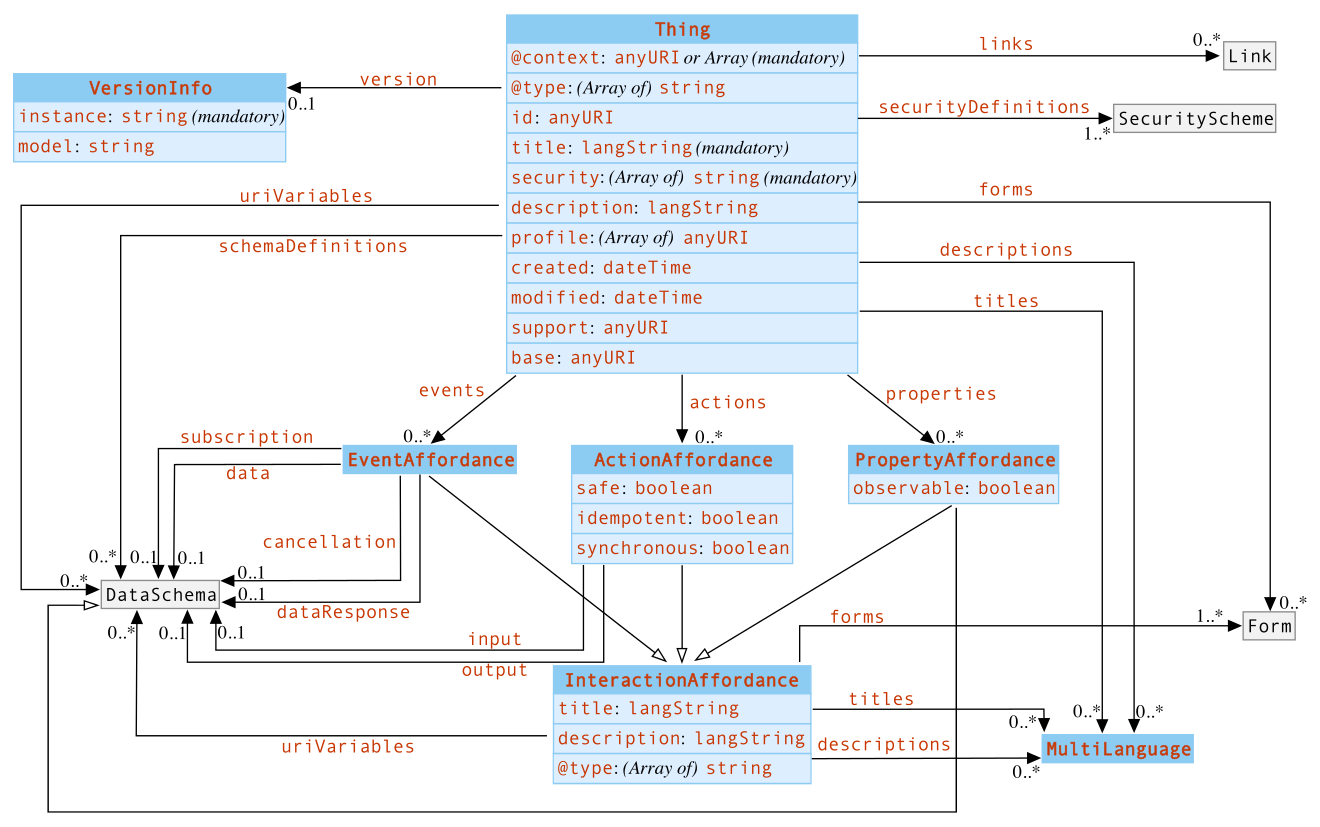
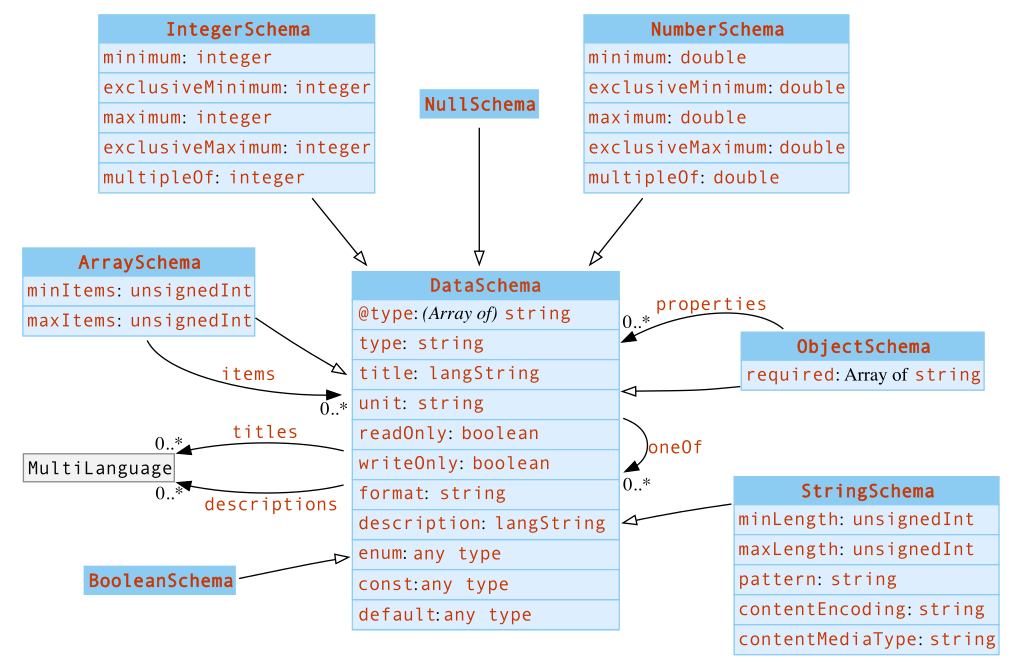
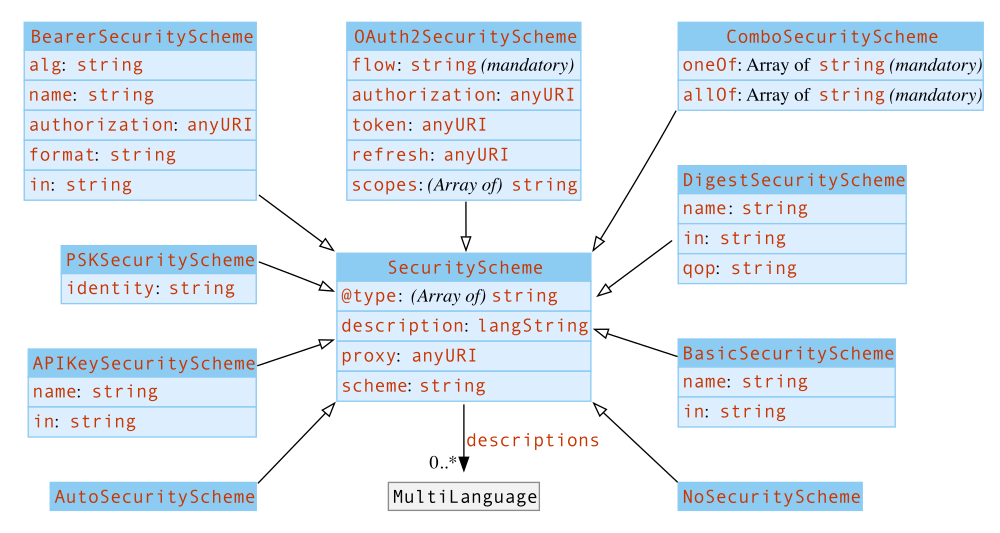
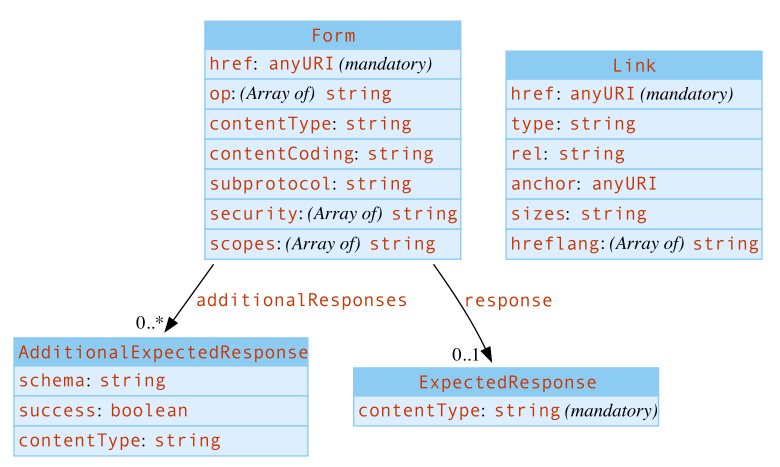
The UML diagram shown next gives an overview of the
TD Information Model.
It represents all classes as tables and the associations that
exist between classes, starting from the class Thing, as directed arrows. For the
sake of readability, the diagram was split in four parts, one
for each of the four base Vocabularies.
To provide a model that can be easily processed by both, simple rules on a tree-based document (i.e., raw JSON processing) and rich Semantic Web tooling (i.e., JSON-LD processing), this document defines the following formal preliminaries to construct the TD Information Model accordingly.
All definitions in this section refer to sets, which intuitively are collections of elements that can themselves be sets. All arbitrarily complex data structures can be defined in terms of sets. In particular, an Object is a data structure recursively defined as follows:
- a Term, which may or may not belong to a Vocabulary, is an Object.
- a set of name-value pairs where the name is a Term and the value is another Object, is also an Object.
Though this definition does not prevent Objects to include multiple name-value pairs with the same name, they are generally not considered in this specification. An Object whose elements only have numbers as names is called an Array . Similarly, an Object whose elements only have Terms (that do not belong to any Vocabulary) as names is called a Map . All names appearing in some name-value pair in a Map are assumed to be unique within the scope of the Map.
Moreover, Objects can be instances of some Class . A Class, which is denoted by a Vocabulary Term, is first defined by a set of Vocabulary Terms called a Signature . A Class whose Signature is empty is called a Simple Type .
The Signature of a Class allows to construct two
functions that further define Classes: an Assignment Function and a Type Function . The Assignment Function
of a Class takes a Vocabulary Term of the
Class's Signature as input and returns
either true or false as output.
Intuitively, the Assignment Function
indicates whether an element of the Signature is mandatory or
optional when instantiating the Class. The Type Function of a
Class also takes a Vocabulary Term of the
Class's Signature as input and returns
another Class as
output. These functions are partial: their domain is
limited to the Signature of the Class being defined.
On the basis of these two functions, an Instance Relation can be defined for a pair composed of an Object and a Class. This relation is defined as constraints to be satisfied. That is, an Object is an instance of a Class if the two following constraints are both satisfied:
- if for every Term for
which the Assignment Function
of the Class
returns
true, the Object includes a name-value pair with the Vocabulary Term as name. - if for every Vocabulary Term in the Signature of the Class used as name in some name-value pair of the Object, the value of that pair is an instance of the Class returned by the Type Function of the Class for the given Vocabulary Term.
According to the definition above, an Object would be an instance of
every Simple
Type, regardless of its structure. Instead, another
definition for the Instance Relation is
introduced for Simple
Types: an Object is
an instance of a Simple Type if it is a
Term with a given lexical form
(e.g., true, false for the
boolean type, 1, 2,
3, ... for the unsignedInt type,
etc.).
Moreover, additional Classes, called Parameterized Classes , can be derived from the generic Map and Array structures. An Object is a Map of some Class, that is, an instance of the Map type parameterized with some Class, if it is a Map such that the value in all the name-value pairs it contains is an instance of this Class. The same applies to Arrays.
Finally, a Class is a Subclass of some other Class if every instance of the former is also an instance of the latter.
Given all definitions above, the TD Information Model is to be
understood as a set of Class definitions, which include a
Class name (a Vocabulary Term), a
Signature (a set of
Vocabulary Terms),
an Assignment Function,
and a Type
Function. These Class
definitions are provided as tables in 5.3 Class Definitions. For each table, the
values "mandatory" (respectively, "optional") in the
assignment column indicates that the Assignment Function
returns true (respectively, false)
for the corresponding Vocabulary Term.
By convention, Simple Types are denoted by
names starting with lowercase. The TD Information Model
references the following Simple Types defined in
XML Schema [XMLSCHEMA11-2-20120405]:
string, anyURI,
dateTime, integer,
unsignedInt, double, and
boolean. Their definition (i.e., the
specification of their lexical form) is outside of the scope
of the TD
Information Model.
In addition, the TD Information Model defines a
global function on pairs of Vocabulary Terms. The
function takes a Class name
and another Vocabulary Term as input and
returns an Object.
If the returned Object is
different from null, it represents the
Default Value for some assignment on the input
Vocabulary Term in
an instance of the input Class. This function allows to
relax the constraint defined above on the Assignment Function:
an Object is an instance of
a Class if it includes all
mandatory assignments or if Default Value exist for
the missing assignments. All Default Values are given in
the table of 5.4 Default Value
Definitions. In each table of 5.3 Class Definitions, the assignment
column contains the value "with default" if a Default Value is
available for the corresponding combination of Class and Vocabulary Term in the
TD Information
Model.
The formalization introduced here does not consider the possible relation between Objects as abstract data structures and physical world objects such as Things. However, care was given to the possibility of re-interpreting all Vocabulary Terms involved in the TD Information Model as RDF resources, so as to integrate them in a larger model of the physical world (an ontology). For details about semantic processing, please refer to D. JSON-LD Context Usage and the documentation under the namespace IRIs, e.g., https://www.w3.org/2019/wot/td.
A TD Processor MUST satisfy the Class instantiation constraints on all Classes defined in 5.3.1 Core Vocabulary Definitions, 5.3.2 Data Schema Vocabulary Definitions, 5.3.3 Security Vocabulary Definitions, and 5.3.4 Hypermedia Controls Vocabulary Definitions.
In particular, note that all vocabulary terms and values are case sensitive. This is also true for the serialization of the information model (Section 6. TD Representation Format).
An abstraction of a physical or a virtual entity whose metadata and interfaces are described by a WoT Thing Description, whereas a virtual entity is the composition of one or more Things.
| Vocabulary term | Description | Assignment | Type |
|---|---|---|---|
@context |
JSON-LD keyword to define short-hand names called terms that are used throughout a TD document. | mandatory |
anyURI or Array
|
@type |
JSON-LD keyword to label the object with semantic tags (or types). | optional |
string or Array of
string
|
id |
Identifier of the Thing in form of a URI [RFC3986] (e.g., stable URI, temporary and mutable URI, URI with local IP address, URN, etc.). | optional |
anyURI
|
title |
Provides a human-readable title (e.g., display a text for UI representation) based on a default language. | mandatory |
string
|
titles |
Provides multi-language human-readable titles (e.g., display a text for UI representation in different languages). Also see MultiLanguage. | optional |
Map of MultiLanguage
|
description |
Provides additional (human-readable) information based on a default language. | optional |
string
|
descriptions |
Can be used to support (human-readable) information in different languages. Also see MultiLanguage. | optional |
Map of MultiLanguage
|
version |
Provides version information. | optional |
VersionInfo
|
created |
Provides information when the TD instance was created. | optional |
dateTime
|
modified |
Provides information when the TD instance was last modified. | optional |
dateTime
|
support |
Provides information about the TD maintainer as
URI scheme (e.g., mailto
[RFC6068],
tel [RFC3966],
https [RFC9112]). |
optional |
anyURI
|
base |
Define the base URI that is used for all
relative URI references throughout a TD document.
In TD instances, all relative URIs are resolved
relative to the base URI using the algorithm
defined in [RFC3986].
|
optional |
anyURI
|
properties |
All Property-based Interaction Affordances of the Thing. | optional |
Map of PropertyAffordance
|
actions |
All Action-based Interaction Affordances of the Thing. | optional |
Map of ActionAffordance
|
events |
All Event-based Interaction Affordances of the Thing. | optional |
Map of EventAffordance
|
links |
Provides Web links to arbitrary resources that relate to the specified Thing Description. | optional |
Array of Link
|
forms |
Set of form hypermedia controls that describe how an operation can be performed. Forms are serializations of Protocol Bindings. Thing level forms are used to describe endpoints for a group of interaction affordances. | optional |
Array of Form
|
security |
Set of security definition names, chosen from
those defined in securityDefinitions.
These must all be satisfied for access to
resources. |
mandatory |
string or Array of
string
|
securityDefinitions |
Set of named security configurations
(definitions only). Not actually applied unless
names are used in a security
name-value pair. |
mandatory |
Map of SecurityScheme
|
profile |
Indicates the WoT Profile mechanisms followed by this Thing Description and the corresponding Thing implementation. | optional |
anyURI or Array of
anyURI
|
schemaDefinitions |
Set of named data schemas. To be used in a
schema name-value pair inside an
AdditionalExpectedResponse
object. |
optional |
Map of DataSchema
|
uriVariables |
Define URI template variables according to
[RFC6570] as collection
based on DataSchema declarations. The Thing level
uriVariables can be used in Thing level
forms or in Interaction Affordances.
The individual variables DataSchema cannot be an
ObjectSchema or an ArraySchema since each
variable needs to be serialized to a string
inside the href upon the execution
of the operation. If the same variable is both
declared in Thing level
uriVariables and in Interaction
Affordance level, the Interaction Affordance
level variable takes precedence.
|
optional |
Map of DataSchema
|
For @context the following rules are
defined for Thing Description
instances:
- The
@contextname-value pair MUST contain the anyURIhttps://www.w3.org/2022/wot/td/v1.1in order to identify the document as a TD 1.1 which would allow Consumers to use the newly introduced terms. - When there are possibly
TD 1.0 consumers the anyURI
https://www.w3.org/2019/wot/td/v1MUST be the first entry and thehttps://www.w3.org/2022/wot/td/v1.1MUST be the second entry. - TD 1.1 consumers MUST accept TDs satisfying the W3C WoT Thing Description 1.0 [wot-thing-description10] specification.
- When
@contextis an Array, the anyURIhttps://www.w3.org/2022/wot/td/v1.1MAY be followed by elements of typeanyURIor type Map in any order, while it is RECOMMENDED to include only one Map with all the name-value pairs in the@contextArray. - Maps contained in an
@contextArray MAY contain name-value pairs, where the value is a namespace identifier of typeanyURIand the name a Term or prefix denoting that namespace. - One Map contained in an
@contextArray SHOULD contain a name-value pair that defines the default language for the Thing Description, where the name is the Term@languageand the value is a well-formed language tag as defined by [BCP47] (e.g.,en,de-AT,gsw-CH,zh-Hans,zh-Hant-HK,sl-nedis).
To determine the base direction of all human-readable text in Thing Description and Thing Model instances this specification recommends to follow the [STRING-META] guideline about string-specific directional information when no built-in mechanism for associating base direction metadata is available.
TD Processors should be aware of certain special cases when processing bidirectional text. TD Processors SHOULD take care to use bidi isolation when presenting strings to users, particularly when embedding in surrounding text (e.g., for Web user interface). Mixed direction text can occur in any language, even when the language is properly identified.
TD producers SHOULD attempt to provide mixed direction strings in a way that can be displayed successfully by a naive user agent. For example, if an RTL string begins with an LTR run (such as a number or a brand or trade name in Latin script), including an RLM character at the start of the string or wrapping opposite direction runs in bidi controls can assist in proper display.
Strings on the Web: Language and Direction Metadata [string-meta] provides some guidance and illustrates a number of pitfalls when using bidirectional text.
In addition to the
explicitly provided Interaction
Affordances in the properties,
actions, and events Maps, a Thing can also provide
meta-interactions, which are indicated by
Form instances in its optional
forms Array. When the
forms Array of a Thing instance contains
Form instances, it MUST contain op member with
the string values assigned to the name op,
either directly or within an Array, MUST be one of the following operation
types: readallproperties,
writeallproperties,
readmultipleproperties,
writemultipleproperties,
observeallproperties,
unobserveallproperties,
queryallactions,
subscribeallevents, or
unsubscribeallevents. (See an example for an usage
of form in a Thing instance.)
The data schema for each of the property
meta-interactions is constructed by combining the data
schemas of each PropertyAffordance instance
in a single ObjectSchema instance, where the
properties Map of the
ObjectSchema instance contains each data
schema of the PropertyAffordances identified
by the name of the corresponding
PropertyAffordances instance.
If not specified otherwise (e.g., through a TD Context
Extension), the request data of the
readmultipleproperties operation is an
Array that contains
the intended PropertyAffordances instance
names, which is serialized to the content type specified
by the Form instance.
Metadata of a Thing that shows the possible choices to Consumers, thereby suggesting how Consumers may interact with the Thing. There are many types of potential affordances, but W3C WoT defines three types of Interaction Affordances: Properties, Actions, and Events.
| Vocabulary term | Description | Assignment | Type |
|---|---|---|---|
@type |
JSON-LD keyword to label the object with semantic tags (or types). | optional |
string or Array of
string
|
title |
Provides a human-readable title (e.g., display a text for UI representation) based on a default language. | optional |
string
|
titles |
Provides multi-language human-readable titles (e.g., display a text for UI representation in different languages). Also see MultiLanguage. | optional |
Map of MultiLanguage
|
description |
Provides additional (human-readable) information based on a default language. | optional |
string
|
descriptions |
Can be used to support (human-readable) information in different languages. Also see MultiLanguage. | optional |
Map of MultiLanguage
|
forms |
Set of form hypermedia controls that describe how an operation can be performed. Forms are serializations of Protocol Bindings. The array cannot be empty. | mandatory |
Array of Form
|
uriVariables |
Define URI template variables according to
[RFC6570] as collection
based on DataSchema declarations. The individual
variables DataSchema cannot be an ObjectSchema or
an ArraySchema since each variable needs to be
serialized to a string inside the
href upon the execution of the
operation. If the same variable is both declared
in Thing level
uriVariablesand in Interaction
Affordance level, the Interaction Affordance
level variable takes precedence.
|
optional |
Map of DataSchema
|
The class InteractionAffordance has the
following subclasses:
An Interaction Affordance that exposes state of the Thing. This state can then be retrieved (read) and/or updated (write). Things can also choose to make Properties observable by pushing the new state after a change.
| Vocabulary term | Description | Assignment | Type |
|---|---|---|---|
observable |
A hint that indicates whether Servients hosting
the Thing and Intermediaries should provide a
Protocol Binding that supports the
observeproperty and
unobserveproperty operations for this
Property. |
with default |
boolean
|
Note
Property instances are also instances of
the class DataSchema. Therefore, it can contain the
type, unit,
readOnly and writeOnly
members, among others.
PropertyAffordance is a Subclass of the
InteractionAffordance Class and the
DataSchema Class. When a Form
instance is within a PropertyAffordance
instance, the value assigned to op
MUST be one of
readproperty, writeproperty,
observeproperty,
unobserveproperty or an Array containing a combination
of these terms.
Note
It is considered to be good practice that
each observeproperty has a corresponding
unobserveproperty unless the protocol
supports implicit unsubscription mechanisms (e.g.,
heartbeat to detect connection loss).
Note
The observation mechanism depends on the underlying protocol or sub-protocol. Having said that, it is not guaranteed that the current Property value will be provided once the subscription is initiated. Hence, it may be necessary to read the current Property value before/after the subscription to get a first value.
An Interaction Affordance that allows to invoke a function of the Thing, which manipulates state (e.g., toggling a lamp on or off) or triggers a process on the Thing (e.g., dim a lamp over time).
| Vocabulary term | Description | Assignment | Type |
|---|---|---|---|
input |
Used to define the input data schema of the Action. | optional |
DataSchema
|
output |
Used to define the output data schema of the Action. | optional |
DataSchema
|
safe |
Signals if the Action is safe (=true) or not. Used to signal if there is no internal state (cf. resource state) is changed when invoking an Action. In that case responses can be cached as example. | with default |
boolean
|
idempotent |
Indicates whether the Action is idempotent (=true) or not. Informs whether the Action can be called repeatedly with the same result, if present, based on the same input. | with default |
boolean
|
synchronous |
Indicates whether the action is synchronous (=true) or not. A synchronous action means that the response of action contains all the information about the result of the action and no further querying about the status of the action is needed. Lack of this keyword means that no claim on the synchronicity of the action can be made. | optional |
boolean
|
ActionAffordance is a Subclass of the
InteractionAffordance Class. When a Form
instance is within an ActionAffordance
instance, the value assigned to op MUST either be invokeaction,
queryaction, cancelaction or an
Array containing a
combination of these terms.
An Interaction Affordance that describes an event source, which asynchronously pushes event data to Consumers (e.g., overheating alerts).
| Vocabulary term | Description | Assignment | Type |
|---|---|---|---|
subscription |
Defines data that needs to be passed upon subscription, e.g., filters or message format for setting up Webhooks. | optional |
DataSchema
|
data |
Defines the data schema of the Event instance messages pushed by the Thing. | optional |
DataSchema
|
dataResponse |
Defines the data schema of the Event response messages sent by the consumer in a response to a data message. | optional |
DataSchema
|
cancellation |
Defines any data that needs to be passed to cancel a subscription, e.g., a specific message to remove a Webhook. | optional |
DataSchema
|
EventAffordance is a Subclass of the
InteractionAffordance Class. When a Form
instance is within an EventAffordance
instance, the value assigned to op
MUST be either
subscribeevent,
unsubscribeevent, or both terms within an
Array.
Note
It is considered to be good practice that
each subscribeevent has a corresponding
unsubscribeevent unless the protocol
supports implicit unsubscription mechanisms (e.g.,
heartbeat to detect connection loss).
Metadata of a Thing that provides version information about the TD document. If required, additional version information such as firmware and hardware version (term definitions outside of the TD namespace) can be extended via the TD Context Extension mechanism.
| Vocabulary term | Description | Assignment | Type |
|---|---|---|---|
instance |
Provides a version indicator of this TD. | mandatory |
string
|
model |
Provides a version indicator of the underlying TM. | optional |
string
|
It is recommended that the values within
instances and model of the
VersionInfo Class follow the semantic
versioning pattern, where a sequence of three numbers
separated by a dot indicates the major version, minor
version, and patch version, respectively. See
[SEMVER] for
details.
A Map providing a set of human-readable texts in different languages identified by language tags described in [BCP47]. See 6.3.2 Human-Readable Metadata for example usages of this container in a Thing Description instance.
Each name of the
MultiLanguage Map MUST be a language tag as defined in
[BCP47].
Each value of the
MultiLanguage Map MUST be of type
string.
A data schema is an abstract notation for data contained in data formats.
The data schema vocabulary definition reflects a very common subset of the terms defined by JSON Schema [JSON-SCHEMA]. A JSON Schema [JSON-SCHEMA] processor for JSON Schema draft 7 can consume a data schema. It is noted that data schema definitions within Thing Description instances are not limited to this defined subset and may use additional terms found in JSON Schema using a TD Context Extension for the additional terms as described in 7. TD Context Extensions, otherwise these terms are semantically ignored by TD Processors (for details about semantic processing, please refer to D. JSON-LD Context Usage and the documentation under the namespace IRIs, e.g., https://www.w3.org/2019/wot/td).
In a TD, concrete data formats are specified in Forms
(see 5.3.4.2 Form) using content
types. When the value of a content type in an instance of
the Form is application/json, the data schema
can be processed directly by JSON Schema processors.
Otherwise, Web of Things (WoT) Binding Templates
[WOT-BINDING-TEMPLATES]
defines data schema's available mappings to other content
types such as XML [xml].
If the content type in an instance of the Form is not
application/json and if no mapping is defined
for the content type, specifying a data schema does not
make sense for the content type.
The following table contains content types which MAY use data schema to describe the structure of their payloads.
| Format | Content Type |
|---|---|
| JSON/CBOR | application/jsonapplication/ld+jsonapplication/senml+jsonapplication/cborapplication/senml+cbor |
| XML/EXI | application/xmlapplication/senml+xmlapplication/exiapplication/senml-exi |
Metadata that describes the data format used. It can be used for validation.
| Vocabulary term | Description | Assignment | Type |
|---|---|---|---|
@type |
JSON-LD keyword to label the object with semantic tags (or types) | optional |
string or Array of
string
|
title |
Provides a human-readable title (e.g., display a text for UI representation) based on a default language. | optional |
string
|
titles |
Provides multi-language human-readable titles (e.g., display a text for UI representation in different languages). Also see MultiLanguage. | optional |
Map of MultiLanguage
|
description |
Provides additional (human-readable) information based on a default language. | optional |
string
|
descriptions |
Can be used to support (human-readable) information in different languages. Also see MultiLanguage. | optional |
Map of MultiLanguage
|
const |
Provides a constant value. | optional | any type |
default |
Supply a default value. The value SHOULD validate against the data schema in which it resides. | optional | any type |
unit |
Provides unit information that is used, e.g., in international science, engineering, and business. To preserve uniqueness, it is recommended that the value of the unit points to a semantic definition (also see Section Semantic Annotations). | optional |
string
|
oneOf |
Used to ensure that the data is valid against one of the specified schemas in the array. This can be used to describe multiple input or output schemas. | optional |
Array of DataSchema
|
enum |
Restricted set of values provided as an array. | optional | Array of any type |
readOnly |
Boolean value that is a hint to indicate whether a property interaction / value is read only (=true) or not (=false). | with default |
boolean
|
writeOnly |
Boolean value that is a hint to indicate whether a property interaction / value is write only (=true) or not (=false). | with default |
boolean
|
format |
Allows validation based on a format pattern such as "date-time", "email", "uri", etc. (Also see below.) | optional |
string
|
type |
Assignment of JSON-based data types compatible with JSON Schema (one of boolean, integer, number, string, object, array, or null). | optional |
string (one of
object, array,
string, number,
integer, boolean, or
null)
|
The class DataSchema has the following
subclasses:
The format string values are known from a
fixed set of values and their corresponding format rules
defined in [JSON-SCHEMA]
(Section 7.3 Defined Formats in particular). Servients MAY use the format value to
perform additional validation accordingly.
When a value that is
not found in the known set of values is assigned to
format, such a validation SHOULD succeed.
any type (e.g.,
const, default) follow data
types compatible with JSON Schema (boolean, integer,
number, string, object, array, or null).
Note
The format term is not widely
implemented by JSON Schema tools. In addition, the term
format is being discussed by the JSON
Schema standardisation community and may be replaced by
another mechanism or removed in a future JSON Schema
version.
Metadata describing data of type Array. This Subclass is indicated by
the value array assigned to
type in DataSchema
instances.
| Vocabulary term | Description | Assignment | Type |
|---|---|---|---|
items |
Used to define the characteristics of an array. | optional |
DataSchema
or Array of DataSchema
|
minItems |
Defines the minimum number of items that have to be in the array. | optional |
unsignedInt
|
maxItems |
Defines the maximum number of items that have to be in the array. | optional |
unsignedInt
|
Metadata describing data of type boolean.
This Subclass is indicated by the
value boolean assigned to type
in DataSchema instances.
Metadata describing data of type number.
This Subclass is indicated by the
value number assigned to type
in DataSchema instances.
| Vocabulary term | Description | Assignment | Type |
|---|---|---|---|
minimum |
Specifies a minimum numeric value, representing an inclusive lower limit. Only applicable for associated number or integer types. | optional |
double
|
exclusiveMinimum |
Specifies a minimum numeric value, representing an exclusive lower limit. Only applicable for associated number or integer types. | optional |
double
|
maximum |
Specifies a maximum numeric value, representing an inclusive upper limit. Only applicable for associated number or integer types. | optional |
double
|
exclusiveMaximum |
Specifies a maximum numeric value, representing an exclusive upper limit. Only applicable for associated number or integer types. | optional |
double
|
multipleOf |
Specifies the multipleOf value number. The value must strictly greater than 0. Only applicable for associated number or integer types. | optional |
double
|
Metadata describing data of type integer.
This Subclass is indicated by the
value integer assigned to type
in DataSchema instances.
| Vocabulary term | Description | Assignment | Type |
|---|---|---|---|
minimum |
Specifies a minimum numeric value, representing an inclusive lower limit. Only applicable for associated number or integer types. | optional |
integer
|
exclusiveMinimum |
Specifies a minimum numeric value, representing an exclusive lower limit. Only applicable for associated number or integer types. | optional |
integer
|
maximum |
Specifies a maximum numeric value, representing an inclusive upper limit. Only applicable for associated number or integer types. | optional |
integer
|
exclusiveMaximum |
Specifies a maximum numeric value, representing an exclusive upper limit. Only applicable for associated number or integer types. | optional |
integer
|
multipleOf |
Specifies the multipleOf value number. The value must strictly greater than 0. Only applicable for associated number or integer types. | optional |
integer
|
Metadata describing data of type Object. This Subclass is indicated by
the value object assigned to
type in DataSchema
instances.
| Vocabulary term | Description | Assignment | Type |
|---|---|---|---|
properties |
Data schema nested definitions. | optional |
Map of DataSchema
|
required |
Defines which members of the object type are
mandatory, i.e. which members are mandatory in the
payload that is to be sent (e.g. input of
invokeaction,
writeproperty) and what members will
be definitely delivered in the payload that is
being received (e.g. output of
invokeaction,
readproperty) |
optional |
Array of
string
|
Metadata describing data of type string.
This Subclass is indicated by the
value string assigned to type
in DataSchema instances.
| Vocabulary term | Description | Assignment | Type |
|---|---|---|---|
minLength |
Specifies the minimum length of a string. Only applicable for associated string types. | optional |
unsignedInt
|
maxLength |
Specifies the maximum length of a string. Only applicable for associated string types. | optional |
unsignedInt
|
pattern |
Provides a regular expression to express constraints of the string value. The regular expression must follow the [ECMA-262] dialect. | optional |
string
|
contentEncoding |
Specifies the encoding used to store the contents, as specified in [RFC2045] (Section 6.1) and [RFC4648]. | optional |
string (e.g., 7bit,
8bit, binary,
quoted-printable,
base16, base32, or
base64)
|
contentMediaType |
Specifies the MIME type of the contents of a string value, as described in [RFC2046]. | optional |
string (e.g.,
image/png, or
audio/mpeg)
|
Note
The length of a string (i.e.,
minLength and maxLength) is
defined as the number of Unicode code points, as
defined by [RFC8259].
Note that some user-perceived characters are
composed of more than one Unicode code point. Arbitrary
index values might not fall on these grapheme
boundaries, so truncation according to
maxLength might alter the appearance or
meaning of the string.
Metadata describing data of type null.
This subclass is indicated by the value null
assigned to type in DataSchema
instances. This Subclass describes only one acceptable
value, namely null. It is important to note
that null does not mean the absence of a
value. It is analogous to null in
JavaScript, None in Python,
null in Java and nil in Ruby
programming languages. It can be used as part of a
oneOf declaration, where it is used to
indicate, that the data can also be
null.
This specification provides a selection of well-established security mechanisms that are directly built into protocols eligible as Protocol Bindings for W3C WoT or are widely in use with those protocols. The current set of HTTP security schemes is partly based on OpenAPI 3.0.1 (see also [OPENAPI]). However while the HTTP security schemes, Vocabulary, and syntax given in this specification share many similarities with OpenAPI, they are not compatible.
Generally, security schemes require some form of secure transport to be effective, such as TLS or DTLS. Requirements for the use of secure transport are given in Section 10. Security Considerations in this document and in the Security Considerations section of [wot-architecture11].
Metadata describing the configuration of a security
mechanism. The value assigned to the name
scheme MUST be
defined within a Vocabulary included in
the Thing Description,
either in the standard Vocabulary defined in
§ 5. TD
Information Model or in a TD Context
Extension.
For all security schemes, any keys, passwords, or other sensitive information directly providing access MUST NOT be stored in the TD and should instead be shared and stored out-of-band via other mechanisms. The purpose of a TD is to describe how to access a Thing if and only if a Consumer already has authorization, and is not meant be used to grant that authorization.
Each security scheme object used in a TD defines a set of requirements to be met before access can be granted. We say a security scheme is satisfied when all its requirements are met. In some cases requirements from multiple security schemes will have to be met before access can be granted.
Security schemes generally may require additional
authentication parameters, such as a password or key. The
location of this information is indicated by the value
associated with the name in, often in
combination with the value associated with
name. The value associated with
in can take one of the following values:
header:- The parameter will be given in a header provided by
the protocol, with the name of the header provided by
the value of
name. query:- The parameter will be appended to the URI as a
query parameter, with the name of the query parameter
provided by
name. body:- The parameter will be provided in the body of the
request payload, with the data schema element used
provided by
name. When used in the context of abodysecurity information location, the value ofnameMUST be in the form of a JSON pointer [RFC6901] relative to the root of the inputDataSchemafor each interaction it is used with. Since this value is not a fragment identifier, and is not relative to the root of the TD but to whichever data schemas the security scheme is bound to, this value should not start with#; it is a "pure" JSON pointer. Since this value is not a fragment identifier, it also does not need to URL-encode special characters. The targeted element may or may not already exist at the specified location in the referenced object or array schema (consequently the mechanism is not applicable to simple types). If it does not, it will be inserted. This avoids having to duplicate definitions in the data schemas of every interaction. When an element of a data schema indicated by a JSON pointer indicated in abodylocator does not already exist in the indicated schema, it MUST be possible to insert the indicated element at the location indicated by the pointer. The JSON pointer used in thebodylocator MAY use the "-" character to indicate a non-existent array element when it is necessary to insert an element after the last element of an existing array. The element referenced (or created) by abodysecurity information location MUST be required and of type "string". Ifnameis not given, it is assumed the entire body is to be used as the security parameter. cookie:- The parameter is stored in a cookie identified by
the value of
name. uri:- The parameter is embedded in the URI itself, which
is encoded in the relevant interaction using a URI
template variable defined by the value of
name. This is more general than thequerymechanism but more complex. The valueuriSHOULD be specified for the nameinin a security scheme only ifqueryis not applicable. The URIs provided in interactions where a security scheme usingurias the value forinMUST be a URI template including the defined variable. auto:- The location is determined as part of the protocol,
or negotiated. If a value of
autois set for theinfield of aSecurityScheme, then thenamefield SHOULD NOT be set. In this case, the application of theSecuritySchemeis subject to the respective specification for the given protocol (e.g. [RFC8288] when using theBasicSecuritySchemewith HTTP).
If multiple parameters are needed for a security
scheme, repeat the security scheme definition for each
parameter and combine them using a combo
security scheme and allOf. In some cases
parameters may not actually be secret but a user may wish
to leave them out of the TD to help protect privacy. As
an example of this, some security mechanisms require both
a client identifier and a secret key. In theory, the
client identifier is public however it may be hard to
update and pose a tracking risk. In such a case it can be
provided as an additional security parameter so it does
not appear in the TD.
The names of URI
variables declared in a SecurityScheme
MUST be distinct from all other
URI variables declared in the TD.
| Vocabulary term | Description | Assignment | Type |
|---|---|---|---|
@type |
JSON-LD keyword to label the object with semantic tags (or types). | optional |
string or Array of
string
|
description |
Provides additional (human-readable) information based on a default language. | optional |
string
|
descriptions |
Can be used to support (human-readable) information in different languages. Also see MultiLanguage. | optional |
Map of MultiLanguage
|
proxy |
URI of the proxy server this security configuration provides access to. If not given, the corresponding security configuration is for the endpoint. | optional |
anyURI
|
scheme |
Identification of the security mechanism being configured. | mandatory |
string (e.g.,
nosec, combo,
basic, digest,
bearer, psk,
oauth2, apikey, or
auto)
|
The class SecurityScheme has the
following subclasses:
A security configuration corresponding to identified
by the Vocabulary Term
nosec (i.e., "scheme":
"nosec"), indicating there is no authentication or
other mechanism required to access the resource.
An automatic authentication security configuration
identified by the term auto (i.e.,
"scheme": "auto"). This scheme indicates
that the security parameters are going to be negotiated
by the underlying protocols at runtime, subject to the
respective specifications for the protocol (e.g.
[RFC8288]
for Basic Authentication when using HTTP).
A combination of other security schemes identified by
the Vocabulary Term
combo (i.e., "scheme":
"combo"). Elements of this scheme define various
ways in which other named schemes defined in
securityDefinitions, including other
ComboSecurityScheme
definitions, are to be combined to create a new scheme
definition. Exactly one
of either oneOf or allOf
vocabulary terms MUST be
included. Only security scheme definitions which
can be used together can be combined with
allOf. For example, it is not possible in
general to combine different OAuth 2.0 flows together
using allOf unless one applies to a proxy
and one to the endpoint. Note that when multiple named
security scheme definitions are listed in a
security field the same semantics apply as
in an allOf combination (and the same
limitations on allowable combinations). The
oneOf combination is equivalent to using
different security schemes on forms that are otherwise
identical. In this sense a oneOf scheme is
not an essential feature but it does avoid redundancy in
such cases.
| Vocabulary term | Description | Assignment | Type |
|---|---|---|---|
oneOf |
Array of two or more strings identifying other named security scheme definitions, any one of which, when satisfied, will allow access. Only one may be chosen for use. | mandatory |
Array of
string
|
allOf |
Array of two or more strings identifying other named security scheme definitions, all of which must be satisfied for access. | mandatory |
Array of
string
|
Basic Authentication [RFC7617]
security configuration identified by the Vocabulary Term
basic (i.e., "scheme":
"basic"), using an unencrypted username and
password.
| Vocabulary term | Description | Assignment | Type |
|---|---|---|---|
name |
Name for query, header, cookie, or uri parameters. | optional |
string
|
in |
Specifies the location of security authentication information. | with default |
string (one of
header, query,
body, cookie, or
auto)
|
Digest Access Authentication [RFC7616]
security configuration identified by the Vocabulary Term
digest (i.e., "scheme":
"digest"). This scheme is similar to basic
authentication but with added features to avoid
man-in-the-middle attacks.
| Vocabulary term | Description | Assignment | Type |
|---|---|---|---|
name |
Name for query, header, cookie, or uri parameters. | optional |
string
|
in |
Specifies the location of security authentication information. | with default |
string (one of
header, query,
body, cookie, or
auto)
|
qop |
Quality of protection. | with default |
string (one of
auth, or auth-int)
|
API key authentication security configuration
identified by the Vocabulary Term
apikey (i.e., "scheme":
"apikey"). This scheme is to be used when the
access token is opaque, for example when a key in an
unknown or proprietary format is provided by a cloud
service provider. In this case the key may not be using a
standard token format. This scheme indicates that the key
provided by the service provider needs to be supplied as
part of service requests using the mechanism indicated by
the "in" field.
| Vocabulary term | Description | Assignment | Type |
|---|---|---|---|
name |
Name for query, header, cookie, or uri parameters. | optional |
string
|
in |
Specifies the location of security authentication information. | with default |
string (one of
header, query,
body, cookie,
uri, or auto)
|
Bearer Token [RFC6750]
security configuration identified by the Vocabulary Term
bearer (i.e., "scheme":
"bearer") for situations where bearer tokens are
used independently of OAuth2. If the oauth2
scheme is specified it is not generally necessary to
specify this scheme as well as it is implied. For
format, the value jwt indicates
conformance with [RFC7519],
jws indicates conformance with
[RFC7797],
cwt indicates conformance with
[RFC8392], and
jwe indicates conformance with
[RFC7516], with
values for alg interpreted consistently with
those standards. Other formats and
algorithms for bearer tokens MAY
be specified in vocabulary extensions.
| Vocabulary term | Description | Assignment | Type |
|---|---|---|---|
authorization |
URI of the authorization server. | optional |
anyURI
|
name |
Name for query, header, cookie, or uri parameters. | optional |
string
|
alg |
Encoding, encryption, or digest algorithm. | with default |
string (e.g.,
ES256, or ES512-256)
|
format |
Specifies format of security authentication information. | with default |
string (e.g., jwt,
cwt, jwe, or
jws)
|
in |
Specifies the location of security authentication information. | with default |
string (one of
header, query,
body, cookie, or
auto)
|
Pre-shared key authentication security configuration
identified by the Vocabulary Term
psk (i.e., "scheme": "psk").
This is meant to identify that a standard is used for
pre-shared keys such as TLS-PSK [RFC4279],
and that the ciphersuite used for keys will be
established during protocol negotiation.
| Vocabulary term | Description | Assignment | Type |
|---|---|---|---|
identity |
Identifier providing information which can be used for selection or confirmation. | optional |
string
|
OAuth 2.0 authentication security configuration for
systems conformant with [RFC6749]
and [RFC8252],
identified by the Vocabulary Term
oauth2 (i.e., "scheme":
"oauth2").
| Vocabulary term | Description | Assignment | Type |
|---|---|---|---|
authorization |
URI of the authorization server. | optional |
anyURI
|
token |
URI of the token server. | optional |
anyURI
|
refresh |
URI of the refresh server. | optional |
anyURI
|
scopes |
Set of authorization scope identifiers provided
as an array. These are provided in tokens returned
by an authorization server and associated with
forms in order to identify what resources a client
may access and how. The values associated with a
form SHOULD be chosen from
those defined in an
OAuth2SecurityScheme active on that
form. |
optional |
string or Array of
string
|
flow |
Authorization flow. | mandatory |
string (e.g., code,
or client)
|
For the code
flow both authorization and
token vocabulary terms
MUST be included.
For the
client flow token vocabulary term
MUST be included.
For the
client flow authorization
vocabulary term
MUST NOT be included. The
mandatory elements for each flow are summarized in the
following table:
| Element | code |
client |
|---|---|---|
authorization |
mandatory | omit |
token |
mandatory | mandatory |
refresh |
optional | optional |
The present model provides a representation for (typed)
Web links and Web forms exposed by a Thing. The Link
class definition reflects a very common subset of the terms
defined in Web Linking [RFC8288]. The defined terms can be
used, e.g., to describe the relation to another Thing such as a Lamp
Thing is controlled by a Switch Thing. The
Form class corresponds to a newly introduced
form of hypermedia control to manipulate the state of
Things (and other Web
resources).
A link can be viewed as a statement of the form "link context has a relation type resource at link target", where the optional target attributes may further describe the resource.
| Vocabulary term | Description | Assignment | Type |
|---|---|---|---|
href |
Target IRI of a link or submission target of a form. | mandatory |
anyURI
|
type |
Target attribute providing a hint indicating what the media type [RFC2046] of the result of dereferencing the link should be. | optional |
string
|
rel |
A link relation type identifies the semantics of a link. | optional |
string
|
anchor |
Overrides the link context (by default the
Thing itself identified by its id)
with the given URI or IRI. |
optional |
anyURI
|
sizes |
Target attribute that specifies one or more sizes for the referenced icon. Only applicable for relation type "icon". The value pattern follows {Height}x{Width} (e.g., "16x16", "16x16 32x32"). | optional |
string
|
hreflang |
The hreflang attribute specifies the language of a linked document. The value of this must be a valid language tag [BCP47]. | optional |
string or Array of
string
|
Note: hreflang type
The hreflang attribute is
allowed to be a string or
array in this version of the spec.
Depending on the result of [LINKSET-MEDIA-TYPES]
the values of hrefLang can be restricted
to array only.
Link relations can be used to describe relations such as to other Things (e.g., a Switch Thing controls a Lamp Thing), to a specific kind of Thing Models (e.g., a Thing Description is an instance of a specific Thing Model), or to further documentations information (e.g., device manual of a Thing). It is recommended to reuse existing and established Link Relation definitions from IANA.
In the following a best practice relation type table is introduced that is recommended to use within WoT Thing Description or Thing Model instances.
| Value | Occurrence | Explanation | Source of value origin |
|---|---|---|---|
icon |
0..* | Imports an icon associated to the Thing (e.g., for UI purposes). | IANA Link Relation |
service-doc |
0..* | Relation to a resource that provide (human-readable) documentation or descriptions. | IANA Link Relation |
alternate |
0..* | Point to alternative representation of the Thing (i.e. RDF-Turtle, human-readable HTML document, ...). | IANA Link Relation |
type |
0..1 | Indicate that the Thing is an instance of the target resource such as to a Thing Model. | IANA Link Relation |
tm:extends |
0..1 | Extends an existing definition of the target resource such as a Thing Model. Only applicable for Thing Model definitions. | W3C WoT Thing Model |
tm:submodel |
0..* | Used to compose one or multiple Thing Models. Only applicable for Thing Model definitions. | W3C WoT Thing Model |
manifest |
0..* | Point to the web app manifest of a web application which provides, e.g., a user interface with which a user can interact with the Thing (also see [APPMANIFEST]). | IANA Link Relation |
proxy-to |
0..* |
Target resource provide the address of a proxy.
Additional security metadata can be provided
using the proxy field in a SecurityScheme.
|
W3C WoT Security and WoT Binding Template |
collection |
0..1 | Points to a collections of Things. | IANA Link Relation |
item |
0..* | Points to a Thing that is member of the current Thing collections. | IANA Link Relation |
predecessor-version |
0..1 | Points to a previous Thing Description or Thing Model version. | IANA Link Relation |
controlledBy |
0..* | Refers to a Thing that controls the context Thing. | W3C Thing Description |
A form can be viewed as a statement of "To perform an operation type operation on form context, make a request method request to submission target" where the optional form fields may further describe the required request. In Thing Descriptions, the form context is the surrounding Object, such as Properties, Actions, and Events or the Thing itself for meta-interactions.
| Vocabulary term | Description | Assignment | Type |
|---|---|---|---|
href |
Target IRI of a link or submission target of a form. | mandatory |
anyURI
|
contentType |
Assign a content type based on a media type
(e.g., text/plain) and potential
parameters (e.g., charset=utf-8) for
the media type [RFC2046]. |
with default |
string
|
contentCoding |
Content coding values indicate an encoding transformation that has been or can be applied to a representation. Content codings are primarily used to allow a representation to be compressed or otherwise usefully transformed without losing the identity of its underlying media type and without loss of information. Examples of content coding include "gzip", "deflate", etc. . | optional |
string
|
security |
Set of security definition names, chosen from
those defined in securityDefinitions.
These must all be satisfied for access to
resources. |
optional |
string or Array of
string
|
scopes |
Set of authorization scope identifiers provided
as an array. These are provided in tokens returned
by an authorization server and associated with
forms in order to identify what resources a client
may access and how. The values associated with a
form SHOULD be chosen from
those defined in an
OAuth2SecurityScheme active on that
form. |
optional |
string or Array of
string
|
response |
This optional term can be used if, e.g., the output communication metadata differ from input metadata (e.g., output contentType differ from the input contentType). The response name contains metadata that is only valid for the primary response messages. | optional |
ExpectedResponse
|
additionalResponses |
This optional term can be used if additional expected responses are possible, e.g. for error reporting. Each additional response needs to be distinguished from others in some way (for example, by specifying a protocol-specific error code), and may also have its own data schema. | optional |
Array of AdditionalExpectedResponse
|
subprotocol |
Indicates the exact mechanism by which an
interaction will be accomplished for a given
protocol when there are multiple options. For
example, for HTTP and Events, it indicates which of
several available mechanisms should be used for
asynchronous notifications such as long polling
(longpoll), WebSub [websub]
(websub), Server-Sent Events
(sse) [html] (also known as
EventSource). Please note that there is no
restriction on the subprotocol selection and other
mechanisms can also be announced by this
subprotocol term. |
optional |
string (e.g.,
longpoll, websub, or
sse)
|
op |
Indicates the semantic intention of performing the operation(s) described by the form. For example, the Property interaction allows get and set operations. The protocol binding may contain a form for the get operation and a different form for the set operation. The op attribute indicates which form is for which and allows the client to select the correct form for the operation required. op can be assigned one or more interaction verb(s) each representing a semantic intention of an operation. | with default |
string or Array of
string (one of
readproperty,
writeproperty,
observeproperty,
unobserveproperty,
invokeaction,
queryaction,
cancelaction,
subscribeevent,
unsubscribeevent,
readallproperties,
writeallproperties,
readmultipleproperties,
writemultipleproperties,
observeallproperties,
unobserveallproperties,
subscribeallevents,
unsubscribeallevents, or
queryallactions)
|
Possible values for the contentCoding
property can be found, e.g., in the
IANA HTTP content coding registry.
The list of possible operation types of a form is fixed. As of this version of the specification, it only includes the well-known types necessary to implement the WoT interaction model described in [wot-architecture11]. Future versions of the standard may extend this list but operations types MUST be restricted to the values in the table below.
| Operation Type | Description |
|---|---|
| readproperty | Identifies the read operation on Property Affordances to retrieve the corresponding data. |
| writeproperty | Identifies the write operation on Property Affordances to update the corresponding data. |
| observeproperty | Identifies the observe operation on Property Affordances to be notified with the new data when the Property is updated. |
| unobserveproperty | Identifies the unobserve operation on Property Affordances to stop the corresponding notifications. |
| invokeaction | Identifies the invoke operation on Action Affordances to perform the corresponding action. |
| queryaction | Identifies the querying operation on Action Affordances to get the status of the corresponding action. |
| cancelaction | Identifies the cancel operation on Action Affordances to cancel the ongoing corresponding action. |
| subscribeevent | Identifies the subscribe operation on Event Affordances to be notified by the Thing when the event occurs. |
| unsubscribeevent | Identifies the unsubscribe operation on Event Affordances to stop the corresponding notifications. |
| readallproperties | Identifies the readallproperties operation on a Thing to retrieve the data of all Properties in a single interaction. |
| writeallproperties | Identifies the writeallproperties operation on a Thing to update the data of all writable Properties in a single interaction. |
| readmultipleproperties | Identifies the readmultipleproperties operation on a Thing to retrieve the data of selected Properties in a single interaction. |
| writemultipleproperties | Identifies the writemultipleproperties operation on a Thing to update the data of selected writable Properties in a single interaction. |
| observeallproperties | Identifies the observeallproperties operation on Properties to be notified with new data when any Property is updated. |
| unobserveallproperties | Identifies the unobserveallproperties operation on Properties to stop notifications from all Properties in a single interaction. |
| queryallactions | Identifies the queryallactions operation on a Thing to get the status of all Actions in a single interaction. |
| subscribeallevents | Identifies the subscribeallevents operation on Events to subscribe to notifications from all Events in a single interaction. |
| unsubscribeallevents | Identifies the unsubscribeallevents operation on Events to unsubscribe from notifications from all Events in a single interaction. |
A Thing Description of a WoT producer may have multiple forms entries with, e.g., different protocol and/or content types declarations that a Consumer could possibly support. In that case the Consumer may choose any form entry that works (e.g., the protocol and content type is supported) for them. When one form is chosen, it is expected that the Consumer will continue to use it as long as possible for every new interaction with the WoT producer.
This section is non-normative.
Protocols that can be used with TDs follow
request-response or eventing mechanisms. The Data
Schema of an affordance generally correlates with the
op keywords used in forms.
The table below informatively summarizes the available
data schema related terms with the op
keywords.
- Consumer to Thing applies for messages sent by the Consumer to the Thing, such as the value for writing a property.
- Thing to Consumer applies for messages sent by the Thing to the Consumer, such as the value of a property value as the result of reading a property.
- In case that there is no correlation with the data schema and the operation, it implies that no payload is required for executing the operation or no payload is expected as a result of the operation.
| Operation Type | Consumer to Thing DataSchema Correlation | Thing to Consumer DataSchema Correlation |
|---|---|---|
| readproperty | No correlation. | All fields in the Property Affordance without
"writeOnly":true. |
| writeproperty | All fields in the Property Affordance without
"readOnly":true. |
No correlation.
additionalResponses can be used in
the form level. |
| observeproperty | No correlation. | All fields in the Property Affordance without
"writeOnly":true. |
| unobserveproperty | No correlation. | No correlation. |
| invokeaction | Value of the input key. |
Value of the output key. |
| queryaction | No correlation. | No correlation.
additionalResponses can be used in
the form level. |
| cancelaction | No correlation. | No correlation.
additionalResponses can be used in
the form level. |
| subscribeevent | Value of the subscription key
with all fields without
"readOnly":true |
Value of the subscription key
with all fields without
"writeOnly":true |
| unsubscribeevent | Value of the subscription key
with all fields without
"readOnly":true |
Value of the subscription key
with all fields without
"writeOnly":true |
Note: writeproperty and observeproperty relationship
Writing to a property does not necessarily mean that a new value will be sent to the Consumer observing the property. It depends on the protocol and implementation.
Note: Further Data Schemas mappings
Further specification of how to map
operations to data schemas, as well as mapping meta
operations such as readallproperties can
be found in the respective protocol specification of
the [WOT-BINDING-TEMPLATES].
The optional response name-value pair
can be used to provide metadata for the expected
response message. With the core vocabulary, it only
includes content type information, but TD Context
Extensions could be applied. If no
response name-value pair is provided, it
MUST be assumed that the
content type of the response is equal to the content
type assigned to the Form instance. Note that
contentType within an
ExpectedResponse Class does not have a
Default Value. For
instance, if the value of the content type of the form
is application/xml the assumed value of
the content type of the response will be also
application/xml.
In some cases additional responses might be
possible. One example of this is error responses but in
some cases there might also be additional successful
responses. In this case, the response
name-value pair is still used for the primary response
but additionalResponses may also be
provided, whose value is an array of
AdditionalExpectedResponse objects. Each
additional response must be distinguished in some way
from the primary response, either by
contentType or by protocol-specific
settings such as error code header values. Each
additional response may also have a data schema which
can differ from the normal output data schema for the
interaction.
In some use cases, input and output data might be
represented in a different form, for instance an Action
that accepts JSON, but returns an image. In such a
case, the optional response name-value
pair can describe the content type of the expected
response. If the content type
of the expected response differs from the content type
of the form, the Form instance MUST include a name-value pair with
the name response. For instance, an
ActionAffordance could only accept
application/json for its input data, while
it will respond with an image/jpeg content
type for its output data. In that case the content
types differ and the response name-value
pair has to be used to provide response content type
(image/jpeg) information to the Consumer.
Similar considerations apply to additional
responses, although in this case the
contentType is optional if it is the same
as the input content Type (e.g. JSON). If the
content type of an additional expected response differs
from the content type of the form, the
Form instance MUST include an
entry in the array associated with the name
additionalResponses that includes a value
for the name contentType.
If the data
schema of an additional expected response differs from
the output data schema of the interaction, the
Form instance MUST include an
entry in the array associated with the name
additionalResponses that includes a value
for the name schema.
The different cases on the variation of request and response are explained above. The tables at C. contentType usage in Thing Descriptions summarize these cases in a concise manner.
Communication metadata describing the expected response message for the primary response.
| Vocabulary term | Description | Assignment | Type |
|---|---|---|---|
contentType |
Assign a content type based on a media type
(e.g., text/plain) and potential
parameters (e.g., charset=utf-8) for
the media type [RFC2046]. |
mandatory |
string
|
Communication metadata describing the expected response message for additional responses.
| Vocabulary term | Description | Assignment | Type |
|---|---|---|---|
success |
Signals if an additional response should not be considered an error. | with default |
boolean
|
contentType |
Assign a content type based on a media type
(e.g., text/plain) and potential
parameters (e.g., charset=utf-8) for
the media type [RFC2046]. |
with default |
string
|
schema |
Used to define the output data schema for an
additional response if it differs from the default
output data schema. Rather than a
DataSchema object, the name of a
previous definition given in a
schemaDefinitions map must be
used. |
optional |
string
|
When assignments in a TD are missing, a TD Processor MUST follow the Default Value assignments expressed in the table of Default Value Definitions.
The following table gives all Default Values defined in the TD Information Model.
| Class | Vocabulary Term | Default Value | Comment |
|---|---|---|---|
PropertyAffordance |
readOnly |
false |
The default value for this vocabulary term applies
only to the PropertyAffordance level
definition. In other contexts, such as
DataSchema definitions, the vocabulary
term is optional. |
PropertyAffordance |
writeOnly |
false |
The default value for this vocabulary term applies
only to the PropertyAffordance level
definition. In other contexts, such as
DataSchema definitions, the vocabulary
term is optional. |
PropertyAffordance |
observable |
false |
|
ActionAffordance |
safe |
false |
|
ActionAffordance |
idempotent |
false |
|
AdditionalExpectedResponse |
success |
false |
|
AdditionalExpectedResponse |
contentType |
value of the contentType of the
Form element it belongs to. |
|
Form |
contentType |
application/json |
|
Form |
op |
Array of
string with the elements
readproperty and
writeproperty when readOnly
and writeOnly are set to
false or Array of
string with the element
readproperty when readOnly
is set to true or Array of
string with the element
writeproperty when
writeOnly is set to
true. |
If defined within an instance of
PropertyAffordance |
Form |
op |
invokeaction |
If defined within an instance of
ActionAffordance |
Form |
op |
Array of
string with the elements
subscribeevent and
unsubscribeevent
|
If defined within an instance of
EventAffordance |
BasicSecurityScheme |
in |
header |
|
DigestSecurityScheme |
in |
header |
|
DigestSecurityScheme |
qop |
auth |
|
APIKeySecurityScheme |
in |
query |
|
BearerSecurityScheme |
in |
header |
|
BearerSecurityScheme |
alg |
ES256 |
|
BearerSecurityScheme |
format |
jwt |
WoT Thing Descriptions represent Things and are modeled and
structured based on 5. TD Information Model.
This section defines a JSON-based representation format for
Things, a serialization of
instances of the Class
Thing defined by the TD Information Model.
A TD Processor MUST be able to serialize Thing Descriptions into the JSON format [RFC8259] and/or deserialize Thing Descriptions from that format, according to the rules noted in 6.1 Mapping to JSON Types and 6.3 Information Model Serialization.
The JSON serialization of the TD Information Model is aligned with the syntax of JSON-LD 1.1 [json-ld11] in order to streamline semantic evaluation. Hence, the TD representation format can be processed either as raw JSON or with a JSON-LD 1.1 processor (for details about semantic processing, please refer to D. JSON-LD Context Usage and the documentation under the namespace IRIs, e.g., https://www.w3.org/2019/wot/td).
In order to support interoperable internationalization, TDs MUST be serialized according to the requirements defined in Section 8.1 of RFC8259 [RFC8259] for open ecosystems. In summary, this requires the following:
- TDs MUST be encoded using UTF-8 [RFC3629].
- Implementations MUST NOT add a byte order mark (U+FEFF) to the beginning of a TD document.
- TD Processors MAY ignore the presence of a byte order mark rather than treating it as an error.
The TD Information Model is constructed, so that there is an easy mapping between model Objects and JSON types. Every Class instances maps to a JSON object, where each name-value pair of the Class instance is a member of the JSON object.
Every Simple
Type mentioned in 5.3 Class Definitions
(i.e., string, anyURI,
dateTime, integer,
unsignedInt, double, and
boolean) maps to a primitive JSON type (string,
number, boolean), as per the rules listed below. These rules
apply to values in name-value pairs:
- Values that are of type
stringoranyURIMUST be serialized as JSON strings. - Values that are of type
dateTimeMUST be serialized as JSON strings following the "date-time" format specified by [RFC3339]. Examples would include2019-05-24T13:12:45Zand2015-07-11T09:32:26+08:00. Values that are of typedateTimeSHOULD use the literalZrepresenting the UTC time zone instead of an offset. - Values that are of type
integerorunsignedIntMUST be serialized as JSON numbers without a fraction or exponent part. - Values that are of type
doubleMUST be serialized as JSON number. - Values that are of type
booleanMUST be serialized as JSON boolean.
Every complex type of the TD Information Model (i.e., Arrays, Maps, and Class instances) maps to a structured JSON type (array and object), as per the rules listed below:
- A value of type Array MUST be serialized as JSON array, with each value of the name-value pairs as element of the JSON array ordered by the numeric name of the pair.
- A value of type Map MUST be serialized as a JSON object, with each name-value pair as member of the JSON object.
- A Class instance MUST be serialized as a JSON object, following the detailed rules given individually in 6.3 Information Model Serialization.
A Thing Description serialization may omit Vocabulary Term for which Default Values are defined, as listed in the table given in 5.4 Default Value Definitions.
The following example shows the TD instance from Example 1 with a checkbox to also include the members with Default Values (=checkbox checked). These members can be omitted (=checkbox unchecked) to simplify the TD serialization. Note that a TD Processor interprets these omitted members identically as if they were explicitly present with a given Default Value.
Please note that, depending on the Protocol Binding used, additional protocol-specific Vocabulary Terms may apply. They may also have associated Default Values, and hence can also be omitted as explained in this subsection. Further information can be found in 8.3 Protocol Bindings.
A Thing Description is a data structure rooted at an
Object of type
Thing. In turn, a JSON
serialization of the Thing Description is a JSON object,
which is the root of a syntax tree constructed from the
TD
Information Model.
The root
element of a TD Serialization
MUST be a JSON object that
includes a member with the name @context and a
value of type string or array that equals or respectively
contains
https://www.w3.org/2022/wot/td/v1.1.
In general, this URI is used to identify the TD
representation format version defined by this
specification. For JSON-LD processing [json-ld11], this URI
specifies the Thing Description context file. An
@context of type array indicates TD Context Extensions
(see 7. TD Context
Extensions for details).
{
"@context": "https://www.w3.org/2022/wot/td/v1.1",
// ...
}All name-value pairs of an instance
of Thing, where the name is a Vocabulary Term in the
Signature of
Thing, MUST be
serialized as JSON members of the root object.
A TD snippet for a serialized root object including all mandatory and optional members is given below:
: Sample of Thing serializations
{
"@context": "https://www.w3.org/2022/wot/td/v1.1",
"@type": "Thing",
"id": "urn:uuid:1b37933b-3212-4dad-9c2c-74c6042c3e2b",
"title": "MyThing",
"titles": {/*...*/},
"description": "Human readable information.",
"descriptions": {/*...*/},
"support": "mailto:support@example.com",
"version": {/*...*/},
"created": "2018-11-14T19:10:23.824Z",
"modified": "2019-06-01T09:12:43.124Z",
"securityDefinitions": {/*...*/},
"security": /*...*/,
"base": "https://servient.example.com/",
"properties": {/*...*/},
"actions": {/*...*/},
"events": {/*...*/},
"links": [...],
"forms": [...]
}All
values assigned to version,
securityDefinitions,
descriptions, schemaDefinitions,
uriVariables, properties,
actions, and events in an
instance of the Class
Thing MUST be
serialized as JSON objects.
All
values assigned to links, and
forms in an instance of the Class Thing
MUST be serialized as JSON arrays
containing JSON objects as defined in 6.3.8 links and 6.3.9
forms, respectively.
The value assigned to
security in an instance of Class Thing
MUST be serialized as
JSON string or as JSON array whose elements are JSON
strings.
JSON members named title and
description are used within a TD document to
provide human-readable metadata. They can be used as
comments for developers inspecting a TD document or as
display texts for user interface.
As defined in 5.3.1.1
Thing, the base text direction used to
display human-readable metadata can either be estimated
using heuristics such as the first-strong rule or inferred
from language information. In TD documents the default
language is defined by a value assigned to
@language in the @context, and
this, along with a script subtag if necessary, can be used
to determine a base text direction. However,
when interpreting human-readable text, each human-readable
string value MUST be processed
independently. In other words, a TD Processor
cannot carry forward changes in direction from one string
to another, or infer direction for one string from another
one elsewhere in the TD.
A TD snippet using title and
description is shown below. The default
language is set to en through the definition
of the @language member within a JSON object
in the @context array.
{
"@context": [
"https://www.w3.org/2022/wot/td/v1.1",
{ "@language": "en" }
],
"title": "MyThing",
"description": "Human readable information.",
// ...
"properties": {
"on": {
"title": "On/Off",
"type": "boolean",
"forms": [...]
},
"status": {
"title": "Status",
"type": "object",
// ...
"forms": [...]
}
},
// ...
}Strings on the Web [STRING-META]
recommends the use of metadata to determine the base
direction of string values. Given that
the Thing Description format is based on JSON-LD 1.1
[json-ld11],
@direction with the string values
"ltr", "rtl" and null value
null MAY be used
inside the @context to indicate the default
text direction for the human readable strings in the entire
TD document. When metadata such as
@direction is not present, TD Consumers
SHOULD use
first-strong detection as a fallback.
For the MultiLanguage
Map, TD Consumers MAY infer the base
direction from the language tag of the individual
strings. The example below illustrates the use of
the @direction term. See [json-ld11] and
[string-meta]
for more detailed information.
{
"@context": [
"https://www.w3.org/2022/wot/td/v1.1",
{
"@language": "ar-EG",
"@direction": "rtl"
}
],
"title": "شيء يخصني يقيس درجة الحرارة",
"description": "شيء يقيس درجة الحرارة و يظهر حالته",
// ...
"properties": {
"temp": {
"title": "درجة الحرارة",
"type": "boolean",
"forms": [...]
},
"status": {
"title": "حالة",
"type": "object",
// ...
"forms": [...]
}
},
// ...
}The JSON members named titles and
descriptions are used within the TD document
to provide human-readable metadata in multiple languages
within a single TD document. All name-value
pairs of a MultiLanguage Map MUST be serialized as members of a JSON
object, where the name is a valid language tag as defined
by [BCP47] (also
see
W3C I18N Glossary) and the value is a
human-readable string in the language indicated by the
tag. See 5.3.1.7
MultiLanguage for details. All
MultiLanguage object within a TD document
SHOULD contain the same set of
language members.
A TD snippet using titles and
descriptions at different levels is given
below:
{
"@context": "https://www.w3.org/2022/wot/td/v1.1",
"title": "MyThing",
"titles": {
"en": "MyThing",
"de": "MeinDing",
"ja": "私の物",
"zh-Hans": "我的东西",
"zh-Hant": "我的東西"
},
"descriptions": {
"en": "Human readable information.",
"de": "Menschenlesbare Informationen.",
"ja": "人間が読むことができる情報",
"zh-Hans": "人们可阅读的信息",
"zh-Hant": "人們可閱讀的資訊"
},
// ...
"properties": {
"on": {
"titles": {
"en": "On/Off",
"de": "An/Aus",
"ja": "オンオフ",
"zh-Hans": "开关",
"zh-Hant": "開關" },
"type": "boolean",
"forms": [...]
},
"status": {
"titles": {
"en": "Status",
"de": "Zustand",
"ja": "状態",
"zh-Hans": "状态",
"zh-Hant": "狀態" },
"type": "object",
// ...
"forms": [...]
}
},
// ...
}TD instances may also combine the use of
title and description with
titles and descriptions.
When title and
titles or description and
descriptions are present within the same JSON
object, the values of title and
description MAY be
seen as the default text. When
title and titles or
description and descriptions are
present in a TD document, each title and
description member SHOULD have a corresponding
titles and descriptions member,
respectively. The language of the default text is
indicated by the default language, which is usually set by
the creator of the Thing Description instance.
{
"@context": [
"https://www.w3.org/2022/wot/td/v1.1",
{ "@language": "de" }
],
"title": "MeinDing",
"titles": {
"en": "MyThing",
"de": "MeinDing",
"ja": "私の物",
"zh-Hans": "我的东西",
"zh-Hant": "我的東西"
},
"description": "Menschenlesbare Informationen.",
"descriptions": {
"en": "Human readable information.",
"de": "Menschenlesbare Informationen.",
"ja": "人間が読むことができる情報",
"zh-Hans": "人们可阅读的信息",
"zh-Hant": "人們可閱讀的資訊"
},
// ...
"properties": {
"on": {
"title": "An/Aus",
"titles": {
"en": "On/Off",
"de": "An/Aus",
"ja": "オンオフ",
"zh-Hans": "开关",
"zh-Hant": "開關" },
"type": "boolean",
"forms": [...]
},
"status": {
"title": "Zustand",
"titles": {
"en": "Status",
"de": "Zustand",
"ja": "状態",
"zh-Hans": "状态",
"zh-Hant": "狀態" },
"type": "object",
// ...
"forms": [...]
}
},
// ...
}Another possibility to set the default language is
through a language negotiation mechanism, such as the
Accept-Language header field of HTTP.
In cases where
the default language has been negotiated, an
@language member MUST
be present to indicate the result of the negotiation and
the corresponding default language of the returned
content. When the
default language has been negotiated successfully, TD
documents SHOULD include the
appropriate matching values for the members
title and description in
preference to MultiLanguage objects in
titles and descriptions
members. Note
however that Things MAY choose to
not support such dynamically-generated TDs nor to support
language negotiation (e.g., because of resource
constraints).
There is no guarantee that strings in TDs will be displayed in an HTML rendering context. In fact, to mitigate the XSS security risk described in 10.5 Script Injection, HTML tags embedded in strings sourced from TDs should be sanitized (and so not interpreted as HTML) in applications embedding these strings in web pages or web applications. Therefore HTML embedded in strings is not an appropriate mechanism for specifying text rendering direction.
All
name-value pairs of an instance of
VersionInfo, where the name is a Vocabulary Term included
in the Signature of
VersionInfo, MUST be
serialized as JSON members with the Vocabulary Term as
name.
A TD snippet of a version information object is given below:
{
// ...
"version": { "instance": "1.2.1" },
// ...
}The version member is intended as container
for additional application- and/or device-specific version
information based on TD Context Extensions. See
7.1 Semantic Annotations for details.
In a Thing instance, the value assigned to
securityDefinitions is a Map of instances of
SecurityScheme. All name-value pairs
of a Map of
SecurityScheme instances MUST be serialized as members of the
JSON object that results from serializing the Map; the name of a pair MUST be serialized as a JSON string and
the value of the pair, an instance of
SecurityScheme, MUST
be serialized as a JSON object.
All name-value pairs of an instance
of one of the Subclasses of
SecurityScheme, where the name is a Vocabulary Term included
in the Signature of that Subclass or in the
Signature of
SecurityScheme, MUST
be serialized as members of the JSON object that results
from serializing the SecurityScheme Subclass's instance, with
the Vocabulary Term as
name.
The following TD snippet shows a simple security
configuration specifying basic username/password
authentication in the header. The value given for
in is actually the Default Value
(header) and could be omitted. A named
security configuration (basic_sc) is given in
the securityDefinitions map. In this example,
that definition is activated by including its JSON name in
the security member.
{
// ...
"securityDefinitions": {
"basic_sc": {
"scheme": "basic",
"in": "header"
}
},
"security": "basic_sc",
// ...
}Security configuration in the TD is mandatory.
At least one security definition
MUST be activated through the
security member at the Thing level
(i.e., in the TD root object). This configuration
can be seen as the default security mechanism required to
interact with the Thing.
Security definitions MAY also be activated at the level of the
form elements by including a security
member in form objects, which overrides (i.e., completely
replace) all definitions activated at the Thing
level.
The nosec security scheme is provided for
the case that no security is needed. The minimal security
configuration for a Thing is activation of the
nosec security scheme at the Thing level, as
shown in the following example:
{
"@context": "https://www.w3.org/2022/wot/td/v1.1",
"id": "urn:uuid:e9ecb6ad-cd4c-481b-96ce-5b4c57ddb844",
"title": "MyThing",
"description": "Human readable information.",
"support": "https://servient.example.com/contact",
"securityDefinitions": { "nosec_sc": { "scheme": "nosec" }},
"security": "nosec_sc",
"properties": {/*...*/},
"actions": {/*...*/},
"events": {/*...*/},
"links": [/*...*/]
}To give a more complex example, suppose we have a
Thing where all
Interaction
Affordances require basic authentication except for
one, for which no authentication is required. For the
status Property and the toggle
Action, basic authentication is required and
defined at the Thing level. For the
overheating Event, however, no
authentication is required, and hence the security
configuration is overridden at the form level.
{
// ...
"securityDefinitions": {
"basic_sc": {"scheme": "basic"},
"nosec_sc": {"scheme": "nosec"}
},
"security": "basic_sc",
// ...
"properties": {
"status": {
// ...
"forms": [{
"href": "https://mylamp.example.com/status"
}]
}
},
"actions": {
"toggle": {
// ...
"forms": [{
"href": "https://mylamp.example.com/toggle"
}]
}
},
"events": {
"overheating": {
// ...
"forms": [{
"href": "https://mylamp.example.com/oh",
"security": "nosec_sc"
}]
}
}
}TDs can specify a combination of security schemes as
well. Below is a TD snippet showing digest authentication
on a proxy combined with bearer token authentication on
the Thing.
In the digest scheme, the Default Value
of in (i.e., header) is
omitted, but still applies. Note that the corresponding
private security configuration such as username/password
and tokens need to be configured in the Consumer to interact
successfully. When activating multiple security
definitions, the security member becomes an
array.
{
// ...
"securityDefinitions": {
"proxy_sc": {
"scheme": "digest",
"proxy": "https://portal.example.com/"
},
"bearer_sc": {
"scheme": "bearer",
"in": "header",
"format": "jwt",
"alg": "ES256",
"authorization": "https://servient.example.com:8443/"
}
},
"security": ["proxy_sc", "bearer_sc"],
// ...
}However, the use of an
array with multiple elements to combine security schemes
in a security element is now deprecated,
instead a ComboSecurityScheme
SHOULD be used. In the
following example, which is exactly equivalent to the one
above, this is demonstrated:
{
// ...
"securityDefinitions": {
"proxy_sc": {
"scheme": "digest",
"proxy": "https://portal.example.com/"
},
"bearer_sc": {
"scheme": "bearer",
"in": "header",
"format": "jwt",
"alg": "ES256",
"authorization": "https://servient.example.com:8443/"
},
"combo_sc": {
"scheme": "combo",
"allOf": ["proxy_sc", "bearer_sc"]
}
},
"security": "combo_sc",
// ...
}Security configurations can also be specified for
different forms within the same Interaction
Affordance. This may be required for devices that
support multiple protocols, for example HTTP and CoAP
[RFC7252],
which support different security mechanisms. This is also
useful when alternative authentication mechanisms are
allowed. Here is a TD snippet demonstrating three
possible ways to activate a Property affordance: via
HTTPS with basic authentication, with digest
authentication, with bearer token authentication. In
other words, the use of different security configurations
within multiple forms provides a way to combine security
mechanisms in an "OR" fashion. In contrast, putting
multiple security configurations in the same
security member combines them in an "AND"
fashion, since in that case they would all need to be
satisfied to allow activation of the Interaction
Affordance. Note that activating one (default)
configuration at the Thing level is still
mandatory.
{
// ...
"securityDefinitions": {
"basic_sc": { "scheme": "basic" },
"digest_sc": { "scheme": "digest" },
"bearer_sc": { "scheme": "bearer" }
},
"security": "basic_sc",
// ...
"properties": {
"status": {
// ...
"forms": [{
"href": "https://mylamp.example.com/status"
}, {
"href": "https://mylamp.example.com/status",
"security": "digest_sc"
}, {
"href": "https://mylamp.example.com/status",
"security": "bearer_sc"
}]
}
},
// ...
}To avoid redundancy in this case, e.g. repeating the
details of the form elements, a ComboSecurityScheme
with oneOf can be used instead.
{
// ...
"securityDefinitions": {
"basic_sc": { "scheme": "basic" },
"digest_sc": { "scheme": "digest" },
"bearer_sc": { "scheme": "bearer" },
"combo_sc": {
"scheme": "combo",
"oneOf": [ "basic_sc", "digest_sc", "bearer_sc" ]
}
},
"security": "combo_sc",
// ...
"properties": {
"status": {
// ...
"forms": [{
"href": "https://mylamp.example.com/status"
}]
}
},
// ...
}As another more complex example, OAuth 2.0 makes use
of scopes. These are identifiers that may appear in
tokens and must match with corresponding identifiers in a
resource to allow access to that resource (or Interaction
Affordance in the case of W3C WoT). For example,
in the following, the status Property can be
read by Consumers using bearer
tokens containing the scope limited, but the
configure Action can only be invoked with a
token containing the special scope. Scopes
are not identical to roles, but are often associated with
them; for example, perhaps only those in an
administrative role are authorized to perform "special"
interactions. Tokens can have more than one scope and are
issued by dedicated web services to users. In this
example, an administrator could be issued tokens with
both the limited and special
scopes, while ordinary users could be provided with
tokens with the limited scope.
{
// ...
"securityDefinitions": {
"oauth2_sc": {
"scheme": "oauth2",
"flow": "client",
"token": "https://example.com/token",
"scopes": ["limited", "special"]
}
},
"security": "oauth2_sc",
// ...
"properties": {
"status": {
// ...
"forms": [{
"href": "https://scopes.example.com/status",
"scopes": ["limited"]
}]
}
},
"actions": {
"configure": {
// ...
"forms": [{
"href": "https://scopes.example.com/configure",
"scopes": ["special"]
}]
}
},
// ...
}A Thing can require an onboarding process that results in the Consumer requiring an API key to interact with the Thing. This API key can be included in the request to the Thing in different ways as the API key scheme specifies. Below is an example of how it can be used as a URI template where the API key should be replaced in the URI by the Consumer when sending an HTTPS request.
{
// ...
"securityDefinitions": {
"apikey_key": {
"scheme": "apikey",
"in": "uri",
"name": "adminKey"
}
},
"security": "apikey_key",
"properties": {
"status": {
// ...
"forms": [{
"href": "https://example.com/{adminKey}/status",
// ...
}]
}
},
// ...
}To give another example of the use of the ComboSecurityScheme
in addition to the use of URI templates example shown
above, suppose there is a security scheme where a client
ID and a "secret" key provided by a cloud service
provider must both be embedded in the URL. Technically,
only the key is actually secret and must be handled
out-of-band, and the client ID, which is not secret,
could be embedded in the TD. However, if the client ID
cannot be easily rotated we may want to avoid embedding
it in the TD to enhance privacy. In this case we can
combine two instances of APIKeySecurityScheme,
both using the uri value for the
in location specifier, to declare two URI
variables. These can then (in fact, they must) be used in
the href in a Form where the
security scheme is active. An example follows:
{
    // ...
    "securityDefinitions": {
        "apikey_key": {
            "scheme": "apikey",
            "in": "uri",
            "name": "secKey"
        },
        "apikey_id": {
            "scheme": "apikey",
            "in": "uri",
            "name": "secClientID"
        },
        "apikey_combo": {
            "scheme": "combo",
            "allOf": ["apikey_key","apikey_id"]
        }
    },
    "security": "apikey_combo",
    // ...
    "properties": {
        "status": {
            // ...
            "forms": [{
                "href": "https://example.com/{secClientID}/status/{secKey}",
                // ...
            }]
        }
    },
    // ...
}
While not shown in this example, it is legal to
declare additional URI template variables using
uriVariables and include them in the same
URI template, although the names cannot conflict with
those declared in security schemes. Using a specific
prefix as in the above example for URI variables declared
in security schemes can make it easier to avoid name
conflicts.
API Key in Body: Security parameters might also
be included along with the payload in some systems. For
example, suppose a system requires every payload to be a
JSON object including a member named auth
whose value is an object containing a member called
key containing an access key. Depending on
the interaction, however, other elements of the JSON
object might vary. This situation can be dealt with using
the body security information location. Note
that for this location, the name parameter
is actually a JSON pointer evaluated relative to the root
of the DataSchema for each interaction it is
bound with, which allows it to be used with payloads that
vary in other respects. As an example, here is a light
that has a property to set its brightness and color and
two separate actions to turn it on and off. Although the
JSON payloads are different for these actions the
/auth/key element occurs in the same
relative location so single JSON pointer can be used.
Note: if the security key occurs in different
inconsistent locations, it will be necessary to use
multiple security scheme definitions.
{
    // ...
    "securityDefinitions": {
        "apikey_body": {
            "scheme": "apikey",
            "in": "body",
            "name": "/auth/key"
        }
    },
    "security": "apikey_body",
    // ...
    "properties": {
        "color": {
            // ...
            "type": "object",
            "properties": {
                "brightness": {
                    "type": "number",
                    // ...
                },
                "rgb": {
                    "type": "array",
                    // ...
                },
                "auth": {
                    "type": "object",
                    "properties": {
                        "key": {
                           "type": "string"
                        }
                    },
                    "required": ["key"]
                }
            },
            "required": ["brightness", "rgb", "auth"],
            "forms": [{
                "href": "https://example.com/color",
                // ...
            }]
        }
    },
    "action": {
        "on": {
            // ...
            "input": {
                "auth": {
                    "type": "object",
                    "properties": {
                        "key": {
                           "type": "string"
                        }
                    },
                    "required": ["key"]
                }
            },
            "required": ["auth"],
            "forms": [{
                "href": "https://example.com/on",
                // ...
            }]
        },
        "off": {
            // ...
            "input": {
                "auth": {
                    "type": "object",
                    "properties": {
                        "key": {
                           "type": "string"
                        }
                    },
                    "required": ["key"]
                }
            },
            "required": ["auth"],
            "forms": [{
                "href": "https://example.com/off",
                // ...
            }]
        }
    },
    // ...
}body location will be automatically inserted
if it does not exist. In this case the above example can
be simplified to the following. Note that in fact a data
schema will effectively be created for the
actions on and off to hold just
the security information.
{
    // ...
    "securityDefinitions": {
        "apikey_body": {
            "scheme": "apikey",
            "in": "body",
            "name": "/auth/key"
        }
    },
    "security": "apikey_body",
    // ...
    "properties": {
        "color": {
            // ...
            "type": "object",
            "properties": {
                "brightness": {
                    "type": "number",
                    // ...
                },
                "rgb": {
                    "type": "array",
                    // ...
                }
            },
            "required": ["brightness", "rgb"],
            "forms": [{
                "href": "https://example.com/color",
                // ...
            }]
        }
    },
    "action": {
        "on": {
            // ...
            "required": ["auth"],
            "forms": [{
                "href": "https://example.com/on",
                // ...
            }]
        },
        "off": {
            // ...
            "forms": [{
                "href": "https://example.com/off",
                // ...
            }]
        }
    },
    // ...
}
The value assigned to properties in a
Thing instance is a Map of instances of
PropertyAffordance. All name-value pairs
of a Map of
PropertyAffordance instances MUST be serialized as members of the
JSON object that results from serializing the Map; the name of a pair MUST be serialized as a JSON string and
the value of the pair, an instance of
PropertyAffordance, MUST be serialized as a JSON
object.
All name-value pairs of an instance of
PropertyAffordance, where the name is a
Vocabulary Term included in
(one of) the Signatures of
PropertyAffordance,
InteractionAffordance, or
DataSchema, MUST be
serialized as members of the JSON object that results from
serializing the PropertyAffordance instance,
with the Vocabulary Term as
name. See 6.3.10 Data
Schemas for details on serializing DataSchema
instances.
The value assigned to
forms in an instance of
PropertyAffordance MUST be serialized as a JSON array
containing one or more JSON object serializations as
defined in 6.3.9
forms.
A snippet for two Property affordances is given below:
In a Thing instance, the value assigned to
actions is a Map of instances of
ActionAffordance. All name-value pairs of
a Map of
ActionAffordance instances MUST be serialized as members of the
JSON object that results from serializing the Map; the name of a pair MUST be serialized as a JSON string and
the value of the pair, an instance of
ActionAffordance, MUST be serialized as a JSON
object.
All
name-value pairs of an instance of
ActionAffordance, where the name is a Vocabulary Term included
in (one of) the Signatures of
ActionAffordance or
InteractionAffordance, MUST be serialized as members of the JSON
object that results from serializing the
ActionAffordance instance, with the Vocabulary Term as
name.
The values assigned to
input and output in an instance
of ActionAffordance MUST be serialized as JSON objects.
They rely on the Class
DataSchema, whose serialization
is defined in 6.3.10 Data
Schemas.
The value assigned to forms
in an instance of ActionAffordance MUST be serialized as a JSON array
containing one or more JSON object serializations as
defined in 6.3.9
forms.
A TD snippet of an Action affordance is given below:
In a Thing instance, the value assigned to
events is a map of instances of
EventAffordance. All name-value pairs of
a Map of
EventAffordance instances MUST be serialized as members of the
JSON object that results from serializing the Map; the name of a pair MUST be serialized as a JSON string and
the value of the pair, an instance of
EventAffordance, MUST
be serialized as a JSON object.
All
name-value pairs of an instance of
EventAffordance, where the name is a Vocabulary Term included
in (one of) the Signatures of
EventAffordance or
InteractionAffordance, MUST be serialized as members of the JSON
object that results from serializing the
EventAffordance instance, with the Vocabulary Term as
name.
The values assigned to
subscription, data, and
cancellation in an instance of
EventAffordance MUST
be serialized as JSON objects. They rely on the
Class DataSchema,
whose serialization is defined in 6.3.10 Data
Schemas.
The
value assigned to forms in an instance of
EventAffordance MUST
be serialized as a JSON array containing one or more JSON
object serializations as defined in 6.3.9 forms.
A TD snippet of an Event object is given below:
Event affordances have been defined in a flexible
manner, in order to adopt existing (e.g., WebSub
[websub]) or
customer-oriented event mechanisms (e.g., Webhooks). For
this reason, subscription and
cancellation can be defined according to the
desired mechanism. Please find further details in
[WOT-BINDING-TEMPLATES].
Example A.3 Webhook Event
Example illustrates how Events can use
subscription and cancellation to
describe Webhooks.
All
name-value pairs of an instance of Link, where
the name is a Vocabulary Term included in
the Signature of
Link, MUST be
serialized as members of the JSON object that results from
serializing the Link instance, with the
Vocabulary Term as
name.
It is recommended to follow the link relation values as
provided in Section 5.3.4.1
Link. The examples provided below
demonstrate the use of different link relation types.
A reference can be provided that points to a Thing (e.g., a controller) that
controls the underlying unit (e.g., a lamp). For this
controlledBy can be used:
To point to a developer documentation of a Thing the value
service-doc can be used:
: Link to developer documentation
{
       // ...
       "links": [{
           "rel": "service-doc",
           "href": "https://example.com/howTo",
           "type": "application/pdf",
           "hreflang": "en"
       }]
       // ...
}
A superordinate Thing can collect a group of Things and
refer to them by using the item value:
: An electric drive includes two motors.
{
       "title": "Electric Drive",
       // ...
       "links": [{
           "rel": "item",
           "href": "coaps://motor1.example.com",
           "type": " application/td+json"
       },
       {
           "rel": "item",
           "href": "coaps://motor2.example.com",
           "type": " application/td+json"
       }]
       // ...
}
A Thing refers to a group in which it is collected with
the collection value:
: An electric motor is member of the electric drive collection.
{
       "title": "Electric Motor 1",
       "base": "coaps://motor1.example.com",
       // ...
       "links": [{
           "rel": "collection",
           "href": "coaps://drive.example.com",
           "type": " application/td+json"
       }]
       // ...
}
All
name-value pairs of an instance of Form, where
the name is a Vocabulary Term included in
the Signature of
Form, MUST be
serialized as members of the JSON object that results from
serializing the Form instance, with the
Vocabulary Term as
name.
If required, form objects MAY be supplemented with protocol-specific Vocabulary Terms identified with a prefix. See also 8.3 Protocol Bindings.
A TD snippet of a form object in the forms
array is given below:
href may also carry a URI that contains
dynamic variables such as lat and
lon in
http://example.org/weather/?lat=35&lon=139.
In that case the URI can be defined as template as
defined in [RFC6570]:
http://example.org/weather/{?lat,long}.
In such a case, the URI Template
variables MUST be collected in
the JSON-object based uriVariables member
either in the Thing level or in
Interaction Affordance level with the associated (unique)
variable names as JSON names.
The serialization of each
value in the map assigned to uriVariables in
an instance of Form MUST rely on the Class DataSchema, whose
serialization is defined in 6.3.10 Data
Schemas.
A TD snippet using a URI Template for query parameters
and uriVariables in the Interaction
Affordance level is given below:
{
    "@context": "https://www.w3.org/2022/wot/td/v1.1",
    // ...
    "properties": {
        "weather": {
            // ...
            "uriVariables": {
                "lat": {
                    "type": "number",
                    "minimum": 0,
                    "maximum": 90,
                    "description": "Latitude for the desired location in the world" },
                "long": {
                    "type": "number",
                    "minimum": -180,
                    "maximum": 180,
                    "description": "Longitude for the desired location in the world" }
            },
            "forms": [{
              "href": "http://example.org/weather/{?lat,long}",
              "htv:methodName": "GET"
            }]
        },
        // ...
    },
    // ...
}
Alternatively, as defined in [RFC6570],
uriVariables can be used for replacing the
href structure. An example TD is provided
below where a valid request to get the forecast of
Bogota, Colombia would be an HTTP GET request to
http://example.org/weather/bogota:
{
    "@context": "https://www.w3.org/2022/wot/td/v1.1",
    // ...
    "properties": {
        "weather": {
            // ...
            "uriVariables": {
                "city": {
                    "type": "string",
                    "description": "City name to find the weather information for"
                }
            },
            "forms": [{
                "href": "http://example.org/weather/{city}",
                "htv:methodName": "GET"
            }]
        },
        // ...
    },
    // ...
}
The two examples below can be also combined, while
using the same uriVariables feature. An HTTP
GET request to
http://example.org/weather/bogota/?unit=Celsius
can be described as follows:
{
    "@context": "https://www.w3.org/2022/wot/td/v1.1",
    // ...
    "properties": {
        "weather": {
            // ...
            "uriVariables": {
                "city": {
                    "type": "string",
                    "description": "City name to find the weather information for"
                },
                "unit": {
                    "type": "string",
                    "enum": ["fahrenheit_value","celsius_value"],
                    "description": "Desired unit for the temperature value"
                }
            },
            "forms": [{
                "href": "http://example.org/weather/{city}/{?unit}",
                "htv:methodName": "GET"
            }]
        },
        // ...
    },
    // ...
}
uriVariables are mainly for properties
and events. When retrofitting an existing system, it may
be necessary to use uriVariables for
actions. In general, it is recommended to avoid
uriVariables as much as possible when a new
WoT-based system is designed.
The contentType member is used to assign
a media type [RFC2046]
including media type parameters as attribute-value pairs
separated by a ; character. Example:
{
    // ...
    "contentType": "text/plain; charset=utf-8",
    // ...
}
In some use cases, the form metadata of the Interaction
Affordance not only describes the request, but also
provides metadata for the expected response. For
instance, an Action takePhoto defines an
input schema to submit parameter settings of
a camera (aperture priority, timer, etc.) using JSON for
the request payload (i.e., "contentType":
"application/json"). The output of this action is
the photo taken, which is available in JPEG format, for
example. In such cases, the response member
is used to indicate the representation format of the
response payload (e.g., "contentType":
"image/jpeg"). Here no output schema
is required, as the content type fully specifies the
representation format.
If present, the value assigned
to response in an instance of
Form MUST be a JSON
object. If present, the response object
MUST contain a
contentType member as defined in the
Class definition of
ExpectedResponse.
A form snippet with the
response member is shown below based on the
takePhoto Action described above:
{
// ...
"actions": {
"takePhoto": {
// ...
"forms": [{
"op": "invokeaction",
"href": "http://camera.example.com/api/snapshot",
"contentType": "application/json",
"response": {
"contentType":
          "image/jpeg"
}
}]
}
},
// ...
}In some cases, the message received from the Thing as
part of an Interaction
Affordance can differ due to different reasons. Such
reasons could be error cases or alternative responses for
a valid response. In these cases,
additionalResponses terms can be used to
describe this behavior.
For example, an Action Affordance to turn on a car engine may not work in bad weather conditions or in case the engine needs maintenance. In such a case, the Thing needs to reply with payloads that are not usually used.
A TD snippet with the
additionalResponses member in an Action
Affordance is shown below. It describes the case
mentioned above when an error response can be sent with
another payload than what is described in the
output. The success with the
value false refers to the fact that this
payload refers to an error case and schema
allows linking to the payload description used at
schemaDefinitions:
{
    // ...
    "schemaDefinitions": {
      "actionErrorPayload": {
        "type": "object",
        "properties": {
          "reason": {
            "type": "string",
            "enum": ["cold","hot","maintenance"]
          },
          "timeStamp": {
            "description": "UNIX time in numbers indicating when the error happened",
            "type": "number"
          }
        }
      }
    },
    // ...
    "actions": {
        "startEngine": {
            "output": {
              "type": "string"
            },
            "forms": [{
                "op": "invokeaction",
                "href": "http://mycar.example.com/api/engine",
                "contentType": "application/json",
                "additionalResponses": [{
                    "success": false,
                    "contentType": "application/json",
                    "schema": "actionErrorPayload"
                }]
            }]
        }
    },
    // ...
}
The additionalResponses term can be used
in non-error cases as well. In that case,
success is set to true and
another schema can be used to describe the payload.
In some cases binary data is embedded in text-based
values, e.g., a JSON string-based value embeds a base64
encoded image. The terms contentMediaType
and contentEncoding can be used to clarify
the context and encoding format of such name-value pairs.
A sample usage of contentMediaType and
contentEncoding is shown below:
{
    // ...
    "properties": {
        "image": {
                "description": "Provides latest image",
                "type": "string",
                "contentMediaType": "image/png",
                "contentEncoding": "base64",
                "forms": [{
                            "op": "readproperty",
                            "href": "coaps://mylamp.example.com/lastPicture",
                            "cov:methodName": "GET",
                            "contentType": "application/json"
                    }]
        }
    },
    // ...
}
When forms is present at the top level,
it can be used to describe meta interactions offered by a
Thing. For example,
the operation types readallproperties and
writeallproperties are for meta interactions
with a Thing
by which Consumers can read, write
or observe all properties at once. In the example below,
a forms member is included in the TD root
object and the Consumer can use the
submission target
https://mylamp.example.com/properties both
to read or write all Properties (i.e., on,
brightness, and timer) of the
Thing in a single
protocol transaction.
{
    // ...
    "properties": {
        "on": {
            "type": "boolean",
            "forms": [...]
        },
        "brightness": {
            "type": "number",
            "forms": [...]
        },
        "timer": {
            "type": "integer",
            "forms": [...]
        }
    },
    // ...
    "forms": [{
        "op": "readallproperties",
        "href": "https://mylamp.example.com/properties",
        "contentType": "application/json",
        "htv:methodName": "GET"
    },
    {
        "op": "writeallproperties",
        "href": "https://mylamp.example.com/properties",
        "contentType": "application/json",
        "htv:methodName": "PUT"
    }]
}
Thing-level uriVariables can be used here
to supply further variables to the operation or to
specify a list of Property Affordance names for a
readmultipleproperties operation. In the
example below, the unit for the properties can be set via
such a variable and the desired list of properties can be
set:
{
    // ...
    "properties": {
        "temperature": {
            "type": "number",
            "forms": [...]
        },
        "brightness": {
            "type": "number",
            "forms": [...]
        },
        "humidity": {
            "type": "integer",
            "forms": [...]
        }
    },
    "uriVariables": {
        "propertyNames": {
            "type": "string",
            "description": "Comma separated list of property names to select."
        },
        "unitSystem": {
            "type": "string",
            "enum": ["metric_value","imperial_value","uscustomary_value"],
            "description": "System of Measurement that will be used for the values"
        }
    },
    "forms": [{
        "op": "readallproperties",
        "href": "https://mything.example.com/properties{?unitSystem}",
        "contentType": "application/json",
        "htv:methodName": "GET"
    },
    {
        "op": "readmultipleproperties",
        "href": "https://mylamp.example.com/properties{?propertyNames,unitSystem}",
        "contentType": "application/json",
        "htv:methodName": "GET"
    }]
}
For a readmultipleproperties operation,
an example HTTP GET request to the URI
https://mylamp.example.com/properties?propertyNames=humidity,temperature&unitSystem=metric
would return the values humidity and
temperature Property Affordances, with the
metric System of Measurement.
In the case of operation type
writeallproperties, it is expected that the
Consumer provides all
writable (non readOnly) properties and the
(new) assigned values (e.g., within payload). Similarly,
for the writemultipleproperties operation
type, it is expected that the Consumer provides writable
(non readOnly) properties. On the Thing side, Thing is expected to return
readable (non writeOnly) properties in the
case of readmultipleproperties and
readallproperties operation types.
The data schemas of the WoT Thing Description defined
through the DataSchema Class are based on a subset of
the JSON Schema terms [JSON-SCHEMA].
Thus, serializations of the TD data schemas can be fed
directly into JSON Schema validator implementations to
validate the data exchanged with Things.
Data schema serialization applies to
PropertyAffordance instances, the values
assigned to input and output in
ActionAffordance instances, the values
assigned to subscription, data,
and cancellation in
EventAffordance instances, and the value
assigned to uriVariables in instances of
Subclasses of
InteractionAffordance (when a form object uses a URI
Template).
All
name-value pairs of an instance of one of the Subclasses of
DataSchema, where the name is a Vocabulary Term included
in the Signature of that Subclass or in the
Signature of
DataSchema, MUST be
serialized as members of the JSON object that results from
serializing the DataSchema Subclass's instance, with
the Vocabulary Term as
name.
The value assigned to
properties in an instance of
ObjectSchema MUST be
serialized as a JSON object.
The values assigned to
enum, required, and
oneOf in an instance of
DataSchema MUST be
serialized as a JSON array.
The value assigned to
items in an instance of
ArraySchema MUST be
serialized as a JSON object or a JSON array containing JSON
objects.
A TD snippet data schema members is given below. Note
that the surrounding object may be a data schema object
(e.g., for input and output) or a
Property object, which would contain additional
members.
The terms readOnly and
writeOnly can be used to signal which data
items are exchanged in read interactions (i.e., when
reading a Property) and which in write interactions (i.e.,
when writing a Property). This can be used as a workaround
when Properties of an unconventional Thing exhibit different data for
reading and writing, which can be the case when augmenting
an existing device or service with a Thing Description.
A TD snippet with the usage of readOnly and
writeOnly is given below:
{
    // ...
    "properties": {
        "status": {
            "description": "Read or write On/Off status.",
            "type": "object",
            "properties": {
                "latestStatus": {
                    "type": "string",
                    "enum": ["on_value", "off_value"],
                    "readOnly": true
                },
                "newSt