W3C Working Draft
- This version:
- http://www.w3.org/TR/2013/WD-css3-ruby-20130919/
- Latest version:
- http://www.w3.org/TR/css3-ruby/
- Editor's draft:
- http://dev.w3.org/csswg/css3-ruby/ (change log)
- Previous version:
- http://www.w3.org/TR/2011/WD-css3-ruby-20110630/
- Feedback:
- www-style@w3.org with subject line “[css3-ruby] … message topic …” (archives)
- Editors:
- Koji Ishii, Rakuten, Inc.
- Richard Ishida, W3C
- Former editors:
- Michel Suignard, Microsoft
- Marcin Sawicki, Microsoft
Copyright © 2013 W3C® (MIT, ERCIM, Keio, Beihang), All Rights Reserved. W3C liability, trademark and document use rules apply.
Abstract
“Ruby” are short runs of text alongside the base text, typically used in East Asian documents to indicate pronunciation or to provide a short annotation. This module describes the rendering model and formatting controls related to displaying ruby annotations in CSS. CSS is a language for describing the rendering of structured documents (such as HTML and XML) on screen, on paper, in speech, etc.
Status of this document
This section describes the status of this document at the time of its publication. Other documents may supersede this document. A list of current W3C publications and the latest revision of this technical report can be found in the W3C technical reports index at http://www.w3.org/TR/.
Publication as a Working Draft does not imply endorsement by the W3C Membership. This is a draft document and may be updated, replaced or obsoleted by other documents at any time. It is inappropriate to cite this document as other than work in progress.
The (archived) public mailing list www-style@w3.org (see instructions) is preferred for discussion of this specification. When sending e-mail, please put the text “css3-ruby” in the subject, preferably like this: “[css3-ruby] …summary of comment…”
This document was produced by the CSS Working Group (part of the Style Activity).
This document was produced by a group operating under the 5 February 2004 W3C Patent Policy. W3C maintains a public list of any patent disclosures made in connection with the deliverables of the group; that page also includes instructions for disclosing a patent. An individual who has actual knowledge of a patent which the individual believes contains Essential Claim(s) must disclose the information in accordance with section 6 of the W3C Patent Policy.
The following features are at risk: …
Table of Contents
- 1. Introduction
- 2. Ruby Formatting Model
- 3. Ruby Properties
- 4. Edge Effects
- Appendix A: Default Style Sheet
- 5. Glossary
- 6. Conformance
- Acknowledgments
- Changes
- References
- Index
- Property index
1. Introduction
This section is not normative.
1.1. Module interactions
This module extends the inline box model of CSS Level 2 [CSS21] to support ruby.
None of the properties in this module apply to the
::first-line or ::first-letter pseudo-elements.
1.2. Values
This specification follows the CSS property definition conventions from [CSS21]. Value types not defined in this specification are defined in CSS Level 2 Revision 1 [CSS21]. Other CSS modules may expand the definitions of these value types: for example [CSS3VAL], when combined with this module, expands the definition of the <length> value type as used in this specification.
In addition to the property-specific values listed in their definitions, all properties defined in this specification also accept the inherit keyword as their property value. For readability it has not been repeated explicitly.
1.3. Diagram conventions
Many typographical conventions in East Asian typography depend on whether the character rendered is wide (CJK) or narrow (non-CJK). There are a number of illustrations in this document for which the following legend is used:

- Wide-cell glyph (e.g. Han) that is the nth character in the text run. They are typically sized to 50% when used as annotations.

- Narrow-cell glyph (e.g. Roman) which is the nth glyph in the text run.
The orientation which the above symbols assume in the diagrams corresponds to the orientation that the glyphs they represent are intended to assume when rendered by the user agent. Spacing between these characters in the diagrams is incidental, unless intentionally changed to make a point.
1.4. What is ruby?
Ruby is the commonly-used name for a run of text that appears alongside another run of text (referred to as the “base”) and serves as an annotation or a pronunciation guide associated with that run of text.
The following figures show two examples of Ruby, a simple case and one with more complicated structure.
In this first example, a single annotation is used to annotate the base text.
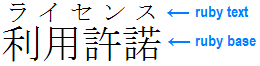
Example of ruby used in Japanese (simple case)
In Japanese typography, this case is sometimes called taigo ruby or group-ruby (per-word ruby), because the annotation as a whole is associated with multi-character word (as a whole).
In this second example, two levels of annotations are attached to a base sequence: the hiragana characters on top refer to the pronunciation of each of the base kanji characters, while the words “Keio” and “University” on the bottom are annotations describing the English translation.
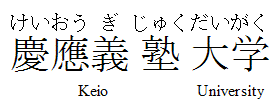
Complex ruby with annotation text over and under the base characters
Notice that to allow correct association between the hiragana characters and their corresponding Kanji base characters, the spacing between these Kanji characters is adjusted. (This happens around the fourth Kanji character in the figure above.) To avoid variable spacing between the Kanji characters in the example above the hiragana annotations can be styled as a collapsed annotation, which will look more like the group-ruby example earlier. However because the base-annotation pairings are recorded in the ruby structure, if the text breaks across lines, the annotation characters will stay correctly paired with their respective base characters.
Ruby formatting as used in Japanese is described in JIS X-4051 [JIS4051] (in Japanese) and in Requirements for Japanese Text Layout [JLREQ] (in English and Japanese)]. In HTML, ruby structure and markup to represent it is described in the Ruby Markup Extension specification. This module describes the CSS rendering model and formatting controls relevant to ruby layout of such markup.
2. Ruby Formatting Model
The CSS ruby model is based on the HTML Ruby Markup Extension and XHTML Ruby Annotation Recommendation [RUBY]. In this model, a ruby structure consists of one or more ruby base elements representing the base (annotated) text, associated with one or more levels of ruby annotation elements representing the annotations. The structure of ruby is similar to that of a table: there are “rows” (the base text level, each annotation level) and “columns” (each ruby base and its corresponding ruby annotations).
Consecutive bases and annotations are grouped together into ruby segments . Within a ruby segment, a ruby annotation may span multiple ruby bases.
In HTML, a single <ruby> element may
contain multiple ruby segments. (In
the XHTML Ruby model, a single <ruby> element can only
contain one ruby segment.)
2.1. Ruby-specific ‘display’ property values
For document languages (such as XML applications) that do not have
pre-defined ruby elements, authors must map document language elements to
ruby elements; this is done with the ‘display’ property.
| Name: | display |
|---|---|
| New Values: | ruby | ruby-base | ruby-text | ruby-base-container | ruby-text-container |
The following new ‘display’ values
assign ruby layout roles to an arbitrary element:
- ‘
ruby’ - Specifies that an element generates a ruby container box .
(Corresponds to HTML/XHTML
<ruby>elements.) - ‘
ruby-base’ - Specifies that an element generates a ruby base box . (Corresponds to
HTML/XHTML
<rb>elements.) - ‘
ruby-text’ - Specifies that an element generates a ruby annotation box .
(Corresponds to HTML/XHTML
<rt>elements.) - ‘
ruby-base-container’ - Specifies that an element generates a ruby base container
box . (Corresponds to XHTML
<rbc>elements; always implied in HTML.) - ‘
ruby-text-container’ - Specifies that an element generates a ruby
annotation container box . (Corresponds to HTML/XHTML
<ruby>elements.)
2.2. Anonymous Ruby Box Generation
The CSS model does not require that the document language include elements that correspond to each of these components. Missing parts of the structure are implied through the anonymous box generation rules similar to those used to normalize tables. [CSS21]
- Any in-flow block-level boxes directly contained by a ruby container, ruby base container, ruby annotation
container, ruby base box, or
ruby annotation box are forced
to be inline-level boxes, and their ‘
display’ value computed accordingly. For example, the ‘display’ property of an in-flow element with ‘display: block’ parented by an element with ‘display: ruby-text’ computes to ‘inline-block’. This computation occurs after any intermediary anonymous-box fixup (such as that required by internal table elements). - Any consecutive sequence of ruby bases not parented by a ruby base container is wrapped in an anonymous ruby base container. Similarly, any consecutive sequence of ruby annotations not parented by a ruby annotation container is wrapped in an anonymous ruby annotation container.
- Within each ruby base container, each sequence of inline-level boxes is wrapped in an anonymous ruby base box. Similarly, within each ruby annotation container, each sequence of inline-level boxes is wrapped in an anonymous ruby annotation box.
- A sequence of ruby base containers and/or ruby annotation containers not parented by a ruby container is wrapped in an anonymous ruby container.
At this point, all ruby layout structures are properly parented, and the UA can start to associate bases with their annotations.
Note that the UA is not required to create any of these anonymous boxes in its internal structures, as long as pairing and layout behaves as if they existed.
2.3. Ruby Pairing and Annotation Levels
Within a ruby structure, each ruby base is associated with ruby annotations and vice versa. A ruby base can be associated with at most one ruby annotation per annotation level. If there are multiple annotation levels, it can therefore be associated with multiple ruby annotations. A ruby annotation is associated with one or more ruby bases; annotations can span multiple bases.
Annotation pairing is the process of associating ruby annotations with ruby bases.
-
First, the ruby structure is divided into ruby segments, each consisting of a single ruby base container followed by one or more ruby annotation containers. If the first child of a ruby container is a ruby annotation container, an anonymous, empty ruby base container is assumed to exist before it. Similarly, if the ruby container contains consecutive ruby base containers, anonymous, empty ruby annotation containers are assumed to exist between them. The ruby base container in each segment is thus associated with each of the ruby annotation containers in that segment.
Each ruby annotation containers in a ruby segment represents one level of annotation: the first one represents the first level of annotation, the second one represents the second level of annotation, and so on.
- Within each ruby segment, each ruby
base box in the ruby base
container is paired with one ruby annotation box from each ruby annotation
container in its ruby segment. If there are not enough ruby annotations in a ruby annotation
container, the last one is associated with any excess ruby bases. (If there are not any in the
ruby annotation
container, an anonymous empty one is assumed to exist.) If there
are not enough ruby bases, any
remaining ruby annotations are
assumed to be associated with empty, anonymous bases inserted at the end
of the ruby base container.
If an implementation supports ruby markup with explicit spanning (e.g. XHTML Complex Ruby Annotations), it must adjust the pairing rules to pair spanning annotations to multiple bases appropriately.
A this point, ruby “columns” are defined, each represented by a single ruby base and associated with one ruby annotation (possibly an empty, anonymous one) from each annotation level.
2.3.1. Nested Ruby
When ruby containers are nested, pairing begins with the deepest ruby container, then expands out, treating each ruby container nested within another ruby container essentially as a single ruby base in the outer ruby container, and associating each ruby annotation paired with the nested ruby container as being associated with (spanning) all of its ruby bases.
Using nested ruby containers thus allows the representation of complex spanning relationships.
This has to be Level 1 because HTML5 allows it, so we have to handle it. Yay HTML5.
2.4. Autohiding Annotations
If a ruby annotation has the exact same text content as its base, it is hidden . Hiding a ruby annotation does not affect annotation pairing or the block-axis positioning of boxes in other levels. However the hidden annotation is not visible, and it has no impact on layout other than to separate adjacent sequences of ruby annotation boxes within its level, as if they belonged to separate segments and the hidden annotation’s base were not a ruby base but an intervening inline.
This is to allow correct inlined display of annotations for Japanese words that are a mix of kanji and hirangana. For example, the word 振り仮名 should be inlined as
振り仮名(ふりがな)
and therefore marked up as
<ruby>
  <rb>振</rb><rb>り</rb><rb>仮</rb><rb>名</rb>
  <rp>(</rp><rt>ふ</rt><rt>り</rt><rt>が</rt><rt>な</rt><rp>)</rp>
<ruby>
However, when displayed as ruby, the “り” should be hidden

Hiragana ruby for 振り仮名
Future levels of CSS Ruby may add controls for this, but in this level it is always forced.
The content comparison for this auto-hiding behavior takes place prior
to white space collapsing and ignores elements (considers only the
textContent of the boxes).
Is before or after white space collapsing easier? We should do whatever is easier, as it really doesn't matter much which way to go.
2.5. White Space
Collapsible white space within a ruby structure is discarded
- at the beginning and end of a ruby container, ruby annotation container, or ruby base container,
- at the beginning/end of a ruby annotation box or ruby base box if white space is not its only contents,
- between a ruby base container and its following ruby annotation container,
- between ruby annotation containers.
Between ruby segments, between ruby bases, and between ruby annotations, however, white space is not discarded.
Where undiscarded white space is collapsible, it will collapse following the standard white space processing rules. [CSS3TEXT] For collapsible white space between ruby segments, however, the contextual text for determining collapsing behavior is given by the ruby bases on either side, not the text on either side of the white space in the source document.
Note that the white space processing rules cause a white space sequence containing a segment break (such as a line feed) to collapse to nothing between CJK characters. This means that CJK ruby can safely use white space for indentation of the ruby markup. For example, the following markup will display without any spaces:
<ruby>
  <rb>東</rb><rb>京</rb>
  <rt>とう</rt><rt>きょう</rt>
</ruby>
However, white space that does not contain a segment break does not collapse completely away, so this markup will display with a space between the first and second ruby pairs:
<ruby>
  <rb>東</rb>	<rb>京</rb>
  <rt>とう</rt>	<rt>きょう</rt>
</ruby>
Any preserved white space is then wrapped in an anonymous box belonging to the ruby base container (if between ruby bases), ruby annotation container (if between ruby annotations), or ruby container (if between ruby segments). In the latter case, the text is considered part of the base level. Such anonynmous boxes do not take part in pairing. They merely ensure separation between adjacent bases/annotations.
Specify how these anonymous white space boxes impact layout.
These rules allow ruby to be used with space-separated scripts such as Latin. For example,
<ruby>
  <rb>W</rb><rb>W</rb><rb>W</rb>
  <rt>World</rt> <rt>Wide</rt> <rt>Web</rt>
</ruby>
They also ensure that annotated white space is preserved. For example,
<ruby>
  <rb>Aerith</rb><rb> </rb><rb>Gainsboro</rb>
  <rt>エアリス</rt><rt>・</rt><rt>ゲインズブール</rt>
</ruby>
2.6. Ruby layout
When a ruby structure is laid out, its base level is laid out on the
line, aligned according to its ‘vertical-align’ property exactly as if its
bases were a regular sequence of inline boxes. Each ruby base container is sized
and positioned to contain exactly the full height of its ruby bases.
Ruby annotations associated
with the base level are then positioned with respect to their ruby base boxes according to the
applicable ‘ruby-position’ values. Ruby annotations within a level
(within a single ruby container)
are aligned to each other as if they were inline boxes participating in
the same inline formatting context. Each ruby annotation container
is sized and positioned to contain exactly the full height of its ruby annotations.
A ruby container (or fragment thereof) measures as wide as the content
of its widest level. Similarly, ruby base
boxes and ruby annotation
boxes within a ruby “column” have the measure of the widest
content in that “column”. In the case of spanning annotations
(whether actually spanning or pretending to span per ‘ruby-collapse’), the measures of the ruby annotation box and the sum of
its associated ruby base boxes must
match.
How the extra space is distributed when ruby content is narrower than
the measure of its box is specified by the ‘ruby-align’ property.
2.6.1. Inter-character ruby layout
Inter-character annotations have special layout. When ‘ruby-position’
indicates ‘inter-character’ annotations, the
affected annotation boxes are spliced into and measured as part of
the layout of the base level. The ruby base container must be
sized to include both the base boxes as well as the ‘inter-character’ annotation boxes. The affected
ruby annotation
container is similarly sized so that its content box coincides
with that of the ruby base
container.
For the purpose of laying out other levels of annotations, an ‘inter-character’ annotation effectively becomes part of
its base. Or should it become a quasi-base between two
bases? A spanning ‘inter-character’
annotation is placed after all the bases that it spans.
2.7. Styling Ruby Boxes
In most respects, ruby boxes can be styled similar to inline boxes. However, the UA is not required to support any of the box properties (borders, margins, padding), any of the background properties or outline properties, or any other property that illustrates the bounds of the box on ruby base container boxes, ruby annotation container boxes, or ruby-internal ruby container boxes. The UA may implement these boxes simply as abstractions for inheritance and control over the layout of their contents.
2.8. Ruby box and line breaking
When there is not enough space for an entire ruby container to fit on the line, the ruby may be broken wherever all levels simultaneously allow a break. Ruby most often breaks between base-annotation sets, but if the line-breaking rules allow it, can also break within a ruby base (and, in parallel, its associated annotation boxes).
Whenever ruby breaks across lines, ruby annotations must stay with
their respective bases. The line must not break between a
ruby base and its annotations,
even in the case of ‘inter-character’
annotations.
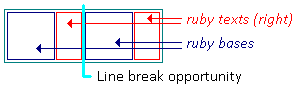
‘inter-character’ ruby line
breaking opportunity
2.8.1. Breaking between bases
In typical cases, ruby base boxes and ruby annotation boxes are styled to forbid internal line wrapping and do not contain forced breaks. (See Appendix A.) In such cases the ruby container can only break between adjacent ruby bases, and only if no ruby annotations span those ruby bases.
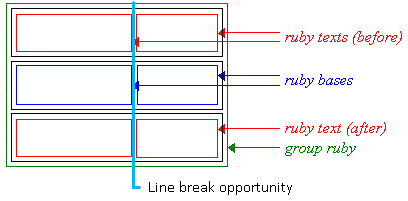
Ruby line breaking opportunity
Whether ruby can break between two adjacent ruby bases is controlled by normal line-breaking rules for the base text, exactly as if the ruby bases were adjacent inline boxes. (The annotations are ignored when determining soft wrap opportunities for the base level.)
For example, if two adjacent ruby bases are “蝴” and “蝶”,
the line may break between them, because lines are normally allowed to
break between two Han characters. However, if ‘word-break’ is ‘keep-all’, that line break is forbidden.
<ruby>蝴<rt>hú</rt>蝶<rt>dié</rt>
Inter-base white space is significant for evaluating line break opportunities between ruby bases. As with white space between inlines, it collapses when the line breaks there. Similarly, annotation white space is also trimmed at a line break.
For example, given the following markup:
<ruby><rb>one</rb> <rb>two</rb> <rt>1</rt> <rt>2</rt></ruby>
Due to the space, the line may break between “one” and “two“. If the line breaks there, that space—and the space between “1” and “2”—disappears, in accordance with standard CSS white space processing rules. [CSS3TEXT]
2.8.2. Breaking within bases
For longer base texts, it is sometimes appropriate to allow breaking within a base-annotation pair. For example, if an English sentence is annotated with its Japanese translation, allowing the text to wrap allows for reasonable line breaking behavior in the paragraph.
Insert scanned example so people don't think this is just the ramblings of an insane spec-writer.
Line-breaking within a ruby base is
only allowed if the ‘white-space’ property
of the ruby base and all its parallel
annotations allow it, and there exists a soft wrap
opportunity within (i.e. not at the start or end) the content
of each base/annotation box. Since there is no structural correspondance
between fragments of content within ruby
bases and annotations, the UA may break at any set of
opportunities; but it is recommended that the UA attempt to proportionally
balance the amount of content inside each fragment.
There are no line breaking opportunities within ‘inter-character’ annotations.
Ruby alignment takes place within each fragment, after line-breaking.
2.9. Bidi Reordering
Constraints: Text within a ruby base must remain contiguous, and bases belonging to a single annotation must remain contiguous. Still figuring out exactly to enforce these limitations in a sensible manner.
2.10. Ruby box and line stacking
The ‘line-height’ property controls
spacing between lines in CSS. When inline content on line is shorter than
the ‘line-height’, half-leading is added
on either side of the content, as specificed in CSS2.1§10.8.
[CSS21]
In order to ensure consistent spacing of lines, documents with ruby
typically ensure that the ‘line-height’ is
large enough to accommodate ruby between lines of text. Therefore,
ordinarily, ruby annotation
containers and ruby annotation
boxes do not contribute to the measured height of a line's inline
contents; any alignment (see ‘vertical-align’) and line-height calculations are
performed using only the ruby base
container, exactly as if it were a normal inline.
However, if the ‘line-height’ specified
on the ruby container is less
than the distance between the top of the top ruby annotation container
and the bottom of the bottom ruby annotation
container, then additional leading is added on the appropriate
side of the ruby base
container such that if a block consisted of three lines each
containing ruby identical to this, none of the ruby containers would overlap.
Note that this does not ensure that the ruby annotations remain within the line box. It merely ensures that if all lines had equal spacing and equivalent amounts and positioning of ruby annotations, there would be enough room to avoid overlap.
Authors should ensure appropriate ‘line-height’ and ‘padding’ to accommodate ruby, and be particularly
careful at the beginning or end of a block and when a line contains
inline-level content (such as images, inline blocks, or elements shifted
with ‘vertical-align’) taller than the
paragraph's default font size.
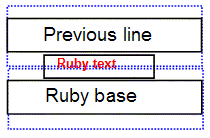
Ruby annotations will often overflow the line; authors should ensure content over/under a ruby-annotated line is adequately spaced to leave room for the ruby.
More control over how ruby affects alignment and line layout will be part of the CSS Line Layout Module Level 3. Note, it is currently in the process of being rewritten; the current drafts should not be relied upon.
3. Ruby Properties
The following properties are introduced to control ruby positioning and alignment.
3.1. Ruby positioning: the ‘ruby-position’
property
| Name: | ruby-position |
|---|---|
| Value: | [ over | under | inter-character ] && [ right | left ] |
| Initial: | over right |
| Applies to: | ruby annotation containers |
| Inherited: | yes |
| Percentages: | N/A |
| Media: | visual |
| Computed value: | specified value |
| Animatable: | no |
| Canonical order: | per grammar |
This property controls position of the ruby text with respect to its base. Values have the following meanings:
Issue-107: Roland Steiner has requested the addition of an auto value as default. See this thread and this one.
- ‘
over’ - The ruby text appears over the base in horizontal text.
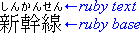
Ruby over Japanese base text in horizontal layout
- ‘
right’ - The ruby text appears on the right side of the base in vertical text.
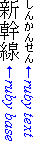
Ruby to the right of Japanese base text in vertical layout
- ‘
under’ - The ruby text appears under the base in horizontal text. This is a
relatively rare setting used in ideographic East Asian writing systems,
most easily found in educational text.
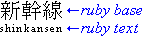
Ruby under Japanese base text in horizontal layout
- ‘
left’ - The ruby text appears on the left side of the base in vertical text.
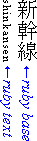
Ruby to the left of Japanese base text in vertical layout
- ‘
inter-character’ -
The ruby text appears on the right of the base in horizontal text. This value forces the ‘
writing-mode’ of the ruby annotation to be vertical.This value is provided for the special case of traditional Chinese as used especially in Taiwan: ruby (made of bopomofo glyphs) in that context appears vertically along the right side of the base glyph, even when the layout of the base characters is horizontal:

“Bopomofo” ruby in traditional Chinese (ruby text shown in blue for clarity) in horizontal layout
Note that the user agent is responsible for ensuring the correct relative alignment and positioning of the glyphs, including those corresponding to the tone marks, when displaying. Tone marks are spacing characters that occur (in memory) at the end of the ruby text for each base character. They are usually displayed in a separate column to the right of the bopomofo characters, and the height of the tone mark depends on the number of characters in the syllable. One tone mark, however, is placed above the bopomofo, not to the right of it.
If multiple ruby annotation
containers have the same ‘ruby-position’, they stack along the block
axis, with lower levels of annotation closer to the base text.
3.2. Collapsed Ruby
Annotations: the ‘ruby-merge’ property
| Name: | ruby-merge |
|---|---|
| Value: | separate | collapse | auto |
| Initial: | separate |
| Applies to: | ruby annotation containers |
| Inherited: | yes |
| Percentages: | N/A |
| Media: | visual |
| Computed value: | specified value |
| Animatable: | no |
| Canonical order: | per grammar |
This property controls how ruby annotation boxes should be rendered when there are more than one in a ruby container box.
Possible values:
- ‘
separate’ -
Each ruby annotation box is rendered in the same column(s) as its corresponding base box(es). This style is called “mono ruby” in [JLREQ].
For example, the following two markups render the same:
<ruby>無<rt>む</ruby><ruby>常<rt>じょう</ruby>
and:
<ruby style="ruby-merge:separate"><rb>無<rb>常<rt>む<rt>じょう</ruby>
- ‘
collapse’ -
All ruby annotation boxes within the same ruby segment on the same line are concatenated, and laid out as if their contents belonged to a single ruby annotation box spanning all their associated ruby base boxes. This style renders similar to “group ruby” in [JLREQ], except that ruby annotations are kept together with their respective ruby bases when breaking lines.
The following two markups render the same both characters fit on one line:
<ruby>無常<rt>むじょう</ruby>
and:
<ruby style="ruby-merge:collapse"><rb>無<rb>常<rt>む<rt>じょう</ruby>
However, the second one renders the same as ‘
ruby-position: separate’ when the two bases are split across lines. - ‘
auto’ -
The user agent may use any algorithm to determine how each ruby annotation box is rendered to its corresponding base box, with the intention that if all annotations fit over their respective bases, the result is identical to “mono ruby”, but if some annotations are wider than their bases the space is shared in some way to avoid forcing space between bases.
One possible algorithm is described as “jukugo ruby” in [JLREQ].
Another, more simplified algorithm of “jukugo ruby” is to render as ‘
separate’ if all ruby annotation boxes fit within the advances of their corresponding base boxes, and render as ‘collapse’ otherwise.
3.3. Ruby Text Distribution: the ‘ruby-align’ property
| Name: | ruby-align |
|---|---|
| Value: | start | center | space-between | space-around |
| Initial: | space-around |
| Applies to: | ruby bases, ruby annotations, ruby base containers, ruby annotation containers |
| Inherited: | yes |
| Percentages: | N/A |
| Media: | visual |
| Computed value: | specified value (except for initial and inherit) |
This property specifies how text is distributed within the various ruby
boxes when their contents do not exactly fill their respective boxes. Note
that space distributed by ‘ruby-align’ is unrelated to, and independent
of, any space distributed due to justification.
Values have the following meanings:
- ‘
start’ - The ruby content is aligned with the start edge of its box.
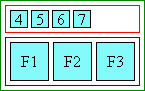
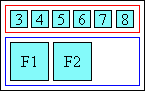
‘
start’ ruby distribution - ‘
center’ - The ruby content is centered within its box.
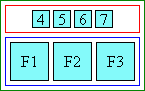
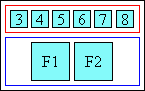
‘
center’ ruby distribution - ‘
space-between’ -
The ruby content expands as defined for normal text justification (as defined by ‘
text-justify’), except that if there are no expansion opportunities the content is centered.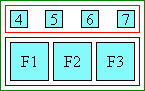
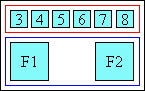
‘
space-between’ ruby distribution - ‘
space-around’ -
As for ‘
space-between’ except that there exists an extra expansion opportunity whose space is distributed half before and half after the ruby content.Since a typical implementation will by default define expansion opportunities between every adjacent pair of CJK characters and not between adjacent pairs of Latin characters, this should result in the behavior recommended by [JLREQ]: for wide-cell ruby content to be distributed...
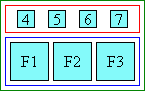
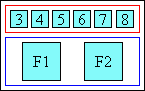
Wide-cell text in ‘
space-around’ ruby distribution is spaced apart... and narrow-cell glyph ruby to be centered.
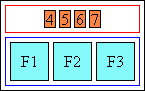
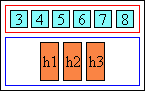
Narrow-width ruby text in ‘
space-around’ ruby distribution is centered
Add a paragraph explaining how to distribute space in situations with spanning annotations.
4. Edge Effects
4.1. Overhanging Ruby
When ruby annotation box is longer than its corresponding ruby base box, the ruby annotation box may partially overhang adjacent boxes.
This level of the specification does not define how much the overhang may be allowed, and under what conditions.
If the ruby text is not allowed to overhang, then the ruby behaves like a traditional inline box, i.e. only its own contents are rendered within its boundaries and adjacent elements do not cross the box boundary:
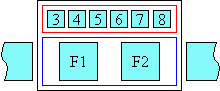
Simple ruby whose text is not allowed to overhang adjacent text
However, if ruby annotation content is allowed to overhang adjacent elements and it happens to be wider than its base, then the adjacent content is partially rendered within the area of the ruby container box, while the ruby annotation may partially overlap the upper blank parts of the adjacent content:
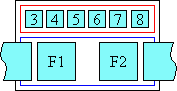
Simple ruby whose text is allowed to overhang adjacent text
The ruby annotations related to a ruby base must never overhang another ruby base.
The alignment of the contents of the base or the ruby text is not
affected by overhanging behavior. The alignment is achieved the same way
regardless of the overhang behavior setting and it is computed before the
space available for overlap is determined. It is controlled by the ‘ruby-align’ property.
I suspect overhanging interacts with alignment in some cases; might need to look into this later.
This entire logic applies the same way in vertical ideographic layout, only the dimension in which it works in such a layout is vertical, instead of horizontal.
The user agent may use [JIS4051] recommendation of using one ruby text character length as the maximum overhang length. Detailed rules for how ruby text can overhang adjacent characters for Japanese are described by [JLREQ].
4.2. Line-edge Alignment
When a ruby annotation box that is longer than its ruby base is at the start or end edge of a line, the user agent may force the side of the ruby annotation that touches the edge of the line to align to the corresponding edge of the base. This type of alignment is described by [JLREQ].
This level of the specification does not provide a mechanism to control this behavior.
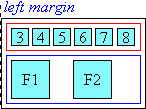
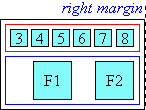
Line-edge alignment
Appendix A: Default Style Sheet
This section is informative.
Supporting Ruby Layout
The following represents a default UA style sheet for rendering HTML and XHTML ruby markup as ruby layout:
ruby { display: ruby; }
rb   { display: ruby-base; white-space: nowrap; }
rt   { display: ruby-text; white-space: nowrap; font-size: 50%; }
rbc  { display: ruby-base-container; }
rtc  { display: ruby-text-container; }
ruby, rb, rt, rbc, rtc { unicode-bidi: isolate; }
Additional rules for UAs supporting the relevant features of [CSS3-TEXT-DECOR] and [CSS3-FONTS]:
rt { font-variant-east-asian: ruby; text-emphasis: none; }
Authors should not use the above rules; a UA that supports ruby layout should provide these by default.
Inlining Ruby Annotations
The following represents a sample style sheet for rendering HTML and XHTML ruby markup as inline annotations:
ruby, rb, rt, rbc, rtc, rp {
  display: inline; white-space: inherit;
  font-variant-east-asian: inherit; text-emphasis: inherit; }
Generating Parentheses
Unfortunately, because Selectors cannot match against text nodes, it's
not possible with CSS to express rules that will automatically and
correctly add parentheses to unparenthesized ruby annotations in HTML.
(This is because HTML ruby allows implying the ruby base from raw text, without a
corresponding element.) However, these rules will handle cases where
either <rb> or <rtc> is used
rigorously.
/* Parens around <rtc> */
rtc::before { content: "("; }
rtc::after  { content: ")"; }
/* Parens before first <rt> not inside <rtc> */
rb  + rt::before,
rtc + rt::before { content: "("; }
/* Parens after <rt> not inside <rtc> */
rb ~ rt:last-child::after,
rt + rb::before  { content: ")"; }
rt + rtc::before { content: ")("; }
5. Glossary
- Bopomofo
- 37 characters and 4 tone markings used as phonetics in Chinese, especially standard Mandarin.
- Hanja
- Subset of the Korean writing system that utilizes ideographic characters borrowed or adapted from the Chinese writing system. Also see Kanji.
- Hiragana
- Japanese syllabic script, or character of that script. Rounded and cursive in appearance. Subset of the Japanese writing system, used together with kanji and katakana. In recent times, mostly used to write Japanese words when kanji are not available or appropriate, and word endings and particles. Also see Katakana.
- Ideograph
- A character that is used to represent an idea, word, or word component, in contrast to a character from an alphabetic or syllabic script. The most well-known ideographic script is used (with some variation) in East Asia (China, Japan, Korea,...).
- Kana
- Collective term for hiragana and katakana.
- Kanji
- Japanese term for ideographs; ideographs used in Japanese. Subset of the Japanese writing system, used together with hiragana and katakana. Also see Hanja.
- Katakana
- Japanese syllabic script, or character of that script. Angular in appearance. Subset of the Japanese writing system, used together with kanji and hiragana. In recent times, mainly used to write foreign words. Also see Hiragana.
6. Conformance
6.1. Document conventions
Conformance requirements are expressed with a combination of descriptive assertions and RFC 2119 terminology. The key words “MUST”, “MUST NOT”, “REQUIRED”, “SHALL”, “SHALL NOT”, “SHOULD”, “SHOULD NOT”, “RECOMMENDED”, “MAY”, and “OPTIONAL” in the normative parts of this document are to be interpreted as described in RFC 2119. However, for readability, these words do not appear in all uppercase letters in this specification.
All of the text of this specification is normative except sections explicitly marked as non-normative, examples, and notes. [RFC2119]
Examples in this specification are introduced with the words “for
example” or are set apart from the normative text with
class="example", like this:
This is an example of an informative example.
Informative notes begin with the word “Note” and are set apart from
the normative text with class="note", like this:
Note, this is an informative note.
6.2. Conformance classes
Conformance to CSS Ruby Module is defined for three conformance classes:
- style sheet
- A CSS style sheet.
- renderer
- A UA that interprets the semantics of a style sheet and renders documents that use them.
- authoring tool
- A UA that writes a style sheet.
A style sheet is conformant to CSS Ruby Module if all of its statements that use syntax defined in this module are valid according to the generic CSS grammar and the individual grammars of each feature defined in this module.
A renderer is conformant to CSS Ruby Module if, in addition to interpreting the style sheet as defined by the appropriate specifications, it supports all the features defined by CSS Ruby Module by parsing them correctly and rendering the document accordingly. However, the inability of a UA to correctly render a document due to limitations of the device does not make the UA non-conformant. (For example, a UA is not required to render color on a monochrome monitor.)
An authoring tool is conformant to CSS Ruby Module if it writes style sheets that are syntactically correct according to the generic CSS grammar and the individual grammars of each feature in this module, and meet all other conformance requirements of style sheets as described in this module.
6.3. Partial implementations
So that authors can exploit the forward-compatible parsing rules to assign fallback values, CSS renderers must treat as invalid (and ignore as appropriate) any at-rules, properties, property values, keywords, and other syntactic constructs for which they have no usable level of support. In particular, user agents must not selectively ignore unsupported component values and honor supported values in a single multi-value property declaration: if any value is considered invalid (as unsupported values must be), CSS requires that the entire declaration be ignored.
6.4. Experimental implementations
To avoid clashes with future CSS features, the CSS2.1 specification reserves a prefixed syntax for proprietary and experimental extensions to CSS.
Prior to a specification reaching the Candidate Recommendation stage in the W3C process, all implementations of a CSS feature are considered experimental. The CSS Working Group recommends that implementations use a vendor-prefixed syntax for such features, including those in W3C Working Drafts. This avoids incompatibilities with future changes in the draft.
6.5. Non-experimental implementations
Once a specification reaches the Candidate Recommendation stage, non-experimental implementations are possible, and implementors should release an unprefixed implementation of any CR-level feature they can demonstrate to be correctly implemented according to spec.
To establish and maintain the interoperability of CSS across implementations, the CSS Working Group requests that non-experimental CSS renderers submit an implementation report (and, if necessary, the testcases used for that implementation report) to the W3C before releasing an unprefixed implementation of any CSS features. Testcases submitted to W3C are subject to review and correction by the CSS Working Group.
Further information on submitting testcases and implementation reports can be found from on the CSS Working Group's website at http://www.w3.org/Style/CSS/Test/. Questions should be directed to the public-css-testsuite@w3.org mailing list.
Acknowledgments
This specification would not have been possible without the help from:
Stephen Deach, Martin Dürst, Hideki Hiura(樋浦 秀樹), Masayasu Ishikawa(石川 雅康), Chris Pratley, Takao Suzuki(鈴木 孝雄), Frank Yung-Fong Tang, Chris Thrasher, Masafumi Yabe家辺 勝文), Steve Zilles.
Changes
The following major changes have been made since the previous Working Draft:
- Remove ‘
ruby-span’ and mentions ofrbspan. - Explicit spanning is not used in HTML ruby in favor of implicit spanning. This can't handle some pathological double-sided spanning cases, but there seems to be no requirement for these at the moment. (For implementations that support full complex XHTML Ruby, they can imply spanning from the markup the same magic way that we handle cell spanning from tables. It doesn't seem necessary to include controls this in Level 1.)
- Defer ‘
ruby-overhang’ and ‘ruby-align: line-end’ to Level 2. - It's somewhat complicated, advanced feature. Proposal is to make this behavior UA-defined and provide some examples of acceptable options.
- Close issue requesting ‘
display: rp’: use ‘display: none’. - The Internationalization WG added an issue requesting a display value
for <rp> elements. They're supposed to be hidden when <ruby> is
displayed as ruby. But this is easily accomplished already with ‘
display: none’. - Change ‘
ruby-position’ values to match ‘text-emphasis-position’. - Other than ‘
inter-character’, which we need to keep, it makes more sense to align ruby positions with ‘text-emphasis-position’, which can correctly handle various combinations of horizontal/vertical preferences. - Remove unused values of ‘
ruby-align’. - ‘
left’, ‘right’, and ‘end’ are not needed. - Replace ‘
auto’, ‘distribute-letter’, and ‘distribute-space’ from ‘ruby-align’ with ‘space-between’ and ‘space-around’. - The ‘
auto’ value relied on inspecting content to determine behavior; this can be avoided by just using ‘space-around’ with standard justification rules (which allow spacing between CJK but not between Latin). Replaced ‘distribute-letter’ and ‘distribute-space’ with ‘space-between’ and ‘space-around’ for consistency with distribution keywords in [CSS3-FLEXBOX] and [CSS3-ALIGN] and to avoid any links to the definition of ‘text-justify: distribute’. - Added ‘
ruby-merge’ property to control jukugo rendering. - This is a stylistic effect, not a structural one; the previous model assumed that it was structural and suggested handling it by changing markup. :(
- Remove ‘
inline’ from ‘ruby-position’. - This is do-able via ‘
display: inline’ on all the ruby-related elements, see Appendix A - Added Default Style rules
- As requested by Internationalization WG.
- Wrote anonymous box generation rules
- And defined pairing of bases and annotations. Should now handle all the crazy proposed permutations of HTML ruby markup.
- Defined layout of ruby
- Defined in detail space distribution, white space handling, line breaking, line stacking, etc. Open issue left for bidi.
References
Normative references
- [CSS21]
- Bert Bos; et al. Cascading Style Sheets Level 2 Revision 1 (CSS 2.1) Specification. 7 June 2011. W3C Recommendation. URL: http://www.w3.org/TR/2011/REC-CSS2-20110607
- [CSS3TEXT]
- Elika J. Etemad; Koji Ishii. CSS Text Module Level 3. 13 November 2012. W3C Working Draft. (Work in progress.) URL: http://www.w3.org/TR/2012/WD-css3-text-20121113/
- [RFC2119]
- S. Bradner. Key words for use in RFCs to Indicate Requirement Levels. Internet RFC 2119. URL: http://www.ietf.org/rfc/rfc2119.txt
Other references
- [CSS3-ALIGN]
- Elika J. Etemad; Tab Atkins Jr. CSS Box Alignment Module Level 3. 14 May 2013. W3C Working Draft. (Work in progress.) URL: http://www.w3.org/TR/2013/WD-css3-align-20130514/
- [CSS3-FLEXBOX]
- Tab Atkins Jr.; Elika J. Etemad; Alex Mogilevsky. CSS Flexible Box Layout Module. 18 September 2012. W3C Candidate Recommendation. (Work in progress.) URL: http://www.w3.org/TR/2012/CR-css3-flexbox-20120918/
- [CSS3-FONTS]
- John Daggett. CSS Fonts Module Level 3. 12 February 2013. W3C Working Draft. (Work in progress.) URL: http://www.w3.org/TR/2013/WD-css3-fonts-20130212/
- [CSS3-TEXT-DECOR]
- Elika J. Etemad; Koji Ishii. CSS Text Decoration Module Level 3. 1 August 2013. W3C Candidate Recommendation. (Work in progress.) URL: http://www.w3.org/TR/2013/CR-css-text-decor-3-20130801/
- [CSS3VAL]
- Håkon Wium Lie; Tab Atkins; Elika J. Etemad. CSS Values and Units Module Level 3. 30 July 2013. W3C Candidate Recommendation. (Work in progress.) URL: http://www.w3.org/TR/2013/CR-css3-values-20130730/
- [JIS4051]
- Formatting rules for Japanese documents (『日本語文書の組版方法』). Japanese Standards Association. 2004. JIS X 4051:2004. In Japanese
- [JLREQ]
- Yasuhiro Anan; et al. Requirements for Japanese Text Layout. 3 April 2012. W3C Working Group Note. URL: http://www.w3.org/TR/2012/NOTE-jlreq-20120403/
- [RUBY]
- Masayasu Ishikawa; et al. Ruby Annotation. 31 May 2001. W3C Recommendation. URL: http://www.w3.org/TR/2001/REC-ruby-20010531
Index
- annotation level, 2.3.
- Annotation pairing, 2.3.
- authoring tool, 6.2.
- hidden annotation, 2.4.
- hidden ruby annotation, 2.4.
- level, 2.3.
- renderer, 6.2.
- Ruby, 1.4.
- ruby-align, 3.3.
- ruby-align:center, 3.3.
- ruby-align:space-around, 3.3.
- ruby-align:space-between, 3.3.
- ruby-align:start, 3.3.
- ruby annotation, 2., 2.1.
- ruby annotation box, 2.1.
- ruby annotation container, 2.1.
- ruby annotation container box, 2.1.
- ruby base, 2., 2.1.
- ruby base box, 2.1.
- ruby base container, 2.1.
- ruby base container box, 2.1.
- ruby container, 2.1.
- ruby container box, 2.1.
- ruby-merge, 3.2.
- ruby-merge:auto, 3.2.
- ruby-merge:collapse, 3.2.
- ruby-merge:separate, 3.2.
- ruby-position, 3.1.
- ruby-position:inter-character, 3.1.
- ruby-position:left, 3.1.
- ruby-position:over, 3.1.
- ruby-position:right, 3.1.
- ruby-position:under, 3.1.
- ruby segments, 2.
- style sheet
- as conformance class, 6.2.
Property index
| Property | Values | Initial | Applies to | Inh. | Percentages | Media |
|---|---|---|---|---|---|---|
| ruby-align | start | center | space-between | space-around | space-around | ruby bases, ruby annotations, ruby base containers, ruby annotation containers | yes | N/A | visual |
| ruby-merge | separate | collapse | auto | separate | ruby annotation containers | yes | N/A | visual |
| ruby-position | [ over | under | inter-character ] && [ right | left ] | over right | ruby annotation containers | yes | N/A | visual |