About the school
The School of Electrical Engineering and Computer Science offers a vibrant research environment where the traditional disciplines of electronics, computer and software engineering and computer science come together to create unique synergy.
Undergraduate programs
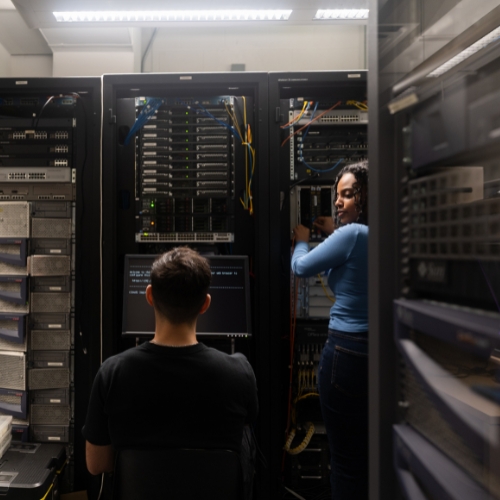
Computer engineering
This program allows for more specialized studies in microprocessor-based systems, computer architecture, programming concepts, etc.
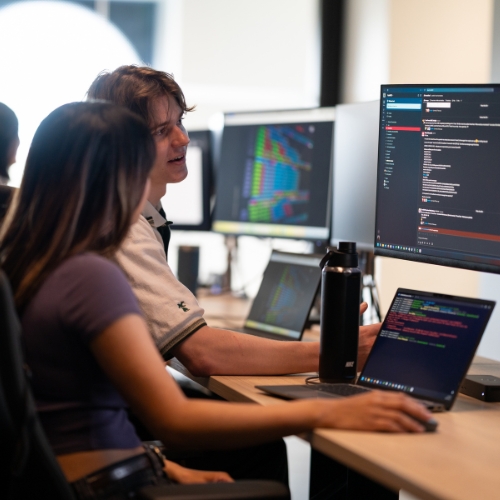
Computer science
Computer science combines the study of computation and information processing fundamentals with their application in the world around us.
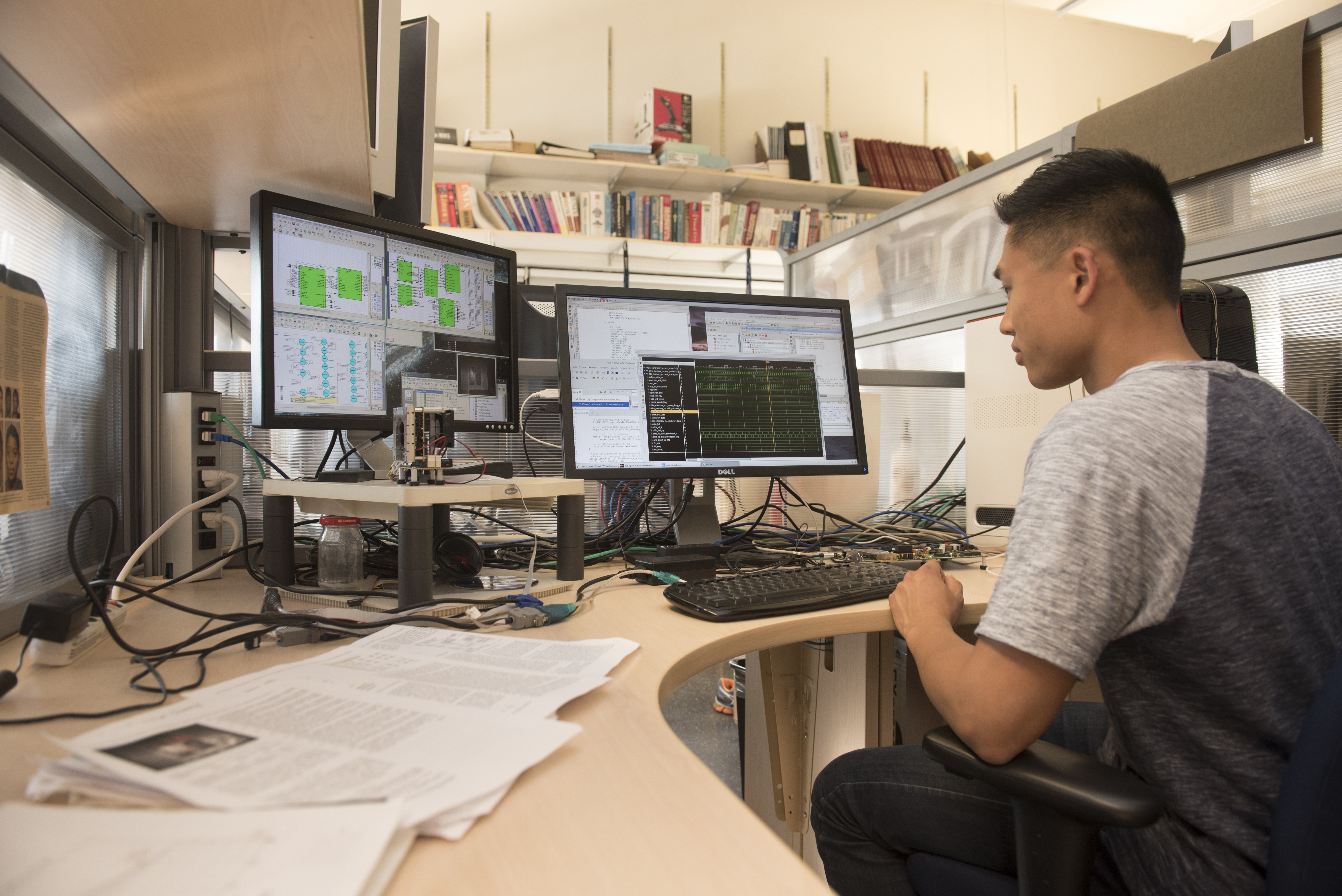
Data science
Combine elements of mathematics, computer science and statistics to make decision in areas like business, sports, advertising, medicine, etc.
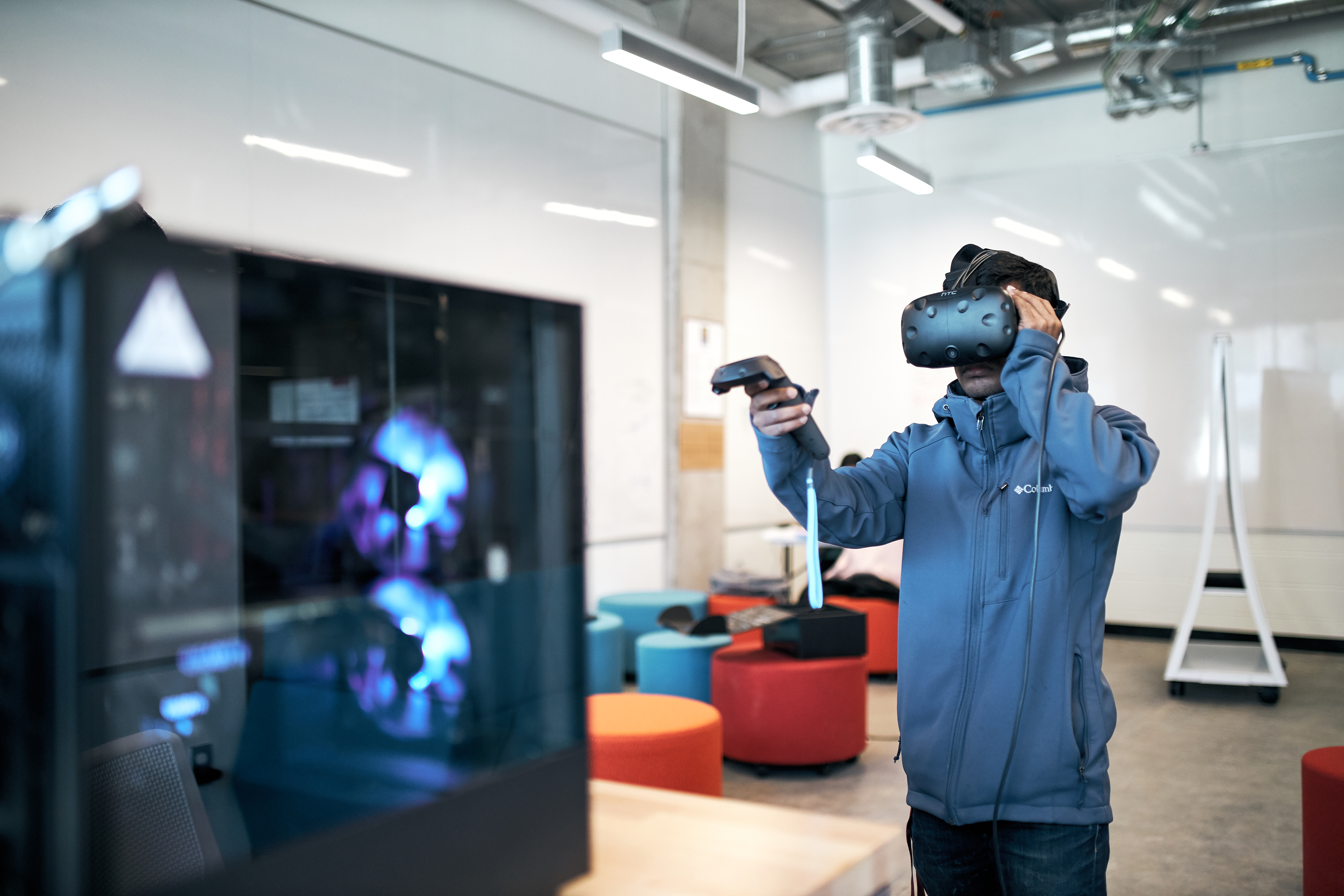
Software engineering
Software engineers are found in fields such as high tech, finance, telecommunications, government, health care, transportation and entertainment.
Graduate programs

Computer science
Students who wish to pursue graduate studies in computer science can do so in joint programs offered by the University of Ottawa and Carleton.
Research
Research areas within the School of Electrical Engineering and Computer Science
With over 70 faculty researchers and 750+ graduate students, the School of Electrical Engineering and Computer Science (EECS) conducts research in applied artificial intelligence, advanced software systems, cybersecurity and emerging computing technologies. This research is supported by strong, long-standing partnerships with industry and public-sector organizations to create a research environment that emphasizes deployment, scalability, security and real-world impact.
Our core strengths include applied and trustworthy AI, machine learning and data analytics, intelligent and autonomous software systems, modern software engineering practices, cloud and edge computing, and cybersecurity and privacy-by-design. These efforts are tightly integrated into research in quantum computing and quantum algorithms, photonics, and semiconductor technologies, particularly where these platforms enable AI acceleration, secure computation, high-performance systems and next-generation digital infrastructure.
Research at EECS spans the full innovation pipeline, from exploratory and pre-competitive research to industry-driven applied projects, prototyping and technology transfer. Our collaboration models are flexible and include graduate student sponsorship, joint research initiatives, research on contract and longer-term strategic partnerships. University-based research offers a cost-effective path to innovation, and industry support can frequently be leveraged to access provincial and federal funding, creating a strong multiplier effect.
Loosely speaking, an algorithm is a formally defined, finite procedure to solve a problem in a finite number of steps. Algorithms are what make it possible for computers to solve problems. They are at the very heart of computer science and play a key role in most of its areas. Typical algorithm problems include the following: Is there a constructive solution to a given problem? Is there an efficient constructive solution to a given problem (minimizing one or several factors)? How efficient is a given constructive solution? Is it optimal? Is there a good heuristic for a given problem?
The algorithm team works on many different aspects of these questions, developing algorithms to efficiently solve combinatorial optimization problems, algorithms based on graphical representations, algorithms applied to ad hoc and sensor networks, network protocol algorithms, ordered sets manipulation and drawing, algorithms for covering arrays used in software testing, algorithms for mobile agents and algorithms for mobile robots.
Our team’s research can be applied to a wide variety of topics, including design of reliable communication networks, covering schemes for software testing, robotic routing, message routing in wireless networks, design, modelling, analysis and performance evaluation of computer communication network, circuit board production, automatic rendering of complex and large graphs, and construction of test suites for interaction testing.
Researchers
Text analysis and machine learning are core to applied AI systems that turn data into actionable intelligence. This research focuses on building systems that can represent, learn and reason to support real-world decision-making. Key challenges include determining whether available data is sufficient to address a given problem, learning useful representations from examples, extracting insight from complex sources (especially text and documents written in natural language), and organizing knowledge to allow autonomous or semi-autonomous agents to act effectively.
Beyond foundational methods, this research focuses on high-impact applications in fields ranging from health care, computer security and management to digital entertainment and consumer technologies.
Researchers
The Big Data Management and Analytics group investigates ways to upscale data-driven methods to deal with very large volumes of data in real time. This includes: techniques for data preparation (organization, basic statistics, cleaning, and integration); data mining techniques (pattern mining, classification, clustering, outlier and anomaly detection); model evaluation; data warehousing and multidimensional analysis; data visualization and visual data analytics.
Applications include: information extraction from social media messages, opinion mining from the Web, analysing sensor data for military applications, and data schema harmonization in scientific data sets and retail warehouses.
Researchers
Biomedical engineering comprises several fields of research, including bioinformatics, medical imaging, physiological signal processing and medical informatics. It is a relatively new field of research that applies mathematical and computer science theories to organized models, to help understand fundamental biological and biomedical problems.
Biomedical engineering and bioinformatics create new knowledge, from the molecular to the systems level. The field also focuses on developing approaches to prevent, diagnose and treat medical conditions. Our major research efforts in bioinformatics apply machine learning to biological data to gain insights into a range of problems, including cell type specificity and drug response.
Researchers
With the tremendous increase in traffic over the Internet, researchers started to use optical fibres to provide high capacity communication links with much improved efficiency. More recently, optical networks researchers have introduced wavelength division multiplexing (WDM), the technology of transmitting multiple data streams independently on a single fibre using different light wavelengths, to increase the network capacity many times over. In addition, “burst switching,” sharing the bandwidth in the time domain using very fast switches, has been proposed. However, these approaches introduce several challenging issues related to light path establishment and control, network architecture, optical switch architecture, routing and wavelength and time-slot assignment, optical network survivability, routing algorithms and protocols, network security and network management. Network access cost remains the big challenge for optical networks end users, stimulating research in the area of passive optical networks (PON), Ethernet PON and WDM-PON.
Applications of broadband networks and broadband Internet include multimedia communications, IP-telephony, video teleconferencing, e-commerce, web services and collaborative applications.
Researchers
The Internet can be a dangerous place where malicious software, denial of service, phishing, credit card theft, identity theft and other attacks threaten the wellbeing and productivity of many in society. Other electronic networks — including voice/data networks (such as cellphone and wireless ad hoc nets), text networks, and cloud environments — are not much better. The goal of privacy and security research is to create environments in which it is safe for people to work and play. Specific applications include e-commerce, e-business, online gaming, healthcare, and corporate and government networks.
This research area involves a number of different sub-disciplines, including mathematics, communications protocols, distributed systems, software development, specification and formal design, model checking and theorem proving, verification, validation and testing, and hardware/firmware design. It seeks to combine some of these sub-disciplines in ways that allow secure and private interaction over electronic and wireless networks.
Researchers
“Distributed systems” is a generic term used to indicate any system that is composed of a collection of communicating computational devices, and “distributed computing” refers to computability and complexity issues in such environments. The distributed computing and systems team is quite diverse and complementary, and covers a wide spectrum of aspects of distributed computing and systems, from theory to application, including algorithm design, simulation, networks, architectures and management. Our research focuses on a variety of distributed environments (wired, wireless, ad hoc, mobile, peer-to-peer, self-organized). In these environments our team is interested in various issues, among them design, efficiency, fault tolerance, quality of service, communication software reliability, safety and security.
Researchers
All physical electrical devices involve the interaction of electro-magnetic fields. The higher the frequency at which a device operates, the smaller the wavelength of the electromagnetic fields involved and the larger the devices are relative to a wavelength. Also, the electromagnetic phenomena are used in different ways than at lower frequencies. Thus, we need to develop in-depth efficient circuit modelling tools and measurement techniques specifically suited to the components that make terrestrial wireless, satellite, and optical communications networks possible. This includes developing advanced electro-magnetic and circuit simulation CAD tools that help with the design, simulation and optimization of devices and components for use in communication systems.
Microwave equipment such as cellular phones, cordless computer peripherals, indoor and outdoor security systems, positioning systems for cars and airplanes, satellite links and more is now part of our daily life. RF/microwave and optical devices are also used in industrial production lines, medical technologies and transport systems. Currently, demands for smaller size and weight, as well as accessibility to services such as text messaging, email, Internet and photo and video cameras, to name a few, are creating new challenges for RF/microwave engineers. Integrating so many different features in a single device means multi-task design, requiring experienced designers with both theoretical and experimental technical skills.
Researchers
The field of information management and data mining focuses on the collection, management and intelligent analysis of large-scale data repositories. Our research aims to help realize the dream of making data, and the associated knowledge hidden within, available anywhere, anytime and in any possible format. We are studying best practices concerning organization of and control over the structure, processing and delivery of information, especially within an e-commerce framework. Furthermore, our research aims to extract useful knowledge from these sources, by developing new techniques to seamlessly mine complex databases.
This research has applications in a variety of areas, including e-commerce, health care systems management, anthropometry, and bioinformatics, among many others. Our research includes the simulation of a complete data warehouse at a major teaching hospital and three major health care processes. We are also developing a location-aware data management and mining system, that aid users by providing them with personalized recommendations as they travel.
Researchers
Multimedia communications deals with the representation, storage, retrieval and dissemination of information that is expressed in multiple media, such as text, voice, graphics, audio, video, haptics and 3D virtual worlds. Collaborative multimedia communications refers to multimedia which features collaborative work among several participants who are concurrently engaged in a multimedia session. A virtual environment is an artificial environment created with computer hardware and software and presented to the user in such a way that it appears and feels like a real environment.
These environments are widely used by major companies (IBM, CISCO) for selling their products. Haptics refers to the hardware/software representation and electronic transmission of the feeling of human touch.
The potential of these technologies is significant. They have been explored in contexts as diverse as modelling and animation, geophysical analysis, dentistry training, virtual museums, assembly planning, mine design, surgical simulation, design evaluation, control of scientific instruments, gaming, and robotic simulation and manipulation in hazardous environments.
Researchers
Photonics studies the interaction of light with human-made structures created through nanofabrication (photonic structures). It involves generating and controlling light and other forms of radiant energy, with the photon as its quantum unit.
Semiconductor photonic (optoelectronic or active photonic) devices can emit, transmit, amplify and detect light. Passive photonic devices include fibre optics, on-chip optical waveguides and advanced photonic systems for light-matter interaction and nonlinear manipulation of light.
Applications include powering the world with low-cost, environmentally friendly, high-efficiency concentrated solar cells, enabling broadband information access (internet, telephony, cable) for all and communicating sound, vision and touch over optical networks, as well as quantum information, sensing and measuring the world.
For more, discover the Nexus for Quantum Technologies Institute.
Researchers
Robotics has often been described as the intelligent connection of perception to action. Robot actuators provide the action function. A variety of sensors provide the perception capability. Computational intelligence is needed for a framework to coordinate the perception and action capabilities in a meaningful way. Machine vision is one of the most powerful perception mechanisms. It involves extracting, characterizing and interpreting information from images in order to identify or describe objects in the environment. Autonomous robot systems are designed to operate in uncertain and highly dynamical environments.
Researchers
Software engineering aims at improving software qualities such as reliability, safety, security and usability. It also aims to reduce cost and time-to-market in the context of both new system development and maintenance of existing software systems. Our software engineering faculty members concentrate on several types of software systems, including telecommunication systems, software engineering tools, e-commerce systems and other distributed web-based applications. Their interests cover the entire development process, from requirements to testing and deployment. They investigate new methodologies and evolving best practices in software engineering, and work to apply their research results by collaborating with tool developers, participating in developing international standards, using the methodologies in graduate and undergraduate education and working directly with companies that develop software.
Research applications include improved software products, new software engineering tools and improved software development processes, which can be applied in all industries and all types of software used in industries.
Researchers
This area of research includes signal processing, data compression schemes, and transmission and storage of specific media (speech, audio, image or video), as well as signal classification and the semantic analysis of such media information. It also includes problems combining these different media into multimedia applications.
Audiovisual information constitutes the means for humans to interact with their environment. Reproduction and manipulation of such information forms the basis for huge industries in the fields of communications, robotics, entertainment, biomedical engineering and education, among many others. Specific applications include speech processing for telephony and teleconferencing, noise and echo cancellation, image processing and enhancement, media analysis for classification, storage and retrieval, the creation of virtual environments and many others.
Researchers
Theoretical Computer Science is the study of the foundations of computing, in all its aspects, from the understanding of inherent limitations and capabilities of computational systems, to the mathematical structures and properties underlying computations.
It includes the design and analysis of algorithms with applications in a variety of computer science and engineering fields.
In particular, the EECS faculty members belonging to this group cover a wide range of fundamental CS topics: design and analysis of algorithms, cryptography, combinatorial optimization, distributed computing, graph theory, computational geometry, complexity theory, logic and foundations of programming, computability of mobile entities.
Researchers
Our team’s research in this area focuses mainly on the physical (PHY) and medium access control (MAC) layers of wireless communication systems. Topics include modulation, coding, fading mitigation and channel phase compensation, multiple access, improved spectral efficiency techniques, MIMO and RF technologies for wireless systems.
Wireless communications systems permit individuals to be “connected” regardless of their physical location. Research done in this area can be applied to cellular networks, wireless sensor networks (WSNs), wireless local area networks (WLAN), etc.
Researchers
Our research in this area involves wireless networking and mobile computing at different levels. It includes distributed and mobile computing, wireless networks, wireless and mobile ad hoc networks, wireless sensor networks, wireless mesh, ubiquitous and pervasive networking, wireless multimedia networking and computing, mobile e-commerce, and WPAN, GPRS, VoIP, WiMax and RFID technologies. While mobile computing focuses on the design of algorithms and protocols for distributed computing with mobile communication networks, wireless and mobile networking focuses upon several aspects of wireless networks, such as network services, network management, mobility management, energy-efficient protocols and power management, wireless security, privacy and dependability, multicasting and broadcasting issues.
As the wireless networking and mobile computing industry has moved forward at lightning speed, so has the design and development of new technologies and standards to support this industry. Applications include telemedicine, emergency preparedness and response, intelligent buildings, intelligent transport networks, environmental monitoring aspects, etc.
Researchers
Research groups and chairs
- Advanced Materials and Devices Laboratories
- Bio-Medical Instrumentation and Processing Group (BioMIP)
- Centre for Research in Photonics at the University of Ottawa (CRPuO)
- Contract Specification Monitoring Lab (CSM)
- Complexity Reduction in Software Engineering (CRuiSE)
- Computer Architecture Research Group (CARG)
- Distributed and Collaborative Virtual Environments Research Lab (Discover)
- Integer Programming, Combinatorial Optimization and Structures (IPOS)
- Lab of Image, Intelligence and Innovation (LIII)
- Logic and Foundation of Computing Group (LFC)
- Machine Intelligence, Robotics, and Mechatronics (MIRaM)
- Medical Devices Center (MDC) at the University of Ottawa Heart Institute
- Multimedia Communications Research Lab (MCRLab)
- Nanda Laboratory on Trustable Software Engineering
- Networked Systems and Communications Research (NETCORE) Lab
- Next Generation Communications and Computing Networks-Smart Connected Vehicles Innovation (NEXTCON-SCVI) Labs
- Ontario Research Network on Electronic Commerce - Information and Communications Technologies (ORNEC-ICT)
- Photonic Technology Laboratory (PTL)
- Piano Pedagogy Research Lab (PianoLab)
- Radio-Frequency and Microwave Group (RF&M)
- Sedna Laboratory on Engineering Trustworthy IoT Systems
- Sensing and Modeling Research Lab (SMR)
- Signal Processing Oriented Technologies Research Group (SPOT)
- The Ottawa-Carleton Discrete Mathematics Group (DM)
- Theory of Computing (TOC)
- The Text Analysis and Machine Learning Group (TAMALE, GRIL)
- Video, Image, Vision, Audio Lab (VIVA)
Canada Research Chairs
Berini, Pierre
Canada Research Chair in Nanophotonics
Boukerche, Azzedine
Canada Research Chair in Large-Scale Distributed Simulation Systems and Vehicular Networking (Tier 1)
Erol-Kantarci, Melike
Canada Research Chair in ArtificiaI Intelligence-Enabled Next-Generation Wireless Networks (Tier 2)
Jabbour, Ghassan
Canada Research Chair in Engineered Advanced Materials and Devices (Tier 1)
Shirani, Paria
Canada Research Chair in Cybersecurity (Tier 2)
University Research Chairs
Briand, Lionel
Distinguished Research Chair in Trustworthy AI-Enabled Software Systems
Hinzer, Karin
University Research Chair in Photonic Devices for Energy
Dujmovic, Vida
University Research Chair in Structural and Algorithmic Graph Theory
Kantarci, Burak
University Research Chair in AI-Enabled Secure Networking for Smart Critical Infrastructures
Hall, Trevor
University Research Chair in Photonic Circuits & Integration

Using artificial intelligence to detect internal damage to vehicles in real time
Master’s student Sina Negarandeh is working on an innovative model that uses artificial intelligence to speed up the process of analyzing X-rays showing internal damage to vehicles, such as cars and airplanes. This research helps avoid catastrophic vehicle failure and reduce wasted resources.
Master’s student Sina Negarandeh is working on an innovative model that uses artificial intelligence to speed up the process of analyzing X-rays showing internal damage to vehicles, such as cars and airplanes. This research helps avoid catastrophic vehicle failure and reduce wasted resources.
July 31, 2026