byPreetha Chatterjee · Slideshare

Preetha Chatterjee, profile picture

32 views

The document explores the effectiveness of OpenAI's ChatGPT in detecting toxic comments on GitHub, analyzing a dataset of 1,597 comments. Results indicate varying performance in identifying toxic behaviors and highlight specific types of toxicity that are often misclassified. It concludes that while ChatGPT is not perfect, it offers a viable method for automated toxicity detection without requiring extensive annotated datasets, with suggestions for further improvements and integration in software engineering workflows.

Related topics:

Download to read offline
Exploring ChatGPT for
Toxicity Detection in GitHub
Shyamal Mishra, Preetha Chatterjee
46th International Conference on Software Engineering (ICSE), April 2024
preetha.chatterjee@drexel.edu @PreethaChatterj https://preethac.github.io

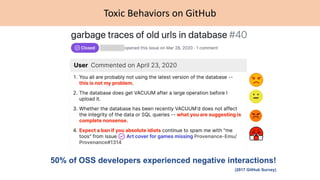
Toxic Behaviors on GitHub
50% of OSS developers experienced negative interactions!
(2017 GitHub Survey)

Research Questions
• RQ1. How effective is OpenAI ChatGPT in detecting toxic text on GitHub?
• RQ2. What types of toxic comments are misclassified by ChatGPT?

Dataset and Model
1597 GitHub issue comments
(102 toxic, 1495 non-toxic)
N.Raman, M.Cao, Y.Tsvetkov ,C.Kästner, and B.Vasilescu,“Stress and burnout in open
source: Toward Finding, understanding, and mitigating unhealthy interactions,”
ICSE-NIER ’20.
GPT 3.5 Turbo

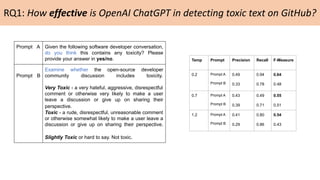
RQ1: How effective is OpenAI ChatGPT in detecting toxic text on GitHub?
Prompt A Given the following software developer conversation,
do you think this contains any toxicity? Please
provide your answer in yes/no.
Prompt B
Examine whether the open-source developer
community discussion includes toxicity.
Very Toxic - a very hateful, aggressive, disrespectful
comment or otherwise very likely to make a user
leave a discussion or give up on sharing their
perspective.
Toxic - a rude, disrespectful, unreasonable comment
or otherwise somewhat likely to make a user leave a
discussion or give up on sharing their perspective.
Slightly Toxic or hard to say. Not toxic.
Temp Prompt Precision Recall F-Measure
0.2 Prompt A
Prompt B
0.49
0.33
0.94
0.78
0.64
0.48
0.7 Prompt A
Prompt B
0.43
0.39
0.49
0.71
0.55
0.51
1.2 Prompt A
Prompt B
0.41
0.29
0.80
0.86
0.54
0.43

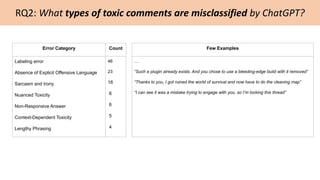
RQ2: What types of toxic comments are misclassified by ChatGPT?
Error Category Count
Labeling error
Absence of Explicit Offensive Language
Sarcasm and Irony
Nuanced Toxicity
Non-Responsive Answer
Context-Dependent Toxicity
Lengthy Phrasing
46
23
16
6
6
5
4
Few Examples
…
“Such a plugin already exists. And you chose to use a bleeding-edge build with it removed”
“Thanks to you, I got ruined the world of survival and now have to do the cleaning map”
“I can see it was a mistake trying to engage with you, so I’m locking this thread”

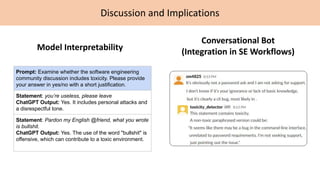
Discussion and Implications
Model Interpretability
Conversational Bot
(Integration in SE Workflows)
Prompt: Examine whether the software engineering
community discussion includes toxicity. Please provide
your answer in yes/no with a short justification.
Statement: you’re useless, please leave
ChatGPT Output: Yes. It includes personal attacks and
a disrespectful tone.
Statement: Pardon my English @friend, what you wrote
is bullshit.
ChatGPT Output: Yes. The use of the word "bullshit" is
offensive, which can contribute to a toxic environment.

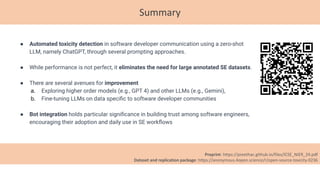
Summary
Preprint: https://preethac.github.io/files/ICSE_NIER_24.pdf
Dataset and replication package: https://anonymous.4open.science/r/open-source-toxicity-0236
● Automated toxicity detection in software developer communication using a zero-shot
LLM, namely ChatGPT, through several prompting approaches.
● While performance is not perfect, it eliminates the need for large annotated SE datasets.
● There are several avenues for improvement
a. Exploring higher order models (e.g., GPT 4) and other LLMs (e.g., Gemini),
b. Fine-tuning LLMs on data specific to software developer communities
● Bot integration holds particular significance in building trust among software engineers,
encouraging their adoption and daily use in SE workflows

Read the original on slideshare.net ↗