Notice: This page displays a fallback because interactive scripts did not run. Possible causes include disabled JavaScript or failure to load scripts or stylesheets.
Note: Python 3.11.7 has been superseded by Python 3.11.16.
Release date: Dec. 4, 2023
This is the seventh maintenance release of Python 3.11
Python 3.11.7 is the newest major release of the Python programming language, and it contains many new features and optimizations.
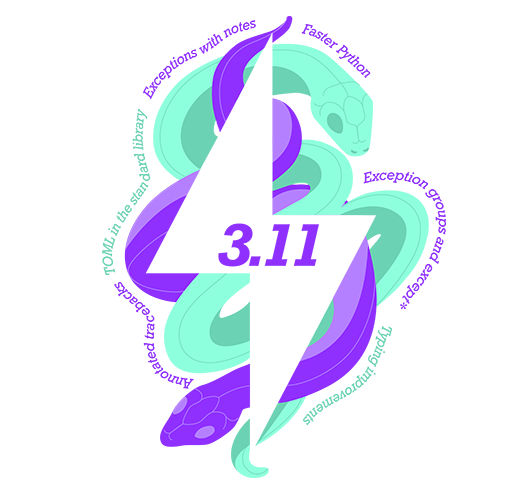
Major new features of the 3.11 series, compared to 3.10
Some of the new major new features and changes in Python 3.11 are:
General changes
- PEP 657 -- Include Fine-Grained Error Locations in Tracebacks
- PEP 654 -- Exception Groups and
except* - PEP 680 -- tomllib: Support for Parsing TOML in the Standard Library
- gh-90908 -- Introduce task groups to asyncio
- gh-34627 -- Atomic grouping (
(?>...)) and possessive quantifiers (*+, ++, ?+, {m,n}+) are now supported in regular expressions. - The Faster CPython Project is already yielding some exciting results. Python 3.11 is up to 10-60% faster than Python 3.10. On average, we measured a 1.22x speedup on the standard benchmark suite. See Faster CPython for details.
Typing and typing language changes
- PEP 673 -- Self Type
- PEP 646 -- Variadic Generics
- PEP 675 -- Arbitrary Literal String Type
- PEP 655 -- Marking individual TypedDict items as required or potentially-missing
- PEP 681 -- Data Class Transforms
More resources
- Online Documentation
- PEP 664, 3.11 Release Schedule
- Report bugs at https://github.com/python/cpython/issues.
- Help fund Python and its community.
And now for something completely different
A pentaquark is a human-made subatomic particle, consisting of four quarks and one antiquark bound together; they are not known to occur naturally, or exist outside of experiments specifically carried out to create them.
Quarks quarks have a baryon number of +1/3 and antiquarks of -1/3, the pentaquark would have a total baryon number of 1, and thus would be a baryon. Further, because it has five quarks instead of the usual three found in regular baryons (a.k.a. 'triquarks'), it is classified as an exotic baryon. The name pentaquark was coined by Claude Gignoux and Harry J. Lipkin in 1987; however, the possibility of five-quark particles was identified as early as 1964 when Murray Gell-Mann first postulated the existence of quarks. Although predicted for decades, pentaquarks proved surprisingly difficult to discover and some physicists were beginning to suspect that an unknown law of nature prevented their production.
Files
| Version | Operating system | Description | File size | Sigstore | GPG | MD5 checksum | |
|---|---|---|---|---|---|---|---|
| Gzipped source tarball | Source release | 25.4 MB | .sigstore | SIG | ef61f81ec82c4904 84219c7f0ec96783 |
||
| XZ compressed source tarball | Source release | 19.1 MB | .sigstore | SIG | d96c7e134c35a8c4 6236f8a0e566b69c |
||
| macOS 64-bit universal2 installer | macOS | for macOS 10.9 and later | 42.5 MB | .sigstore | SIG | 89b63192da4def3d 0d4f17ff06a33064 |
|
| Windows installer (64-bit) | Windows | Recommended | 24.8 MB | .sigstore | SIG | 6ebd889155ac3261 308202b29d39c5a4 |
|
| Windows installer (32-bit) | Windows | 23.6 MB | .sigstore | SIG | 8a52f3859989f0b1 313f4baaa6936410 |
||
| Windows installer (ARM64) | Windows | Experimental | 24.1 MB | .sigstore | SIG | 216803e75bf3944c 183873adf135c459 |
|
| Windows embeddable package (64-bit) | Windows | 10.7 MB | .sigstore | SIG | 696ae7fa83452652 3ba5492d3a1ead14 |
||
| Windows embeddable package (32-bit) | Windows | 9.6 MB | .sigstore | SIG | f6fa152aa4259f51 604f5bbaf5a5f4c4 |
||
| Windows embeddable package (ARM64) | Windows | 10.0 MB | .sigstore | SIG | f3a6296650c51e3e 64ae7d41999b4a78 |
||