
MOJO: Decoding the Tumor with Multimodal AI...
on Jul 08, 2026 | 11:03am
TL;DR: Integrating multiple biological data types gives oncologists a much richer picture of a patient's cancer. However, effectively training AI on massive amounts of highly comp...

Strategic partnership: Wilo and InstaDeep shape the smart future ...
on Mar 04, 2026 | 01:43pm
Pioneering companies sign cooperation agreement at Wilopark Dortmund. By signing a partnership agreement, water technology group Wilo and AI technology company InstaDeep have s...

Modelling the Genome with NTv3...
on Feb 18, 2026 | 01:49pm
The genome is not a linear string of information, but a long-range, three-dimensional system in which regulatory signals act across large genomic distances to control gene express...

NeurIPS 2025...
on Dec 16, 2025 | 01:52pm
The 39th Annual Conference on Neural Information Processing Systems (NeurIPS) was capped off by a series of firsts for the InstaDeep team, with researchers leading the way in exch...

MEMENTO: Memory-Enhanced Neural Solvers for Routing Problems...
on Nov 25, 2025 | 01:39pm
Combinatorial optimisation (CO) problems are among the hardest challenges in computer science, with real-world importance in logistics, transport, and energy systems. These proble...

Breaking the Performance Ceiling in Reinforcement Learning...
on Nov 18, 2025 | 01:50pm
Reinforcement learning (RL) has delivered some of AI’s most striking successes, from human-level Atari 1 play to world-class performance in Go2. Yet when applied to messy, real-...

Oryx: InstaDeep’s scalable sequence model for multi-agent coord...
on Nov 11, 2025 | 01:51pm
Multi-agent reinforcement learning (MARL) holds significant promise across domains such as autonomous driving, warehouse logistics, intelligent rail networks, and satellite alignm...

Genome annotation with SegmentNT...
on Oct 29, 2025 | 11:30am
Nucleotides are the fundamental units of DNA, and when linked together by a sugar-phosphate backbone, they form the strands that define our genome. Analysing the precise role o...

AI Day 2025: Powering biology with a full-stack AI ecosystem...
on Oct 13, 2025 | 10:11am
BioNTech hosted its annual AI Day at the Science Museum in London, the second event in their Innovation Series. The day brought together investors, analysts, media representatives...

Introducing DEgym: A framework for developing Reinforcement Learn...
on Sep 16, 2025 | 02:59pm
Reinforcement learning (RL) is increasingly being applied to complex processes across science and engineering, with promising results in manufacturing, biology, and energy systems...
Research
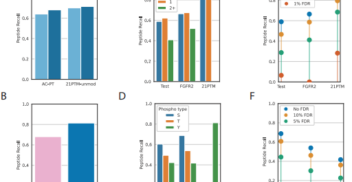
InstaNovo-P: A de novo peptide sequencing model for phosphoproteomics
Jesper Lauridsen | Pathmanaban Ramasamy | Rachel Catze | Vahap Canbay | Amandla Mabona | Kevin Eloff | Paul Fullwood | Jennifer Ferguson | Annekatrine Kirketerp-Møller | Ida Sofie Goldschmidt | Tine Claeys | Sam van Puyenbroeck | Nicolas Lopez Carranza | Erwin M. Schoof | Lennart Martens | Jeroen Van Goey | Chiara Francavilla | Timothy Patrick Jenkins | Konstantinos Kalogeropoulos
Nature Communications (2026) Jul 2026
Generalizable direct protein sequencing with InstaNexus
Marco Reverenna | Maike Wennekers Nielsen | Darian Stephan Wolff | Jemma Daniel | Elpida Lytra | Suthimon Thumtecho | Pasquale D. Colaianni | Anne Ljungars | Andreas H. Laustsen | Erwin M. Schoof | Jeroen Van Goey | Timothy P. Jenkins | Marie V. Lukassen | Alberto Santos | Konstantinos Kalogeropoulos
Molecular & Cellular Proteomics 2026 Mar 2026

Annotating the genome at single-nucleotide resolution with DNA foundation models
Bernardo P. de Almeida | Hugo Dalla-Torre | Guillaume Richard | Christopher Blum | Lorenz Hexemer | Maxence Gélard | Javier Mendoza-Revilla | Ziqi Tang | Frederikke I. Marin | David M. Emms | Priyanka Pandey | Stefan Laurent | Marie Lopez | Alexandre Laterre | Maren Lang | Uğur Şahin | Karim Beguir | Thomas Pierrot
Nature Methods (2025) Jan 2026

In the Press


